Digital vs Physical Tangrams: Which is Better for Learning?
Explore the debate between tangram apps vs physical sets. Discover which medium enhances spatial intelligence, brain activation, and math skills for 2025 students.
By Free To Play Puzzles Editorial Team 12 min read
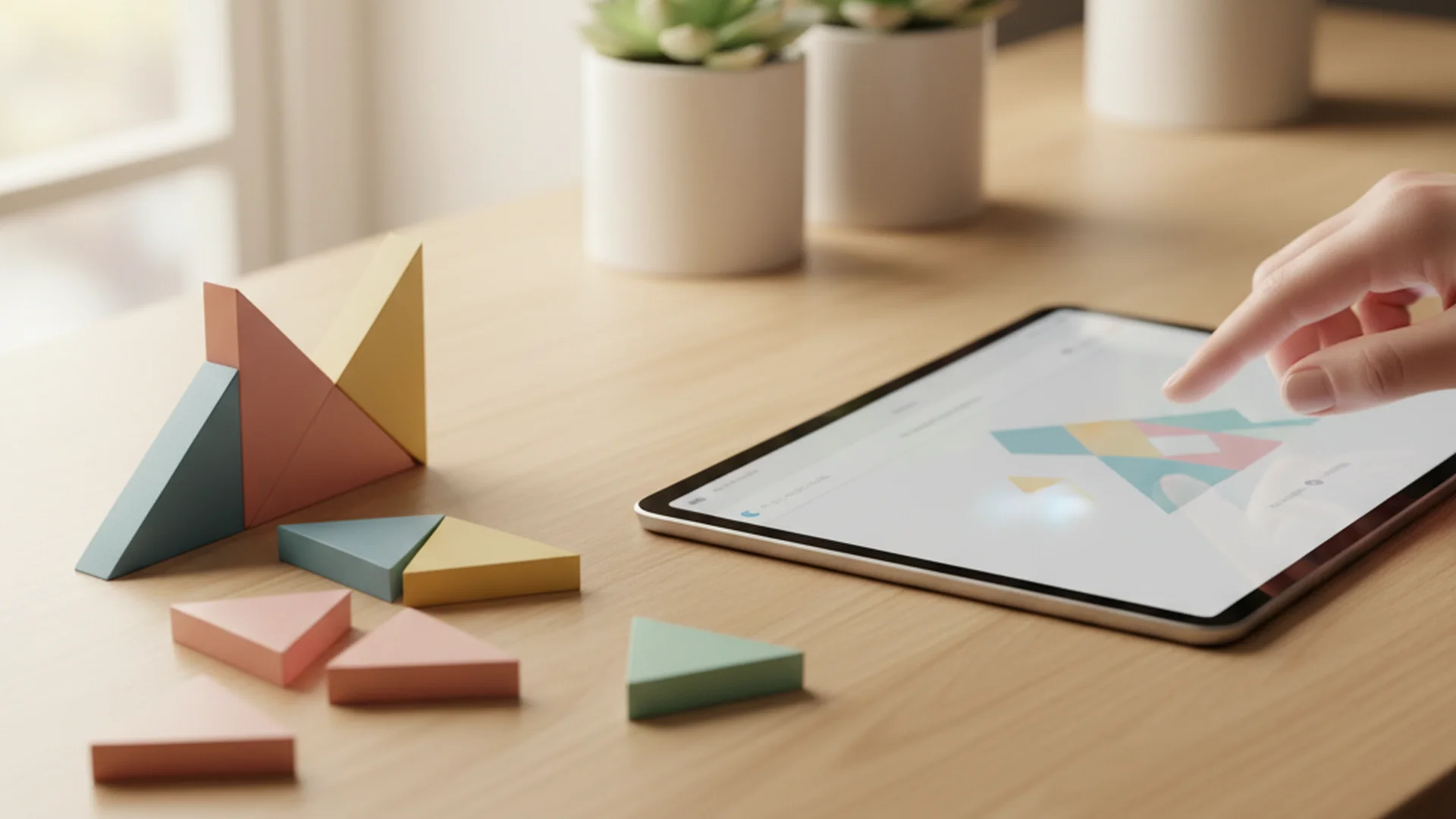
In the world of educational manipulatives, few tools have survived the transition from ancient history to the digital age as successfully as the seven flat shapes known as the tangram. As we navigate the educational landscape of 2025, the debate over tangram apps vs physical wooden sets has reached a fever pitch among educators and parents alike. While both mediums aim to teach the same geometric principles, the cognitive pathways they activate are surprisingly distinct.
As a logic instructor, I have watched students flourish with both high-end wooden tiles and the latest AI-driven apps. Understanding the nuance of this tangram comparison is essential for anyone looking to boost spatial intelligence, whether for a preschooler learning their shapes or a high schooler tackling advanced geometry.
The Case for Physical Tangrams: Tactile Intelligence
There is a visceral quality to physical tangrams that digital screens have yet to perfectly replicate. For centuries, the History of Tangram has been rooted in the physical manipulation of wood, stone, or ceramic. In 2025, research continues to support the idea that the "hands-on" approach is more than just a nostalgic preference; it is a neurological necessity for early development.
Spatial Language and Parental Engagement
One of the most compelling arguments for physical sets is the way they facilitate human interaction. Studies involving parent-child dyads show that when using physical sets, parents are significantly more likely to use "spatial language." You’ll hear words like "parallel," "rotate," "beside," and "flip" much more frequently than when a child is silently swiping on a tablet. This verbal reinforcement is a critical bridge between physical action and abstract mathematical thought.
Tactile Retention and the "Struggle"
Physical sets engage multiple senses—the weight of the wood, the sound of the pieces clinking, and the friction of the edges. For children aged 3–6, this multi-sensory feedback is a memory booster. Statistics indicate that children who begin with physical sets are 5x more likely to complete complex puzzles later in life compared to those who are "digital-first" learners.
Digital Tangrams: Scaffolding and Speed
While physical sets dominate in tactile retention, tangram apps vs physical comparisons often highlight the efficiency and "scaffolding" provided by digital versions. By 2024, data showed that students using virtual manipulatives achieved mean scores roughly 10-15% higher in identifying 2D shape characteristics.
Instant Feedback and Math Anxiety
In a traditional physical setting, a student might struggle for ten minutes without knowing why a piece doesn't fit, potentially leading to frustration. Digital apps provide instant, non-judgmental feedback. Features like "glow effects" when a piece is near its correct position or "undo" buttons lower the stakes. For students dealing with math anxiety, the digital environment feels like a safe playground rather than a test.
AI-Adaptive Difficulty
Modern 2025 apps, such as Tangram Heaven, utilize AI to track how long a user hovers over a piece or how many incorrect rotations they attempt. The app then subtly adjusts the difficulty of the next puzzle to stay within the user’s "Zone of Proximal Development." This level of personalization is nearly impossible to achieve with a static wooden set and a printed booklet.
Advertisement
Side-by-Side Comparison
| Feature | Physical Tangrams | Digital Tangram Apps |
|---|---|---|
| Primary Benefit | Tactile memory & Motor skills | Speed of learning & Scaffolding |
| Engagement | High parental/social interaction | High individual focus |
| Feedback | Manual/None (The "Struggle") | Instant/Adaptive |
| Portability | Requires flat surface/case | Highly portable (Phone/Tablet) |
| Advanced Concepts | Great for group collaboration | Best for individual assessment |
Real-World Examples of Learning in Action
To understand the practical application of this tangram comparison, let's look at how these tools are being used in three different environments in 2025.
1. The Collaborative Preschool Classroom
In a Montessori-style classroom, a group of four children works with a single large-scale wooden tangram set. Because there are only seven pieces, they must negotiate, use spatial language to direct one another, and physically pass the "large triangle" to a peer. This builds social-emotional skills alongside Deductive Reasoning Puzzles.
2. The Individualized Geometry Lab
A 9th-grade teacher uses a digital tangram interface to teach the difference between area and perimeter. Using the "infinite copy" tool available in digital versions, students can quickly see how many small triangles fit into the square, instantly visualizing fractions and square roots without the clutter of 50 physical pieces sliding around the desk.
3. The "ARTangram" Home Experience
A family uses a 2025 Augmented Reality set. The child places physical bamboo pieces on the kitchen table, but through a tablet lens, those pieces transform into a jumping rabbit or a fire-breathing dragon once the puzzle is solved. This combines the tactile benefits of physical play with the gamified reward systems of digital apps.
Recent Trends (2025–2026)
The landscape of Logic Puzzles is evolving rapidly. Here are the trends we are seeing this year:
- Sustainability & Eco-Puzzles: There is a massive surge in modular bamboo and recycled ocean plastic sets. These aren't just toys; they are designed as "Puzzle Art" to be displayed on coffee tables after completion.
- Gamified Daily Challenges: Inspired by the "Wordle" craze, apps like Netflix Puzzled now offer daily 5-minute shape challenges to keep cognitive skills sharp.
- AR-Enhanced Learning: As mentioned, the bridge between physical and digital is narrowing. Physical sets now often come with digital overlays that provide "ghost silhouettes" to help beginners.
Advertisement
Common Mistakes to Avoid
Even with the best tools, learning can be hindered by a few common pitfalls. Whether you are using tangram apps vs physical sets, keep these in mind:
- Neglecting the "Parallelogram Flip": The parallelogram is the only piece that may need to be flipped (mirrored) to solve certain silhouettes. In many digital apps, this is a separate button that users often forget exists.
- Correcting the Learner Too Quickly: The cognitive benefit of a tangram comes from the "struggle." If a parent or an app provides the answer too soon, the brain's right-hemisphere workout is cut short.
- Treating it "Just as a Game": While fun, tangrams are foundational for STEM. They teach the decomposition of shapes, a skill directly linked to understanding calculus and architectural design later in life.
- Ignoring Physical Dexterity: Introducing digital-only tangrams to a 3-year-old can skip the vital development of fine motor skills. Always start with physical pieces for the youngest learners.
Frequently Asked Questions
Is a tangram app as good as a wooden set for my child?
Both have unique value. Wooden sets are superior for developing fine motor skills and spatial language, while apps are excellent for providing adaptive challenges and instant feedback that prevents frustration.
At what age should children start using tangrams?
Physical tangrams are ideal for children as young as age 3. Digital versions are best introduced around age 5 or 6, once the child has the dexterity to handle precise touchscreen movements.
Can digital tangrams help with math anxiety?
Yes. Digital versions offer infinite "undos" and non-judgmental hints, which can lower the pressure for students who feel intimidated by traditional mathematical challenges.
Do tangrams help with high school level learning?
Absolutely. Concepts such as congruence, area vs. perimeter, and even basic algebra (using pieces as "zero pairs") are increasingly taught using Tangram tiles in high school geometry.
Conclusion
The debate over tangram apps vs physical sets doesn't have a single winner. Instead, the most effective learning strategy in 2025 is the Hybrid Approach. Start with a high-quality physical set—perhaps one made of sustainable bamboo—to build that foundational tactile awareness and spatial vocabulary. Once the basic seven-piece logic is mastered, introduce digital apps to explore complex puzzles, AI-driven challenges, and collaborative global communities.
By engaging both the hands and the screen, we provide the brain with the widest possible array of "epistemic actions," ensuring that the ancient art of the tangram continues to sharpen modern minds.
Ready to Sharpen Your Logic?
Explore our collection of puzzles and start your daily brain training today.
Put it into practice



Keep reading
Logic Puzzles
Mastering Matching Logic Puzzles: The Ultimate Guide to Deductive Reasoning
Explore the world of matching puzzles. Learn expert strategies for logic grids, discover 2025 trends, and improve your deductive reasoning skills today.
Nov 21, 2026 12 min
Logic Puzzles
Dominosa Puzzles: The Ultimate Strategy Guide to Solitaire Dominoes
Master Dominosa puzzles with our comprehensive guide. Learn history, advanced logic strategies, and 2025 trends for this classic domino placement challenge.
Nov 8, 2026 10 min
Logic Puzzles
Mastering Kuromasu Puzzles: The Ultimate Guide to "Where Is Black Cells"
Explore the fascinating world of Kuromasu puzzles. Learn rules, advanced strategies, and the cognitive benefits of this Nikoli classic.
Sep 30, 2026 10 min
Advertisement