Mastering Kuromasu Puzzles: The Ultimate Guide to "Where Is Black Cells"
Explore the fascinating world of Kuromasu puzzles. Learn rules, advanced strategies, and the cognitive benefits of this Nikoli classic.
By Free To Play Puzzles Editorial Team 10 min read
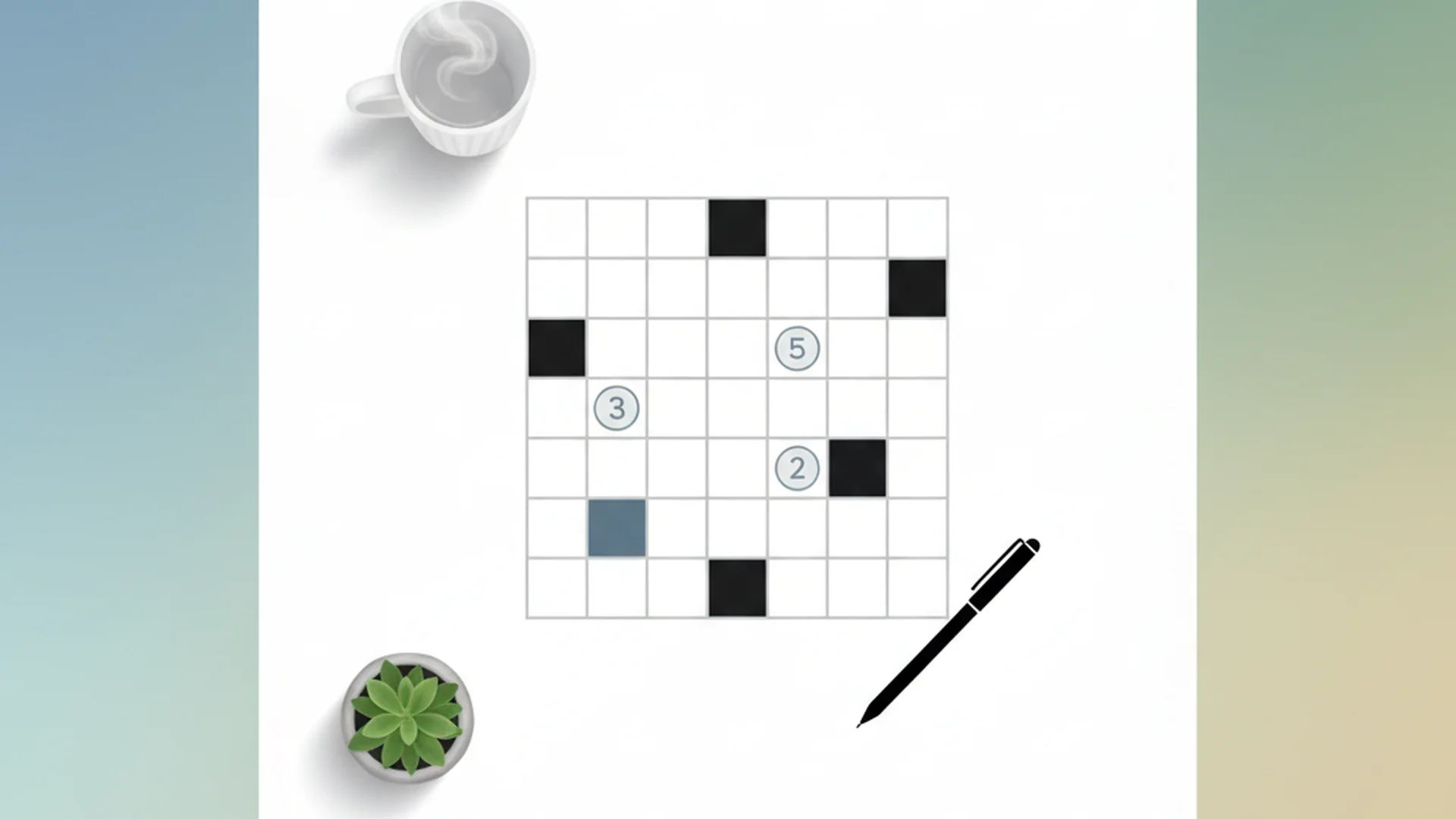
In the vast landscape of Japanese logic games, few offer the elegant simplicity and profound depth of kuromasu puzzles. Originally appearing in the legendary Puzzle Communication Nikoli #34 in June 1991, this puzzle—often referred to as "Where Is Black Cells" (from the Japanese Kurodoko)—has captivated the minds of logic enthusiasts for decades. Kuromasu is particularly compelling because it engages the brain’s spatial reasoning and deductive faculties in a way that few other deductive reasoning puzzles can.
While the aesthetic of the grid might remind you of Sudoku, the logic is entirely different. Instead of focusing on arithmetic or unique sets of numbers, Kuromasu relies on "line-of-sight" mechanics and global connectivity. In this guide, we will break down how to master these puzzles, the advanced strategies used by experts in 2025, and the common pitfalls that trip up even seasoned solvers.
Understanding the Core Rules of Kuromasu
To solve a Kuromasu puzzle, you must determine which cells in a rectangular grid should be colored black and which should remain white. The "Where Is Black Cells" name is a literal translation of its goal. The puzzle is governed by four immutable laws:
- The Number Rule: Each numbered cell represents the total number of white cells visible from that cell in its row and column, including the numbered cell itself.
- The Visibility Rule: A white cell is "visible" if there is no black cell blocking the line of sight between it and the numbered cell.
- The Adjacency Rule: Black cells cannot be orthogonally adjacent (they cannot share a side). However, they can touch diagonally.
- The Connectivity Rule: All white cells must be connected to each other in a single, continuous group (no "islands" of white cells).
Expert Strategies for 2025 Solvers
As we move into 2026, the complexity of logic puzzles found in publications like Nikoli’s The Pencil Puzzles 2026 has reached new heights. To keep up, you need a systematic approach to deduction rather than relying on trial and error.
1. The "Maximum Reach" Start
Look for the largest numbers on the grid first. For example, in a 7x7 grid, a cell containing the number "13" in the center is a goldmine. If the total number of possible white cells in that row and column equals exactly 13, then every single cell in that line of sight must be white. Mark these immediately with a small dot or "X" to ensure you don't accidentally shade them later.
2. The Adjacency Chain
Every time you identify a black cell, the Adjacency Rule gives you "free" information. Because black cells cannot touch side-to-side, the four cells surrounding any black cell (up, down, left, right) must be white.
3. The Two-Clue Diagonal Trap
A common expert-level deduction involves the number "2." If you see a "2" near a corner or another constraint, you must be careful. You can never shade a cell that is diagonally adjacent to a "2" if doing so would block two directions of sight simultaneously. This would force the "2" to see more white cells than its clue allows or violate the connectivity of the board.
4. Gap Management
If you have a number "2" and another known white cell in the same row with only one empty space between them, that space must be black. If it were white, the "2" would see at least three cells (itself, the middle cell, and the third cell), violating the number rule.
Advertisement
Real-World Logic Examples
To better understand how these rules interact, let's look at three scenarios you will frequently encounter in modern digital apps like Kuromasu: Logic Puzzles.
Example A: The Corner Constraint
Imagine a "3" in the top-left corner (1,1) of a grid. It sees the cell to its right and the cell below it. If the cell at (1,3) is black, the "3" must see the cells at (1,1), (1,2), and (2,1). This forces (3,1) to be black to "cut off" the view.
Example B: The Narrow Corridor
If a section of the grid is becoming crowded with black cells, check the connectivity. If shading a specific cell would split the white cells into two separate groups that cannot reach each other, that cell must be white, regardless of what the numbers say. This is similar to the logic used in Akari Light Up Puzzles.
Example C: The Overlapping Sightlines
When two numbered cells "see" each other, they share a portion of their count. If a "5" and a "4" are in the same row with three cells between them, the state of those three cells affects both numbers simultaneously. Solving one often solves the other.
| Feature | Kuromasu | Sudoku | Nonograms |
|---|---|---|---|
| Logic Type | Line-of-Sight | Latin Square | Grid Shading |
| Primary Goal | Binary Shading | Number Placement | Image Creation |
| Connection Rule | Yes (All White) | No | No |
| Complexity | NP-Complete | NP-Complete | NP-Complete |
Recent Trends (2025–2026)
The world of Kuromasu is evolving. In 2025, we saw a shift toward explanation-based hints in mobile apps. Instead of simply revealing the color of a cell, modern AI-driven solvers explain the specific rule (e.g., "This cell must be white to maintain connectivity").
Additionally, there is a growing movement toward Sustainable Puzzling. Publishers like Nikoli have transitioned to recycled paper and soy-based inks for their physical books, such as the Pencil Puzzles 2026 collection. For those who prefer digital, augmented reality (AR) integrations now allow you to point your smartphone at a printed puzzle to see real-time "sightline" overlays, making it easier to track high numbers.
Common Mistakes to Avoid
- The "Diagonal Contact" Myth: Many beginners assume black cells cannot touch at all. Remember: they can touch at the corners. Only sharing an edge is forbidden.
- Forgetting Numbered Cells are White: It is a common slip-up to shade a cell containing a number. These are always white and must be included in the counts of other numbers that see them.
- Neglecting the "Unseen" Rule: Players often ensure a number sees enough white cells but forget that they must eventually place a black cell to stop the count. If a "5" sees 5 cells, the 6th cell in that line must be black.
Advertisement
Frequently Asked Questions
Does the number in the cell include the cell itself?
Yes. This is the most important rule to remember. If a cell has the number "3," it means that cell plus two other visible white cells make up its total count.
Can black cells touch diagonally?
Yes, they can. The restriction only applies to orthogonal (side-by-side) adjacency. Diagonal contact is often a necessary part of the solution.
How do I know when a puzzle is complete?
A Kuromasu puzzle is solved when three conditions are met: all numbered cells see the correct number of white cells, no black cells touch side-to-side, and all white cells are part of a single, continuous network.
Are there multiple solutions?
High-quality, hand-crafted puzzles from reputable sources like Nikoli are designed to have exactly one unique solution. If you find yourself with two possibilities, you likely missed a subtle connectivity constraint.
Conclusion
Kuromasu is more than just a pastime; it is a workout for the brain that sharpens spatial awareness and logical deduction. By mastering the "Where Is Black Cells" logic, you are engaging in a tradition of Japanese puzzle-solving that dates back over 30 years. Whether you are playing on the latest 2026 digital platforms or with a classic pencil and paper, the thrill of the final "click" when the grid resolves is unparalleled.
For those looking to expand their logic skills further, we highly recommend exploring Battleship Logic Puzzles or diving into the world of Color Nonograms for a different kind of visual challenge.
Ready to Start?
Challenge your brain with our daily logic puzzles.
Put it into practice



Keep reading
Logic Puzzles
The Ultimate Masyu Puzzles Guide: Mastering the Art of Pearl Logic
Unlock the secrets of Masyu puzzles. Learn advanced strategies, rules, and the neuroscience behind these captivating Japanese pearl puzzles.
May 11, 2026 12 min

Logic Puzzles
Master Light Up Puzzles: The Ultimate Guide to Solving Akari Like a Pro
Learn how to master Akari light up puzzles with our comprehensive guide. Explore expert strategies, history, and advanced logic for this Nikoli classic.
Jun 11, 2026 12 min

Logic Puzzles
The Ultimate Slitherlink Puzzles Guide: Rules, Expert Strategies, and 2025 Trends
Master Slitherlink puzzles with our comprehensive guide. Learn rules, expert corner strategies, the X-rule, and explore 2025 trends in logic gaming.
Apr 1, 2026 12 min
Advertisement