Grid Logic Puzzles: Step-by-Step Solving Guide
Master grid logic puzzles with our comprehensive step-by-step tutorial. Learn expert deduction techniques, avoid common mistakes, and explore 2025 puzzle trends.
By Free To Play Puzzles Editorial Team 12 min read
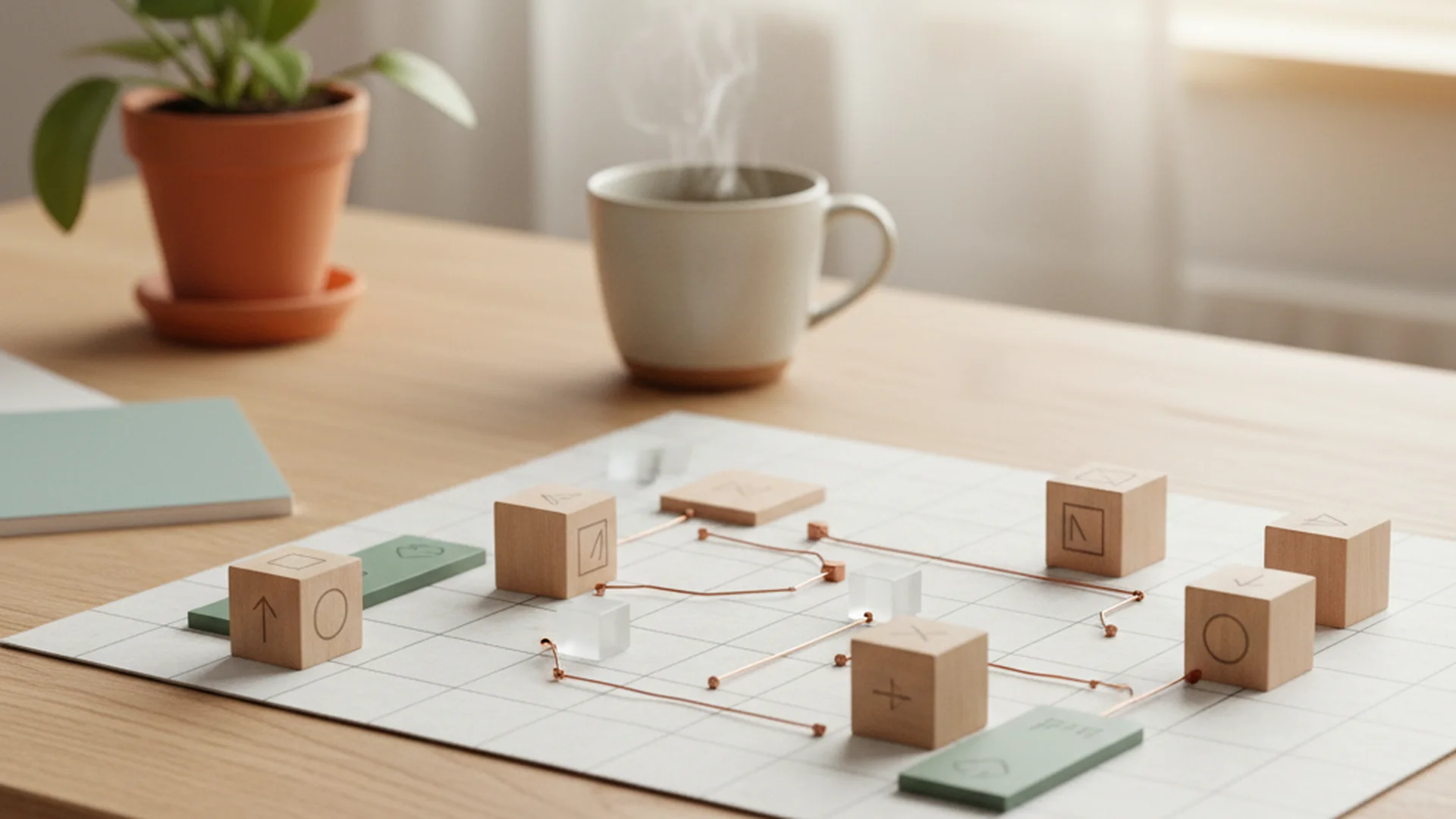
There is a specific, unparalleled satisfaction in the "click" of a final deduction. If you have ever stared at a grid of empty squares, clutching a list of cryptic clues and wondering how on earth you are supposed to figure out who owns the zebra or which neighbor baked the cherry pie, you have entered the world of grid logic puzzles. As a gameplay analyst, I have seen these puzzles evolve from newspaper fillers to a global digital phenomenon. Mastering grid logic puzzles isn't just about being "smart"; it’s about a disciplined, step-by-step application of deductive reasoning that anyone can learn.
Whether you are a seasoned solver looking to shave minutes off your completion time or a beginner following your first logic grid tutorial, the path to mastery is paved with logic, not luck. In this guide, we will break down the mechanics of the grid, explore the latest trends for 2025 and 2026, and provide you with a bulletproof methodology to solve even the most daunting challenges.
The Anatomy of a Logic Grid
Before we dive into the steps, we must understand the tool itself. A logic grid is a visual representation of all possible relationships between several sets of categories. For example, if you are solving a puzzle about four people, their favorite colors, and their pets, the grid allows you to track every possible combination.
The grid is divided into sub-grids. Each sub-grid represents the relationship between two specific categories (e.g., Names vs. Pets). Within these squares, we use two primary symbols:
- A Checkmark (✓) or "O": Confirms a positive relationship (Anna has the Cat).
- An "X": Eliminates a relationship (Anna does not have the Dog).
Understanding how these intersections interact is the first step in any logic grid tutorial.
Step 1: The "First Pass" (Handling Direct Clues)
The most common mistake beginners make is overthinking the initial clues. Your first goal is to harvest "low-hanging fruit"—clues that explicitly state what is or is not true.
Marking "Is" and "Is Not"
If a clue says, "The person in the blue shirt is named David," you have found a direct link.
- Find the intersection of "Blue Shirt" and "David."
- Place a checkmark (✓) there.
- The Golden Rule: Immediately fill the rest of that row and column within that sub-grid with "X"s.
If David is in the blue shirt, he cannot be in the red or green shirt. Similarly, if David is in the blue shirt, Sarah cannot be in the blue shirt.
Utilizing Negative Clues
"The runner from New York did not win the gold medal." This is just as valuable as a positive clue. Place an "X" at the intersection of New York and Gold Medal. Experts treat "not" clues as foundational pillars for narrowing the field.
Advertisement
Step 2: Relational Deduction (Beyond the Basics)
Once the direct clues are exhausted, you must look for relational clues. These involve comparisons like "faster than," "to the left of," or "arrived after."
Handling "Before" and "After"
Consider the clue: "Jane finished the race before the person in the red shirt." This single sentence provides three distinct pieces of information:
- Jane is NOT the person in the red shirt (Place an "X").
- Jane did NOT finish last (Place an "X" at Jane/Last Place).
- The person in the red shirt did NOT finish first (Place an "X" at Red/First Place).
By analyzing the constraints of the relationship, you eliminate multiple possibilities at once. This is a core component of deductive reasoning.
Narrative Pronouns
Pay close attention to the grammar of the clues. In 2025, puzzle designers are increasingly using "hidden" thematic clues.
- Example: "The person who brought the pie forgot his umbrella."
- Deduction: You can immediately eliminate all female names from the "Pie" category.
Step 3: The Symmetrical Transfer (The Pro's Secret)
This is the stage where intermediate solvers often get stuck. Symmetrical transfer is the process of moving information from one sub-grid to another using a common link.
How to Execute a Symmetrical Transfer
Suppose you have established two facts in different parts of the grid:
- Fact A: Anna wears a Blue Shirt.
- Fact B: The Blue Shirt owner is the Doctor.
By looking at the grid, you can perform a "handshake" between these two points. If Anna = Blue and Blue = Doctor, then Anna = Doctor. Find the intersection of Anna and Doctor and place your checkmark. Then, follow the Golden Rule from Step 1 and fill out the corresponding "X"s.
Step 4: The "Only One Left" Rule
As you fill the grid with "X"s, you will eventually reach a point where a row or column in a sub-grid has only one empty square left.
Because every person must have one (and only one) attribute from each category, that final empty square must be a checkmark. Conversely, if you place a checkmark, all other squares in that row/column must be "X"s. Scanning the grid specifically for these "forced moves" is a high-speed strategy used by competitive solvers.
| Name | Red | Blue | Green |
|---|---|---|---|
| Anna | X | ✓ | X |
| Bob | X | X | ✓ |
| Cate | ✓ | X | X |
In the example above, if Anna is Blue and Cate is Red, Bob must be Green.
Advertisement
Step 5: Advanced Cross-Referencing
In complex puzzles (like 5x5 grids), clues will often link three different categories.
- Example: "The person from Ohio, who is not the lawyer, arrived 10 minutes after Sarah."
This clue links Geography (Ohio), Profession (Lawyer), and Time (10 minutes after Sarah).
- Sarah did not come from Ohio.
- The person from Ohio is not the lawyer.
- Sarah is not the lawyer.
- Sarah did not arrive last.
- The person from Ohio did not arrive first.
By breaking down a single narrative sentence into its logical components, you can often clear 5–10 squares in one go.
Real-World Example 1: The Pet Shop Mystery
Imagine a small puzzle: Three owners (Alice, Brian, Chloe) bought three pets (Cat, Dog, Fish) using three different payment methods (Cash, Card, App).
- Clue 1: Brian used an App.
- Clue 2: The person who bought the Fish did not use Cash.
- Clue 3: Alice bought a Dog.
The Solve:
- From Clue 3: Alice = Dog. (X Alice/Cat, X Alice/Fish, X Brian/Dog, X Chloe/Dog).
- From Clue 1: Brian = App. (X Brian/Cash, X Brian/Card, X Alice/App, X Chloe/App).
- Deduction: Since Alice = Dog and Brian = App, we look for Chloe. Chloe is the only one left for Cash. (Chloe = Cash).
- From Clue 2: Fish ≠ Cash. Since Chloe = Cash, Chloe ≠ Fish.
- Result: Alice has the Dog, Brian has the Fish (via elimination), and Chloe has the Cat.
Real-World Example 2: The Marathon Finishers
Four runners (1st, 2nd, 3rd, 4th) from four cities (London, Paris, Tokyo, NY).
- Clue: The runner from London finished two spots ahead of the runner from Paris.
- Deduction:
- London cannot be 3rd or 4th.
- Paris cannot be 1st or 2nd.
- Possible pairs: (London 1st / Paris 3rd) or (London 2nd / Paris 4th).
As you find more clues, these "either/or" scenarios will collapse into a single truth.
The "Murdle" Effect and 2025 Trends
As a retro gaming historian, I find the current resurgence of logic puzzles fascinating. We are entering what I call the "Narrative Renaissance" of deduction.
Crime-Themed Logic
Inspired by the viral success of the Murdle series, 2025 is seeing a surge in crime-themed logic books like Detective Dilemmas. These puzzles pair the traditional grid with a mystery narrative—you aren't just solving for the sake of completion; you are finding a murderer's motive and weapon.
AI-Personalized Puzzles
New platforms are now using AI to generate "Logic Mastery Blueprints." These systems analyze your completion times and the specific types of clues you struggle with (like relational deductions) to create a personalized difficulty curve. This ensures the player remains in a state of "flow" without becoming frustrated.
Screen-Free Renaissance
Despite the growth of mobile word logic games, there is a documented 6.2% CAGR growth in high-end physical/wooden logic puzzles. This "digital fatigue" movement emphasizes the tactile nature of solving—using a pencil and paper to disconnect from the digital world and engage in mindfulness.
Common Mistakes to Avoid
Even experts can stumble. Here are the most frequent pitfalls I see in gameplay analysis:
- The "IQ Myth": Many believe logic puzzles measure raw intelligence. In reality, they measure familiarity with deductive patterns. You don't need to be a genius; you just need to practice the "Symmetrical Transfer."
- Literal Thinking: Failing to combine clues is a major roadblock. If Clue A says "The doctor lives in the red house" and Clue B says "Sarah is not the doctor," you must conclude "Sarah does not live in the red house."
- Neglecting the "Not" Clues: Beginners often wait until the end to use negative information. In high-level solving, "Not" clues are your primary tool for carving away the impossible.
- Forgetting the Cross-Out: Every time you place a checkmark, you MUST fill the rest of that category's row and column with "X"s. Skipping this step leads to a cluttered grid where patterns are invisible.
Einstein’s Riddle: The Gold Standard
No discussion of grid logic is complete without mentioning the "Zebra Puzzle," often attributed to Albert Einstein. It involves five houses, five nationalities, five beverages, five brands of cigarettes, and five pets.
While the legend that "98% of the world cannot solve it" is likely an exaggeration, it remains the ultimate test of the techniques described in this guide. If you can solve the Zebra Puzzle, you have mastered the grid. You can find a deep dive into this specific challenge in our guide on Einstein's Riddle Explained.
Frequently Asked Questions
Do I need to guess to solve these?
No. Every legitimate grid logic puzzle is designed to be solved through pure deduction. If you feel forced to guess, you have likely missed a subtle clue, a transitive relationship, or a cross-referencing opportunity in the grid.
How long should a puzzle take?
Depending on the grid size (e.g., 3x3 vs. 5x5), an intermediate puzzle typically takes 15 to 45 minutes. Expert-level puzzles with hundreds of squares can take over an hour.
What are the cognitive benefits of logic puzzles?
Research from 2024 indicates that regular engagement with logic puzzles can delay the onset of dementia symptoms by an average of 2.5 years. They primarily improve working memory, pattern recognition, and executive function.
What is the best way for a beginner to start?
Start with a small 3x3 grid (three categories, three items each). Focus on mastering the "First Pass" and the "Only One Left" rule before moving on to larger grids or relational "before/after" clues.
Are logic puzzles better on paper or on an app?
This is a matter of preference. Apps offer "auto-X" features that speed up the process, while paper puzzles provide a tactile experience that many find more relaxing and better for concentration.
Conclusion
Grid logic puzzles are more than just a way to pass the time; they are a workout for your deductive faculties. By following a systematic approach—starting with direct clues, moving through relational deductions, and mastering the symmetrical transfer—you can transform from a frustrated guesser into a strategic analyst.
As we move into 2026, the world of logic puzzles continues to expand with narrative-driven mysteries and AI-enhanced challenges. Whether you're solving a classic grid in a newspaper or a complex "Murdle" mystery, the core principles remain the same: observe, eliminate, and deduce.
Ready to Start?
Challenge your mind with our collection of deductive challenges.
Put it into practice

Keep reading
Logic Puzzles
Grid Logic Puzzles: How to Solve Them
Master the art of deductive reasoning with our comprehensive guide to grid logic puzzles. Learn expert strategies, common mistakes, and 2025 trends.
Mar 11, 2026 12 min

Logic Puzzles
Mastering Knights and Knaves: The Ultimate Guide to Truth-Teller and Liar Puzzles
Unlock the logic of the Island of Knights and Knaves. Learn expert strategies to solve truth-teller and liar puzzles, from Smullyan classics to AI benchmarks.
Jun 4, 2026 12 min
Logic Puzzles
Mastering Sequence Puzzles: The Ultimate Guide to Logic and Pattern Recognition
Unlock the secrets of sequence puzzles. Learn expert strategies for numerical, verbal, and order arrangement puzzles to boost your fluid intelligence and logic skills.
Aug 11, 2026 12 min
Advertisement