Grid Logic Puzzles: How to Solve Them
Master the art of deductive reasoning with our comprehensive guide to grid logic puzzles. Learn expert strategies, common mistakes, and 2025 trends.
By Free To Play Puzzles Editorial Team 12 min read
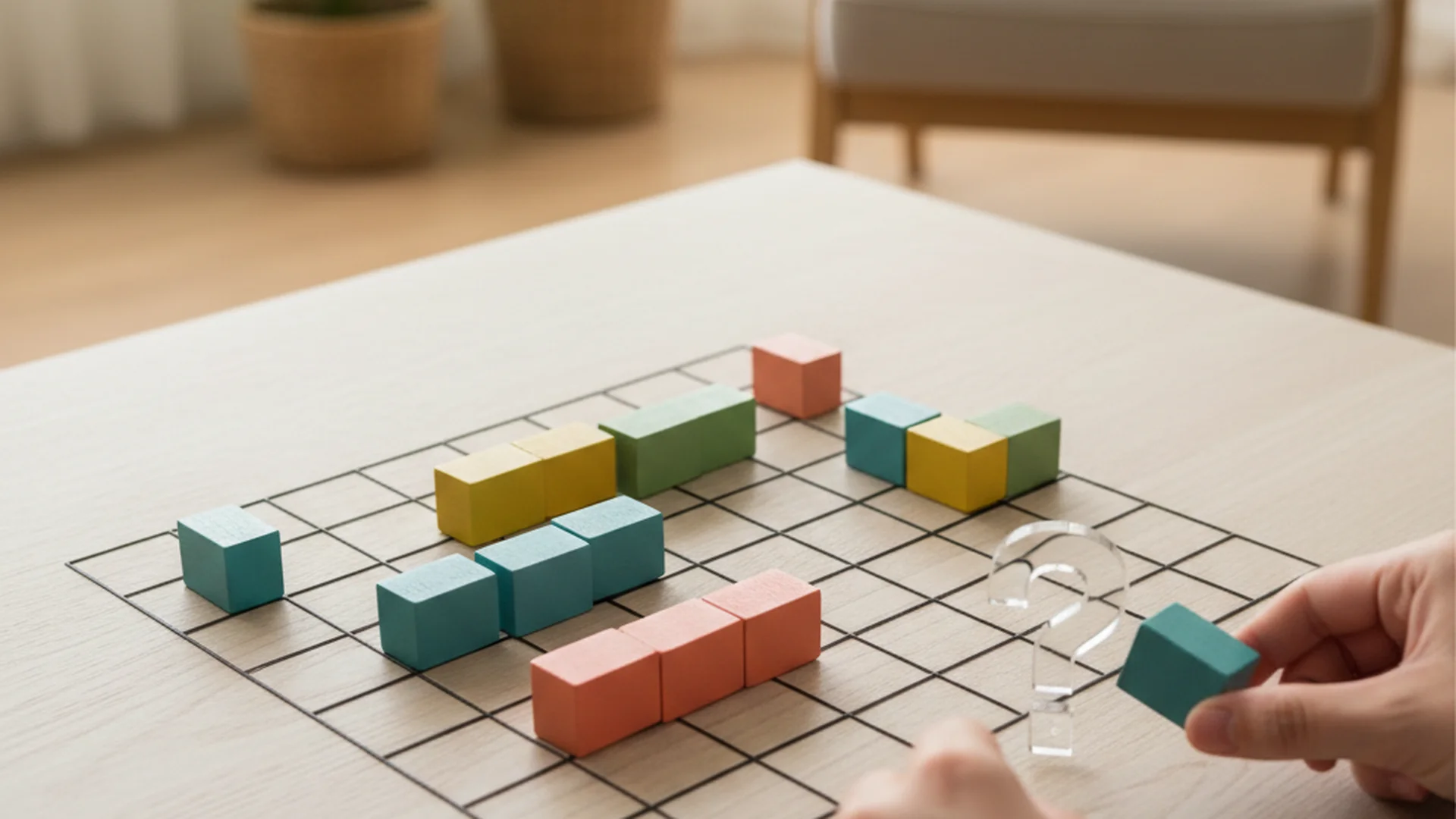
If you’ve ever found yourself staring at a complex table of squares, pen in hand, trying to figure out which neighbor owns the zebra or which traveler went to Paris, you’ve encountered the fascinating world of grid logic puzzles. These brainteasers are more than just a way to pass the time; they are a rigorous workout for your prefrontal cortex. As a tournament director and logic instructor, I have seen thousands of solvers tackle these challenges, and while they may look intimidating at first, they follow a strict set of rules that anyone can master.
Knowing how to solve logic grid puzzles is a skill that blends linguistic precision with systematic elimination. Whether you are a casual solver or an aspiring pro, understanding the mechanics behind the grid is the first step toward mastery.
The Evolution of the Logic Grid
While the roots of logic go back to Aristotle, the specific format of the logic puzzle we use today is a relatively modern invention. Lewis Carroll, the famous author of Alice in Wonderland, was a pioneer in this field. In 1886, he published The Game of Logic, which introduced a symbolic method for solving syllogisms using a grid-like structure.
However, the modern "logic grid" that utilizes a matrix of checkboxes was first printed by Clarence Raymond Wylie, Jr. in 1957. Since then, the genre has exploded. In the early 2020s, puzzle sales saw a staggering 370% year-over-year increase, sparking a "puzzle renaissance" that has transitioned into high demand for digital logic apps and narrative-driven games in 2025.
The Cognitive Benefits of Puzzling
Engaging with grid logic puzzles isn't just about the thrill of the "Aha!" moment. Research indicates that adults who regularly engage in word and number puzzles have brain functions equivalent to those 10 years younger. Specifically, a study published in the International Journal of Geriatric Psychiatry found that regular puzzling could delay the onset of dementia symptoms by up to 2.5 years.
By forcing the brain to hold multiple variables in "working memory" while applying deductive rules, you are essentially strengthening the neural pathways responsible for complex problem-solving. This is similar to how Sudoku or Advanced Sudoku Techniques sharpen numerical and spatial reasoning.
Advertisement
Anatomy of a Logic Grid
Before we dive into the steps, you must understand the tool you are working with. A standard logic grid consists of several main categories (e.g., Names, Pets, Colors, Cities). The grid is designed so that every item in one category is compared against every item in the other categories.
The One-to-One Rule
The most fundamental rule of grid puzzles is the "One-to-One" relationship. Each item in a category pairs with exactly one item in every other category. If "Alice" is the "Doctor," then no one else can be the Doctor, and Alice cannot have any other profession.
The Sub-Grids
Harder puzzles often include "bottom" or "side" grids. These smaller sub-grids allow you to track relationships between secondary categories. For example, if you know the "Doctor" lives in "Seattle," but the main grid only shows "Name vs. Profession" and "Name vs. City," the sub-grid lets you map "Profession vs. City" directly. Filling these in is essential for solving harder puzzles.
How to Solve Logic Grid Puzzles: A Step-by-Step Guide
Step 1: The First Pass (Direct Clues)
Read through the clues and look for "positive" or "direct" information.
- Example: "The person who owns the cat lives in the blue house."
- Action: Find the intersection of "Cat" and "Blue House" and place a checkmark (or an "O").
Step 2: Extracting Negative Information
Beginners often overlook "negative clues," but in a grid puzzle, an "X" is just as valuable as an "O."
- Example: "The person in the green house does not own a dog."
- Action: Put an "X" at the intersection of "Green House" and "Dog."
Step 3: Identifying Transitive Relationships
This is where the real logic happens. The transitive rule states: "If A=B and B=C, then A=C."
- Example: You have a checkmark showing John owns the Red Car. You find another clue stating the Red Car belongs to the Doctor.
- Action: You can immediately mark that John is the Doctor.
Step 4: Decoding "Either/Or" Clues
These clues are powerful because they provide a "negative" and "positive" simultaneously.
- Example: "The person in the red house is either Mike or the owner of the dog."
- Action: This tells you three things:
- The red house is not owned by anyone other than Mike or the dog owner.
- Mike does not own the dog.
- If you later find out Mike lives in the blue house, then the dog owner must live in the red house.
Real-World Examples of Deductive Reasoning
To truly understand how to solve these, let's look at three common scenarios you will encounter.
Example 1: The "Silent Clue" in the Intro
Many solvers skip the introduction paragraph, but it often contains "silent clues."
- Scenario: "Four friends—Alice, Bob, Charlie, and the person who loves hiking—met for lunch."
- Deduction: This tells you that Alice, Bob, and Charlie are NOT the person who loves hiking. You can place three "X" marks immediately.
Example 2: The Order Clue
- Scenario: "The person who bought the apples arrived immediately before the person who bought the pears."
- Deduction: This gives you two "X" marks: The apple buyer was not the last to arrive, and the pear buyer was not the first to arrive.
Example 3: The Exclusionary Clue
- Scenario: "Of the pilot and Sarah, one lives in London and the other owns a parrot."
- Deduction: Sarah is NOT the pilot. Furthermore, whoever is the pilot does NOT live in London (because if they did, the clue would have to say "The pilot lives in London and Sarah owns a parrot").
Advertisement
2025 Trends: The Future of Logic Puzzles
The world of Logic Puzzles is evolving rapidly. As we move through 2025, several key trends are changing how we interact with the grid:
- AI-Driven "Smart Hints": Modern platforms now use AI to provide "dynamic hints." Instead of just giving the answer, the AI analyzes your current grid and explains which specific clue you should re-examine and the logic you're missing. This is a great way to learn Brain Training techniques without spoiling the fun.
- Thematic "Murdle" Influence: There is a move toward "Narrative Puzzles." Inspired by the success of the book Murdle, grid puzzles are moving away from abstract facts toward murder mysteries and spy-themed missions where the grid is a "crime board."
- Collaborative Solving: Digital platforms are introducing "Co-op Mode," allowing two people to work on the same grid simultaneously from different devices—perfect for those who enjoy social gaming.
- Sustainable Physical Media: For fans of paper, 2025 has seen a surge in "eco-conscious" puzzle books printed on recycled materials with refillable "erasable" ink systems to reduce waste.
Common Mistakes to Avoid
Even seasoned experts can trip up. Avoid these pitfalls to keep your grid clean:
- Misconception: "You have to be good at math." Logic puzzles are about language and relationships, not arithmetic. Many of the world’s best solvers are linguists and lawyers.
- Mistake: Forgetting the "One-to-One" Rule. If you find two items that could fit, you haven't finished the deduction. Each "O" must have a wall of "X"s around it.
- Mistake: Ignoring "Negative Clues." People often look only for "is" clues and ignore "is not" clues. An "X" is the foundation of every "O."
- Mistake: Overlooking Order Clues. Words like "immediately before" or "adjacent" provide spatial information. Try creating a small mental timeline or map alongside your grid to visualize these relationships.
| Feature | Beginner Mistake | Pro Strategy |
|---|---|---|
| Clue Reading | Reads once and starts | Works in multiple rounds |
| Intro Text | Skips it | Scans for "Silent Clues" |
| Grid Marks | Only uses "O" | Uses "X" for every elimination |
| Complex Clues | Guesses | Uses sub-grids to bridge info |
Frequently Asked Questions
Is guesswork ever required?
No. Every valid logic puzzle is designed with a single, logically deducible solution. If you reach a point where you feel you must guess, go back and re-read the clues. Often, combining two separate clues provides the "missing link" you need.
What are the "bottom" or "side" grids for?
These are called cross-reference grids. They allow you to track relationships between two categories that aren't the primary focus. For instance, if you need to know if the "Blue House" belongs to the "Lawyer," but the main grid only compares names to houses and names to jobs, the side grid lets you link "House" to "Job" directly.
How do I use 'Either/Or' clues?
These are "double information" clues. If "The pilot is either Dave or the person from Texas," you know:
- Dave is not from Texas.
- The person from Texas is the pilot (if Dave is not).
- Dave is the pilot (if the person from Texas is not). You can place an "X" at the intersection of Dave and Texas immediately.
Why do I keep getting stuck at the very end?
This usually happens because a "Transitive Relationship" was missed. Check your "O" marks and see if they can be linked across different categories. If Alice is the Pilot and the Pilot has the Blue House, then Alice has the Blue House. Ensure every "O" you place is reflected across all sections of the grid.
Conclusion
Mastering grid logic puzzles is a journey of patience and precision. By applying the "Cross-Out" rule, identifying transitive relationships, and keeping an eye out for "silent clues" in the introduction, you can solve even the most daunting puzzles. Remember that these puzzles are designed to be solved through pure deduction—no math or guessing required.
As you continue to sharpen your mind, you might also find interest in other logic-based challenges. Exploring Brain Training Apps or learning 10 Crossword Solving Strategies can provide a well-rounded cognitive workout that keeps your brain sharp for years to come.
Ready to Start?
Challenge your mind with our latest puzzles today.
Put it into practice

Keep reading
Logic Puzzles
Grid Logic Puzzles: Step-by-Step Solving Guide
Master grid logic puzzles with our comprehensive step-by-step tutorial. Learn expert deduction techniques, avoid common mistakes, and explore 2025 puzzle trends.
Apr 16, 2026 12 min

Logic Puzzles
Mastering Knights and Knaves: The Ultimate Guide to Truth-Teller and Liar Puzzles
Unlock the logic of the Island of Knights and Knaves. Learn expert strategies to solve truth-teller and liar puzzles, from Smullyan classics to AI benchmarks.
Jun 4, 2026 12 min

Logic Puzzles
Mastering Who Done It Puzzles: The Science of Deductive Mystery
Explore the resurgence of who done it puzzles. Learn expert strategies, the logic grid method, and how 2026 technology is transforming the mystery genre.
Nov 28, 2025 12 min
Advertisement