Advanced Sudoku Techniques: Mastering the X-Wing and Swordfish
Unlock the secrets of advanced Sudoku with our deep dive into X-Wing and Swordfish techniques. Learn how to spot these patterns and solve the hardest puzzles.
By Free To Play Puzzles Editorial Team 12 min read

The human brain is remarkably good at processing complex patterns and logical structures. While many people view Sudoku as a simple pastime, it is actually a profound exercise in deductive reasoning and spatial awareness. Once you move beyond the basic strategies, you encounter a threshold where "Naked Pairs" and "Pointing Triples" are no longer enough. To conquer the most challenging grids, you must master x-wing sudoku and its more complex sibling, the Swordfish.
These techniques represent a shift in how you view the board. Instead of looking for where a number must go, you begin looking for where a number cannot go. By eliminating candidates across multiple rows and columns simultaneously, you can collapse the logic of an "impossible" puzzle in a single move.
The Logic of "Fish" Techniques
Before we dive into the specific patterns, it is important to understand the category they belong to. In the professional Sudoku community, X-Wing and Swordfish are known as "Fish" techniques. This logic relies on two distinct components: "Base Sets" and "Cover Sets."
The Base Sets are the rows or columns where a specific candidate is restricted to a small number of cells. The Cover Sets are the perpendicular lines that "cover" those same cells. When the number of Base Sets equals the number of Cover Sets, you have a valid Fish pattern, allowing you to eliminate that candidate from any other cell in the Cover Sets.
Mastering the X-Wing Sudoku Pattern
The x-wing sudoku technique is the most common advanced strategy you will encounter. It occurs when a candidate appears exactly twice in two parallel rows (or columns) and those four cells form a perfect rectangle.
How to Identify an X-Wing
To find an X-Wing, follow these steps:
- Isolate a Digit: Focus on one number at a time (e.g., the number 5).
- Find Two Rows: Look for two rows where the number 5 appears only twice.
- Check Alignment: If the two 5s in Row 2 are in the same columns as the two 5s in Row 8, you have found an X-Wing.
- Connect the Dots: If you draw lines between these four cells, they form a rectangle. The diagonal "X" represents the two possible configurations for that digit.
Why It Works
Because the digit must appear exactly once in each of the two rows, and they are restricted to the same two columns, the digit must occupy either the top-left and bottom-right corners or the top-right and bottom-left corners. In either scenario, those two columns are effectively "claimed" by that digit within those specific rows. Therefore, you can safely remove that digit from every other cell in those two columns.
Example 1: The Row-Based X-Wing
Imagine Row 3 and Row 7 both have the digit 4 in only two positions: Column 2 and Column 5. Because the 4 must exist in Column 2 or 5 for Row 3, and Column 2 or 5 for Row 7, no other cell in Column 2 or Column 5 (outside of these two rows) can contain a 4. You can now eliminate "4" as a candidate from the rest of those columns, often revealing a "Naked Single" elsewhere.
Advertisement
Scaling Up: The Swordfish Technique
If the X-Wing is a rectangle, the swordfish sudoku is a more complex web. It is a "Size 3" Fish, involving three rows and three columns. While it follows the same fundamental logic as the X-Wing, the visual pattern is harder to spot because it doesn't have to be a perfect 3x3 square.
The Swordfish Rules
For a Swordfish to be valid:
- You must identify three rows where a specific candidate appears in no more than three cells each.
- All of those cells (across all three rows) must be confined to the same three columns.
- The same logic applies if you start with three columns and find them restricted to three rows.
Example 2: The 2-2-2 Swordfish
A Swordfish doesn't require all 9 cells to be filled with candidates. In fact, a "staggered" formation is more common.
- Row 2 has candidates in Col 1 and Col 5.
- Row 5 has candidates in Col 5 and Col 9.
- Row 8 has candidates in Col 1 and Col 9.
- Total: 3 Rows, 3 Columns (1, 5, and 9).
Even though each row only has two candidates, they are all linked within those three columns. This allows you to eliminate the candidate from any other cells in Columns 1, 5, and 9.
Example 3: The Full 3-3-3 Swordfish
In a more robust example, you might find a digit (let's say 7) appears in three cells in Row 1 (Cols 2, 4, 6), three cells in Row 4 (Cols 2, 4, 6), and three cells in Row 6 (Cols 2, 4, 6). This perfect alignment means the 7s for these three rows must be distributed among these nine cells. You can immediately clear all other 7s from Columns 2, 4, and 6.
Advanced Scanning: How the Pros Do It
To find these patterns effectively, you need a systematic approach. From a neuroscientific perspective, our brains are better at spotting patterns when we reduce "noise."
- Complete Basic Logic First: Never hunt for a Swordfish until you have exhausted "Pointing Pairs" and "Box-Line Reductions." These simpler moves often break the patterns you are looking for, saving you time. For more on this, see Common Sudoku Mistakes to Avoid.
- Look for "Strong Links": A strong link exists when a number appears only twice in a row or column. If you find a row with a strong link, check if other rows share those same columns.
- The Perspective Flip: If you have spent five minutes scanning rows and found nothing, flip your brain to scan columns. Most players have a "horizontal bias" and miss vertical X-Wings.
- Snyder vs. Center Notation: While Snyder notation is great for beginners, "Center Marking" (noting all possible candidates in a cell) is almost essential for spotting a Swordfish.
Common Mistakes to Avoid
Even seasoned players can fall into traps when applying these advanced sudoku strategies.
The Rectangle Trap
Beginners often find a rectangle of four cells and immediately assume it's an X-Wing. However, you must ensure the candidate does not appear anywhere else in those two rows. If Row 2 has a 5 in Column 1, Column 5, and Column 9, the rectangle at (1,5) is invalid. The only exception is the "Finned X-Wing," a much more advanced variation.
Miscounting the Sets
For a Swordfish, the rule is N x N. If you have 3 rows but the candidates occupy 4 different columns, the logic fails. Always double-check your column count before making eliminations.
Box Bias
Remember that Fish patterns must span across different 3x3 boxes to be useful. If your X-Wing pattern is contained entirely within one or two boxes, it is likely a simpler "Locked Candidate" move. You can learn more about these fundamental structures in our guide to Sudoku.
| Feature | X-Wing | Swordfish |
|---|---|---|
| Size | 2x2 (4 cells) | 3x3 (Up to 9 cells) |
| Difficulty | Hard / Expert | Evil / Diabolical |
| Rarity | Common in Expert grids | Rare |
| Required Logic | Exactly 2 rows/cols | Exactly 3 rows/cols |
Advertisement
The Future of Advanced Sudoku (2025-2026)
The world of competitive Sudoku is evolving. As we look toward SudokuCon 2026 in Manchester, England, the focus is shifting toward "variant-hybrid" logic. Experts are now applying X-Wing and Swordfish patterns to "Killer Sudoku" and "Thermo Sudoku," where additional constraints make these patterns even harder to spot.
Furthermore, the World Sudoku Championship 2026 in India is expected to showcase "Sashimi" and "Finned" variants as the new standard for speed solvers. These are "imperfect" fish patterns where an extra candidate (the fin) or a missing candidate (sashimi) alters the elimination rules.
If you are using modern Sudoku apps, you may notice new AI-integrated "Logical Pathing" tools. These apps don't just give you the answer; they highlight the specific Swordfish you missed and walk you through the "if-then" logic, which is an excellent way to train your Brain Training skills.
Frequently Asked Questions
Is a Swordfish just three X-Wings?
Not exactly. While they share the same underlying logic, a Swordfish is a single integrated pattern. You cannot always break a Swordfish down into three separate X-Wings because the candidates in each row might be "staggered" (e.g., a 2-2-2 formation) rather than forming three distinct rectangles.
Do I need to learn these as a beginner?
No. Beginners should focus on "Naked" and "Hidden" pairs and triples. X-Wings are the natural next step once you can comfortably solve "Hard" puzzles. Swordfish should only be tackled once you are comfortable with systematic candidate marking.
How many cells are in a Swordfish?
A Swordfish involves 3 rows and 3 columns, which creates a potential grid of 9 cells. However, a Swordfish is valid with as few as 6 cells (two candidates in each of the three rows) as long as they are all contained within the same three columns.
Can X-Wings be vertical?
Yes! X-Wings can be "Row-based" (where you eliminate candidates from columns) or "Column-based" (where you eliminate candidates from rows). Always check both orientations.
What is a Jellyfish?
A Jellyfish is a "Size 4" Fish technique. It involves 4 rows and 4 columns. While the logic is identical to a Swordfish, they are incredibly rare and usually only appear in the most extreme, "diabolical" puzzles.
Conclusion
Mastering the X-Wing and Swordfish is a rite of passage for any serious Sudoku player. These techniques transform the game from a test of patience into a high-level exercise in spatial geometry and logical deduction. By training your eyes to see the "Base Sets" and "Cover Sets," you will find that even the most daunting "Evil" puzzles begin to reveal their secrets.
Remember, Sudoku is not just about filling in numbers; it is about the journey of elimination. Every candidate you remove brings you one step closer to the solution. Keep practicing your scanning techniques, stay systematic, and soon, the complex patterns of the Swordfish will be as clear to you as a simple 1 through 9.
Ready to Level Up?
Put your new skills to the test with our daily expert puzzles.
Put it into practice
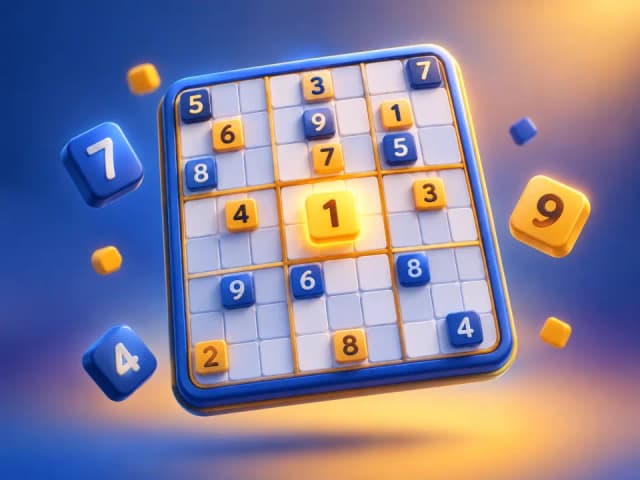


Keep reading
Sudoku
Sudoku Variants: Exploring Different Types and Advanced Rules
Discover the fascinating world of sudoku variants. From Killer Sudoku to Samurai layouts, learn the rules, strategies, and cognitive benefits of these logical puzzles.
May 13, 2025 18 min

Sudoku
Sudoku Y-Wing Technique: Master Advanced Logic to Crack Expert Grids
Master the Sudoku Y-Wing (XY-Wing) technique with our comprehensive guide. Learn to identify pivots and pincers to solve "Hard" to "Expert" puzzles like a pro.
Dec 7, 2025 12 min
Sudoku
Mastering the Sudoku Coloring Technique: An Advanced Solving Guide
Unlock the secrets of the Sudoku coloring technique. Learn how to use simple coloring and conjugate pairs to solve the hardest puzzles with expert precision.
Aug 25, 2025 12 min
Advertisement