Sudoku Y-Wing Technique: Master Advanced Logic to Crack Expert Grids
Master the Sudoku Y-Wing (XY-Wing) technique with our comprehensive guide. Learn to identify pivots and pincers to solve "Hard" to "Expert" puzzles like a pro.
By Free To Play Puzzles Editorial Team 12 min read
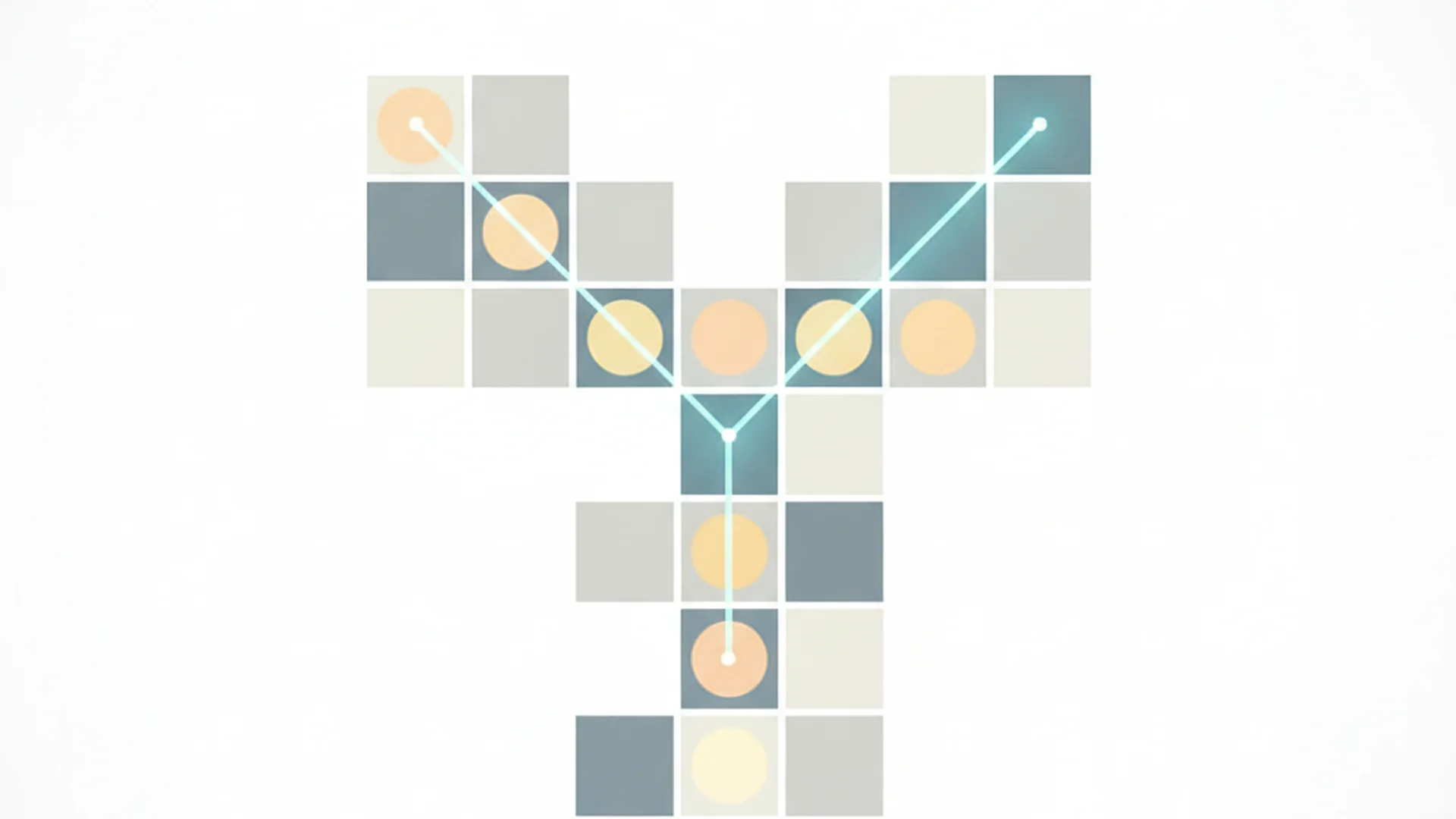
For many enthusiasts, the transition from "Intermediate" to "Expert" Sudoku is marked by a sudden wall. You’ve mastered Hidden Singles in Sudoku, you can spot Naked Pairs in your sleep, and you’ve even dabbled in Hard Sudoku Strategies. But then, you encounter a grid where the basic logic fails. This is where the sudoku y-wing (also known as the XY-Wing) becomes your most powerful weapon.
The y-wing technique sudoku strategy is more than just a trick; it is an exercise in "short-chain" logical reasoning that engages the prefrontal cortex and sharpens spatial awareness. In this guide, we will break down the geometry, the logic, and the application of this essential move.
Understanding the Anatomy of a Y-Wing
Before you can spot a Y-Wing in the wild, you must understand its DNA. Unlike basic techniques that look at a single row or box, the Y-Wing is a "bent triple." It involves three specific cells that share a relationship across different houses (rows, columns, or boxes).
The Three Components
To find a Y-Wing, you are looking for three "bivalue" cells. A bivalue cell is simply a cell that has exactly two possible candidates remaining.
- The Pivot: This is the "hinge" of the technique. It contains two candidates, let's call them X and Y.
- Pincer A: This cell must "see" the Pivot (meaning it is in the same row, column, or box). It contains candidates X and Z.
- Pincer B: This cell must also "see" the Pivot. It contains candidates Y and Z.
The magic happens with the "Z" candidate. Because of the way these three cells are linked, we can prove that one of the two Pincers must be Z. Consequently, any cell that can see both Pincer A and Pincer B simultaneously cannot be Z.
The Logical Proof: Why It Works
Why are we so certain we can eliminate a candidate? Let's look at the logic. Imagine our Pivot has the candidates [1, 2].
- If the Pivot is 1, then Pincer A (which has candidates [1, 3]) must be 3.
- If the Pivot is 2, then Pincer B (which has candidates [2, 3]) must be 3.
In either scenario, one of the two Pincers will contain the number 3. Therefore, any cell that is visible to both Pincer A and Pincer B is "covered" by a 3. If that target cell had a 3 as a candidate, we can safely delete it. This is the heart of the sudoku y-wing.
Advertisement
How to Find a Y-Wing: A Step-by-Step Strategy
Scanning for a Y-Wing requires a systematic approach. If you just look at the whole grid, you will get overwhelmed. Instead, follow this "Pivot-First" methodology:
Step 1: Filter for Bivalue Cells
Look for every cell on the board that has exactly two candidates. In modern digital interfaces like Sudoku, you can often highlight these or use coloring tools to make them stand out.
Step 2: Identify a Potential Pivot
Pick one bivalue cell to be your "Pivot" (candidates X and Y). Now, look along its row, its column, and within its 3x3 box for other bivalue cells.
Step 3: Find the Pincers
Look for two other cells that:
- Share exactly one candidate with the Pivot (one shares X, the other shares Y).
- Share a common third candidate (Z) with each other.
Step 4: Locate the Target Zone
Identify the cells that "see" both Pincers. This is usually the intersection of the Pincers' rows or columns. If the common candidate (Z) exists in that intersection, strike it out!
| Component | Candidates | Relationship |
|---|---|---|
| Pivot | 4, 7 | The Hinge |
| Pincer 1 | 4, 9 | Sees Pivot via Row |
| Pincer 2 | 7, 9 | Sees Pivot via Box |
| Elimination | 9 | Cells seeing both Pincers |
Real-World Examples
To truly master the y-wing technique sudoku, let's look at how these patterns manifest in actual gameplay.
Example 1: The "L-Shaped" Box Connection
Imagine the Pivot is at r1c1 (Row 1, Column 1) with candidates [1, 5].
- Pincer A is at r1c9 with candidates [1, 9]. (Connected by Row 1)
- Pincer B is at r3c2 with candidates [5, 9]. (Connected by Box 1)
- The Target: Any cell that sees both r1c9 and r3c2. In this case, r3c9 sees both. If r3c9 has a candidate 9, it can be eliminated.
Example 2: The Extended Row-Column Span
The Pivot is at r5c5 [2, 8].
- Pincer A is at r5c1 [2, 3].
- Pincer B is at r9c5 [8, 3].
- The Target: The cell at r9c1 sees both pincers. We can eliminate candidate 3 from r9c1.
Example 3: The Box-Box Jump
Sometimes the Y-Wing is compact.
- Pivot: r4c4 [6, 7]
- Pincer A: r4c6 [6, 8]
- Pincer B: r6c4 [7, 8]
- The Target: Cells in the intersection of Row 4 and Column 4 within the nearby boxes. Specifically, any cell in Box 5 or Box 6 that sees both pincers.
Common Mistakes to Avoid
Even seasoned players can stumble when applying the sudoku y-wing. Here are the most frequent errors:
- Misidentifying the Pivot: Players often pick a cell as a pincer when it should be the pivot. Remember: The pivot is the cell that shares one number with each pincer. The pincers should not share their "unique" numbers with the pivot.
- The "Third Digit" Confusion: A common mistake is trying to eliminate one of the digits found in the pivot. You must eliminate the digit that is shared by the two pincers but absent from the pivot.
- Visibility Errors: The two pincers must see the pivot, but they do not need to see each other. In fact, if the pincers see each other, you likely have a "Naked Triple," which is a simpler technique you should have used earlier.
- Incomplete Notation: If you haven't marked all candidates, you might miss a third candidate in a cell, turning a potential Y-Wing into an XYZ-Wing, which requires different rules.
Advertisement
Cognitive Benefits of Advanced Sudoku
A common question is whether Sudoku actually prevents cognitive decline. While "brain games" are sometimes overhyped, techniques like the sudoku y-wing provide genuine cognitive exercise.
When you scan for a Y-Wing, you are practicing working memory (holding the candidates of multiple cells in your mind) and visuospatial reasoning (mapping the lines of sight between cells). By moving beyond basic Easy Sudoku Puzzles for Beginners and tackling Expert Sudoku Techniques, you are forcing your brain to create new neural pathways to handle complex logic chains.
Recent Trends: AI and Competitive Sudoku (2025-2026)
The world of competitive Sudoku is evolving. In the upcoming 2026 World Sudoku Championship in India, organizers have announced a shift toward "Pencilmark Sudoku." In these variants, candidates are pre-filled, which removes the "chore" of note-taking and places the entire focus on rapid pattern recognition of advanced moves like Y-Wings and Advanced Sudoku Techniques: X-Wing and Swordfish.
Furthermore, new AI-assisted learning tools are changing how we practice. The latest solvers can now analyze your "solve path" and identify exactly which Y-Wing you missed, providing a "Heat Map" of where your eyes should have been looking.
Frequently Asked Questions
Is XY-Wing the same as Y-Wing?
Yes. In the Sudoku community, these terms are used interchangeably. "XY-Wing" is technically more accurate as it describes the three candidates (X, Y, and Z) involved in the logic, but "Y-Wing" is more common due to the visual shape.
Can a Y-Wing have more than 3 candidates?
No. A standard Y-Wing must only involve three bivalue cells. If the pivot has three candidates (XYZ), it becomes an XYZ-Wing. While similar, the XYZ-Wing has a much more restricted elimination zone (usually only within the same box as the pivot).
Where should I look for a Y-Wing?
The best time to look for a Y-Wing is when you are "stuck" and have many cells with only two candidates left. If you see a cluster of bivalue cells, start picking them one by one as "Pivots" and check their neighbors.
Why didn't my elimination work?
The most common reason is a "Visibility Error." For a Y-Wing elimination to be valid, the target cell must be able to "see" both pincer cells at the same time. If it only sees one, the logic doesn't hold.
Is the Y-Wing considered "cheating" or "guessing"?
Absolutely not. The Y-Wing is pure deductive logic. Unlike "Trial and Error" (where you plug in a number to see if it works), a Y-Wing proves a candidate is impossible based on the existing constraints of the grid.
Conclusion
The sudoku y-wing is the bridge between being a casual player and a true master of the craft. By training your eyes to spot the Pivot and Pincer relationship, you unlock the ability to solve even the most diabolical puzzles found in national newspapers and tournament brackets.
Remember, the key to mastery is practice. Don't jump straight into "Extreme" puzzles; instead, practice on "Hard" grids where a single Y-Wing is often the intended "break-in" point for the logic. With time, your brain will begin to see these Y-shapes automatically, turning a complex logical deduction into a simple moment of pattern recognition.
Ready to Level Up?
Challenge yourself with our expert-level grids and put your Y-Wing skills to the test.
Put it into practice


Keep reading
Sudoku
The Complete Sudoku Guide: From Beginner to Master (2025-2026 Edition)
Master Sudoku with our comprehensive 2025 guide. Learn everything from basic rules and Snyder notation to advanced X-Wing and Swordfish techniques.
Mar 27, 2026 25 min

Sudoku
Advanced Sudoku Techniques: Mastering the X-Wing and Swordfish
Unlock the secrets of advanced Sudoku with our deep dive into X-Wing and Swordfish techniques. Learn how to spot these patterns and solve the hardest puzzles.
Sep 20, 2026 12 min
Sudoku
Mastering the Sudoku Coloring Technique: An Advanced Solving Guide
Unlock the secrets of the Sudoku coloring technique. Learn how to use simple coloring and conjugate pairs to solve the hardest puzzles with expert precision.
Aug 25, 2025 12 min
Advertisement