Sudoku Pencil Marks & Candidate Notation: The Ultimate Guide
Master sudoku pencil marks and notation techniques. Learn Snyder notation, the Rule of Seven, and expert candidate strategies for 2025-2026 gameplay.
By Free To Play Puzzles Editorial Team 12 min read
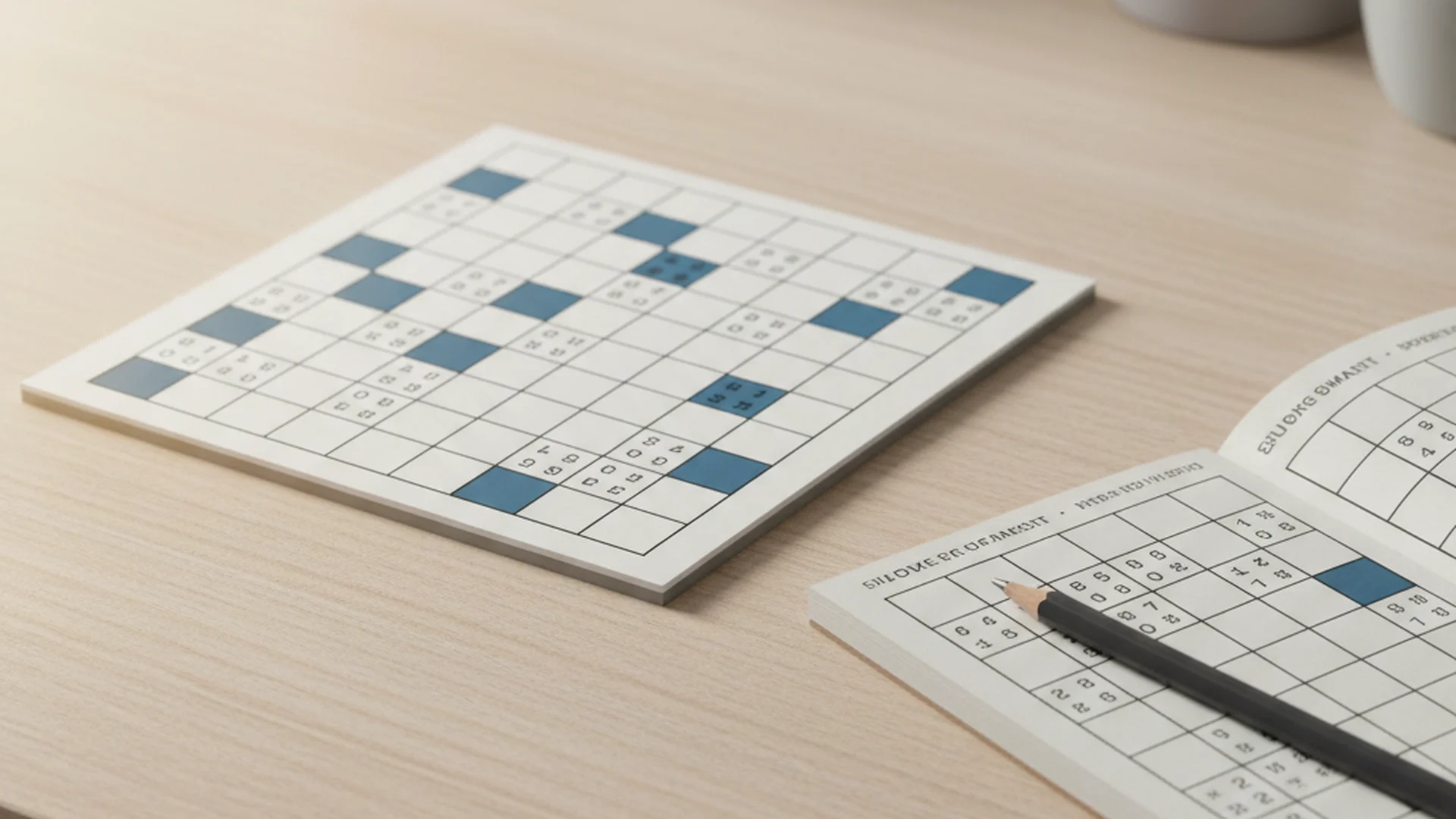
If you have ever reached a point in a Sudoku puzzle where you feel completely stuck, staring at a grid of empty white squares, you have encountered the limits of human working memory. For beginners, the game is a test of observation. For experts, it is a game of management. This management is executed through sudoku pencil marks—the small candidate digits written into the corners or centers of cells to track possibilities.
In the world of competitive play, using sudoku notation is not just a helpful tip; it is a fundamental requirement. Whether you are solving a classic grid in a Sunday newspaper or competing in the 2026 World Sudoku Championship, your ability to efficiently manage these "notes" determines how quickly you can identify complex patterns like X-Wings or hidden triples.
The Science of Sudoku Notation: Why We Mark
Many novice players feel that using pencil marks is somehow "cheating" or that a "pure" solver should do everything mentally. However, cognitive science suggests otherwise. Research into the "Rule of Seven" shows that the average human working memory can only hold roughly seven bits of information at once.
In a Sudoku grid of 81 cells, where a single cell might have five or six different candidates, the mental load exceeds human capacity almost instantly. Sudoku pencil marks serve as an "external hard drive" for your brain, offloading the memory task so your prefrontal cortex can focus on the logic of elimination.
The Snyder Notation: Speed and Precision
The most influential development in modern Sudoku strategy is Snyder Notation. Developed by Thomas Snyder, a legendary three-time World Sudoku Champion, this system prioritizes speed and clarity by limiting when and where you place your marks.
The Two-Candidate Rule
In pure Snyder notation, you only place pencil marks for a digit if that digit can fit in exactly two positions within a specific 3x3 box.
If a digit can fit in three or more spots, you leave the box blank. This might seem counterintuitive to beginners who want to mark everything, but it offers a massive advantage: if you see two pencil marks of the same number in a box, you know for a fact that one of them must be that number. This makes "pointing pairs" and "hidden pairs" leap off the page.
When to Transition to Full Notation
While Snyder is excellent for the "easy" and "medium" phases of a puzzle, it eventually "runs out of gas." When you have exhausted all basic eliminations and no more Snyder marks can be placed, it is time to transition to Full Notation. This involves marking every possible candidate in a cell. This is usually necessary for advanced techniques found in our guide on Advanced Sudoku Techniques: X-Wing and Swordfish.
Advertisement
Center vs. Corner Marks: A Visual Strategy
In 2025, digital Sudoku platforms like SudokuPad and Sudoku - Paperlike have standardized two distinct types of marks. Understanding the difference is crucial for high-level solving.
Corner Marks (The "Where")
Corner marks are typically placed around the perimeter of the cell. In the Snyder method, these tell you where a digit can go within a larger box. If you see a small '5' in the top-left corner of two different cells in Box 1, your brain immediately recognizes a pair.
Center Marks (The "What")
Center marks are placed in the middle of the cell and are used to denote what digits can fit into that specific cell. This is often used for "Naked Singles" or when you are down to the final three candidates of a row or column.
Three Real-World Examples of Marking Logic
Example 1: The Snyder Hidden Pair
Imagine Box 5 (the center box). After scanning, you realize the number 2 can only go in the top-left and top-right cells of that box. You mark them. Then, you realize the number 7 can also only go in those exact same two cells.
- Result: You have found a Hidden Pair. Because you used Snyder notation, you can immediately conclude that no other numbers can go in those two cells. If you had cluttered the box with "Full Notation," you might have missed this.
Example 2: The Pointing Pair
In Box 1, the number 4 can only appear in two cells, both of which are in Row 2. Even though you don't know which cell is the 4 yet, you have a "pointing pair."
- Result: You can now logically eliminate the number 4 from every other empty cell in Row 2 outside of Box 1. This is a foundational step in Sudoku Solving Techniques: Complete Guide.
Example 3: The "Clean-Up" Rule in Action
You finally place a large "8" in Row 5, Column 5.
- Result: You must immediately scan Row 5, Column 5, and Box 5 to delete any small pencil-mark 8s. This "living document" approach prevents "ghost candidates" from leading you into a logic trap.
Modern Trends: Sudoku Notation in 2025–2026
The landscape of Sudoku is shifting toward digital integration. As we look toward the 2026 World Sudoku Championship in India, several new trends have emerged from the community at SudokuCon 2025:
- Extended Snyder: Top-tier solvers are now marking candidates that form a "line" (pointing pairs) even if they appear in three cells, provided they are restricted to a single row or column within a box.
- Digital Handwriting Recognition: New AI-driven apps now allow players to write pencil marks with a stylus, which the app then converts into clean, searchable digital candidates. This bridges the gap between the tactile feel of paper and the efficiency of digital logic.
- Hybrid Notation: Solvers are increasingly using "Color Coding" alongside pencil marks to track "chains" or "links," a technique that is becoming standard for solving "Extreme" difficulty puzzles.
Advertisement
Common Mistakes to Avoid
Even the most seasoned players can fall into "notation traps." Avoid these common pitfalls to keep your solve on track:
- Over-Notation: Filling every cell with 5+ candidates immediately. This creates "visual noise" that makes it impossible to see obvious moves.
- The "Guessing" Fallacy: Using pencil marks to "try out" a number. Pencil marks must always be based on certainty (i.e., "It must be one of these three"), not a guess.
- Static Notes: Forgetting to update your marks. A single placed digit can have a ripple effect that eliminates a dozen pencil marks across the grid.
- Inconsistent Placement: Putting a '3' in the top-left of one cell and the bottom-right of another. This forces your brain to work harder to "read" the grid rather than "recognize" it.
| Feature | Snyder Notation | Full Notation |
|---|---|---|
| Best For | Early Game / Speed | Late Game / Advanced Logic |
| Clutter | Low | High |
| Identifies | Hidden Pairs / Pointing Pairs | Naked Pairs / X-Wings |
| Complexity | Simple | Technical |
Frequently Asked Questions
Is using pencil marks considered "cheating"?
Absolutely not. In competitive Sudoku, including the World Sudoku Championship, pencil marks are a standard and expected part of the gameplay. The challenge of Sudoku is the logic of elimination, not a test of your short-term memory capacity.
When should I switch from Snyder to Full Notation?
Most experts recommend switching when you can no longer make any progress using Snyder marks. This usually happens when the "easy" numbers are filled in and you need to look for complex structures like Naked Pairs in Sudoku or Swordfish patterns.
Should I use a pencil or a pen for paper Sudoku?
Always use a pencil for candidates! Even pros make mistakes, and the ability to cleanly erase a note is vital. Many high-level paper solvers use a mechanical pencil with 0.5mm lead for precise marking in small spaces.
What is "Double-Marking"?
Double-marking is the practice of identifying two cells in a box that can only contain the same two numbers (e.g., 1 and 7). By marking "1,7" in both cells, you create a "Locked Pair," which allows you to eliminate those two digits from all other cells in that specific box, row, or column.
Conclusion
Mastering sudoku pencil marks is the single biggest leap a player can make from "casual" to "strategic" solving. By adopting a system like Snyder notation and adhering to the "Clean-Up Rule," you transform the grid from a chaotic jumble of numbers into a clear map of logical possibilities.
As you practice, remember that your sudoku notation is a living document. It should evolve as the puzzle does. If you’re just starting out, keep it simple. Learn the basics of How to Play Sudoku: Step-by-Step and slowly integrate Snyder marks into your routine. Over time, you’ll find that the "stuck" moments become fewer, and your solve times will plummet.
Ready to Play?
Put your pencil marking skills to the test today.
Put it into practice

Keep reading

Sudoku
Mastering Sudoku Box/Line Reduction: The Ultimate Guide to Locked Candidates
Master the sudoku box line reduction and pointing pairs techniques. Learn how to break through hard puzzles with expert strategies.
Aug 19, 2025 12 min

Sudoku
Sudoku Rules Explained: The Ultimate Guide for Beginners and Pros
Master the essential sudoku rules with this expert guide. Learn the logic behind the 9x9 grid, advanced solving strategies, and the cognitive benefits of the game.
Jul 18, 2025 12 min
Sudoku
Diagonal Sudoku Guide: Mastering the Rules and Solving Strategies
Learn how to master Diagonal Sudoku (Sudoku X). Discover essential rules, advanced solving strategies, and the mathematics behind this popular Sudoku variant.
Jul 17, 2026 12 min
Advertisement