Sudoku for Beginners: The Complete 2025-2026 Guide
Master Sudoku with our comprehensive beginner guide. Learn rules, expert strategies like Snyder Notation, and explore 2026 trends in AI-driven gameplay.
By Free To Play Puzzles Editorial Team 15 min read

Welcome to the definitive guide to sudoku for beginners. If you have ever opened a newspaper or a mobile app and felt intimidated by the 81-cell grid of numbers, you are not alone. However, as a retro gaming historian, I have seen many puzzles come and go, but few possess the elegant simplicity and enduring challenge of Sudoku. Despite the presence of digits 1 through 9, this is not a math game—it is a game of pure, unadulterated logic.
In this guide, we will break down how to play sudoku from the absolute basics to the strategies used by world champions. Whether you are looking to boost your brainpower or simply find a relaxing hobby for your morning commute, this 2025-2026 updated guide covers everything from the mathematical "17-clue rule" to the latest AI-driven learning tools.
The Fundamentals: What is Sudoku?
At its core, Sudoku is a logic-based, combinatorial number-placement puzzle. While the game exploded into global consciousness in the mid-2000s, its roots are surprisingly modern. Modern Sudoku was actually developed in the 1970s by an American architect named Howard Garns. At the time, it was called "Number Place," but it wasn't until the Japanese publisher Nikoli rebranded it as "Sudoku" (meaning "single number") that it became a worldwide phenomenon.
The Anatomy of the Grid
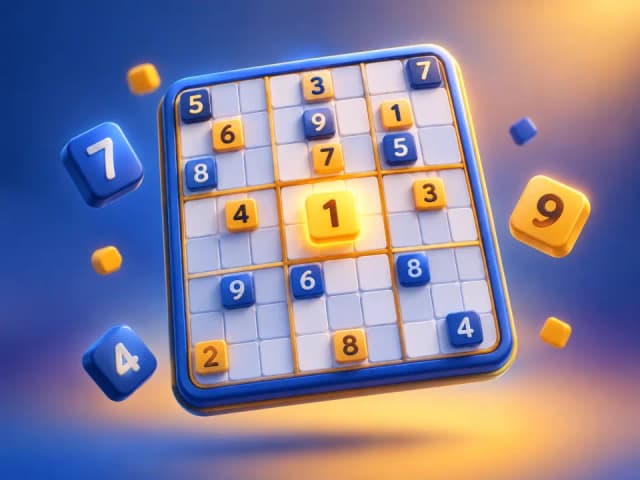
To understand how to play sudoku, you must first understand the board. A standard Sudoku puzzle consists of a 9x9 grid. This large grid is further subdivided into nine smaller 3x3 subgrids, often referred to as "boxes," "blocks," or "regions."
The goal is simple: fill the grid so that every row, every column, and every 3x3 box contains all of the digits from 1 to 9.
How to Play Sudoku: The Three Golden Rules
Before you place your first number, you must memorize the three constraints that govern every move.
- The Row Rule: Each horizontal row must contain the numbers 1 through 9 exactly once. No repeats allowed.
- The Column Rule: Each vertical column must contain the numbers 1 through 9 exactly once. No repeats allowed.
- The Box Rule: Each 3x3 subgrid must contain the numbers 1 through 9 exactly once. No repeats allowed.
That is it. There is no addition, subtraction, or multiplication. If you can count to nine and recognize patterns, you can master sudoku for beginners.
Advertisement
Why Play Sudoku? Cognitive Benefits in 2025
In an era of short-form videos and constant digital distractions, Sudoku offers a rare opportunity for "deep work" and mental focus. A 2024 survey indicated that 42% of online players engage with the game specifically for brain-boosting benefits.
Research suggests that regular engagement with logic puzzles can:
- Improve Working Memory: Keeping multiple "candidate" numbers in your head strengthens your short-term recall.
- Delay Cognitive Decline: Consistent mental stimulation is a key factor in maintaining brain health as we age. For more on this, see our guide on the Best Brain Games for Seniors.
- Reduce Stress: The rhythmic, logical progression of solving a grid provides a "flow state" that many find meditative.
Essential Beginner Strategies: Your Step-by-Step Toolkit
When you first look at a grid, don't just guess. Guessing is the enemy of logic. Instead, use these proven techniques to find the "low-hanging fruit."
1. Scanning and Cross-Hatching
This is the most basic technique for sudoku for beginners. Pick a number (let’s say 1) and scan every row and column where a 1 already exists. Since a 1 cannot appear again in those rows or columns, you can "eliminate" those paths. Look at a 3x3 box that does not have a 1 yet. If the existing 1s in the surrounding rows and columns leave only one empty cell in that box, you’ve found your spot!
2. The Full House
This is the easiest move in the game. A "Full House" occurs when a row, column, or 3x3 box has eight numbers filled in and only one empty cell remaining. Since every unit must contain 1-9, the missing number is logically guaranteed.
3. The "Square Route" (Chuting)
Experts often refer to "chutes"—the three large vertical columns of boxes or the three large horizontal rows of boxes. Look at a horizontal chute (three boxes side-by-side). If the number 5 appears in the top row of the first box and the middle row of the second box, logic dictates that in the third box, the 5 must be in the bottom row.
4. Snyder Notation
Named after 3-time World Sudoku Champion Thomas Snyder, this is a "pencil mark" technique. When you are scanning a 3x3 box and find that a number can only fit in exactly two cells, write that number in small "candidate" marks in the corners of those cells.
Real-World Example: Solving Your First Box
Imagine you are looking at the top-left 3x3 box.
- The box is missing the numbers 2, 5, and 9.
- You look at the top row (Row 1) of the entire 9x9 grid and see a 2 and a 5 already placed elsewhere in that row.
- This means the empty cell in the top-left box that intersects Row 1 cannot be 2 or 5.
- By the process of elimination, that cell must be 9.
This is the essence of Sudoku: it's not about knowing what a number is, but rather knowing what it cannot be.
Advertisement
Common Mistakes to Avoid
Even the most analytical minds fall into these traps when starting out.
- The "Clustering" Trap: Beginners often hover over the box with the most numbers. While this is a good start, remember that the clues outside that box (in the connecting rows and columns) are what actually provide the solution.
- Over-reliance on Auto-Fill: Many Best Sudoku Apps 2025 offer a feature that fills in all possible candidates for you. Warning: Avoid this! It prevents your brain from learning the elimination logic required for harder puzzles.
- The Speed Misconception: Sudoku isn't a race against the clock until you reach the competitive level. Rushing leads to "blind spots." One wrong number placed in the first three minutes can make the entire puzzle unsolvable by the end.
- Ignoring the Pencil: Never try to solve a Medium or Hard puzzle entirely in your head. Use pencil marks. If you're playing on paper, keep an eraser handy.
| Mistake | Why it Happens | How to Fix It |
|---|---|---|
| Guessing | Frustration/Stuck | Switch to a different number (1-9) and re-scan. |
| Double Numbers | Lack of cross-checking | Always check the Row, Column, and Box before final placement. |
| Messy Notes | Marking every possibility | Use Snyder Notation (only mark when 2 spots remain). |
2025-2026 Trends: The Future of Sudoku
As we move into 2026, the way we interact with Sudoku is changing. It is no longer just a pen-and-paper game.
AI-Driven Learning
Modern apps now use Adaptive Difficulty AI. Instead of static "Easy" or "Hard" levels, the AI tracks your solving patterns. If it notices you struggle with "Naked Pairs" but breeze through "Cross-hatching," it will generate custom puzzles designed to teach you the specific logic you're missing.
Augmented Reality (AR) Sudoku
One of the most exciting trends for 2026 is the use of AR glasses and mobile AR. You can point your device at a blank Sudoku grid in a physical newspaper, and the AR will overlay candidate numbers in 3D space, helping you visualize the logic without marking up the paper.
Hybrid Variants
While the classic 9x9 remains the gold standard, beginners are increasingly moving toward variants to keep things fresh.
- Killer Sudoku: Adds "cages" with sum totals, combining logic with basic arithmetic. Check out our Killer Sudoku Strategy Guide.
- Windoku: Adds four extra shaded 3x3 regions that must also contain 1-9.
- Diagonal Sudoku: The two main diagonals must also contain 1-9. See the Diagonal Sudoku Guide.
Frequently Asked Questions
Is Sudoku a math game?
No. Although it uses numbers, it is a logic puzzle. You could replace the numbers with letters (A-I) or different emojis, and the game would play exactly the same way.
Can a Sudoku puzzle have two solutions?
A mathematically "valid" Sudoku puzzle must have exactly one unique solution. If you find a situation where two different numbers seem to work, it usually means you made an error earlier in the puzzle or the puzzle itself is poorly designed.
Is guessing a valid strategy?
Professional players and logic purists say no. Every cell in a well-crafted Sudoku can be solved using pure deduction. Guessing usually leads to "tangled logic," where you realize 20 moves later that the grid is broken.
How long should a beginner puzzle take?
For a standard "Easy" grid, most beginners take between 10 and 20 minutes. With practice and the use of scanning techniques, this time often drops to under 5 minutes.
What is the 17-clue rule?
It is the mathematical minimum number of clues required for a 9x9 Sudoku grid to have a unique solution. Any puzzle with 16 clues will have at least two different ways it could be solved.
Taking the Next Step
Once you feel comfortable with the basics of how to play sudoku, you might find yourself looking for more of a challenge. The transition from "Beginner" to "Intermediate" involves learning about "Hidden Pairs," "Naked Triples," and "Pointing Pairs." These techniques allow you to eliminate candidates even when you can't immediately place a number.
If you enjoy Sudoku, you might also enjoy other logic-based games that test your pattern recognition:
- 10 Crossword Solving Strategies the Pros Use
- 2048 Strategy Guide: How to Win Every Time
- Advanced Sudoku Techniques: X-Wing and Swordfish
Conclusion
Sudoku is more than just a way to pass the time; it is a workout for your brain that rewards patience and logical thinking. By starting with the basics of scanning, mastering the "Full House," and utilizing Snyder Notation, you will quickly move from a confused beginner to a confident solver. Remember: focus on accuracy first, and speed will follow naturally.
Ready to Start?
Test your new skills with our daily puzzles.
Put it into practice

Keep reading
Sudoku
The Complete Sudoku Guide: From Beginner to Master (2025-2026 Edition)
Master Sudoku with our comprehensive 2025 guide. Learn everything from basic rules and Snyder notation to advanced X-Wing and Swordfish techniques.
Mar 27, 2026 25 min
Sudoku
Sudoku Rules Explained: The Ultimate Guide for Beginners and Pros
Master the essential sudoku rules with this expert guide. Learn the logic behind the 9x9 grid, advanced solving strategies, and the cognitive benefits of the game.
Jul 18, 2025 12 min

Sudoku
What is Sudoku? The Complete Introduction to the World’s Favorite Logic Puzzle
Discover what is Sudoku, from its mathematical origins to its brain health benefits. Learn rules, expert strategies, and 2025 trends in this complete guide.
Jul 11, 2025 12 min
Advertisement