Diagonal Sudoku Guide: Mastering the Rules and Solving Strategies
Learn how to master Diagonal Sudoku (Sudoku X). Discover essential rules, advanced solving strategies, and the mathematics behind this popular Sudoku variant.
By Free To Play Puzzles Editorial Team 12 min read
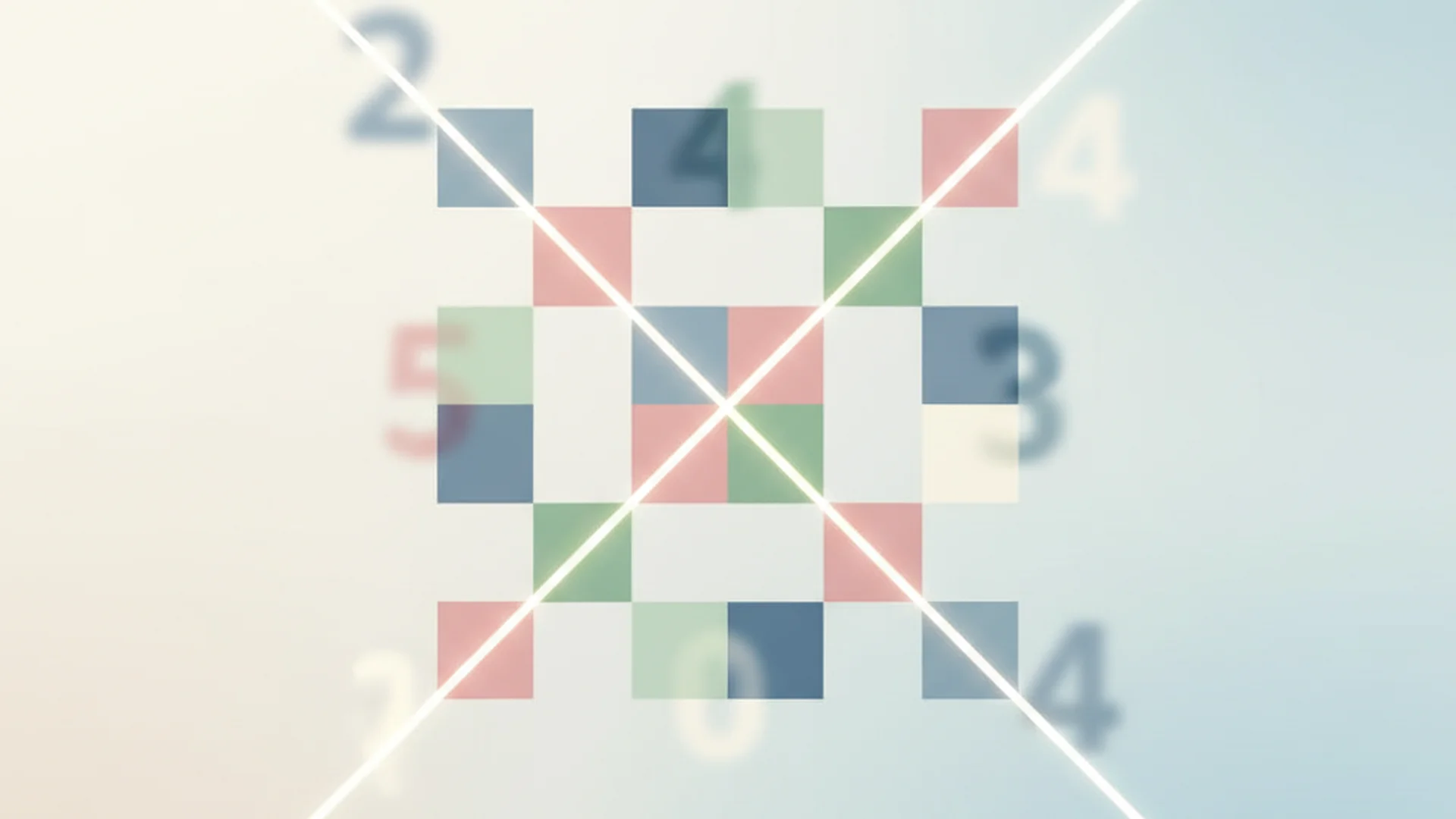
For many puzzle enthusiasts, the standard 9x9 grid eventually becomes a predictable routine. When the usual rows and columns no longer offer a sufficient challenge, diagonal sudoku—often referred to as Sudoku X—provides the perfect evolution. By adding just two additional constraints to the classic rules, this variant transforms the logical landscape of the game, demanding a sharper eye and a more nuanced strategy.
Whether you are a seasoned solver looking to shave minutes off your time or a beginner curious about the "X" marks on your grid, understanding the mechanics of these diagonals is the key to mastery. In this guide, we will break down the fundamental rules, explore the mathematical beauty of the variant, and dive deep into the specific strategies that separate amateurs from world-class competitors.
What is Diagonal Sudoku?
Diagonal Sudoku is a popular variant of the classic logic puzzle that introduces a geometric twist. In a standard game, your focus is entirely on the horizontal rows, vertical columns, and 3x3 subgrids (boxes). However, in Sudoku X, the "X" refers to the two main diagonals that run from corner to corner across the entire 9x9 grid.
The Core Rules
The rules of Sudoku X are additive. You must still follow all the traditional rules:
- Every row must contain the digits 1 through 9 exactly once.
- Every column must contain the digits 1 through 9 exactly once.
- Every 3x3 box must contain the digits 1 through 9 exactly once.
The "X" factor adds a fourth rule: 4. The two main diagonals—running from top-left to bottom-right and top-right to bottom-left—must also contain the digits 1 through 9 exactly once.
These diagonals are technically known as the negative diagonal (top-left to bottom-right) and the positive diagonal (top-right to bottom-left). Because these diagonals act as additional "houses" or units, they provide more opportunities for elimination but also more ways to make a fatal error.
The Mathematical Complexity of Sudoku X
As a strategic gameplay analyst, I find the mathematics of Sudoku X fascinating. In classic Sudoku, the total possible number of valid completed 9x9 grids is approximately 6.67 x 10²¹. When you impose the diagonal constraint, the number of valid completed grids drops significantly.
However, a decrease in the number of valid grids does not mean the game is easier to design. In fact, it makes the logic more intricate. One of the most striking differences lies in the "clue minimum." While it has been mathematically proven that a standard Sudoku requires at least 17 clues to have a unique solution, Sudoku X can be solved with far fewer. Researchers have identified thousands of valid 12-clue Sudoku X puzzles. Theoretically, the extra constraints might allow for even lower clue counts, as each clue placed on a diagonal influences more "houses" than a standard cell.
Historical Context: From Euler to the Modern X
The logical roots of Sudoku go back much further than the 1980s Japanese boom. Swiss mathematician Leonhard Euler developed Latin Squares in the 18th century, which are the foundation of all Sudoku puzzles. Euler himself experimented with various constraints, including diagonal requirements. What we now call Sudoku X is essentially a Latin Square with additional diagonal symmetry, a concept that has intrigued mathematicians for centuries before it became a staple of modern puzzle books.
Advertisement
Essential Solving Strategies for Sudoku X
To solve Sudoku X efficiently, you must treat the diagonals with the same priority as rows and columns. If you are new to the game, you might want to review How to Play Sudoku: Step-by-Step before diving into these variant-specific tactics.
1. The Junction Point Strategy (The Center Cell)
The most important cell in any Sudoku X puzzle is R5, C5 (Row 5, Column 5). This is the exact center of the grid.
Why it matters: The center cell is the only cell in the entire puzzle that belongs to both diagonals. Furthermore, it belongs to its row, its column, and the center 3x3 box. This makes it a "high-traffic junction."
2. Diagonal Intersection Removal
This technique involves looking at how a diagonal interacts with the 3x3 boxes it passes through.
Real-World Example 1: The Box 1 Constraint Imagine you are looking at the top-left 3x3 box (Box 1). The negative diagonal passes through three cells in this box (R1C1, R2C2, R3C3). If, through logical deduction, you realize the number 5 must be located on the negative diagonal within Box 1, you can immediately eliminate 5 from every other cell in Box 1 that is not on that diagonal. Conversely, if a number in Box 1 can only fit in the cells that happen to be on the diagonal, that number is then eliminated from the rest of the diagonal outside that box.
3. Pencil Marking and Snyder Notation
Experts recommend using "Snyder notation"—marking candidates in the corners of a cell—specifically for the diagonals. Treat each diagonal as its own independent unit.
Real-World Example 2: The Naked Pair on a Diagonal Suppose you are examining the positive diagonal (top-right to bottom-left). You find that in cells R2C8 and R3C7, the only possible candidates are 2 and 4. Because these two cells are both on the same diagonal, you have found a Naked Pair. You can now remove 2 and 4 from all other cells on that specific diagonal, even if those cells are in different rows, columns, or boxes.
4. Advanced "Fish" Techniques on Diagonals
Advanced players can apply techniques like the X-Wing or Swordfish by using a diagonal as one of the "base sets."
Real-World Example 3: The Diagonal X-Wing In a standard X-Wing, you look for a candidate restricted to two columns in two different rows. In Sudoku X, you can substitute a diagonal for one of those rows. If a digit is restricted to two columns on the negative diagonal and the same two columns in Row 9, you can perform eliminations in those columns. This level of logic is often required for "Extreme" or "Evil" difficulty levels. For more on this, see Advanced Sudoku Techniques: X-Wing and Swordfish.
Diagonal Sudoku in the Modern Era (2025–2026)
The world of competitive Sudoku is more vibrant than ever. As we move through 2025 and into 2026, Sudoku X remains a core component of professional play.
- World Sudoku Championship (WSC): Following the 2025 WSC in Eger, Hungary, the community is looking forward to the 2026 WSC in India. Sudoku X is traditionally featured in the "Variants" rounds of these championships.
- Sudoku Grand Prix 2026: The World Puzzle Federation (WPF) has confirmed the 2026 Grand Prix schedule. Starting in January 2026, monthly rounds hosted by various countries (beginning with Türkiye) will feature Sudoku X puzzles designed by the world's top authors.
- AI and Hybrid Puzzles: 2025 saw the rise of AI-driven apps like Sudoku V+ (2026 Edition), which can generate "Hybrid" puzzles. These combine the diagonal constraint with others, such as Killer Sudoku X (where you must also manage sum cages) or Arrow Sudoku X.
Common Mistakes to Avoid
Even experienced players can trip up when the diagonal lines are introduced. Here are the most frequent pitfalls:
The "Deadly Pattern" Trap
In classic Sudoku, players often use the "Unique Rectangle" technique to avoid patterns that would result in two solutions.
Overlooking the "Hidden House"
Beginners often treat diagonals as secondary hints rather than mandatory rules. They focus on rows and columns and only check the diagonals when they get stuck. This is a mistake. A diagonal is a full "house." If you ignore it, you miss out on early-game eliminations that make the rest of the puzzle significantly easier.
Guessing Instead of Logic
Many players assume that because a puzzle looks complex, it must require "bifurcation" (guessing). However, every properly constructed Sudoku X puzzle can be solved using pure logic. If you feel the need to guess, it usually means you haven't fully explored the Expert Sudoku Techniques or how they interact with the diagonal constraints.
Advertisement
Frequently Asked Questions
Is Sudoku X harder than regular Sudoku?
Not necessarily. While there are more rules to keep track of, the extra diagonal constraints actually provide more information. A Sudoku X puzzle with the same number of starting clues as a classic puzzle is usually easier to solve because the diagonals offer more paths for elimination.
Do the diagonals have a special name?
Yes. The diagonal running from the top-left to the bottom-right (R1C1 to R9C9) is called the negative diagonal. The one running from the top-right to the bottom-left (R1C9 to R9C1) is called the positive diagonal.
Can I use regular Sudoku apps for Sudoku X?
Most standard apps only recognize row, column, and box constraints. To play Sudoku X, you need a dedicated variant app such as SudokuPad or the Cracking the Cryptic apps, which highlight the diagonals and include the logic for them in their hint systems.
Does the center cell really matter that much?
Yes. The cell at R5, C5 is the "heart" of the puzzle. It is the only cell that influences both diagonals simultaneously. If you can solve the center cell early, it often acts as a catalyst for solving the rest of the grid.
How do I know if a puzzle is a Diagonal Sudoku?
Most publishers will label it as "Sudoku X" or "Diagonal Sudoku." Visually, these puzzles often have shaded or colored cells along the two main diagonals to remind the player of the extra constraint.
Conclusion
Diagonal Sudoku offers a refreshing and intellectually stimulating twist on the classic game. By mastering the intersection of diagonals with traditional rows and boxes, and paying special attention to the high-traffic center cell, you can unlock a new level of puzzle-solving proficiency. As you prepare for the upcoming competitive seasons in 2026, remember that the "X" isn't just a decorative feature—it is your most powerful tool for solving the grid.
For those looking to refine their general skills further, exploring Hard Sudoku Strategies can provide the foundation needed to tackle even the most daunting Sudoku X challenges.
Ready to Start?
Challenge yourself with our daily puzzles and master the X.
Put it into practice


Keep reading

Sudoku
Mastering the Sudoku Coloring Technique: An Advanced Solving Guide
Unlock the secrets of the Sudoku coloring technique. Learn how to use simple coloring and conjugate pairs to solve the hardest puzzles with expert precision.
Aug 25, 2025 12 min

Sudoku
Jigsaw Sudoku Guide: Mastering Irregular Regions and Logic
Master Jigsaw Sudoku with our expert guide. Learn the Law of Leftovers, irregular region strategies, and 2026 trends.
Apr 11, 2026 12 min

Sudoku
Mastering Sudoku Box/Line Reduction: The Ultimate Guide to Locked Candidates
Master the sudoku box line reduction and pointing pairs techniques. Learn how to break through hard puzzles with expert strategies.
Aug 19, 2025 12 min
Advertisement