Killer Sudoku: Rules and Strategies
Master the essentials of Killer Sudoku with our comprehensive 2025 guide. Learn the fundamental killer sudoku rules, the magic Rule of 45, and advanced solving strategies.
By Free To Play Puzzles Editorial Team 12 min read
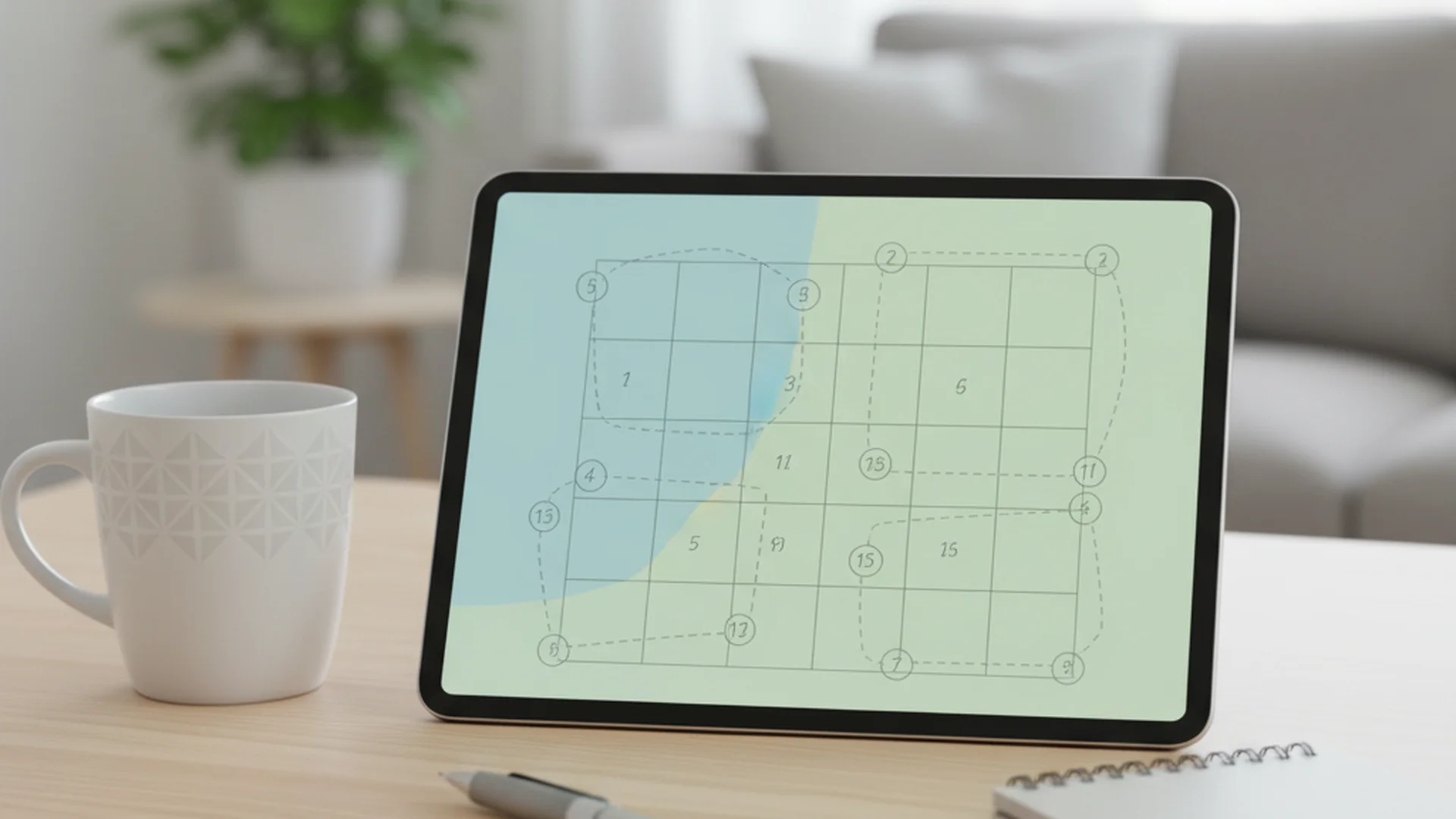
The world of logic puzzles is undergoing a fascinating transformation as we move through 2025. While the classic 9x9 grid remains a staple of morning routines worldwide, a more intense, mathematically driven variant has taken center stage: Killer Sudoku. By blending the placement constraints of traditional Sudoku with the arithmetic requirements of Kakuro, this variant offers a multi-dimensional challenge that tests both your spatial logic and your mental calculation speed.
Understanding the killer sudoku rules is the first step toward joining the ranks of elite solvers. Whether you are a logic purist looking for a new hurdle or an arithmetic enthusiast seeking a structured challenge, mastering the "Killer" variant is immensely rewarding. In this guide, we will break down the fundamental mechanics, explore high-level strategies used by tournament professionals, and look ahead at the competitive landscape for 2026.
Understanding the Fundamental Killer Sudoku Rules
To the uninitiated, a Killer Sudoku grid looks like a standard Sudoku board that has been overtaken by dashed lines. These dashed lines form "cages." To solve the puzzle, you must satisfy three distinct sets of requirements simultaneously.
1. Standard Sudoku Constraints
Every row, every column, and every 3x3 nonet (box) must contain the digits 1 through 9 exactly once. If you find yourself placing a 5 in a row that already contains a 5, you have violated a fundamental rule, regardless of what the math says.
2. The Sum Constraint
Each dashed-line cage has a small number printed in its top-left corner. This number is the "sum" of all the digits contained within that cage. For example, if a cage covers two cells and has a sum of "3," the only possible digits for those cells are 1 and 2.
3. The No-Repeat Cage Rule
This is the rule most frequently missed by beginners. No digit can be repeated within a single cage. Even if a cage spans across multiple rows or boxes where a number could technically repeat under standard Sudoku rules, the cage itself forbids it.
The Magic of the Rule of 45
The most powerful weapon in any professional's arsenal is the Rule of 45. In any standard Sudoku grid, the sum of the digits 1 through 9 is always exactly 45 $(1+2+3+4+5+6+7+8+9 = 45)$.
Because Killer Sudoku cages provide the sums of their contents, you can use this mathematical constant to "mathematically see" through the grid. If a 3x3 box is almost entirely covered by cages that sum to 38, you know with absolute certainty that the remaining cell (the "innie") must be 7 $(45 - 38 = 7)$.
Real-World Example: The "Innie" Technique
Imagine the top-left 3x3 box. It is covered by four cages with sums of 12, 10, 8, and 10. These cages are entirely contained within the box, except for one cell of the box that is left out.
- Total sum of cages = $12 + 10 + 8 + 10 = 40$.
- Total sum required for the box = $45$.
- The remaining cell must be $45 - 40 = 5$.
Real-World Example: The "Outie" Technique
The same logic applies in reverse. If a group of cages totals 52 and covers an entire 3x3 box plus one cell in the adjacent box, that "outie" cell must be 7 $(52 - 45 = 7)$. This allows you to place numbers in regions where you might not have any other clues.
Advertisement
Killer Sudoku Strategy: From Beginner to Expert
Once you have the rules down, you need a coherent killer sudoku strategy to tackle harder grids. Expert solvers in 2025 do not just guess and check; they look for "locked combinations" and "cage parity."
Identifying Extreme Sums
Just as you look for "naked singles" in Easy Sudoku Puzzles for Beginners, in Killer Sudoku, you look for "unique sums." These are cages that can only be filled with one specific set of numbers.
| Cage Size | Sum | Required Digits |
|---|---|---|
| 2 Cells | 3 | [1, 2] |
| 2 Cells | 4 | [1, 3] |
| 2 Cells | 17 | [8, 9] |
| 3 Cells | 6 | [1, 2, 3] |
| 3 Cells | 7 | [1, 2, 4] |
| 3 Cells | 23 | [6, 8, 9] |
| 3 Cells | 24 | [7, 8, 9] |
By identifying these "low-hanging fruit" cages, you immediately restrict the candidates for neighboring cells. If you see a 2-cell cage with a sum of 17, you know those cells must be 8 and 9. If a row already has an 8 elsewhere, you have just solved two cells instantly.
Mastering Cage Parity
Advanced solvers use parity (even vs. odd) to solve expert-level grids.
- An odd sum in a 2-cell cage must consist of one odd number and one even number.
- An even sum in a 2-cell cage must consist of two odd numbers or two even numbers.
If you are stuck on a difficult puzzle, look at the available candidates for a cage. If the cage sum is 10 (even) and your only available candidates for the first cell are 3 and 4, you can test the logic: if you place the 4 (even), the other cell must be 6 (even). If you place the 3 (odd), the other cell must be 7 (odd). This narrows your search space significantly.
Intersection Logic
Sometimes a cage spans across a box boundary. This creates an "intersection." This is where you combine cage sums with Expert Sudoku Techniques like pointing pairs or triples. If a cage totaling 15 spans across two boxes, and you know from the box logic that it cannot contain a 7, you've narrowed the mathematical possibilities for that cage from $(6+9, 7+8)$ to just $(6+9)$.
Recent Trends and Competitive Play (2025-2026)
As we look toward 2026, the Killer Sudoku scene is more vibrant than ever. The integration of technology and global competition has changed how players approach the game.
AI Integration and Learning Tools
One of the most significant shifts in 2025 has been the rise of AI-driven solvers. These aren't just tools that give you the answer; they are sophisticated educational platforms. New apps now feature "Cage Unit Overlap" detection. This helps players visualize how complex cages interact with the Rule of 45, highlighting areas where "Innies" or "Outies" are mathematically forced. If you are looking to improve, check out some of the Best Sudoku Apps 2025 which often include these advanced logic trainers.
New Hybrid Variants
The 2025-2026 season has also seen the rise of "Greater-Than Killer Sudoku." In these puzzles, cages might not have sum values at all. Instead, they use symbols ($>$, $<$) to indicate the relationship between cells or cages. This requires a different kind of logic, focusing on relative values rather than absolute sums.
The Global Stage: Sudoku Grand Prix 2026
For those who enjoy the thrill of competition, the Sudoku Grand Prix 2026 is the pinnacle. Running from January to July 2026, this online tournament features dedicated rounds for variants like Killer and Diagonal Sudoku Guide. Furthermore, the World Sudoku Championship 2026, set to be held in India, will feature high-speed Killer Sudoku rounds where top-tier solvers are expected to clear 9x9 expert grids in under 12 minutes.
Common Mistakes to Avoid
Even seasoned players can fall into traps when the grid gets complex. Here are the most frequent errors observed in tournament play:
- The Guessing Trap: Many players start guessing when they can't find a sum combination. Modern puzzles (especially handcrafted ones) are guaranteed to be solvable through logic. If you're stuck, you likely missed a Rule of 45 application or an intersection.
- Repeating Digits in Cages: It’s easy to forget the no-repeat rule in a large, L-shaped cage that spans three different boxes. Always double-check that your cage solution doesn't contain a duplicate.
- Arithmetic Errors: Even a simple $7+5=13$ mistake can ruin an entire hour of work. Expert solvers often use "candidate mode" to write down all possible combinations for a cage before committing to a digit.
- Tunnel Vision: Getting so focused on the math that you forget to check basic row and column exclusions. If you're struggling with this, reviewing Common Sudoku Mistakes to Avoid can help ground your basic skills.
Advertisement
Frequently Asked Questions
Is Killer Sudoku harder than regular Sudoku?
It depends on the difficulty level. Many beginners find "Easy" Killer puzzles more approachable because the cage sums provide more clues than a standard Sudoku start. However, at the "Expert" and "Master" levels, Killer Sudoku is significantly more difficult as it requires keeping track of both mathematical combinations and complex logical chains like X-Wings.
Can numbers repeat in a cage?
No. A universal rule across all standard Killer Sudoku puzzles is that no digit can be repeated within a single dashed-line cage. This applies even if the cage crosses into different rows, columns, or 3x3 boxes.
What is the "Rule of 45"?
The Rule of 45 is a strategy based on the fact that every row, column, and 3x3 box in a Sudoku puzzle must sum to 45. By comparing the known sums of cages within a specific region to the total of 45, you can identify the value of cells that are either "inside" or "outside" that region's boundary.
Do I need to be a math genius to play?
Not at all. While you need to be able to perform basic addition, the game is 90% logic. Most expert players simply memorize the most common 2-cell and 3-cell combinations (like $17 = 8+9$ or $6 = 1+2+3$) so they don't have to do the math manually during the solve.
What happens if a cage crosses into two different 3x3 boxes?
The no-repeat rule still applies to the cage itself, and the standard Sudoku rules still apply to the boxes. This actually makes the puzzle easier to solve in some cases, as it creates more constraints that limit which numbers can go where.
Conclusion
Killer Sudoku is the ultimate evolution of the classic grid, offering a depth of play that keeps the mind sharp and engaged. By mastering the basic killer sudoku rules and implementing a robust killer sudoku strategy involving the Rule of 45 and unique sum combinations, you can transition from a casual solver to a logic master.
As we look forward to the 2026 competitive season, there has never been a better time to dive into this variant. The combination of digital learning tools and handcrafted puzzle designs ensures that every solve is a fair, logical, and deeply satisfying experience. Remember: stay patient, trust the math, and never stop looking for those hidden "innies."
Ready to Master the Grid?
Join our daily challenge and put your logic to the test.
Put it into practice


Keep reading
Sudoku
Sudoku Variants: Exploring Different Types and Advanced Rules
Discover the fascinating world of sudoku variants. From Killer Sudoku to Samurai layouts, learn the rules, strategies, and cognitive benefits of these logical puzzles.
May 13, 2025 18 min
Sudoku
Diagonal Sudoku Guide: Mastering the Rules and Solving Strategies
Learn how to master Diagonal Sudoku (Sudoku X). Discover essential rules, advanced solving strategies, and the mathematics behind this popular Sudoku variant.
Jul 17, 2026 12 min

Sudoku
Greater Than Sudoku: A Master Guide to Comparison Puzzles
Master Greater Than Sudoku with our expert guide. Learn advanced solving strategies, inequality chain logic, and how to tackle zero-clue comparison puzzles.
Jun 8, 2026 10 min
Advertisement