Sudoku Variants: Exploring Different Types and Advanced Rules
Discover the fascinating world of sudoku variants. From Killer Sudoku to Samurai layouts, learn the rules, strategies, and cognitive benefits of these logical puzzles.
By Free To Play Puzzles Editorial Team 18 min read
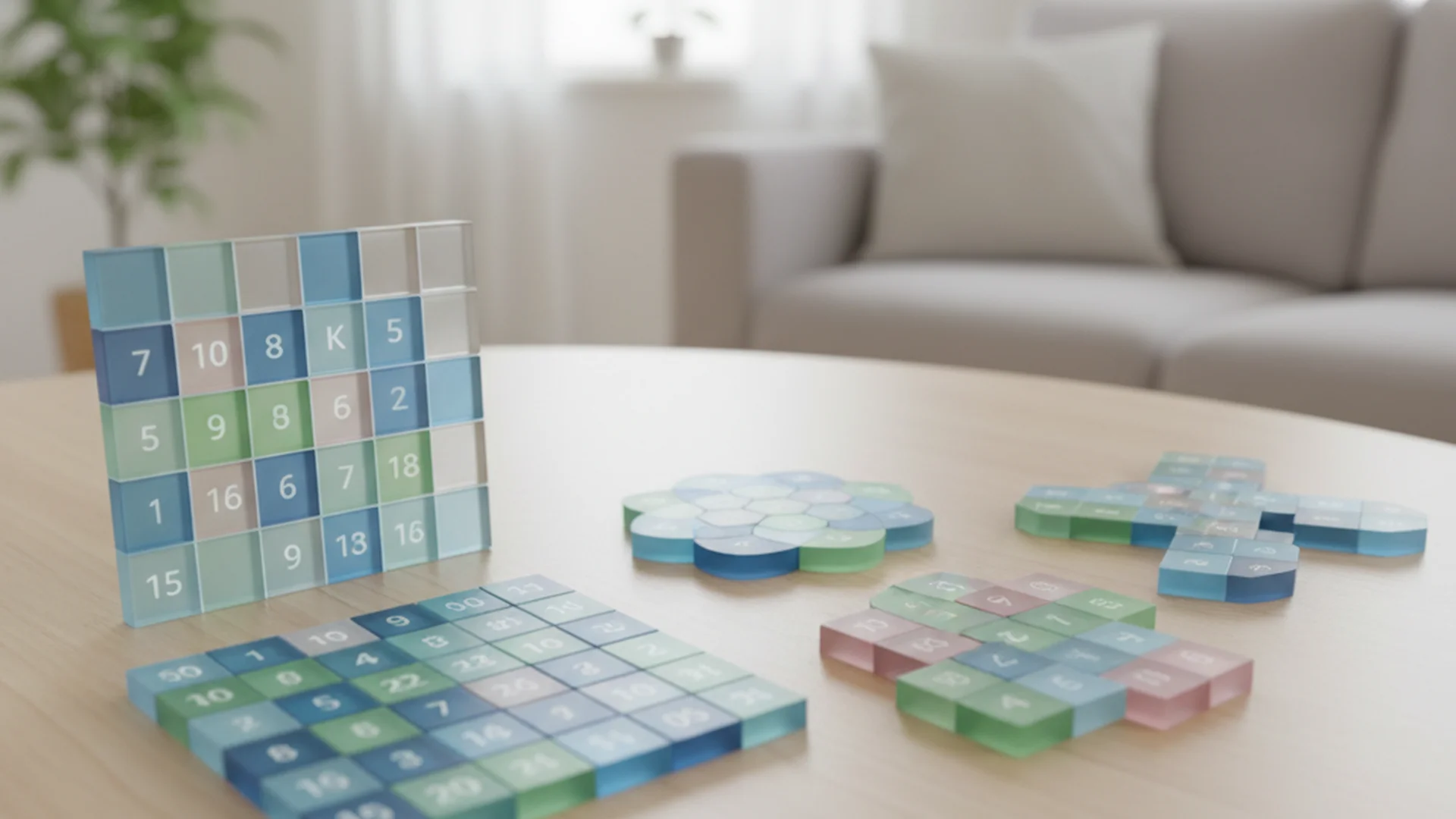
For decades, the standard 9×9 grid has dominated the world of logic puzzles, but the universe of sudoku variants offers a depth that goes far beyond the traditional box. While a standard grid offers a staggering 6,670,903,752,021,072,936,960 possible combinations, seasoned players eventually crave new constraints. Whether you are a student looking to sharpen your math skills or a veteran solver aiming for the World Sudoku Championship, understanding the different types of sudoku is the key to mastering the art of logical deduction.
In this comprehensive guide, we will explore the evolution of these puzzles, the mathematical genius behind them, and the strategic shifts required to solve the most complex hybrids hitting the market in 2025 and 2026.
The Mathematical Evolution of Sudoku
As a retro gaming historian, I often look back at the origins of the "Latin Square"—the mathematical foundation of Sudoku. While the modern version gained global fame in the early 2000s, it is a purely logical challenge that transcends language and arithmetic. Interestingly, research from Britannica shows that while there are sextillions of possible grids, when we account for rotations and symmetries, there are only 5,472,730,538 "essentially different" puzzles.
This limited (though still massive) pool is exactly why sudoku variants have become so popular. By adding new rules or changing the grid shape, developers create entirely new logical paths. If you are just starting your journey, it is helpful to understand the basics of How to Play Sudoku: Step-by-Step before diving into the complex variants discussed below.
Popular Rule-Based Sudoku Variants
The most common way to vary a Sudoku puzzle is to add a "constraint." This means that in addition to the standard rows, columns, and 3x3 boxes, another rule must be satisfied.
1. X-Sudoku (Diagonal Sudoku)
In X-Sudoku, the two main diagonals (forming an "X" across the grid) must also contain the digits 1 through 9 without repetition. This variant is highly recommended for beginners because it only adds two extra groups to track.
2. Hyper Sudoku (Windoku)
Hyper Sudoku adds four extra 3x3 shaded regions that overlap with the existing boxes. Because these shaded regions must also contain the digits 1-9, they provide extra "look-ahead" information that can help you solve the rest of the grid faster.
3. Jigsaw (Irregular) Sudoku
In Jigsaw Sudoku, the internal 3x3 squares are replaced by irregular, "jigsaw" shapes. While the row and column rules remain the same, the geometry of the regions changes everything. This variant requires a specific technique known as "Innies and Outies."
Advertisement
Mathematical and Arithmetic Hybrids
While standard Sudoku is purely logic-based, many of the most popular types of sudoku in 2025 incorporate basic arithmetic to increase the challenge.
Killer Sudoku
Killer Sudoku is often cited by experts as one of the most mentally taxing variants. It removes most (or all) of the starting digits and replaces them with "cages"—dotted-line areas with a small number in the corner. The digits in the cage must sum to that number, and no digit can repeat within a cage.
| Feature | Standard Sudoku | Killer Sudoku |
|---|---|---|
| Starting Digits | Usually 20-30 | Often Zero |
| Logic Type | Pure Placement | Logic + Arithmetic |
| Key Tool | Scanning | Sum Combinations |
Arrow Sudoku
In Arrow Sudoku, the grid features shapes that look like arrows. A circle contains a number, and a line (the arrow's tail) extends from it. The digits placed on the tail must sum to the digit in the circle. This creates a fascinating interplay between the standard grid rules and the mathematical tails.
Kropki Sudoku
Kropki uses white and black dots between cells to indicate relationships. A white dot means the two digits are consecutive (e.g., 2 and 3), while a black dot means one digit is double the other (e.g., 4 and 8). This variant is excellent for practicing Logic Puzzles and spatial reasoning.
Size-Based Variants: From Mini to Giant
Not every Sudoku needs to be a 9x9 grid. Depending on your time and skill level, you might prefer a different scale.
- Mini Sudoku (4x4 or 6x6): Perfect for children or as a quick mental warm-up.
- Giant Sudoku (16x16 or 25x25): These use hexadecimals (0-9 and A-F) or larger number sets. They aren't necessarily harder logically, but they require much more stamina and focus.
- Samurai Sudoku: This consists of five 9x9 grids that overlap at the corner boxes. To solve it, you must treat the overlapping boxes as part of both grids simultaneously.
Expert Strategies for Mastering Variants
Solving a variant requires more than just Expert Sudoku Techniques. You need a systematic approach to handle the extra layers of information.
Snider Notation (Pencil Marking)
A common mistake among intermediate players is over-filling the grid with small candidate numbers. Experts use Snider Notation, where you only mark a candidate if it can only fit into exactly two cells within a 3x3 block.
Scanning vs. Skimming
- Scanning: This is the act of looking at a specific digit (for example, the number 5) and seeing where it can go in every 3x3 box across the entire board.
- Skimming: This is focusing on a single empty cell and looking at its row, column, and box to see which numbers are "possible."
In sudoku variants, skimming is often more effective because the extra constraints (like diagonals or cages) quickly eliminate possibilities for a single cell.
Advertisement
Recent Trends: AI and the Future of Sudoku (2025-2026)
As we move through 2025, the world of digital puzzles is undergoing a massive transformation. The rise of "AI-Enhanced Puzzle Generation" has solved a long-standing problem: computer-generated puzzles that require "guessing."
Modern AI tools now ensure that every puzzle has a "human-logic-only" path, meaning you never have to fall into the "Guessing Trap." Additionally, 2026 is seeing the rise of Entropy Line Sudoku. In this trend, adjacent cells on a line must contain a set of "low" (1,2,3), "mid" (4,5,6), and "high" (7,8,9) digits in a repeating order.
Furthermore, platforms are moving toward Live Sudoku Battles. These are timed 1v1 duels where players solve identical variant grids in real-time, often using Augmented Reality (AR) to project 3D "Sudoku Cubes" onto their desks.
Common Mistakes to Avoid
Even seasoned pros can get tripped up by sudoku variants. Here are the most frequent errors reported by the Sudoku community:
- The "Guessing" Trap: Many believe hard puzzles require a guess. This is a myth. Every valid Sudoku has a unique logical solution. If you feel forced to guess, you likely missed a hidden pair or a "pointing triple."
- Ignoring Partially Filled Groups: Beginners often focus on the "empty" areas of a grid because they look easier. In reality, the areas with fewer numbers are often influenced by "clusters" in neighboring boxes, providing the most powerful deductions.
- Under-Scanning: Players often jump to Advanced Sudoku Techniques: X-Wing and Swordfish before finishing basic cross-hatching. Experts note that 70-80% of an expert-level puzzle can be solved with simple scanning.
- The Math Misconception: People often avoid Killer Sudoku because they think they aren't "good at math." Remember, Sudoku is a Latin Square challenge—the numbers are just symbols. You could replace them with colors or icons, and the logic would remain the same.
Frequently Asked Questions
What is the hardest Sudoku variant?
Most experts consider Samurai Sudoku and Killer Sudoku to be the most challenging. Samurai Sudoku requires immense stamina to track logic across five overlapping grids, while Killer Sudoku demands both high-level logical deduction and quick mental arithmetic.
Which variant is best for beginners?
If you are looking for a gentle introduction to sudoku variants, try X-Sudoku or Hyper Sudoku. These variants keep the traditional 9x9 structure and only add one or two extra rules, making them much easier to learn than Jigsaw or Killer variants.
Do I need to be good at math to play Killer Sudoku?
While basic addition is required, Killer Sudoku is primarily a game of logic. Most players find that the "math" part becomes second nature once they learn the common "sum combinations" (for example, a 3-cell cage totaling 6 must contain the digits 1, 2, and 3).
How many Sudoku variants actually exist?
There are over 100 documented variants. These include everything from size changes (4x4 to 25x25) to rule twists like "Thermo Sudoku" (numbers must increase along a thermometer shape) and "Mirror Sudoku."
Can playing these variants actually improve my brain?
Yes. Studies indicate that switching between different rule sets—like moving from a standard grid to a Jigsaw grid—can lead to a 94% improvement in logical reasoning and a 91% increase in cognitive flexibility. If you want to dive deeper into these benefits, check out our article on Common Sudoku Mistakes to Avoid to refine your mental approach.
Conclusion
The world of sudoku variants is a testament to the enduring appeal of logic and structure. Whether you are tackling a 16x16 Giant grid or navigating the arithmetic cages of a Killer Sudoku, each puzzle offers a unique opportunity to rewire your brain and improve your problem-solving skills. By using techniques like Snider Notation and avoiding the common "guessing trap," you can move from a casual solver to a strategic analyst.
As 2026 approaches, the integration of AI and AR will only make these puzzles more immersive. There has never been a better time to step away from the standard 9x9 and explore the vast, diverse landscape of modern logic puzzles.
Ready to Challenge Your Brain?
Start your journey into advanced logic today with our curated puzzles.
Put it into practice


Keep reading
Sudoku
Greater Than Sudoku: A Master Guide to Comparison Puzzles
Master Greater Than Sudoku with our expert guide. Learn advanced solving strategies, inequality chain logic, and how to tackle zero-clue comparison puzzles.
Jun 8, 2026 10 min

Sudoku
Advanced Sudoku Techniques: Mastering the X-Wing and Swordfish
Unlock the secrets of advanced Sudoku with our deep dive into X-Wing and Swordfish techniques. Learn how to spot these patterns and solve the hardest puzzles.
Sep 20, 2026 12 min

Sudoku
Hyper Sudoku Explained: Master the 13-Region Extra Challenge
Discover Hyper Sudoku (Windoku). Learn rules, advanced strategies, and how the 13-region grid differs from classic Sudoku in this comprehensive guide.
Jul 30, 2026 12 min
Advertisement