Dominosa Puzzles: The Ultimate Strategy Guide to Solitaire Dominoes
Master Dominosa puzzles with our comprehensive guide. Learn history, advanced logic strategies, and 2025 trends for this classic domino placement challenge.
By Free To Play Puzzles Editorial Team 10 min read
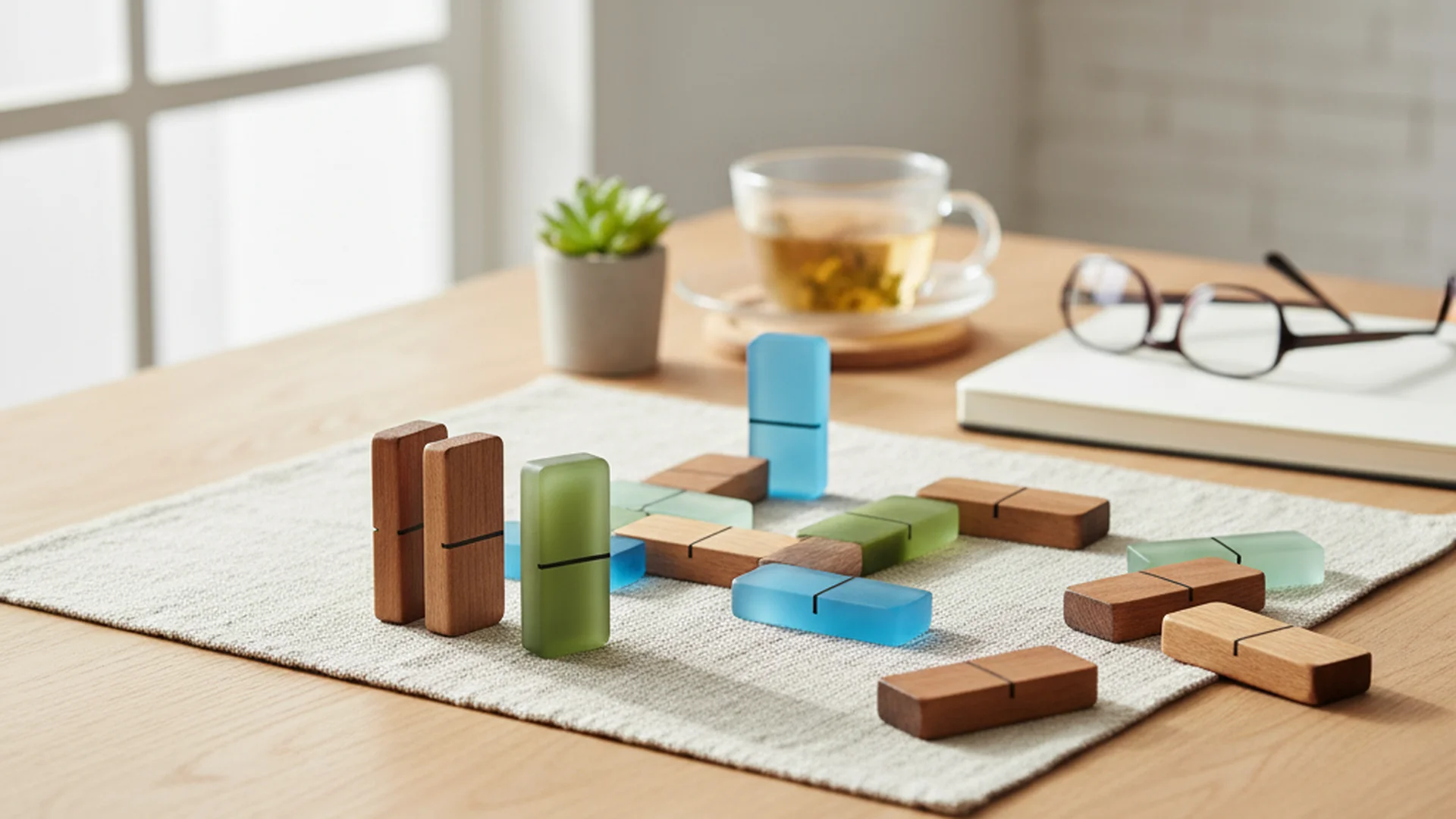
In the world of logic-based challenges, few games offer the same blend of numerical deduction and spatial reasoning as dominosa puzzles. Often referred to as "Solitaire Dominoes" or "Domino Hunt," these puzzles strip away the competitive nature of traditional dominoes and replace it with a rigorous, cerebral test of patience. As we move through 2025 and 2026, the puzzle has seen a massive resurgence, appearing in digital apps and print collections as a sophisticated alternative to Sudoku.
Whether you are a seasoned veteran of Deductive Reasoning Puzzles or a newcomer looking for a fresh mental workout, understanding the structural logic of Dominosa is the key to mastering the grid.
The History and Mechanics of Dominosa
Dominosa puzzles were not born in the digital age. They were invented by O.S. Adler in 1874 and eventually patented in Germany in 1893. Adler used the pseudonym "Richard Osa," and the name "Dominosa" is a clever portmanteau of "Domino" and his name. While the game lay dormant for decades, it was popularized for a modern audience in the late 20th century by legendary puzzle columnist Martin Gardner.
How the Puzzle Works
At its core, a Dominosa puzzle consists of a rectangular grid filled with numbers. These numbers represent a complete set of dominoes that have been laid out, but their borders have been removed. Your task is to reconstruct the borders so that every domino in the set is used exactly once.
For a standard Double-Six set, there are 28 unique dominoes (ranging from 0-0 to 6-6). The grid for such a set is typically 7x8 or 8x7, totaling 56 cells.
| Set Type | Number of Dominoes | Total Grid Cells | Grid Dimensions (Typical) |
|---|---|---|---|
| Double-Three | 10 | 20 | 4x5 |
| Double-Six | 28 | 56 | 7x8 |
| Double-Nine | 55 | 110 | 10x11 |
Essential Solving Strategies
Solving domino placement puzzles is an exercise in elimination. Because you cannot have duplicate dominoes, every move you make reduces the possibilities for the rest of the grid. Here are the expert techniques used to crack even the hardest grids.
1. The Checklist Method
Experienced solvers never work from memory. Because you are dealing with a finite set (like the 28 pieces in a Double-Six set), you should always have a "checklist" of all possible pairs next to your grid. As you identify a domino and draw its border, cross it off your list. This prevents the common mistake of trying to place the same domino (like a 3-4) in two different locations.
2. Identifying Unique Pairs
Before drawing any borders, scan the entire grid for "lonely" pairs. If there is only one place in the entire grid where a 6 and a 6 are adjacent, then that must be the 6-6 domino.
3. Corners and Edges
Just like in Battleship Logic Puzzles, the perimeter of the grid is your best friend. A cell in the center of the grid has four potential neighbors, but a corner cell only has two. If a corner cell only has one valid neighbor (because the other neighbor would create a domino that has already been used), the connection is forced.
4. Marking Impossible Borders
This is perhaps the most critical advanced strategy. If you have already placed the 1-2 domino, every other instance of a 1 sitting next to a 2 in the grid must be separated. Use a small "x" or a heavy line to mark these borders as "blocked." Often, blocking these impossible paths will leave a neighboring cell with only one possible direction to go, creating a chain reaction of forced moves.
Advertisement
Real-World Logic Examples
To understand how these strategies interact, let’s look at three common scenarios you will encounter in a standard puzzle.
Example 1: The Forced Corner
Imagine a corner cell containing the number 5. Its only neighbors are a 2 (to its right) and a 4 (below it). If you have already identified and crossed off the 5-4 domino elsewhere in the grid, the corner 5 must pair with the 2. You can safely draw the border around the 5-2 pair.
Example 2: The Only Available Pair
You are looking for the 0-0 domino. You scan the grid and find three places where two 0s are side-by-side. However, in two of those locations, one of the 0s is part of a "forced" move for another number. This leaves only one viable 0-0 pair in the entire grid.
Example 3: The Parity Island
During the mid-game, you might see that drawing a border in a certain way would isolate a small group of three cells in a corner. Because every domino occupies exactly two cells, any isolated region must contain an even number of cells. If a move creates an "island" of 1, 3, or 5 cells, that move is mathematically impossible.
Dominosa in 2025: The Modern Resurgence
The puzzle landscape in 2025 has been dominated by a "tactile revival." While digital versions like those found in Simon Tatham’s Puzzles collection remain popular for their accessibility and "dark mode" features, printable challenge books have seen a massive surge in sales.
A significant driver of this interest is the launch of Pips by the New York Times Games division in late 2024. While Pips adds mathematical constraints (such as requiring certain dominoes to sum to a specific number), it has introduced millions of players to the fundamental mechanics of logic puzzles involving domino placement.
Furthermore, AI-generated puzzles have improved the player experience. Modern platforms now use adaptive algorithms to ensure a smooth difficulty curve. If the system detects you are solving Double-Six grids in under two minutes, it will begin generating Double-Nine grids with increased "ambiguity"—placing identical number pairs close to each other to test your ability to mark impossible borders.
Common Mistakes to Avoid
Even expert solvers can get tripped up by the unique constraints of Dominosa. Avoid these common pitfalls:
- Confusing it with standard Dominoes: In the game of Dominoes, touching ends must match. In Dominosa, this is not a rule. A 1-2 domino can be placed next to a 5-6 domino without any issue.
- Ignoring the "Empty" Cells: Every single cell in the grid must be part of a domino. If you reach the end and have one stray number left over, you have made a mistake.
- Forgetting the Checklist: It is easy to think you haven't used the 4-4 yet, only to realize later it was the very first piece you marked. Always cross them off.
- Overlooking Edge Restrictions: New players often get "tunnel vision" in the center of the grid. If you get stuck, go back to the edges; there is almost always a forced move waiting there.
Advertisement
Frequently Asked Questions
Do I need a physical set of dominoes to play?
No. While some people enjoy placing physical tiles over a printed grid, Dominosa is designed to be solved by drawing borders around pairs of numbers on paper or a screen.
Can there be more than one solution to a Dominosa puzzle?
A professionally designed Dominosa puzzle will always have a single, unique solution. If you find multiple solutions, it is likely a randomly generated puzzle that lacks the necessary constraints to be considered "pure."
What is the best grid size for a beginner?
Beginners should start with a Double-Three set (a 4x5 grid). This uses only 10 dominoes and allows you to practice basic deduction before moving on to the 28 dominoes of a Double-Six set.
Is Dominosa harder than Sudoku?
Difficulty is subjective, but many find Dominosa more challenging because the "shape" of the pieces changes. In Sudoku, you are filling in fixed cells. In Dominosa, you are defining the boundaries of the cells themselves, which adds a layer of spatial complexity.
Conclusion
Dominosa puzzles represent the pinnacle of puzzle benefits, offering a deep workout for your pattern recognition and logical deduction skills. By moving away from random guessing and embracing systematic methods like marking impossible borders and checking for parity, you can solve even the most daunting Double-Nine grids.
As the "analog hobby" trend continues to grow, there has never been a better time to pick up a pen and start hunting for dominoes. Whether you’re playing the latest digital version or a classic printed grid, the satisfaction of crossing off that final domino on your checklist is a reward worth the effort.
Ready to Start?
Challenge your mind with our collection of logic games.
Put it into practice

Keep reading
Logic Puzzles
Mastering Kuromasu Puzzles: The Ultimate Guide to "Where Is Black Cells"
Explore the fascinating world of Kuromasu puzzles. Learn rules, advanced strategies, and the cognitive benefits of this Nikoli classic.
Sep 30, 2026 10 min
Logic Puzzles
The Ultimate Pentomino Puzzles Guide (2025-2026 Edition)
Master pentomino puzzles with our comprehensive guide. Explore historical roots, 12-piece solutions, advanced solving strategies, and 2026 trends in logic gaming.
Sep 22, 2026 12 min
Logic Puzzles
Nonogram Rules Explained: The Ultimate Guide to Solving Picross Puzzles
Master nonogram rules with this comprehensive guide. Learn Picross strategies, from basic overlaps to advanced logic, perfect for beginners and experts alike.
Jun 14, 2026 12 min
Advertisement