The Ultimate Guide to Skeleton Crosswords: Solving the Mystery of the Blank Grid
Master skeleton crosswords and barred crosswords with our expert guide. Learn grid symmetry, the 3-letter rule, and cognitive strategies.
By Free To Play Puzzles Editorial Team 10 min read
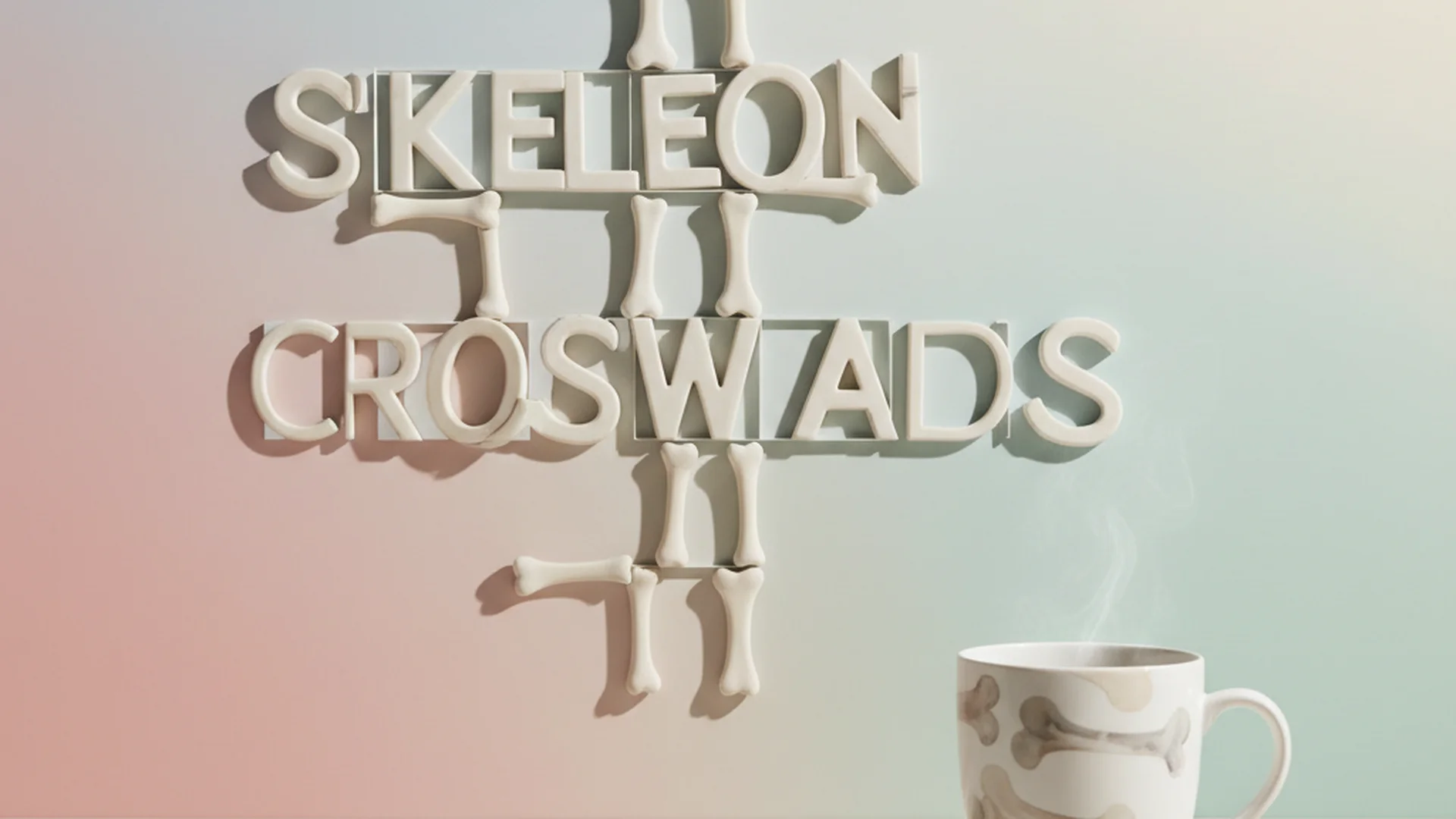
For many enthusiasts, the standard crossword eventually becomes a routine exercise in vocabulary. But there is a variant that demands more than just a deep mental dictionary; it requires the spatial reasoning of an architect and the deductive logic of a codebreaker. I am talking about skeleton crosswords. These puzzles present you with a nearly empty grid, stripped of its "flesh" (the black squares), leaving only the "bones" for you to reconstruct.
Skeleton crosswords are a great choice for anyone looking to exercise their executive function. Unlike standard puzzles, a skeleton crossword forces the brain to engage in "simultaneous processing"—you are solving a linguistic riddle while mentally mapping a symmetrical geometric pattern. It is one of the most complete workouts for your prefrontal cortex available on paper.
What is a Skeleton Crossword?
A skeleton crossword (known in the United States as a "diagramless" crossword) is a puzzle where the grid is almost entirely blank. While a standard crossword tells you exactly where every word begins and ends, a skeleton puzzle provides only the clues and perhaps a few "starter" squares. The solver must determine where the black squares go to create a valid, symmetrical grid.
A close relative to this format is the barred crosswords. While they share a high difficulty level, they differ significantly in their visual structure.
Skeleton vs. Barred Crosswords
| Feature | Skeleton Crosswords | Barred Crosswords |
|---|---|---|
| Grid Density | 25% to 35% black squares | 0% black squares |
| Word Separators | Black blocks (shading) | Thin lines (bars) |
| Symmetry | 180° Rotational | Complex/Variable |
| Clue Type | Usually Quick/Definition | Often Cryptic |
| Naming | "Diagramless" in the US | "Continuity" crosswords |
The Golden Rules of Skeleton Construction
To solve these puzzles successfully, you must understand the constraints that professional constructors use. These aren't just suggestions; they are the "physics" of the crossword world.
1. The 180° Rotational Symmetry
Roughly 95% of published skeleton crosswords adhere to 180° rotational symmetry. This means if you were to turn the puzzle upside down, the pattern of black squares would look exactly the same.
2. The "3-Letter Rule"
In the professional puzzle world, every answer must be at least three letters long. If you find yourself about to place a black square that would leave a 1- or 2-letter gap between it and another block (or the edge of the grid), you know that square cannot be black.
3. The All-Across, All-Down Connectivity
Just like a standard puzzle, every white square must be part of both an "Across" and a "Down" word. You cannot have "islands" of white squares that don't connect to the rest of the grid. If you are struggling with common crossword clue types, this connectivity is your best friend for verifying your work.
Advertisement
Real-World Examples of Grid Logic
To understand how to approach these, let’s look at how grid logic functions in practice.
Example 1: The "Across-Down" Anchor
Imagine you are given a starter: the number 19 is placed in a specific square. You look at your clue list and see a clue for "19 Across" but no clue for "19 Down." This is a massive hint. It means that the square directly above 19 must be a black square, or the edge of the grid. Why? Because if it were white, there would have to be a "Down" word starting there.
Example 2: The Perimeter Boundary
Beginners often waste time trying to "close" words at the edge of the grid with black squares. Remember: the edge of the grid acts as a natural boundary. You don't need a black square to stop a 5-letter word if it ends at the 15th column.
Example 3: The Historical Benchmark
During WWII, The Daily Telegraph used puzzles of this complexity to recruit code-breakers for Bletchley Park. The benchmark was solving the grid and the clues in under 12 minutes. While modern skeletons are usually solved more slowly, the principle of crossword solving strategies remains the same: identify patterns first, fill words second.
Emerging Trends in 2025 and 2026
The world of skeleton crosswords is currently undergoing a digital transformation. These updates are worth following closely for anyone interested in the cognitive benefits of puzzles.
- The "Mini" Revolution: Following the massive success of the NYT Mini, 2025 has seen the rise of "Skeleton Minis." These 7x7 or 9x9 grids are designed for 5-minute mobile sessions. They offer the same logic-building benefits without the hour-long commitment.
- AI vs. Artisanal Puzzles: A significant debate in 2025 involves generative AI tools (like Amuse Labs) creating "instant" crosswords. However, purists on platforms like Reddit are pushing back, preferring "hand-crafted" skeletons. Hand-crafted puzzles often feature more clever, culturally relevant wordplay that AI still struggles to replicate.
- Smart Symmetry Toggles: New apps like Crossword a Day 2026 now feature a "Smart Symmetry" mode. When you shade a block, the app automatically shades its symmetrical partner. This is an excellent "training wheels" feature for beginners.
- The Digital-First Shift: Traditional puzzle magazines like Puzzler have shifted toward high-quality PDF downloads. This eco-friendly niche allows solvers to maintain the "print-at-home" experience while reducing the environmental impact of physical distribution.
Common Mistakes to Avoid
- Ignoring the Symmetry: It is the most common error. Solvers get caught up in a clue, fill the word, and forget to update the "partner" squares on the opposite side.
- Black Square Overload: If you find your grid becoming 50% black, you’ve likely misplaced your dividers. Standard British skeletons should stay between 25% and 35% density.
- Assuming it's Cryptic: Many newcomers fear skeleton crosswords because they assume the clues are cryptic. In reality, most are standard crosswords or "quick" definition-based clues. The difficulty is in the grid, not necessarily the vocabulary.
- Starting Without an Anchor: Never start guessing black square positions in the middle of a blank grid. Use the "starter" squares provided by the publisher. Without these, the puzzle has thousands of possible configurations.
Advertisement
Frequently Asked Questions
What is the difference between a Skeleton and a Diagramless crossword?
They are essentially the same puzzle. "Skeleton" is the terminology used in the UK, Australia, and the Commonwealth, while "Diagramless" is the standard term used by the New York Times and other US publications.
Are answer lengths provided in skeleton puzzles?
In standard skeleton puzzles, answer lengths (e.g., [7]) are usually omitted. Part of the challenge is deducing the length by correctly placing the black squares around the word.
Is it "cheating" to use a digital symmetry tool?
Not at all. Think of digital tools as a "learning aid." They help you internalize the visual logic of 180° symmetry. As you get better, you can turn these features off to increase the challenge.
How do I know if I've finished the grid correctly?
A correctly finished grid will have perfect rotational symmetry, no words shorter than three letters, and all white squares will be interconnected. If your grid looks "chunky" or has isolated sections, something is wrong.
Conclusion
Skeleton crosswords represent the pinnacle of the "DIY" puzzle experience. They transform the solver into a co-constructor, requiring a blend of linguistic skill and geometric precision. Whether you are looking to boost your brain health or simply want a break from standard grids, the "skeleton" format offers a uniquely satisfying "aha!" moment when the final black square clicks into place.
If you are just starting out, we recommend trying a few American vs British crosswords to get a feel for different grid styles before diving into the blank canvas of a skeleton.
Ready to Start?
Challenge your brain with our daily puzzles and master the grid.
Put it into practice
Keep reading
Crosswords
Mastering the Grid: The Ultimate Guide to Crosswords for Beginners
Discover the best crosswords for beginners and expert strategies to start solving today. Learn about brain health benefits, modern trends, and tips to master the grid.
Feb 8, 2026 12 min
Crosswords
Decoding Crosswordese: The Unusual Words That Rule the Grid
Master the hidden language of puzzles with our guide to crosswordese. Learn why words like OREO and ERA appear so often and boost your solving speed today.
Jun 23, 2026 12 min
Crosswords
Crossword Puzzle Themes 101: The Ultimate Guide to Decoding the Grid
Unlock the secrets of the grid with our comprehensive crossword themes guide. Learn to identify revealers, master rebus puzzles, and solve like a pro.
Feb 10, 2026 12 min
Advertisement