American vs British Crosswords: Understanding the Great Grid Divide
Explore the major differences between American and British crosswords, from grid density and clue logic to the 2026 digital trends shaping the game.
By Free To Play Puzzles Editorial Team 12 min read
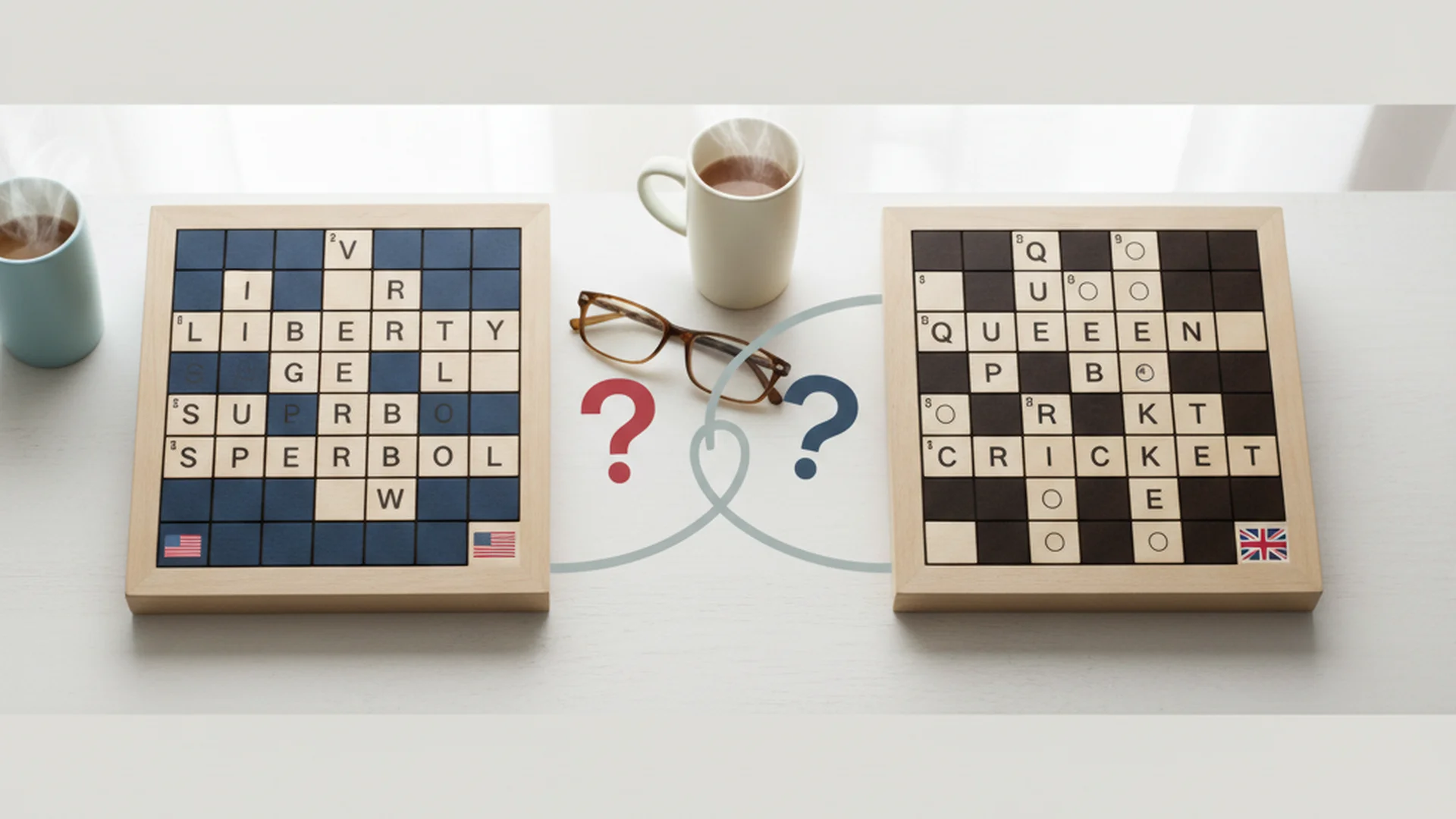
The crossword puzzle is a relatively young invention, tracing its roots back to Arthur Wynne’s "Word-Cross" published in the New York World in 1913. However, since that first diamond-shaped grid appeared, the Atlantic Ocean has acted as a linguistic and structural barrier, allowing the american vs british crossword to evolve into two distinct species. For the uninitiated, switching from a New York Times Monday puzzle to a Guardian Cryptic can feel less like a hobby change and more like trying to read a foreign language.
As we move through 2025 and into 2026, the digital revolution has brought these two styles closer than ever, yet their fundamental DNA remains worlds apart. Whether you are a fan of the "straight" trivia-style American grids or the mind-bending wordplay of British cryptics, understanding these differences is the first step toward mastering the global world of crosswords.
The Visual Divide: Solid vs. Skeletal Grids
The most immediate difference you will notice when comparing a UK crossword vs US is the look of the grid itself. The architecture of the puzzle dictates how you solve it and how much help the "crosses" provide.
The American "Solid White" Grid
In American crosswords, the grid is a masterpiece of density. Every single letter in the grid must be part of both an "Across" and a "Down" answer. This is known as being 100% "checked." If you are stuck on a difficult word, you have a 100% chance of revealing its letters by solving the intersecting clues.
- Density: Black squares are kept to a minimum, typically accounting for less than 16% of the total grid.
- Symmetry: American grids almost always feature 180-degree rotational symmetry.
The British "Skeletal" Grid
British puzzles, particularly cryptics, use a "skeletal" or "barred" grid. In these layouts, black squares are much more prominent, often making up 25% to 35% of the total area. More importantly, the words are only about 50% "checked."
- Checking: You might solve an 8-letter word where only 4 of the letters intersect with other words.
- Isolation: This makes the British style significantly harder if you cannot solve the primary clue, as there are fewer "free" letters provided by the intersecting answers.
| Feature | American Crosswords | British Crosswords |
|---|---|---|
| Grid Density | High (Solid White) | Low (Skeletal) |
| Letter Checking | 100% Checked | ~50% Checked |
| Black Square % | < 16% | 25% – 35% |
| Symmetry | Rotational | Rotational (usually) |
Clue Philosophy: Trivia vs. Wordplay
The heart of the american vs british crossword debate lies in the clues. While both styles use definitions, the path to the answer follows very different logic.
American: The "Straight" and Themed Approach
American puzzles focus heavily on synonyms, trivia, pop culture, and clever themes. On most days of the week, the longest answers in a US puzzle will relate to a central theme or a "revealer" clue. For a deeper look at how these began, check out the Crossword Puzzle History: From 1913 to Today.
- Themes: A Wednesday NYT puzzle might have four long answers that all contain a hidden type of fruit.
- Lateral Thinking: Clues often involve puns. For example, "Capital of France?" might be "EURO" rather than "PARIS."
British: The Cryptic Revolution
While the UK has "Quick" crosswords that function like American puzzles, the gold standard in Britain is the Cryptic. A cryptic clue is a mini-puzzle in itself, consisting of two parts: a definition and a wordplay element.
For example, a British setter might write: "Grasped about forty-nine being well-dressed (8)."
- Definition: "Well-dressed" (CLAD).
- Wordplay: "Grasped" (HAD) around "forty-nine" (the Roman numeral XL).
- Answer: H(XL)AD = HALLELUJAH? No, let's try a real one: "Broken" is a common indicator for an anagram. If you see "Broken heart (5)," the answer is likely an anagram of "heart," which is "EARTH."
For those interested in diving into this style, our Cryptic Crosswords: A Beginner's Introduction is an essential resource.
Advertisement
The 2025-2026 Landscape: Digital Growth and AI
The crossword world is currently experiencing a "second golden age" driven by mobile apps and technological advancement. Data from Q2 2025 shows that the New York Times reached a staggering 11.88 million total subscribers, with the "Games" app being a primary engine for that growth.
Across the pond, The Guardian has surpassed 1 million digital subscriptions. The diversity of their "setters" (the people who create the puzzles) has reached an all-time high, with 33 different regular setters featured in 2025. This includes legends like Pasquale, who celebrated his 400th Daily Cryptic in May 2025.
The Rise of "Minis"
One of the most significant trends in 2025 is the "Mini" revolution. Both US and UK publications have introduced 5x5 grids designed to be solved in under two minutes. These "snackable" puzzles have become a daily ritual for millions, often serving as a gateway to full-sized puzzles.
AI and Algorithmic Construction
By 2026, AI has become a standard tool for constructors. While the clues are still primarily written by humans to ensure wit and nuance, "Algorithmic Grid Construction" helps setters find creative word placements that were previously impossible to calculate manually. On the solver side, AI assistants like "Crossword Genius" are now sophisticated enough to explain the complex logic behind a British cryptic clue to a struggling beginner.
Solving Strategies: Moving Between Styles
If you are an American attempting a British puzzle (or vice-versa), you need to shift your mental gears.
Strategies for the American Solver in the UK
- Look for the Parentheses: British clues always provide the letter count, e.g., (7, 5) for a 12-letter answer. This is vital for skeletal grids.
- Identify the Indicators: Memorize "indicator" words. Words like "disturbed," "wild," "mixed," or "broken" almost always signal an anagram.
- Ignore the "Surface" Reading: The clue might read like a coherent sentence about a dog in a park, but that is a distraction. Break it down into the "definition" and the "wordplay."
Strategies for the British Solver in the US
- Trust the Theme: In a US puzzle, if you can't solve a long answer, look at the title. The "gimmick" usually unlocks several clues at once.
- Use the 100% Checking: If an "Across" is a total mystery, focus entirely on the "Downs." In the US style, the grid is your biggest ally.
- Brush up on Trivia: American puzzles love 90s sitcoms, baseball stars, and US geography.
Common Mistakes to Avoid
Whether you are tackling a UK crossword vs US, certain pitfalls are universal.
- Ignoring the Tense: If a clue is in the past tense (e.g., "Jumped"), the answer must also be in the past tense (e.g., "LEAPT"). This is a strict rule in both traditions.
- Literalism in Cryptics: Beginners often try to solve a cryptic clue as if it were a normal sentence. Remember: the "surface" meaning is almost always a lie.
- Skipping the "Monday" Puzzle: Both the NYT and British papers increase difficulty as the week progresses. Monday is the universal entry point; jumping straight into a Saturday (US) or a Prize Cryptic (UK) is a recipe for frustration.
- Failing to Check for Abbreviations: Many clues use common shorthand. To master this, review our Crossword Abbreviations Guide.
Advertisement
Frequently Asked Questions
Is one style harder than the other?
It depends on how your brain works. American puzzles test your breadth of knowledge and ability to spot themes. British cryptics test your depth of linguistic logic. Most people find the one they didn't grow up with to be significantly harder.
Why do British clues have numbers in parentheses?
Because British grids are "skeletal" and have fewer intersecting letters, the letter count (e.g., "4, 6") is provided to give the solver a necessary starting point. American puzzles don't need this because the grid is 100% checked.
Are American crosswords always themed?
Most major US publications (NYT, Wall Street Journal, LA Times) feature themes from Monday through Thursday and on Sundays. Fridays and Saturdays are typically "themeless" and rely on difficult, long-word vocabulary.
Has the internet changed how these are solved?
Absolutely. In 2025, the use of "Wordplay" blogs and AI assistants is considered a standard learning method rather than cheating. Solving is now a community activity rather than a solitary one.
Conclusion: A Global Game
The gap between american vs british crossword styles is narrower than ever thanks to the globalization of digital media. While purists still debate the "Americanization" of British vocabulary—such as using "Janitor" instead of "Caretaker"—the reality is that solvers today have access to the best of both worlds.
With the rise of "Indie" platforms like Puzzmo and AVCX in 2025 and 2026, we are seeing a blend of these styles: American-style grids with more cryptic-leaning clues and modern, diverse themes. Whether you prefer the rigid logic of a London cryptic or the pop-culture flair of a New York grid, there has never been a better time to be a solver.
Ready to Start?
Enhance your solving skills with our expert guides.
Put it into practice
Keep reading
Crosswords
Mastering the Grid: The Ultimate Guide to Crosswords for Beginners
Discover the best crosswords for beginners and expert strategies to start solving today. Learn about brain health benefits, modern trends, and tips to master the grid.
Feb 8, 2026 12 min
Crosswords
The Evolution of Variety Crosswords: A Guide to Puzzles Beyond the Grid
Explore the world of variety crosswords, from Marching Bands to Acrostics. Learn the trends, strategies, and industry shifts defining the 2025-2026 puzzle landscape.
Dec 27, 2025 12 min
Crosswords
Cryptic Crosswords: A Beginner’s Introduction
Unlock the mystery of cryptic crosswords for beginners. Learn the essential logic, clue types, and expert strategies to solve even the toughest puzzles.
Sep 4, 2026 12 min
Advertisement