Crossword Abbreviations Guide: Mastering Common Short Answers
Master crossword abbreviations with our comprehensive 2025 guide. Learn the "Telegraph Rule," modern Gen Z slang, and strategies to solve tricky short-form clues.
By Free To Play Puzzles Editorial Team 12 min read
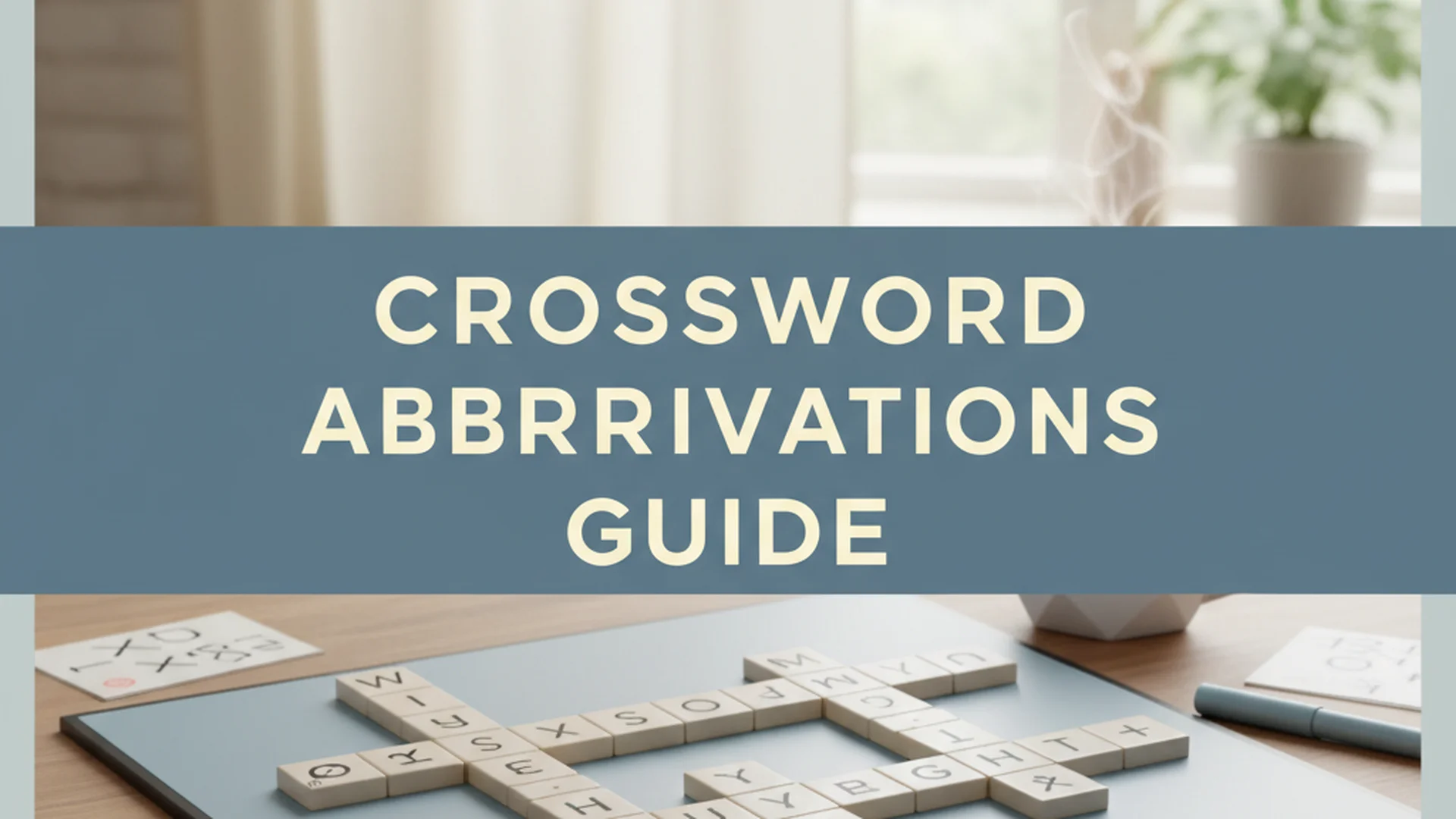
Solving a crossword is as much about understanding the "language" of the grid as it is about general knowledge. For many beginners, the most frustrating hurdles aren't the long, thematic entries, but the tiny, three-letter crossword abbreviations that seem to appear in every puzzle. Our brains often struggle with these truncated forms because they bypass our standard linguistic processing and require a specialized mental "lookup table."
Understanding these short answers is essential for maintaining cognitive fluidity. In this guide, we will break down the conventions of shorthand in puzzles, explore the shifting landscape of 2025–2026 entries, and provide you with the tools to decode even the most cryptic abbreviations.
The Golden Rule: The "Telegraph" Convention
The most important thing to learn about American-style crosswords (like those in the New York Times or Wall Street Journal) is the "Telegraph" Rule. This rule dictates a strict symmetry between the clue and the answer.
If a clue contains an abbreviation, the answer must be an abbreviation. For example, if the clue is "M.D. org.," the answer is AMA (American Medical Association). If the clue was "Doctors' organization," the answer might be ASSOCIATION or GROUP, but because the clue used "M.D." and "org.," you are signaled to look for a 3-letter shorthand.
Common "Tells" in Clues
Constructors use specific phrases to alert you that they are looking for crossword short answers:
- (Abbr.): The most direct signal.
- For short: Used frequently for organizations or titles.
- Briefly: Often indicates a truncated word or a common nickname.
- In shorthand: Signals a technical or professional abbreviation.
Why Short Answers Rule the Grid
Why do we see the same 3-letter words over and over? In the world of crossword construction, these are known as "glue." Because grids are interconnected, a constructor often gets stuck in a corner where they need a word consisting of a vowel, a consonant, and another vowel to make the longer words work.
According to recent analyses of NYT crossword data, words like ASEA, SMEE, and URSA have the highest "crosswordiness" scores. These aren't words we use in daily conversation, but they are the bedrock of puzzle architecture.
The Frequency of 3-Letter Entries
The 3-letter entry is the most common length in standard puzzles. Because they provide the "anchor letters" for difficult 15-letter theme answers, professional solvers often scan the grid for these abbreviations first. By filling in the "givens," you create the skeleton of the puzzle, making the harder sections much easier to visualize.
Advertisement
The Evolution of 2025-2026 Crossword Language
The landscape of crossword puzzles has shifted significantly in 2025. With a record number of unique contributors entering the field, editors are prioritizing modern language over archaic "crosswordese."
The "Gen Z" Shift
If you are solving a puzzle today, you are just as likely to see RIZZ (shorthand for charisma) or SUS (short for suspicious) as you are to see older military ranks. These "Brainrot" or internet-native terms have become standard Monday-to-Wednesday fare.
Tech and Text Speak
As traditional abbreviations like PDA (Personal Digital Assistant) or DSL (Digital Subscriber Line) fade into history, they are being replaced by:
- AI / GPT: References to artificial intelligence.
- NFT / SaaS: Common in business-themed puzzles.
- LMK / FOMO / GOAT: Standard text shorthand.
| Old Standard | Modern Replacement | Context |
|---|---|---|
| SSgt | GPT | Tech vs Military |
| ENE | NFT | Digital vs Compass |
| DDS | RIZZ | Slang vs Professional |
Standard Categories to Memorize
To master the grid, you should familiarize yourself with these high-frequency categories. For more on general strategy, see our guide on 10 Crossword Solving Strategies the Pros Use.
1. Chemical Symbols and Elements
Constructors love these because they are fixed 2-letter combinations.
- Iron: FE
- Gold: AU
- Tin: SN
- Neon: NE
2. Compass Points
These are used to bridge gaps in the grid. Watch for "Bridge direction" or "Flight path."
- ENE (East-Northeast)
- SSW (South-Southwest)
- NNE (North-Northeast)
3. Degrees and Titles
- DDS / DMD: Dentists.
- PHD / LLD: Academic degrees.
- OBGYN: Often clued as "Delivery doc."
- MDT: Mountain Daylight Time (and other time zones like EST/PST).
Cryptic vs. American Abbreviations
If you are transitioning from standard puzzles to British "Cryptic" puzzles, be prepared for a different set of shorthand. Cryptic crosswords rely heavily on historical British designations.
- RA: Royal Academician.
- OR: Other Ranks (military).
- MO: Medical Officer (clued as "doctor").
- OBE: Officer of the Order of the British Empire.
For a deeper dive into these complex puzzles, check out our Cryptic Crosswords: A Beginner's Introduction.
Advertisement
Common Mistakes to Avoid
Even seasoned solvers can fall into traps set by clever constructors. Here are the most common pitfalls when dealing with crossword short answers.
The "Doctor" Trap
In many puzzles, the word "Doctor" in a clue is not asking for DR or MO. Instead, "doctor" can be an anagram indicator. If the clue says "Doctor the letters," it means you need to rearrange the letters provided.
Dictionary Reliance
Beginners often assume every abbreviation is in the standard dictionary. However, "crosswordese" is its own dialect. Words like TAR (for sailor) or ERE (for before) are archaic. If you can't find a word in a standard dictionary, it might be a specific "crosswordese" term.
Misreading "Say" or "E.g."
When a clue ends in "say" or "e.g.", it doesn't always mean the answer is an abbreviation. It means the clue is an example of the category.
- Clue: "Atlantic, e.g."
- Answer: OCEAN (Not an abbreviation!)
Frequently Asked Questions
How do I know if an answer is an abbreviation?
Look for "tells" within the clue. These include the actual use of an abbreviation (e.g., using "CA" instead of "California"), or phrases like "for short," "briefly," or "(Abbr.)." If the clue is shortened, the answer must be too.
Why are Roman Numerals so common in crosswords?
Roman Numerals (I, V, X, L, C, D, M) consist of high-frequency letters that are very useful for constructors trying to fill difficult corners. They are often clued via Super Bowl numbers, dates in the "year of," or "Mid-century year."
Do abbreviations count as "bad" puzzle construction?
In the past, some considered them "lazy," but modern editors like Will Shortz use them strategically. By using common 3-letter abbreviations, constructors can clear space for more interesting and longer "theme" answers elsewhere in the grid.
What are the most common 3-letter crossword words?
The "big four" are ASEA (at sea), SMEE (Captain Hook's henchman), URSA (the bear constellation), and ERA (a period of time). Memorizing these four will help you solve almost any Monday or Tuesday puzzle.
Are there new abbreviations for 2026?
Yes! Look for references to the 2026 travel mandates (TSA/FAA), the expansion of AI (LLM), and specific annual events clued as ANN or YRS.
Conclusion: Building Your Mental Database
Mastering crossword abbreviations is like learning the secret handshake of the puzzling world. Once you recognize that M.D. org. is always AMA and that "sailor" is often TAR or AB, the grid begins to open up. This pattern recognition is not just a game; it is an excellent way to maintain neural plasticity and cognitive health.
By staying updated on modern trends like Gen Z slang and tech initialisms, you ensure your brain remains adaptable to the changing linguistic landscape of 2025 and beyond. For more help on your journey, read our How to Solve Crossword Puzzles: Complete Guide or explore the Daily Crossword Benefits for Brain Health.
Ready to Test Your Skills?
Put your knowledge of abbreviations to the test with our daily puzzles.
Put it into practice
Keep reading
Crosswords
Mastering Acrostic Puzzles: A Complete Guide to the Crossword’s Literary Cousin
Discover the logic and history of acrostic puzzles. Learn expert strategies, explore 2025 trends, and master the art of the Double-Crostic with this guide.
Jul 2, 2026 12 min
Crosswords
Mastering the Celebrity Crossword: Your Guide to Entertainment Puzzles
Dive into the world of the celebrity crossword. Learn expert strategies, market trends, and how to master entertainment-themed puzzles like a pro.
Jun 21, 2026 10 min
Crosswords
Mastering the Grid: How to Create Your Own Crossword Puzzle
Learn how to create crossword puzzles like a pro. From grid symmetry to inclusive cluing, our expert guide covers everything for the 2025 puzzle landscape.
Aug 18, 2026 12 min
Advertisement