Mastering Acrostic Puzzles: A Complete Guide to the Crossword’s Literary Cousin
Discover the logic and history of acrostic puzzles. Learn expert strategies, explore 2025 trends, and master the art of the Double-Crostic with this guide.
By Free To Play Puzzles Editorial Team 12 min read
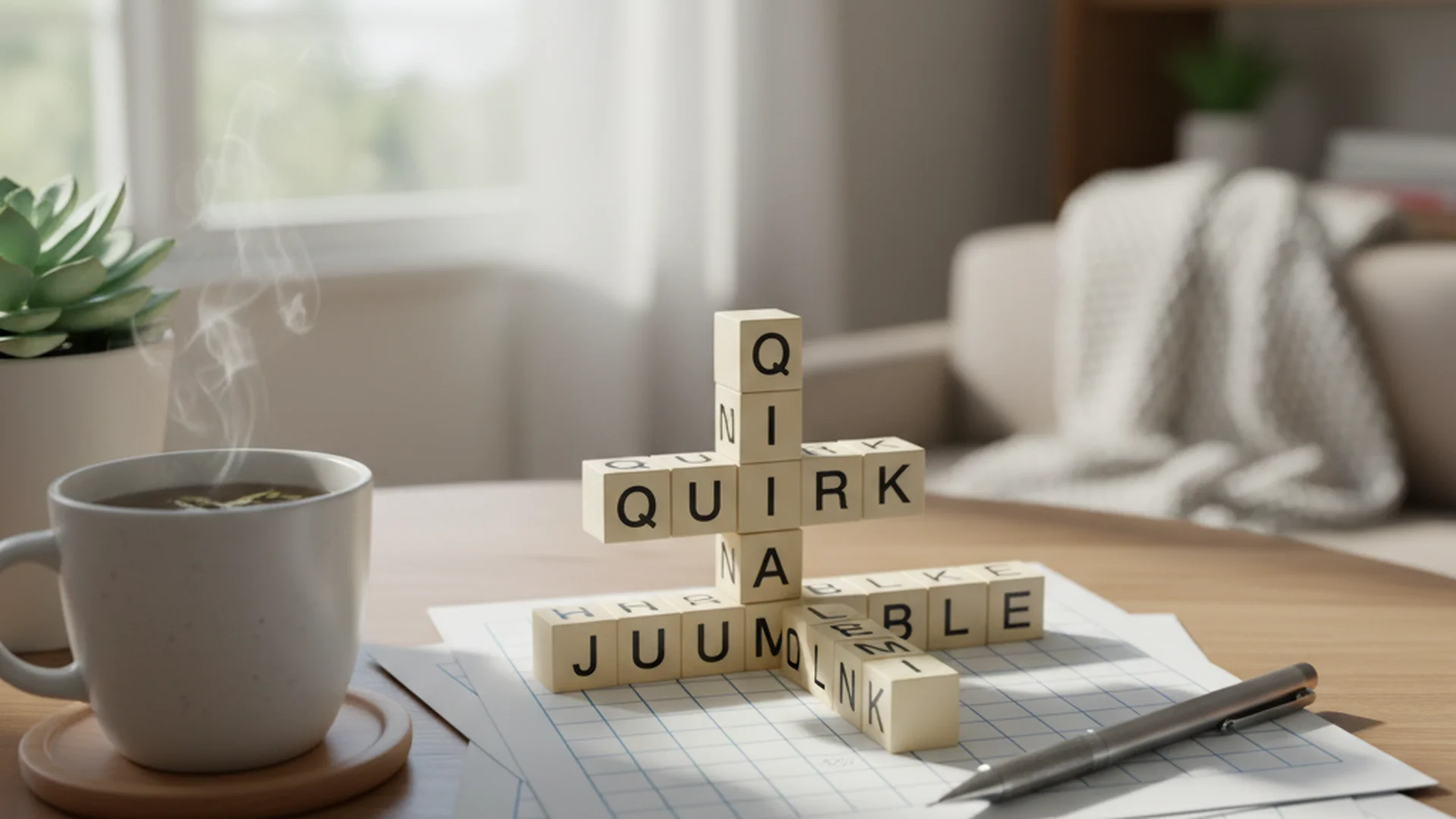
If you have ever felt that a standard crossword was a bit too "grid-locked," it is time to explore the sophisticated world of acrostic puzzles. Often described as a blend of crosswords, cryptograms, and literary trivia, acrostic puzzles offer a unique intellectual challenge that rewards both vocabulary and deductive reasoning. Unlike a traditional grid where words simply interlock, an acrostic is a narrative journey that concludes with the satisfaction of uncovering a profound or witty quotation.
Understanding the Anatomy: What is an Acrostic Puzzle?
At its core, an acrostic puzzle (sometimes called an Anacrostic or Double-Crostic) is a word game consisting of two distinct sections that are mathematically linked. To understand what is an acrostic puzzle, one must look at how the letters move between these two parts.
The first part is a list of lettered clues (A, B, C, etc.), much like a standard crossword. The second part is a numbered grid where the final quote will appear. Every blank in the clue section has a number corresponding to a specific cell in the grid. As you solve the clues, you transfer the letters into the grid. Conversely, as you recognize words forming in the quote grid, you can transfer those letters back to the clue section to help solve the more difficult trivia.
The Evolution of the Acrostic: From 1934 to 2026
The modern format of the acrostic puzzle was invented by Elizabeth Kingsley in 1934. She was a fan of Crosswords but found them lacking in literary depth. She debuted her "Double-Crostic" in the Saturday Review of Literature, later bringing the format to the New York Times in 1943.
In the 2025–2026 puzzle landscape, we are seeing a massive resurgence in this format. According to recent Sensor Tower data, digital platforms like NYT Games have seen revenue peaks near $900/week in specific regional segments, largely driven by "long-solve" audiences who crave more than a five-minute distraction.
Key Differences at a Glance
| Feature | Standard Crossword | Acrostic Puzzle |
|---|---|---|
| Primary Goal | Fill an interlocking grid | Reveal a hidden quotation |
| Grid Logic | Symmetrical, shared letters | Linear, every letter used twice |
| Safety Net | Interlocking words | Author/Title vertical acrostic |
| Content | General knowledge/Puns | Literary/Historical focus |
Advertisement
Strategic Gameplay: How to Solve Like a Pro
As a strategic gameplay analyst, I often tell beginners that the biggest mistake is staying in the clue list for too long. Acrostics are dynamic. You must treat the puzzle as a feedback loop.
1. Identify "Low-Hanging Fruit"
Scan the clues for "fill-in-the-blanks" or straightforward trivia. For example, if a clue asks for "The planet closest to the sun," and the answer length is seven, you immediately have "MERCURY." Transfer those numbers to the grid immediately. Even three or four letters can reveal common word structures like _ N D (likely "AND") or T _ E (likely "THE").
2. The One-Letter Word Rule
Look at the quote grid. If you see a single square isolated by black blocks (word breaks), it can only be two things in the English language: "A" or "I".
3. Reverse-Engineer the Quote
If you see the fragment H _ P P I N _ S S in the grid, you can safely assume the word is "HAPPINESS." Take those new letters and find their corresponding numbers in the clue list. This "backwards solving" is often the only way to solve the most difficult clues in the puzzle.
4. Decode the Vertical Column
Once you have solved about 30% of the clues, look at the first letter of each answer. If you see M _ Y _ _ N G _ L _ _, your brain should immediately recognize "MAYA ANGELOU." This gives you the starting letter for every remaining clue, significantly narrowing down your search space.
Trends and Updates for 2025–2026
The world of acrostics is currently undergoing a digital transformation. While traditionally a paper-and-pencil hobby, new technologies are making it more accessible.
- Mobile-First UX: Developers like Severex have released 2025 updates that fix the "tiny grid" problem. New interfaces allow you to tap a clue and see the corresponding grid squares highlighted in a zoomed-in view, making it playable on smartphones.
- AI-Assisted Construction: Tools like Acrostic.ai now allow educators to input any quote—from Shakespeare to modern song lyrics—and automatically generate a puzzle. This has led to a boom in "custom acrostics" for classrooms and corporate team-building.
- Competitive Leagues: 2025 saw the launch of the first global "High Score Challenges" on Puzzle Baron, where solvers compete for monthly trophies based on speed and accuracy.
- Cross-Generational Content: To bridge the age gap, publishers are incorporating more modern slang and pop culture into the clues. You are just as likely to see a clue about Minecraft as you are about Moby Dick in a 2026 edition acrostic.
Looking to sharpen your skills?
Learn the 10 Crossword Solving Strategies the Pros Use to improve your speed.
Common Mistakes to Avoid
Even seasoned solvers can get tripped up by the unique logic of the Double-Crostic. Avoiding these pitfalls will save you hours of frustration.
The "Independent Clue" Myth
Many beginners think they must solve all clues before looking at the grid. This is a recipe for failure. The grid is your greatest tool. You should spend roughly 50% of your time in the grid guessing words based on letter patterns. If you aren't Building Crossword Vocabulary through the grid, you are missing half the game.
Forcing Synonyms
If a clue answer doesn't fit the logic of the grid, it is wrong. If the grid shows a Q in the middle of a word, and your chosen synonym doesn't have a Q, you must reconsider. The numerical mapping is absolute; it does not lie.
Ignoring Punctuation and Spaces
In most digital acrostics, the grid shows black squares for word breaks but does not show spaces for commas, dashes, or periods. A common mistake is thinking a long string of letters is one word when it is actually two words separated by a comma that isn't visible in the grid layout.
Advertisement
Real-World Examples of Acrostic Solving
To truly understand how this works, let's look at three scenarios you might encounter in a modern acrostic:
- The Trivia Leap: A clue asks for "1980s Arcade Icon." You enter
PACMAN. The 'P' goes into the grid, the 'A' goes into the grid, and so on. If that 'P' lands at the start of a word in the grid, you've just unlocked a major clue for the quote. - The Vertical Reveal: You have the first letters of the first five clues:
A,G,A,T,H. You can intuitively guess the author isAGATHA CHRISTIE. You now know the sixth clue must start with anA. - The Pattern Match: In the grid, you have
_ N _ _ L I _ _ V _ B L E. Any experienced solver of Logic Puzzles will recognize "UNBELIEVABLE."
Frequently Asked Questions
What is the difference between an acrostic and a crossword?
Crosswords rely on a grid of interlocking words where every letter is part of both a horizontal and vertical word. Acrostics use a list of clues to fill a quotation grid. The "interlocking" in an acrostic is the relationship between the clue answer, the quote grid, and the vertical author/title column.
Do I need to be a literary expert to solve them?
No. While many quotes are from classic literature, the clues themselves cover a wide range of topics, including pop culture, science, and geography. The structure of the puzzle is designed to help you guess the literary parts even if you aren't familiar with the specific book or author.
What is a "Double-Crostic"?
"Double-Crostic" is simply the original name for the acrostic puzzle. It refers to the "double" nature of the solve: you are solving for the clue answers while simultaneously solving for the hidden quotation.
Are acrostic puzzles harder than crosswords?
They are considered "long-solve" puzzles. While they may take more time than a daily crossword, many solvers find them more forgiving because every letter is used twice. If you can't figure out a clue, you can often find the answer by solving the quote. If you can't figure out the quote, you can find it by solving the clues.
Conclusion
Acrostic puzzles are the ultimate evolution of wordplay, offering a satisfying blend of logic and literacy. Whether you are a fan of Common Crossword Clue Types or a newcomer looking for a deeper challenge, the acrostic provides a unique sense of accomplishment. By utilizing the feedback loop between the clues and the grid, and keeping an eye on that hidden author/title column, you can master even the most daunting literary puzzles.
As we move into 2026, the digital accessibility of these games means there has never been a better time to start. From mobile-optimized grids to AI-generated challenges, the "twist" on the traditional crossword is here to stay.
Master the Grid
Discover more word logic games and sharpen your mind today.
Put it into practice
Keep reading
Crosswords
Mastering the Celebrity Crossword: Your Guide to Entertainment Puzzles
Dive into the world of the celebrity crossword. Learn expert strategies, market trends, and how to master entertainment-themed puzzles like a pro.
Jun 21, 2026 10 min
Crosswords
The Evolution of Variety Crosswords: A Guide to Puzzles Beyond the Grid
Explore the world of variety crosswords, from Marching Bands to Acrostics. Learn the trends, strategies, and industry shifts defining the 2025-2026 puzzle landscape.
Dec 27, 2025 12 min
Crosswords
Crossword Abbreviations Guide: Mastering Common Short Answers
Master crossword abbreviations with our comprehensive 2025 guide. Learn the "Telegraph Rule," modern Gen Z slang, and strategies to solve tricky short-form clues.
Jun 27, 2026 12 min
Advertisement