Building Crossword Vocabulary: Essential Word Lists and 2026 Trends
Master your crossword vocabulary with our comprehensive guide to crosswordese, modern slang, and strategic word patterns for the 2025-2026 puzzle era.
By Free To Play Puzzles Editorial Team 15 min read
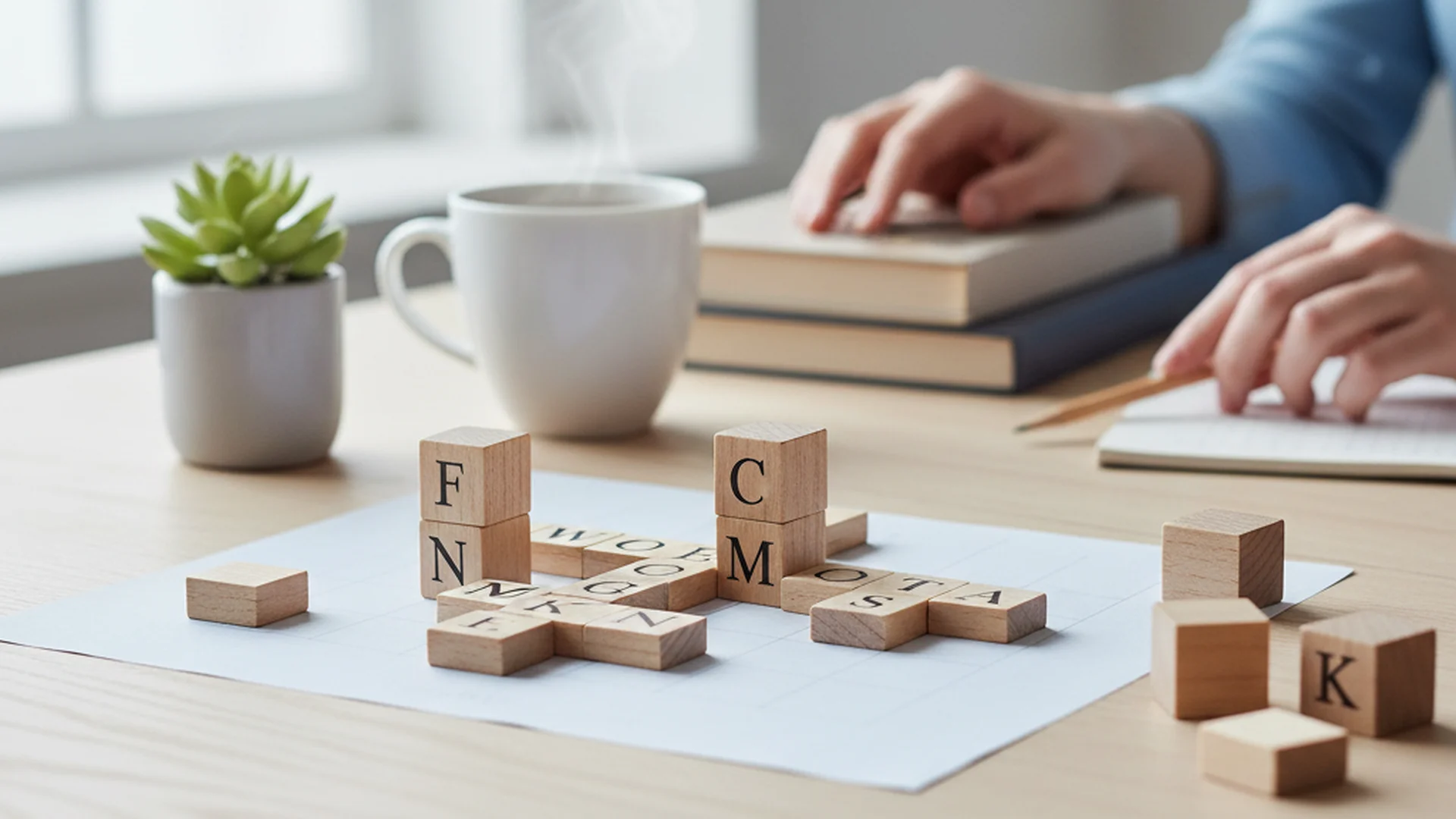
Building a robust crossword vocabulary is not simply about being a "walking dictionary." It is about understanding the specific linguistic architecture that constructors use to build grids. Whether you are tackling a Monday NYT or a grueling Saturday freestyle, your success depends on your ability to recognize patterns, recall high-frequency "glue" words, and stay current with the evolving slang of the 2020s.
As a strategic gameplay analyst, I look at crosswords as a data-driven challenge. The language of the grid is distinct from standard English prose. In a typical crossword, the average word length is just 4.15 letters, compared to the 4.5 letters found in general writing. This means your journey to mastery starts with the short, vowel-dense building blocks that make complex themes possible.
The Foundations: Understanding Crosswordese
Every aspiring solver eventually encounters "Crosswordese." These are words for crosswords that appear frequently in puzzles but are rarely, if ever, used in modern conversation. These words are the "connective tissue" that allows constructors to bridge the gap between long themed entries.
The A-List: High-Frequency Repeaters
In major puzzles, certain words appear with statistical regularity because their letter combinations are incredibly flexible. To build a strong crossword vocabulary, you must memorize the "A-List":
- ERA: Found in roughly 5% of all NYT puzzles. It is a constructor's best friend due to its E-R-A vowel-consonant-vowel (VCV) structure.
- AREA: Another four-letter powerhouse with three vowels.
- ERE: A poetic way of saying "before," useful for its triple-vowel count.
- ELI: Often clued as "Yale student" or "Inventor Whitney."
- OREO: Perhaps the most famous crossword food, used constantly because of its alternating vowel pattern.
Vowel Density and the VCV Pattern
English vowels (A, E, I, O, U) are the most flexible letters for intersections. In a standard 15x15 grid, vowels constitute nearly 45-50% of all letters. This is significantly higher than their frequency in a standard dictionary. To improve your solving speed, focus on learning 3- and 4-letter words that follow the VCV (Vowel-Consonant-Vowel) pattern, such as ALE, IRE, and OPA.
For more on how these words function within the grid, check out our guide on Crosswordese: Unusual Words.
Strategic Techniques for Vocabulary Growth
Memorizing lists is only one part of the equation. To truly master crossword vocabulary, you need to implement strategic solving habits that reinforce word retention and pattern recognition.
The "Fill-in-the-Blank" Strategy
When you first open a puzzle, don't start at 1-Across. Instead, scan the entire clue list for "fill-in-the-blank" clues. Statistically, these are the easiest entries in any grid. They provide "footholds"—confirmed letters that help you solve the more difficult intersecting words.
The "Crosses" Technique
Never try to guess a long word in total isolation. If you are stuck on a 10-letter entry, shift your focus to the "crosses" (the shorter words intersecting it). Solving three or four short words will often reveal enough letters to make the long entry obvious. This deductive process is at the heart of 10 Crossword Solving Strategies the Pros Use.
Keeping a Grid Journal
Top solvers in 2025 recommend keeping a digital "Grid Journal." When a word beats you—perhaps an obscure needle case like an ETUI or a decorative molding like an OGEE—write it down. Re-reading these words once a week helps overcome the Ebbinghaus Forgetting Curve, a psychological phenomenon where we forget 40% of new information within 24 hours.
Advertisement
The 2025–2026 Shift: Modern Slang and AI Influence
The landscape of words for crosswords is changing. We are currently moving away from the "Maleska-era" (named after former NYT editor Eugene Maleska), which favored obscure 1950s opera singers and Latin botanical terms. Today, puzzles are more inclusive and culturally relevant.
The "Brain-Rot" and Gen Z Slang Wave
As we move through 2025, a surge of internet-native slang has entered the mainstream grid. Constructors are increasingly using words that resonate with younger generations to keep the game alive.
| Word | Modern Meaning | Crossword Context |
|---|---|---|
| RIZZ | Charisma/Attraction | "Modern charm, informally" |
| BET | Agreement/Yes | "Slangy 'I agree'" |
| SIGMA | Independent/Lone wolf | "Type of 'alpha' in internet slang" |
| AURA | Vibe/Presence | "Coolness factor, in Gen Z speak" |
Inclusivity and Modern Figures
Modern editors prefer globally recognized figures. You are more likely to see ANA de Armas or TAYLOR SWIFT than a minor 19th-century poet. Similarly, references to "limited series" or streaming platforms like HULU and ROKU are now standard fill.
AI-Assisted Construction in 2026
By 2026, AI tools have become standard for crossword constructors. These tools help find "cleaner" fill, meaning fewer obscure abbreviations and more natural-sounding language. However, this also means puzzles are becoming more focused on clever misdirection rather than rote memorization of trivia. To stay ahead, you must learn to decode common crossword clue types that rely on puns.
Decoding Wordplay: The Question Mark Clue
One of the biggest hurdles in building crossword vocabulary is understanding when a word isn't what it seems. In crosswords, a question mark at the end of a clue indicates wordplay or a pun.
Real-World Example: "Flower?"
If you see the clue "Flower?" (6 letters), your first instinct might be "DAHLIA" or "AZALEA." However, the question mark suggests a pun. The answer is often RIVER—because a river is something that flows.
Real-World Example: "Digital units?"
In a standard dictionary, a "digital unit" might be a bit or a byte. In a crossword, "Digital units?" might be TOES or FINGERS, referring to your digits.
The "Mini-Game" Ecosystem
The rise of 5x5 "Mini" puzzles has changed how we think about letter patterns. Games like Pips (released in late 2025) blend domino-style logic with word-building. This ecosystem emphasizes high-speed pattern matching over deep trivia, influencing how modern grids are constructed. Even if you prefer the standard 15x15 grid, practicing the "Mini" can sharpen your response time for short-word recognition.
Advertisement
Common Mistakes to Avoid
Even experienced solvers can fall into traps that hinder their vocabulary growth. Avoid these common pitfalls:
- Ignoring the Theme: Most puzzles have a "Revealer" (a long entry, usually at the bottom or center, that explains the theme). If you ignore the theme, you lose the ability to predict the longest entries in the grid.
- Over-Cramming: Trying to memorize a 1,000-word list of "crosswordese" in one night is ineffective. Experts recommend spaced repetition. Solving one puzzle a day is significantly better for long-term retention than solving seven puzzles on a Sunday.
- Fear of "Cheating": If you are genuinely stuck, look up the word. Expert consensus in 2025 is that using a solver is a vital learning tool. It adds that word to your mental library so you'll recognize it the next time it appears.
- Assuming Stability: Language evolves. Just because a word meant one thing in a 1990 puzzle doesn't mean it carries the same weight today. Stay current with Crossword Puzzle History to see how clue styles have shifted.
Frequently Asked Questions
What is "Crosswordese"?
It refers to words rarely used in real life but frequently used in puzzles because of their vowel-heavy, short-letter counts. Common examples include ETUI (a needle case), OGEE (an S-shaped curve), and ADO (fuss).
Is using a solver "cheating"?
No. Most expert solvers view it as a learning aid. Looking up a word you don't know helps you memorize it for future puzzles, effectively building your crossword vocabulary over time.
How do I handle clues with question marks?
A question mark indicates wordplay, a pun, or a non-literal definition. For example, the clue "Tower?" might be TUG, referring to a boat that "tows" other vessels.
Does the difficulty change throughout the week?
Yes. Major outlets like the NYT follow a ramp: Monday is the easiest (mostly literal clues), and Saturday is the hardest (heavy misdirection and obscure trivia). Sunday puzzles are large (21x21) but usually mid-week difficulty (Thursday-ish).
Why are there so many abbreviations in crosswords?
Abbreviations help constructors "turn corners" in the grid when full words won't fit. You can find a list of common ones in our Crossword Abbreviations Guide.
Conclusion: The Path to Mastery
Building your crossword vocabulary is a marathon, not a sprint. By focusing on the structural "A-List" of crosswordese, embracing the modern slang of the 2025–2026 era, and utilizing strategic solving patterns like the VCV and the "Crosses" technique, you can dismantle even the most complex grids.
Remember, crosswords are a conversation between the constructor and the solver. The more you play, the better you understand the constructor’s language. Keep a grid journal, don't fear the "check" button, and stay curious about the world around you—from the peak of an ALP to the latest internet RIZZ.
Ready to Level Up?
Download our curated list of high-frequency crossword words to start mastering your next grid.
Put it into practice
Keep reading
Crosswords
Decoding Crosswordese: The Unusual Words That Rule the Grid
Master the hidden language of puzzles with our guide to crosswordese. Learn why words like OREO and ERA appear so often and boost your solving speed today.
Jun 23, 2026 12 min
Crosswords
10 Crossword Solving Strategies the Pros Use
Master the art of the grid with these 10 professional crossword solving strategies. Learn how elite solvers decode clues and finish puzzles in record time.
Oct 10, 2026 12 min
Crosswords
Mastering the Grid: How to Create Your Own Crossword Puzzle
Learn how to create crossword puzzles like a pro. From grid symmetry to inclusive cluing, our expert guide covers everything for the 2025 puzzle landscape.
Aug 18, 2026 12 min
Advertisement