Screen Time and Puzzles: Navigating the Digital vs. Paper Learning Divide
Explore the impact of screen time puzzles on cognitive development. Learn the differences between digital and paper puzzles for kids and seniors in 2025.
By Free To Play Puzzles Editorial Team 12 min read
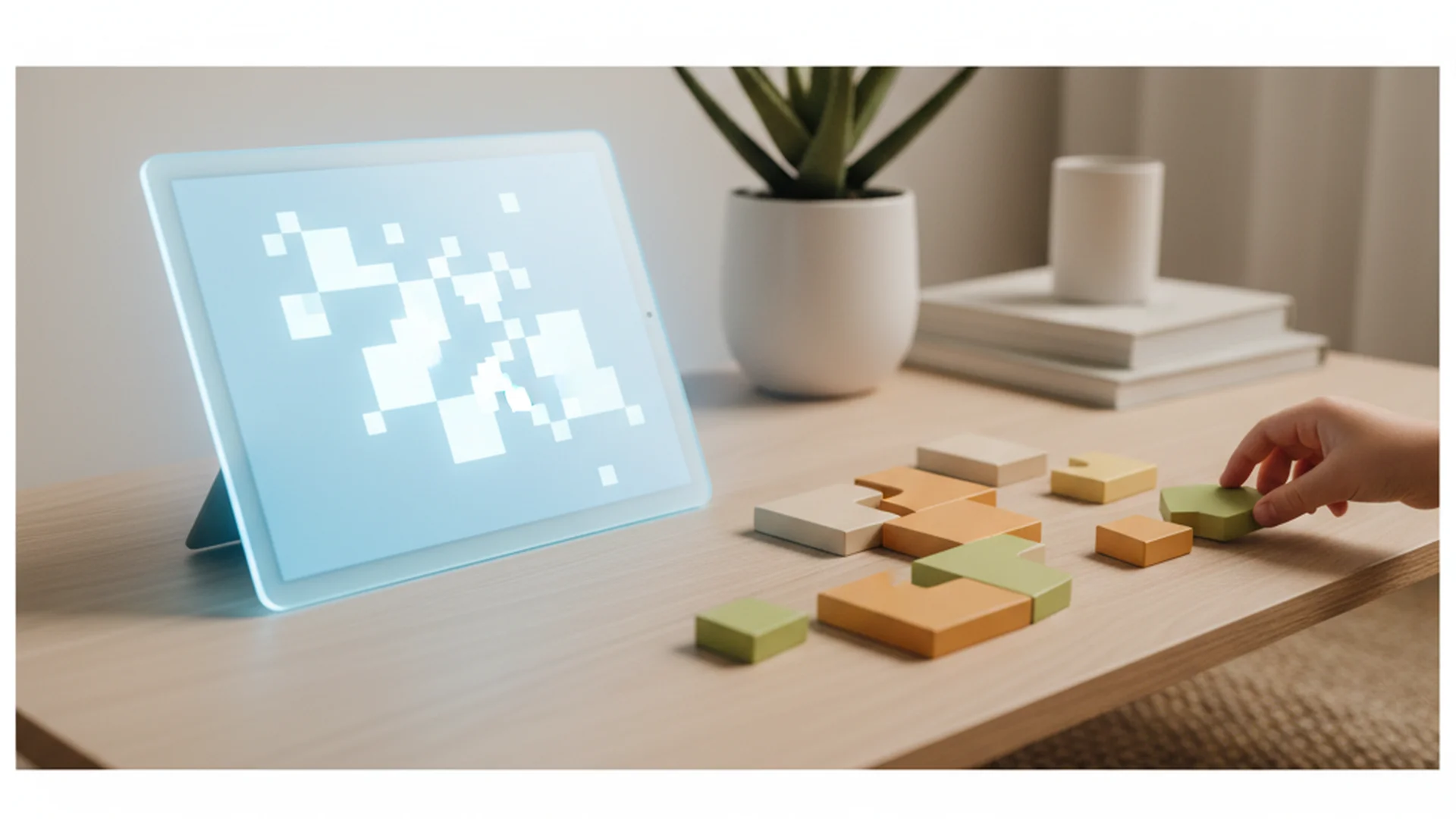
For decades, the conversation surrounding technology in the home has focused on a single, anxiety-inducing metric: the clock. Parents and educators have been told to "limit minutes," yet as we enter 2025, the landscape has shifted. The medium of a puzzle—whether it’s ink on newsprint or pixels on a tablet—changes the way our brains engage with a problem. The debate is no longer about how much time we spend in front of a device, but rather the quality of that engagement. When it comes to screen time puzzles, the distinction between "active" and "passive" use is the key to unlocking true educational potential.
The Quality Gap: Active vs. Passive Screen Time
In the current educational climate, not all digital hours are created equal. A 2025 report from LearningMole highlighted a stark "quality gap." Children who spend over four hours daily on passive screen time—such as mindlessly scrolling through short-form videos—showed a measurable decline in math and reading performance.
However, the story changes entirely when the screen is used for logic-based challenges. Those engaging with Critical Thinking Puzzles or interactive apps for under two hours often outperform their peers by 15% on cognitive tests. This is because screen time puzzles require "active" cognition. The user isn't just a spectator; they are a participant in a feedback loop of trial, error, and resolution.
Physical Puzzles and the STEM Foundation
While digital tools offer convenience, the "tactile first" approach remains a golden rule for early childhood development. Research from the University of Chicago found that children who play with physical puzzles between the ages of 2 and 4 develop significantly better spatial skills.
Why does this matter? Spatial reasoning is a primary predictor for success in STEM (Science, Technology, Engineering, and Math) subjects later in life. When a child physically rotates a cardboard piece to fit a notch, they are engaging in 3D spatial reasoning that a 2D screen cannot perfectly replicate.
Fine Motor Skills and "Pencil Grip"
For learners under the age of three, physical puzzles are non-negotiable. The resistance of a wooden peg puzzle or the friction of a jigsaw piece builds the small muscle groups in the hand. This development is essential for mastering the "pencil grip" and other fine motor tasks required in a traditional classroom setting. You can find more on this in our guide to Math Skills Through Puzzles.
Advertisement
Digital Puzzles: A Fountain of Youth for Seniors
At the other end of the age spectrum, the digital world is providing a remarkable cognitive safety net. Research from the University of York (2023-2024) demonstrated that older adults (60+) who regularly play digital puzzle games, such as Sudoku or digital Crosswords, possess memory abilities comparable to adults in their 20s.
Specifically, these digital puzzles improve "encoding distraction" levels. This is the brain’s ability to ignore irrelevant information while focusing on a specific task. By engaging with Logic Puzzles on a tablet, seniors can build a "cognitive reserve" that may delay the symptoms of age-related decline.
Comparing the Mediums: Digital vs. Paper
| Feature | Physical/Paper Puzzles | Digital/Screen Puzzles |
|---|---|---|
| Spatial Learning | High (3D manipulation) | Moderate (2D rotation) |
| Fine Motor Skills | High (tactile resistance) | Low (tap/swipe) |
| Accessibility | Low (physical storage) | High (thousands in one app) |
| Social Interaction | High (table-top gaming) | Moderate (social leaderboards) |
| Sleep Impact | Neutral | Potential Blue Light interference |
Emerging Trends: The Rise of "Phygital" Learning
As we move through 2025 and into 2026, the industry is moving toward a hybrid model known as "Phygital" (Physical + Digital) play. We are no longer forced to choose between a wooden board and a glass screen.
- AI-Powered Guidance: Platforms like BasuTots use AI-powered apps to monitor a child's progress on a physical puzzle book, offering verbal hints and adjusting difficulty in real-time.
- AR Jigsaw Puzzles: Products like PuzzleTubes allow users to complete a 1,000-piece physical puzzle and then scan it with a smartphone to unlock a 3D animated "hidden story" overlay.
- Spatial Narrative VR: On systems like the Meta Quest 3, "Room-Scale" puzzles turn your entire living room into a digital "Escape Room." This blends physical movement with complex digital problem-solving.
Advertisement
Best Practices for Balanced Puzzling
To maximize the benefits of screen time puzzles while avoiding the pitfalls of over-exposure, consider these expert-vetted strategies:
1. The "Tech Ticket" System
Treat screen time as a currency. Use a physical ticket or token system where children earn 15 minutes of digital play by completing an offline activity, such as finishing a physical maze or reading five pages of a book. This teaches the value of screens as a privilege rather than a default state.
2. Prioritize "Co-Playing"
Experts recommend "joint media engagement." Instead of handing a child a tablet to keep them quiet, sit with them. Ask questions like, "Why do you think that piece goes there?" This turns an isolating activity into a rich Vocabulary Through Puzzles building experience.
3. The Evening "Unplug" Protocol
Blue light from screens can disrupt melatonin production. Switch from digital puzzles to physical ones at least 60 minutes before bed. Physical puzzles provide the same "dopamine hit" of solving a problem without the blue light that ruins sleep quality.
Common Mistakes to Avoid
- Treating All Apps as Educational: Many apps labeled "educational" are actually passive viewing experiences with minor interactive elements. Look for games that require active logic and deduction.
- Focusing Only on the Timer: Don't stress over the exact number of minutes. A 20-minute session of a complex coding puzzle is far more valuable than two hours of "educational" cartoons.
- Replacing Physical Play Entirely: Even for teenagers, physical puzzles offer a "sensory reset." Over-reliance on digital tools can lead to a decline in patience, as digital "undo" buttons remove the stakes of making a mistake.
- Ignoring Social Features: Modern "Hybridcasual" games often include global challenges. Encourage your child to participate in collaborative ciphers to foster a sense of community rather than isolation.
Frequently Asked Questions
Are digital puzzles as "good" for the brain as physical ones?
Both digital and physical puzzles build essential cognitive skills like shape recognition and problem-solving. However, physical puzzles offer tactile feedback and 3D spatial reasoning that current 2D screens cannot replicate perfectly. For well-rounded development, a mix of both is ideal.
How much puzzle-based screen time is appropriate for a toddler?
The American Academy of Pediatrics (AAP) recommends limiting screen time to one hour of high-quality programming for children aged 2–5. Ideally, this should be done with a parent "co-viewing" or playing along to encourage language development.
Can digital puzzles help prevent dementia?
While not a "cure," regular engagement in digital logic puzzles—such as Sudoku, Wordle, and crosswords—is linked to higher "cognitive reserve." This can help delay the onset of symptoms related to age-related cognitive decline by keeping neural pathways active.
How do I transition my child from a tablet back to physical puzzles?
Use "bridge" activities like Augmented Reality (AR) puzzles. These allow the child to use a device to "bring to life" a physical puzzle they just completed, making the transition feel like a continuation of the fun rather than a punishment.
Is blue light a concern for puzzle apps?
Yes, blue light can disrupt sleep. It is best to use "Night Mode" settings on devices or switch to physical puzzles at least one hour before bedtime to ensure a healthy sleep cycle.
Conclusion
The debate over screen time puzzles is evolving. We are moving away from a world of "digital vs. paper" and into an era of "digital + paper." By understanding the unique benefits of each—the spatial foundations of physical pieces and the cognitive accessibility of digital apps—we can create a balanced mental diet for learners of all ages. Whether you are a parent helping a toddler with their first wooden puzzle or a senior tackling a daily digital crossword, the goal remains the same: staying curious, staying engaged, and never stopping the search for the next piece of the puzzle.
Ready to Sharpen Your Mind?
Explore our collection of logic and word games to boost your cognitive health today.
Put it into practice


Keep reading
Education
Puzzles in the Classroom: A Teacher’s Implementation Guide for 2025 and Beyond
Unlock student potential with our comprehensive teacher puzzle guide. Learn how to implement puzzles in the classroom to boost dopamine, memory, and focus.
Apr 27, 2026 12 min
Education
Teaching with Puzzles: Transforming Classrooms into Engines of Discovery
Explore the power of teaching with puzzles. Learn how educational puzzles boost cognitive skills, student engagement, and academic performance in 2025.
May 19, 2025 12 min

Education
Puzzles Education Standards: How Logic-Based Learning Meets Common Core
Explore how puzzles education standards are transforming modern classrooms. Learn how logic games align with Common Core to improve math and ELA proficiency.
Mar 19, 2026 12 min
Advertisement