Teaching with Puzzles: Transforming Classrooms into Engines of Discovery
Explore the power of teaching with puzzles. Learn how educational puzzles boost cognitive skills, student engagement, and academic performance in 2025.
By Free To Play Puzzles Editorial Team 12 min read
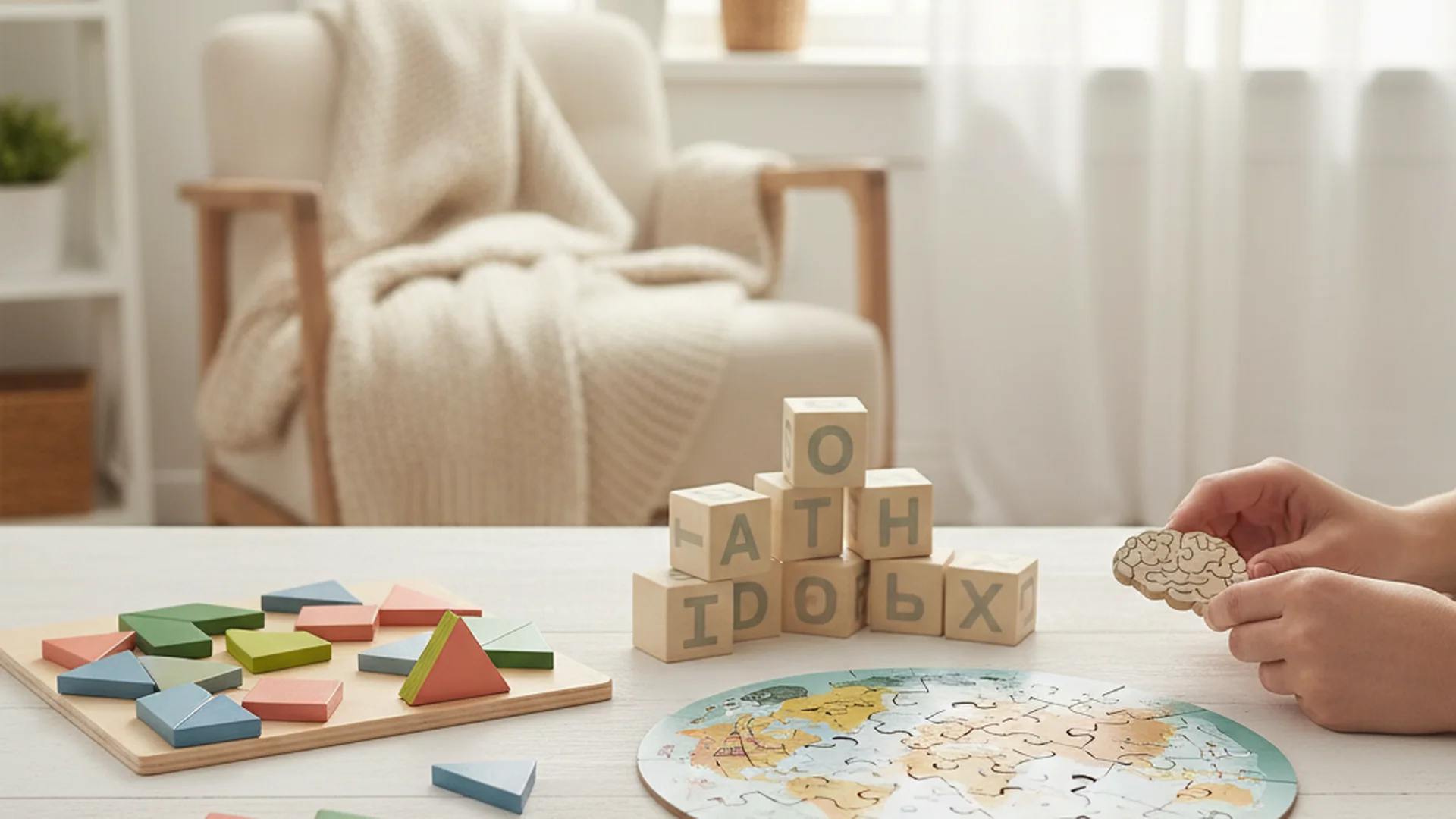
In the modern classroom, the line between play and academic rigor is increasingly blurred—and that is a very good thing. The right arrangement of clues and grids can sharpen the mind. However, teaching with puzzles is no longer just a niche activity for early finishers or a "filler" for rainy days. It has evolved into a sophisticated pedagogical strategy backed by cognitive science.
When we integrate educational puzzles into the curriculum, we aren't just giving students something to do; we are inviting them into a state of "Flow," where time disappears and the brain becomes remarkably receptive to new information. Whether it is a logic grid, a spatial jigsaw, or a complex Word Search, puzzles challenge the brain to think laterally, making them some of the most versatile tools in an educator's arsenal.
The Cognitive Science Behind Puzzle-Based Learning
To understand why teaching with puzzles is so effective, we have to look at how the brain processes problem-solving. A 2024 study on primary school mathematics revealed a staggering difference in outcomes: pupils taught with a puzzle-based approach saw a mean achievement gain of 6.30, while those in conventional settings gained only 0.86. This isn't magic; it’s neurobiology.
Achieving the "Flow" State
When a student engages with a puzzle that is perfectly calibrated to their skill level, they enter what psychologists call "Flow." This is a state of intense concentration where the "diffuse-mode" of thinking takes over. While the focused mind handles the immediate task, the diffuse mode works in the background, making connections between seemingly unrelated concepts. This is why a student might struggle with a Sudoku puzzle for ten minutes, walk away, and suddenly realize the solution while doing something else.
Building Mathematical Language
In early childhood education, puzzles are the first step toward literacy and numeracy. When a child works on a Tangram, they aren't just moving wooden shapes; they are learning "mathematical language." Terms like rotate, corner, above, and symmetrical become tangible concepts rather than abstract definitions. This spatial reasoning is a primary predictor of later success in STEM fields.
Strategic Implementation: Best Practices for 2025
Effective puzzle-based learning requires more than just handing out a worksheet. It requires "scaffolding"—the process of providing enough support so that the student can eventually reach the solution independently.
The "Scaffolding" Approach
Don’t just give a student a 100-piece jigsaw and walk away. Teach them the systems of logic.
- The Edge Method: Start by finding all the pieces with straight edges to build the frame. This provides a "handhold" and defines the boundaries of the problem.
- The Section Method: Group pieces by color or texture. This teaches categorization and pattern recognition, which are essential for Math Skills Through Puzzles.
Minimizing Instructions to Encourage Discovery
One of the most radical shifts in 2025 pedagogy is the move toward "low-instruction" tasks. Expert educators recommend giving the puzzle with the bare minimum of directions. This mimics the intuitive learning seen in video games. If a student has to figure out the goal of the puzzle as well as the solution, they are engaging in higher-order thinking (the "Create" tier of Bloom’s Taxonomy).
Advertisement
3 Real-World Examples of Puzzles in Action
1. The Jigsaw Classroom for History
Instead of lecturing on the causes of World War II, a teacher divides the class into four "expert" groups. Group A studies the Treaty of Versailles; Group B studies the Great Depression; and so on. After mastering their section, students regroup so that each new group has one "expert" from every topic. The students must then piece their knowledge together to understand the "whole" historical picture. This turns a dry history lesson into a social, cooperative puzzle.
2. STEM Engineering with 3D Mechanical Puzzles
In high school STEM labs, 3D mechanical puzzles—like building a working wooden clock or an engine—are being used to teach structural integrity. Students must understand how gears interface and how tension works. If the puzzle doesn't move at the end, they have to "debug" their creation, a core skill in both engineering and computer science.
3. Vocabulary Mastery through Student-Created Crosswords
As any crossword constructor will tell you, creating a puzzle is significantly harder—and more educational—than solving one. Ask students to create a crossword using their weekly science vocabulary. They must write concise, accurate clues and ensure the words intersect correctly. This requires a deep understanding of word definitions and relationships.
Recent Trends (2025–2026): The Future of Educational Puzzles
The landscape of educational puzzles is shifting rapidly due to technological advancements and a renewed focus on sustainability.
AI-Adaptive Puzzles
We are seeing the rise of platforms that use AI to adjust puzzle difficulty in real-time. If a student is flying through a Minesweeper clone, the AI increases the logic complexity. If a student is stuck, the AI doesn’t give the answer; instead, it provides a "subtle hint" (like highlighting a specific area) to maintain the Flow state without breaking the productive struggle.
Augmented Reality (AR) Jigsaws
AR is transforming physical puzzles into interactive experiences. A student might assemble a 200-piece puzzle of the human circulatory system. Once finished, they view it through a tablet, and the puzzle "comes to life," showing blood flow and heart rates in 3D. This bridges the gap between tactile learning and digital visualization.
Sustainability and Eco-Materials
There is a massive movement away from cheap, disposable plastics. Modern classrooms are opting for educational puzzles made from bamboo, recycled wood, and non-toxic soy-based inks. This aligns with broader 2025 trends toward environmental responsibility in schools.
| Puzzle Type | Skill Developed | Recommended Age |
|---|---|---|
| Jigsaw | Spatial Reasoning | 3+ |
| Sudoku | Logical Deduction | 7+ |
| Crossword | Vocabulary/Linguistics | 8+ |
| 2048 | Strategic Planning | 6+ |
| Tangrams | Geometry/Shapes | 4+ |
Common Mistakes to Avoid
Even the best-intentioned puzzle activity can fail if executed poorly. Here are the most common pitfalls:
1. Rushing to Give the Answer
The learning happens in the struggle, not the completion. When a student says, "I'm stuck," the worst thing you can do is point to the correct piece or provide the missing word. The Correction: Ask guiding questions. "What color are you looking for?" or "What happens if we rotate this shape?" This keeps the agency with the student.
2. Over-Complicating the Narrative
In "Educational Escape Rooms," teachers often get bogged down in elaborate stories. If the plot is too thick, students lose focus on the actual curriculum-based puzzles. The Correction: Keep the story simple. The puzzle should be the hero, not the backstory.
3. Using Puzzles Only as "Quiet Time" Activities
While puzzles can be a great way to settle a class, they are also inherently social. The Correction: Use large floor puzzles or digital games like 2048 on an interactive whiteboard to encourage group discussion and collective strategy.
Advertisement
Frequently Asked Questions
At what age should I introduce puzzles?
Won’t puzzles take up too much class time?
Initially, puzzles require a time investment. However, techniques like the "Jigsaw Classroom" actually save time in the long run by making students responsible for their own learning, which reduces the need for repetitive lecturing. Small puzzles can also be used as 5-minute Bell Ringer Puzzles to settle the class immediately.
What if students get frustrated and give up?
Frustration is a sign of a "calibration" issue. If a puzzle is too hard, the student feels anxiety; if it's too easy, they feel boredom. The goal is to find the "just right" challenge. If a student is giving up, offer a small "handhold"—a single piece or a tiny clue—to get the momentum restarted.
Are digital puzzles as effective as physical ones?
They serve different purposes. Physical puzzles are superior for fine motor development and tactile feedback. Digital puzzles, especially Brain Training games, offer instant feedback and can be personalized to a student’s exact skill level via AI. Both have a place in a balanced 2025 curriculum.
Conclusion: The Long-Term Benefits of a Puzzle-Rich Environment
Teaching with puzzles isn't just about getting through a Friday afternoon; it’s about building the cognitive architecture for a lifetime of problem-solving. When we encourage students to engage with Logic Puzzles and spatial challenges, we are teaching them that frustration is just a precursor to discovery. We are teaching them that complex problems can be broken down into manageable pieces.
As an educator, your goal is to transition from being the "provider of answers" to the "architect of challenges." By integrating these tools, you create a classroom culture where curiosity is rewarded, and the joy of the "aha!" moment becomes the primary driver of learning.
Ready to Start?
Enhance your curriculum with our curated logic and word games.
Put it into practice

Keep reading
Education
Puzzles in the Classroom: A Teacher’s Implementation Guide for 2025 and Beyond
Unlock student potential with our comprehensive teacher puzzle guide. Learn how to implement puzzles in the classroom to boost dopamine, memory, and focus.
Apr 27, 2026 12 min
Education
Screen Time and Puzzles: Navigating the Digital vs. Paper Learning Divide
Explore the impact of screen time puzzles on cognitive development. Learn the differences between digital and paper puzzles for kids and seniors in 2025.
Aug 26, 2026 12 min
Education
Mastering Math Skills Through Puzzles: A Guide for 2025 and Beyond
Discover how math puzzles learning outperforms traditional methods. Learn expert strategies, research-backed benefits, and 2025 trends for students and educators.
Aug 17, 2026 12 min
Advertisement