The Logic of Melody: Why Music Theory Puzzles Are the Ultimate Brain Workout
Discover how music theory puzzles and brain games enhance cognitive reserve, improve math skills, and boost executive function for all ages.
By Free To Play Puzzles Editorial Team 10 min read
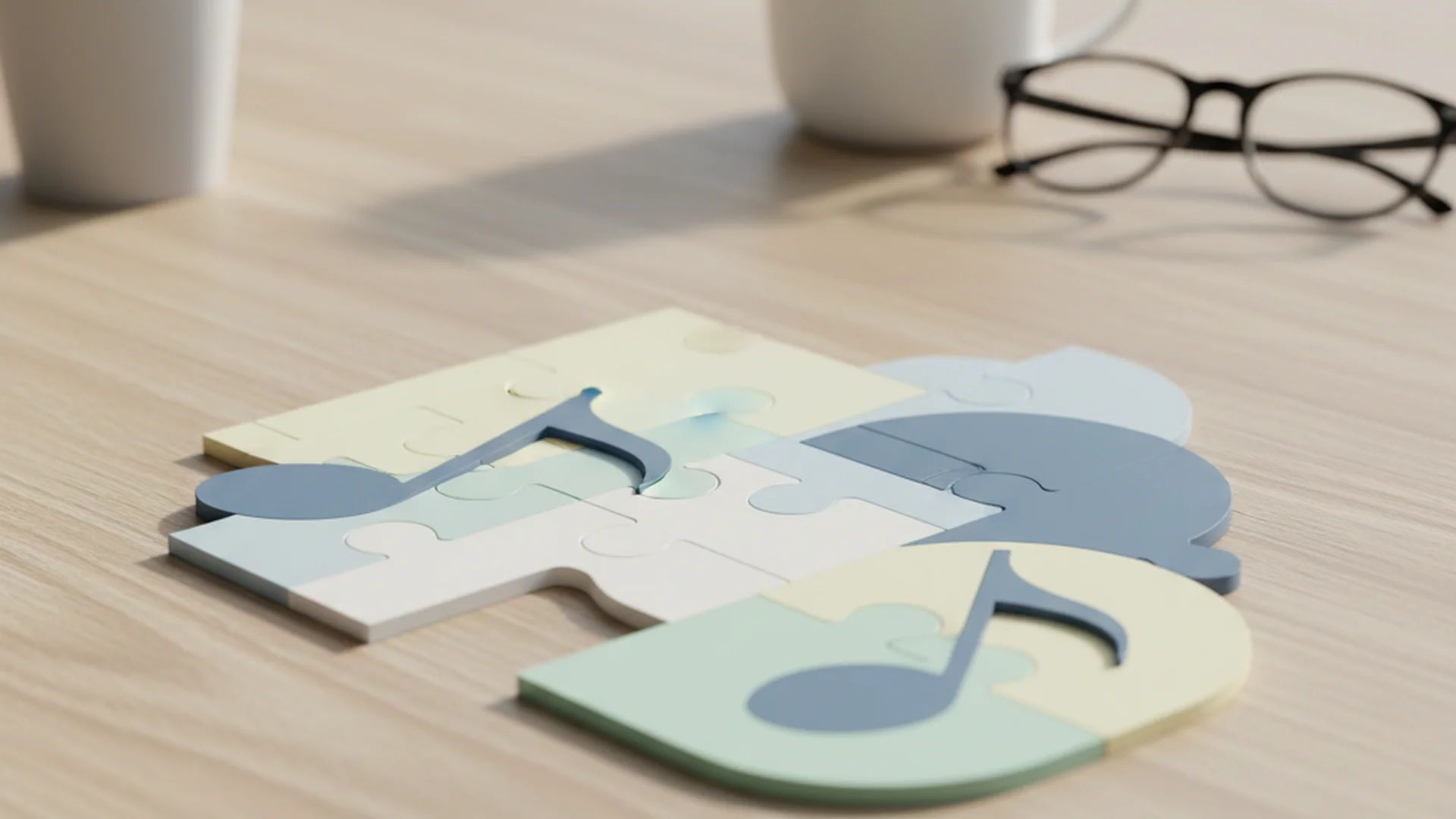
For many, the mention of "music theory" evokes memories of dusty textbooks and repetitive scales. However, as a mathematical logic instructor, I see music through a different lens: it is a complex, beautiful system of patterns, ratios, and logical structures. When we transform these structures into music theory puzzles, we create a powerful tool for cognitive development. These music brain games are not just for conservatory students; they are high-octane fuel for the human mind.
Whether you are a seasoned pianist or someone who can’t read a single note on a staff, engaging with the logic of music provides a unique mental challenge. Recent research suggests that the intersection of auditory patterns and logical problem-solving can protect the brain against aging while sharpening the skills we use for daily decision-making.
The Science Behind Music Brain Games
Why should we treat music theory like a puzzle? The answer lies in how our brains process complex information. Engaging with musical structures is one of the few activities that activates nearly every part of the brain simultaneously.
Building Cognitive Reserve
Research from 2025 indicates that long-term engagement with musical structures builds what scientists call "cognitive reserve." This acts as a buffer for the brain, helping older adults maintain youthful neural patterns. By solving music theory puzzles, you aren't just learning where "Middle C" sits; you are reinforcing the neural pathways that help with speech perception and focus, especially in noisy environments.
The Math-Music Connection
It is no coincidence that many of history’s greatest mathematicians were also musicians. Music theory is deeply mathematical. When you solve a puzzle involving time signatures or rhythmic values, you are essentially performing high-level arithmetic. Understanding how four quarter notes fit into a 4/4 measure—and how that changes when you introduce triplets or dotted notes—improves your proficiency with fractions and ratios.
Types of Music Theory Puzzles to Try
If you’re ready to dive in, you don't need a PhD in composition. The best music theory puzzles start with the fundamentals and turn them into a game of pattern recognition.
1. The "Circle of Fifths" Sudoku
As a Sudoku tournament director, this is my favorite crossover. Instead of using numbers 1 through 9, this puzzle uses the keys in the Circle of Fifths. It requires the player to understand the relationship between major and minor keys while following the strict logical constraints of a Sudoku grid. This reinforces the "visual map" of musical relationships.
2. Rhythm Squeeze and Interval Trains
These are often called "off-the-bench" activities. In an Interval Train, you are given a starting note and a series of instructions (e.g., "up a Major 3rd," "down a Perfect 4th"). Your goal is to identify the destination note. It’s a workout for your Brain Training routine that bridges the gap between abstract symbols and logical movement.
3. Note Name Slap and Rhythm Bingo
For beginners, these games focus on speed and identification. By gamifying the "language of music," students create positive emotional associations with learning. This moves information from short-term memory to long-term storage much faster than traditional flashcards.
Advertisement
Modern Trends in Music Education (2025–2026)
The landscape of music theory puzzles is shifting rapidly thanks to emerging technology. We are moving away from paper worksheets and into immersive, data-driven experiences.
AI-Generated Personalized Challenges
One of the most significant shifts in 2025 is the rise of AI-generated music puzzles. These systems analyze a user's performance in real-time, identifying specific "skill gaps." If you consistently struggle with identifying minor sixths, the AI will adapt the next set of puzzles to focus on that specific interval, creating a "limitless" and personalized curriculum.
VR and Holographic Theory
Looking ahead to 2026, the trend of "holographic music theory" is set to revolutionize classrooms. Imagine stepping into a virtual space where you can physically move 3D notes onto a giant floating staff or conduct a virtual orchestra to see how different harmonic structures change the "shape" of the sound around you.
Neuro-responsive Play
At the 2025 NAMM show, new "neuro-responsive" software was unveiled. This technology uses biometric signals to adjust the difficulty of a puzzle based on the player’s stress or focus levels. If the puzzle is too easy and your mind wanders, the difficulty spikes. If you become overstressed, the system provides "scaffolding" hints to help you through.
| Trend | Technology | Primary Benefit |
|---|---|---|
| Personalization | AI Algorithms | Targeted skill growth |
| Immersion | VR/AR | Spatial understanding of sound |
| Biometrics | Wearable Tech | Optimized flow state |
Common Mistakes to Avoid
When starting your journey with music theory puzzles, it is easy to fall into a few common traps that can hinder your progress.
The "Rules" Fallacy
The biggest misconception is that music theory is a strict set of "laws" you must follow. In reality, theory is a descriptive tool. It is a way to explain why certain things sound good to our ears. Don't approach puzzles as a way to learn "restrictions," but rather as a way to expand your "toolkit" for creative expression.
Neglecting the Ear
A common mistake is focusing purely on visual puzzles, like crosswords or note-naming sheets. Music is an auditory medium. To be truly effective, music brain games should always be linked back to sound. If you are solving a puzzle about chords, try to use an app or tool that plays those chords so your brain connects the logic to the sensation.
Complexity Overload
Many beginners jump straight into complex modal puzzles or advanced counterpoint before they have mastered the basics of the Circle of Fifths or simple note values. This often leads to a "learning plateau." Always start with Logic Puzzles that match your current level to maintain motivation.
Frequently Asked Questions
Can music theory puzzles actually help with memory loss?
Yes, while they aren't a cure, music-themed puzzles are frequently used in therapy to spark both verbal and non-verbal communication. They help improve focus and can be a powerful tool for individuals with dementia by engaging multiple sensory pathways.
Do I need to be a musician to play these games?
Not at all. Many modern music brain games are designed for complete beginners. They teach you the "language of music" from scratch, using puzzles to introduce concepts like rhythm and pitch in a way that feels like a standard logic game.
Are there digital versions of these puzzles available?
Absolutely. Platforms like My Ear Training Journey and Theta Music Trainer have gamified traditional theory. Additionally, AI-driven apps now offer personalized challenges that adapt to your specific learning pace.
How do music puzzles improve executive function?
Playing a musical instrument or solving theory puzzles requires "working memory"—the ability to hold and manipulate information in your mind. For adults over 40, this type of mental gymnastics is significantly linked to better performance in decision-making and cognitive flexibility.
Advertisement
Conclusion
Music theory puzzles represent a perfect marriage of art and logic. By engaging with these games, you aren't just becoming a better musician; you are building a more resilient, efficient, and creative brain. From the mathematical precision of rhythmic ratios to the spatial logic of the staff, these challenges provide a comprehensive workout for the mind.
As we move into 2026, the tools available to us—from AI tutors to holographic staves—will only make this journey more exciting. Start small, stay consistent, and remember that every puzzle solved is a new connection made in the symphony of your mind.
Ready to Sharpen Your Mind?
Explore our collection of logic-based challenges and start your brain workout today.
Put it into practice


Keep reading
Education
The Ultimate Guide to Puzzle Lesson Plans: Boosting Engagement and Logic
Discover how to integrate puzzle lesson plans into your classroom. Learn research-backed strategies, 2025 trends, and expert tips for teaching with puzzles.
Jul 26, 2026 12 min
Education
Mastering the Classroom: The Ultimate Puzzles for Teachers Guide
Explore how puzzles for teachers transform active learning. Discover classroom puzzle activities, AI integration, and cognitive strategies for the 2025-2026 school year.
Apr 28, 2026 12 min

Education
Puzzles Education Standards: How Logic-Based Learning Meets Common Core
Explore how puzzles education standards are transforming modern classrooms. Learn how logic games align with Common Core to improve math and ELA proficiency.
Mar 19, 2026 12 min
Advertisement