Science Crossword Puzzles: The Future of STEM Learning and Brain Health
Discover how science crossword puzzles and STEM crossword puzzles are evolving with AI to boost memory, improve retention, and keep your brain young.
By Free To Play Puzzles Editorial Team 10 min read
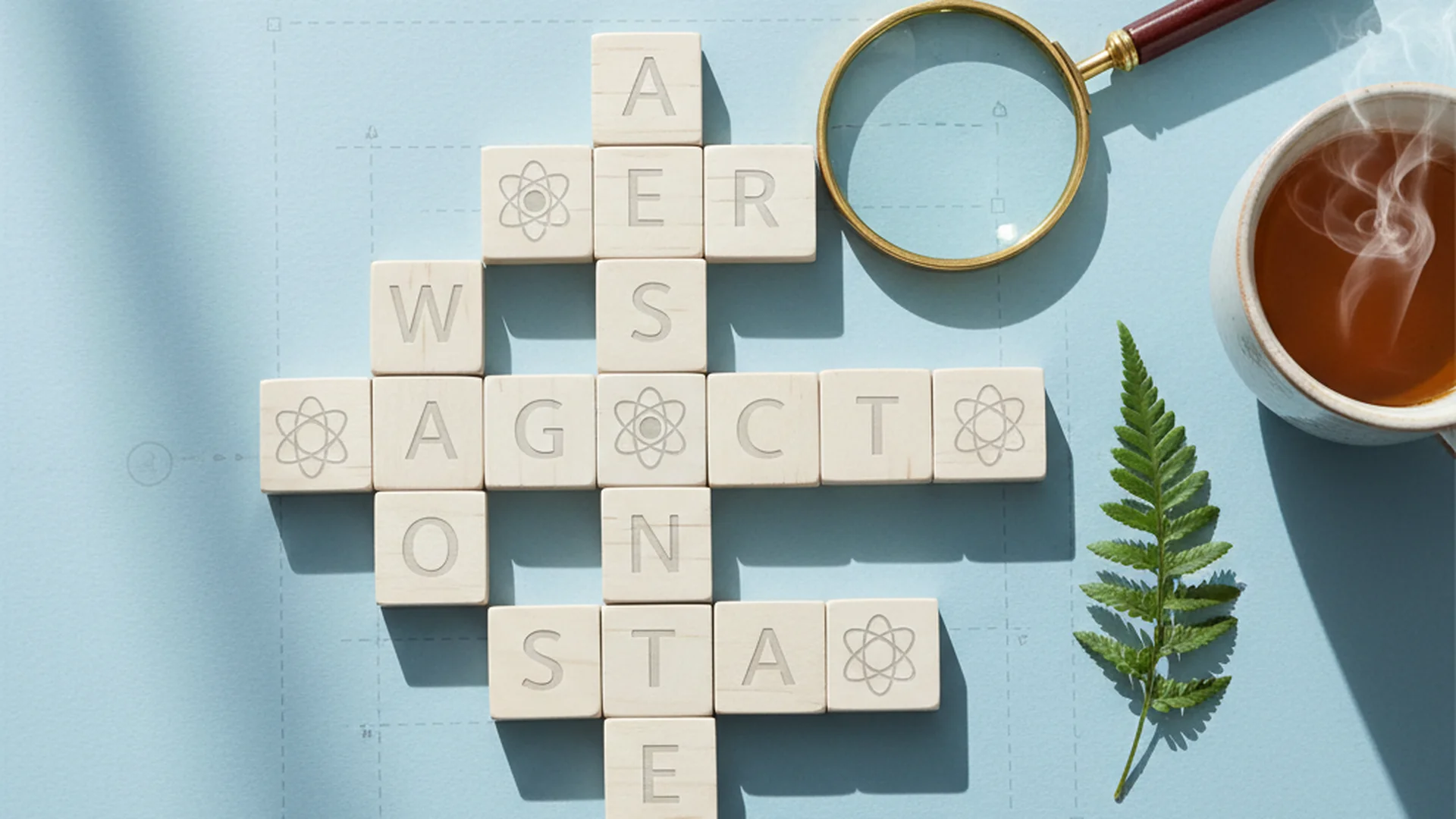
In the landscape of modern education and cognitive fitness, the humble science crossword is experiencing a massive "Renaissance." No longer relegated to the back of a tattered textbook or used as a simple time-filler for early finishers, these puzzles have evolved into sophisticated cognitive-enhancement tools. There has been a significant shift in how we utilize linguistic puzzles to reinforce complex STEM (Science, Technology, Engineering, and Mathematics) concepts. In 2025, the intersection of artificial intelligence and educational psychology has turned the standard crossword into a powerhouse for long-term knowledge retention.
Whether you are a student trying to master the Krebs cycle, a teacher looking to engage a distracted classroom, or an adult seeking to maintain mental agility, understanding the mechanics of STEM crossword puzzles is essential. The transition from passive reading to active solving creates neural pathways that standard study methods simply cannot replicate.
The Neuroscience of Science Crosswords
Why does a science crossword work so much better than a standard lecture? The answer lies in the "retention gap." Research from the University of Exeter and King’s College London has shown that frequent crossword solvers aged 50 and over possess brain function equivalent to someone ten years younger in terms of grammatical reasoning and short-term memory accuracy.
When you solve a puzzle, your brain isn't just "finding" a word; it is engaging in active recall. Unlike "recognition" (where you see a term and remember seeing it before), active recall forces the brain to retrieve a definition from scratch and apply it to a specific constraint—the grid. This process strengthens the synaptic connections associated with that specific piece of scientific data.
STEM Crosswords vs. Word Searches: The Great Debate
One of the most common questions readers ask is whether word searches are just as effective as crosswords for science education. The short answer is: no. While word searches are excellent for pattern recognition and visual scanning, they do not require the solver to understand the meaning of the word.
| Feature | Science Crossword | Word Search |
|---|---|---|
| Cognitive Load | High (Active Recall) | Low (Passive Recognition) |
| Skill Developed | Definition & Application | Pattern Recognition |
| STEM Value | High (Concept Reinforcement) | Low (Vocabulary Familiarity) |
| Engagement | Challenging/Problem-Solving | Relaxing/Repetitive |
Advertisement
How AI is Revolutionizing Science Puzzles in 2025
We have entered a new era of "customized cognition." As of late 2025, tools like ChatGPT-5 and Gemini 2.5 Pro have become the primary "co-pilots" for STEM educators. Instead of searching for a generic chemistry puzzle that might only cover 60% of their curriculum, teachers are now using AI to extract vocabulary directly from their specific lecture notes or YouTube transcripts.
New platforms like WordGenius and Reelmind.ai allow for the creation of "New York Times style" grids that are scientifically accurate and contextually relevant. This ensures that every clue in the science crossword aligns perfectly with the learning objectives of the week.
Best Practices for Teachers and Students
To get the most out of STEM crossword puzzles, it is important to follow a structured approach. Using them as "busy work" actually diminishes their neurological value.
The Hybrid Approach
Experts recommend the "Lecture + Puzzle" hybrid method. Rather than giving the puzzle as homework, have students work on it during or immediately after the lesson. This allows them to fill "information gaps" while the lecture material is still fresh in their working memory.
Collaborative Solving
Science is rarely a solo endeavor. Assigning crosswords to small groups (3–5 people) encourages "scientific dialogue." When students argue over whether the answer is "mitosis" or "meiosis," they are engaging in a high-level cognitive debate that solidifies the definitions of both terms.
The Importance of Precision
In STEM, a single letter can change the entire meaning of a concept.
Common Mistakes and Misconceptions
While we are strong advocates for puzzles, it is important to clear up some common myths that circulate in the "brain training" community.
Misconception: Crosswords are a "Cure" for Dementia
While they keep the brain sharp, crosswords are not a magic bullet. 2025 studies from National Geographic suggest that while puzzles improve "verbal IQ," they must be combined with physical exercise and the learning of new skills (novelty) to truly impact long-term brain health. If you only do crosswords and never try anything else, your brain eventually hits a "plateau."
Mistake: Over-reliance as a Time Filler
If students perceive a science crossword as a way for the teacher to "check out" for 20 minutes, the educational value plummets. It should be framed as a "low-stakes assessment" or a "vocabulary challenge."
Mistake: Using the Same Format Repeatedly
The brain builds new neural pathways when it is challenged by novelty. Once you master a specific puzzle style, your brain goes on "autopilot." I recommend switching between standard grids, cryptic crosswords, and the newer 3D digital grids to keep the "novelty factor" high.
Advertisement
The Future: 3D Grids and Gamified STEM
The future of the science crossword is increasingly digital and gamified. We are seeing the rise of Crosswordle, a hybrid of traditional crosswords and the viral game Wordle, used for daily science "warm-ups." These daily challenges build consistency, which is the key to long-term memory.
Additionally, puzzles are now blending science with literacy and Social Emotional Learning (SEL). You might find an "Environmental Science" puzzle that requires solving clues about "Climate Anxiety" alongside "Carbon Sequestration." This holistic approach ensures that STEM is seen as part of the human experience, not just a set of dry facts.
Frequently Asked Questions
Are crossword puzzles better than word searches for science?
Yes. Crosswords require active recall of definitions and conceptual understanding. Word searches only require passive pattern recognition. For STEM mastery, crosswords are the superior choice.
Can AI create accurate science crosswords?
Absolutely. As of 2025, AI tools can instantly generate grids based on specific textbooks, PDFs, or video transcripts, ensuring that clues are both scientifically accurate and aligned with specific curriculum standards.
At what grade level are science crosswords most effective?
They are effective at all levels. Recent trends show a surge in "Elementary STEM" (Grades 3-5) for vocabulary building and "Medical/Higher Ed" for mastering complex terminology like anatomy or organic chemistry.
Do they count as "STEM" if they are just words?
Yes. They promote computational thinking through decomposition (breaking down a grid) and pattern recognition. They also reinforce the "S" (Science) and "T" (Terminology/Technology) components of the curriculum.
How often should I solve science crosswords for brain health?
For maximum cognitive benefit, aim for 15-20 minutes of solving 3 to 4 times a week. Pair this with a variety of other puzzles to ensure your brain continues to build new neural pathways.
Conclusion
The humble science crossword has proven itself to be a resilient and powerful tool in the STEM toolkit. By moving away from passive recognition and toward the active recall required by STEM crossword puzzles, we can improve knowledge retention, bridge learning gaps, and even keep our brains functioning like they are a decade younger. As we move into 2026, the integration of AI and multimodal clues will only make these puzzles more central to the way we teach and learn.
For more strategies on how to master your next puzzle, check out 10 Crossword Solving Strategies the Pros Use or start Building Crossword Vocabulary to prepare for your next STEM challenge.
Ready to Sharpen Your Mind?
Dive into our collection of daily puzzles and STEM challenges today.
Put it into practice
Keep reading

Crosswords
Crosswords for Seniors: The Science of Brain Health and Cognitive Vitality
Discover how crosswords for seniors can delay memory decline, improve cognitive reserve, and keep the brain 10 years younger according to the latest 2025 research.
Jul 30, 2026 12 min
Brain Health
Brain Teasers vs Puzzles: Key Differences for Brain Health
Explore the vital differences between brain teasers vs puzzles. Discover which cognitive exercises offer the best benefits for mental longevity and focus in 2025.
Apr 17, 2026 10 min

Comparisons
Puzzles vs Language Learning: Which Is Better for Your Brain Health?
Explore the ultimate brain training comparison: puzzles vs languages. Discover which activity offers the best protection against cognitive decline and dementia.
Mar 18, 2026 12 min
Advertisement