How to Solve Cryptograms: Expert Letter Substitution Tips and Strategies
Master the art of cryptograms. Learn frequency analysis, pattern recognition, and modern 2025 strategies to solve ciphers.
By Free To Play Puzzles Editorial Team 12 min read
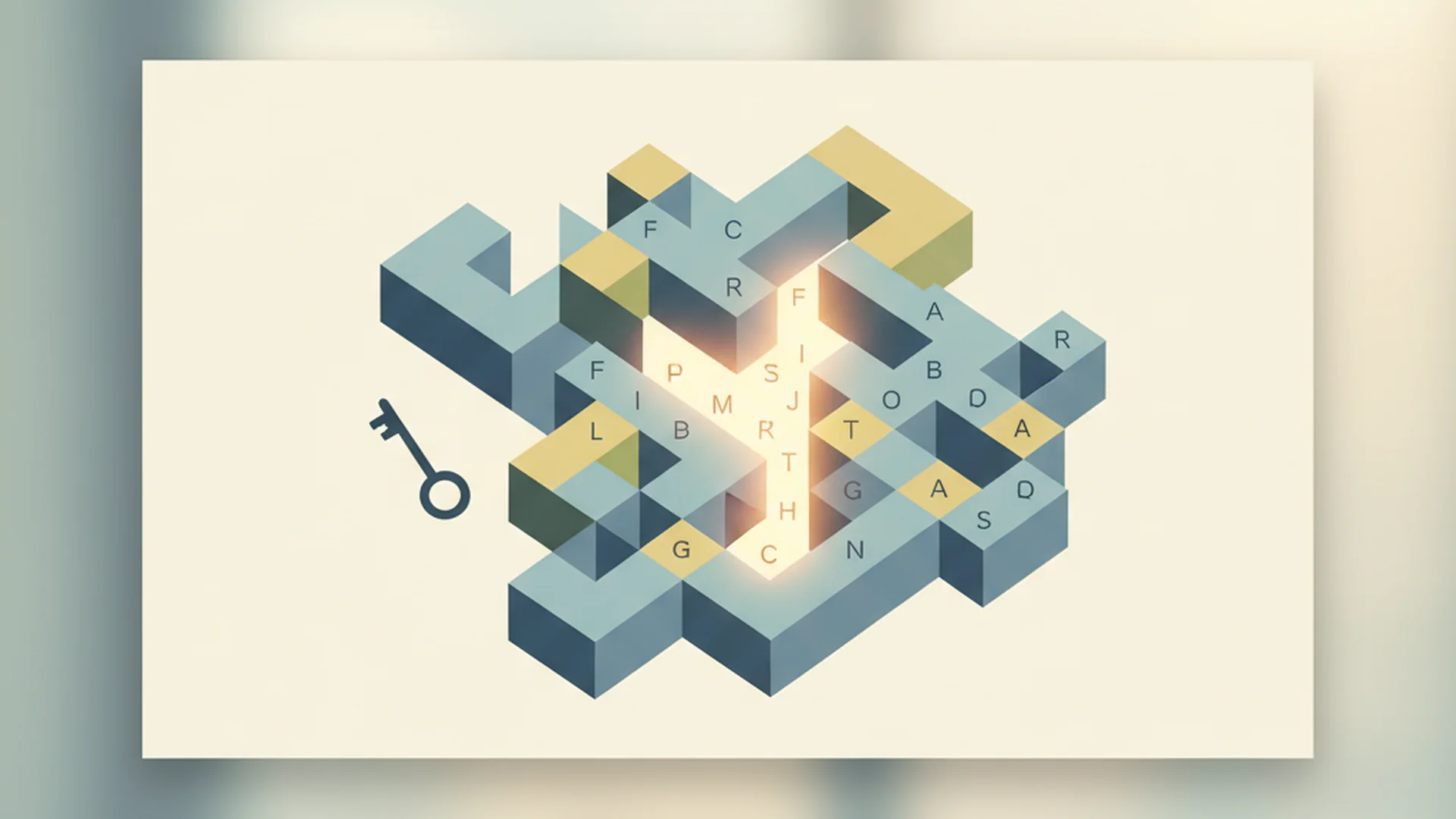
For centuries, the human brain has been captivated by the challenge of hidden messages. Whether you are a casual hobbyist or a dedicated enthusiast, learning how to solve cryptograms is one of the most effective ways to sharpen your cognitive faculties. These puzzles engage both the left-brain logic centers and the right-brain intuitive sectors, creating a unique "neural dance" that keeps the mind resilient.
In 2025, we are witnessing a massive resurgence in these letter-substitution puzzles. While they were once the domain of newspaper back-pages and military bunkers, they have evolved into a digital-age phenomenon. Recent data shows that 50% of Gen Z now regularly engages with word puzzles, a shift driven by the "Wordle effect" and the rise of competitive brain-training apps. Whether you are a digital native or a traditionalist with a pencil and paper, mastering the logic of the cipher is an immensely rewarding pursuit.
The Evolution of the Cryptogram
Before we dive into the mechanics of how to solve cryptograms, it is essential to understand what they are—and what they are not. A cryptogram is a short piece of encrypted text, usually a famous quote or a witty aphorism, where each letter of the alphabet has been replaced by a different letter. For example, every "E" might become a "Q," and every "T" might become an "X."
The history of these puzzles is as old as civilization itself. The Caesar Cipher, named after Julius Caesar, involved a simple shift of the alphabet. However, the cryptograms we enjoy today became popular as entertainment in the 19th century. Edgar Allan Poe, a master of the macabre, was also a master of the cipher. He famously challenged readers of the Philadelphia Saturday Evening Post to send him their most difficult codes, which he would then solve with ease. Poe’s passion for cryptography eventually birthed the modern puzzle-solving community we see today.
Step 1: Mastering Frequency Analysis
The most powerful tool in your arsenal is the statistical nature of the English language. Not all letters are created equal. If you want to solve cryptograms efficiently, you must internalize the "ETAOIN" rule.
The ETAOIN Rule and Letter Probability
In standard English, letters appear with predictable frequency. If you see a three-letter word where the middle letter appears most frequently in the entire puzzle, there is a very high probability that middle letter is "E" or "A."
| Letter | Frequency (%) | Common Usage Notes |
|---|---|---|
| E | 12.51% | The most common letter; often appears at the end of words. |
| T | 9.25% | Frequently starts words (e.g., The, That). |
| A | 8.04% | Common as a one-letter word and in the middle of words. |
| O | 7.60% | Frequent in three-letter words like "YOU" or "FOR." |
| I | 7.26% | Common one-letter word; often found in the second position. |
| N | 7.09% | Often found at the end of words (e.g., -ION, -ING). |
Identifying One-Letter Words
In English, there are only two common one-letter words: "A" and "I." When you spot a single letter standing alone, your puzzle is already 10% solved. But how do you tell them apart?
- Context Clues: "I" is almost always followed by a verb (e.g., I am, I think, I go).
- Sentence Position: If the one-letter word starts a sentence, it is more likely to be "A" (e.g., A bird flew) or "I" (e.g., I saw).
- Punctuation: If it follows a comma or semicolon, look at the grammatical structure of the phrase.
Advertisement
Step 2: Utilizing Punctuation and Apostrophes
Apostrophes are the "gold mines" of any cryptogram. They provide immediate, high-probability clues that narrow down your search from 26 letters to just a handful.
Single-Letter Endings
If you see a word like XYZ'Q, the letter after the apostrophe is almost certainly one of these:
- S: (e.g., dog's, it's)
- T: (e.g., can't, won't)
- D: (e.g., I'd, you'd)
- M: (e.g., I'm)
Double-Letter Endings
If you see two letters after an apostrophe, the options are even more limited:
- RE: (e.g., they're, you're)
- VE: (e.g., I've, we've)
- LL: (e.g., he'll, it'll)
Step 3: Pattern Recognition and "Anchor Hypotheses"
One of the most effective cryptogram tips used by professionals in the American Cryptogram Association (ACA) is identifying word patterns. Certain words have unique "shapes" that are difficult for other words to replicate.
The "THAT" Pattern
Look for four-letter words where the first and fourth letters are the same (1-2-3-1).
- Common Candidates: THAT, SAYS, AREA, ELSE, HIGH.
- Strategy: Statistically, "THAT" is the most common word fitting this pattern. If you plug in T-H-A-T and it makes sense in the rest of the puzzle, you've just unlocked three high-frequency letters.
Double Letters
Double letters (like the "LL" in "puzzles" or the "EE" in "feel") are excellent clues.
- The Big Four: LL, EE, SS, and OO are the most common double letters in English.
- Rarities: You will rarely see "YY" or "WW" in a standard cryptogram. If you see a double letter at the end of a word, it’s often "EE" (as in "SEE") or "SS" (as in "LESS").
The 2025–2026 Landscape: AI and Competition
As we move through 2025 and into 2026, the way we interact with these puzzles is changing. New tools and communities are emerging that redefine the solving experience.
The AI Dilemma
With the rise of sophisticated language models, many enthusiasts are turning to AI for help. However, we caution against this. In 2025, specialized AI Cipher Solvers are known to "hallucinate" solutions. Because AI works on predictive text, it may force a word that sounds correct but doesn't follow the strict substitution rules of the cipher.
If you want the full cognitive benefit of Brain Training, you must do the heavy lifting yourself. Using AI to solve the puzzle for you is like hiring someone to go to the gym for you; the work is done, but you don't get the muscles.
Competitive Sprinting
The ACA's 2026 Convention in Niagara Falls is expected to draw record numbers. The trend is shifting toward "cipher sprinting," where solvers compete against the clock to decode complex messages. This social aspect has brought a new level of excitement to the hobby.
Advertisement
Real-World Examples
To better understand how to solve cryptograms, let's look at three common scenarios you will encounter.
Example 1: The One-Letter Hook
Puzzle: "Q DPX Q CPZ." Analysis: You have two one-letter words. They could be "A" or "I."
- Test 1: "A saw a boy."
- Test 2: "I saw I boy." (Makes no sense).
- Conclusion: The first word is likely "I" and the second is likely "A," or vice-versa, but the context of the surrounding words will confirm it.
Example 2: The Apostrophe Advantage
Puzzle: "XWVW'L S QYRRZS." Analysis: The word "XWVW'L" has an apostrophe followed by a single letter.
- Hypothesis: The 'L is likely 'S. The word is four letters long with the first and third letters being the same (X-W-X-W).
- Result: This fits the pattern for "HERE'S." Suddenly, you know H, E, R, and S.
Example 3: Solving Backward
If the beginning of the quote is "The greatest thing in the world is..." but you can't figure out the first three words, look at the author's name or the very last word. Puzzle: "...QX RHV." Analysis: Short names like "EB WHITE" or "MARK TWAIN" have specific patterns. If the author's name is "RHV," it might be a three-letter name like "POE."
Common Mistakes to Avoid
Even seasoned solvers can fall into traps. Here are the most frequent errors:
- Over-Reliance on Frequency: Never force a letter just because it's the most common in the puzzle. A quote about "a zebra at the zoo" will have a very strange letter frequency compared to a quote about "the weather."
- Ignoring the "Blind Spot": If you get stuck on the first word, move on. Experts often solve the middle or the end of a puzzle first and work backward.
- Refusing to Guess: Some think guessing is "cheating." In reality, experts use Anchor Hypotheses. They guess a common word like "THE" or "AND," and if it creates gibberish elsewhere, they simply erase it and try the next most likely word.
- Forgetting the "Self-Substitution" Rule: In standard competition puzzles, a letter cannot stand for itself. If "X" is in the code, the answer cannot be "X."
Frequently Asked Questions
Where should I start if I'm stuck?
Always look for the shortest words first. One-letter words (A, I) and two-letter words (TO, IT, IS, OF, IN) provide the easiest entry points into the puzzle. If those aren't available, look for words with apostrophes.
Can a letter stand for itself?
In official American Cryptogram Association puzzles and most high-quality apps, the rule is that no letter can represent itself. This is a vital clue; if you are down to two possibilities and one of them is the letter itself, you can safely eliminate it.
Is using a hint cheating?
Within the hobby, hints are viewed as a "foothold." If you've been staring at a puzzle for 20 minutes without a single word, taking a hint (like revealing the letter "E") can prevent burnout and keep the learning process enjoyable.
How do I tell 'A' from 'I' in a one-letter word?
Context is your best friend. "I" is almost always followed by a verb (I am, I see), while "A" is usually followed by a noun or an adjective (A dog, A bright day). Also, "I" is more frequently capitalized in the middle of sentences than "A."
What if the puzzle has no "E"?
This is common in short, punchy quotes. If "E" isn't the most frequent letter, look for "T," "A," or "O." These are the next most likely candidates. Also, look for the word "THE"—if you find a common three-letter word, you’ve likely found your "E."
Conclusion
Solving cryptograms is a journey into the heart of language and logic. By combining the historical wisdom of frequency analysis with modern pattern recognition strategies, you can unlock messages that once seemed like gibberish. As we look toward the 2026 puzzle conventions and the evolving digital landscape, the value of these mental exercises only grows. They are not just games; they are a way to maintain cognitive health and enjoy the thrill of discovery.
If you enjoyed this guide, you might find similar satisfaction in exploring 10 Crossword Solving Strategies the Pros Use or testing your lateral thinking with Hard Riddles for Adults. For those who enjoy the structural logic of secret messages, our guide on Escape Room Puzzle Types offers even more ways to challenge your brain.
Ready to Level Up?
Sharpen your mind with our daily challenges and logic puzzles.
Put it into practice
Keep reading

Puzzle Types
Mastering the Hunt: Expert Spot the Difference Tips to Find Changes Faster
Unlock pro-level spot the difference tips and techniques. Learn the "Magic Eye" method, improve visual processing, and discover how to find changes faster.
Oct 5, 2025 10 min
Puzzle Types
Maze Solving Strategies: How to Find Your Way Out of Any Labyrinth
Master every twist and turn with expert maze solving strategies. Learn the Right-Hand Rule, Trémaux’s Algorithm, and 2025 research on visual navigation.
Jun 17, 2026 12 min
Puzzle Types
The Surprising Science of Jigsaw Puzzle Benefits: A 2025 Cognitive Guide
Discover the scientifically-backed jigsaw puzzle benefits for your brain, from IQ boosts to stress relief. Explore 2025 trends and expert puzzling strategies.
Oct 11, 2026 12 min
Advertisement