Mastering the Game: A Guide to All Escape Room Puzzle Types
Explore the diverse world of escape room puzzle types, from mechanical locks to AI-driven challenges. Expert insights.
By Free To Play Puzzles Editorial Team 12 min read
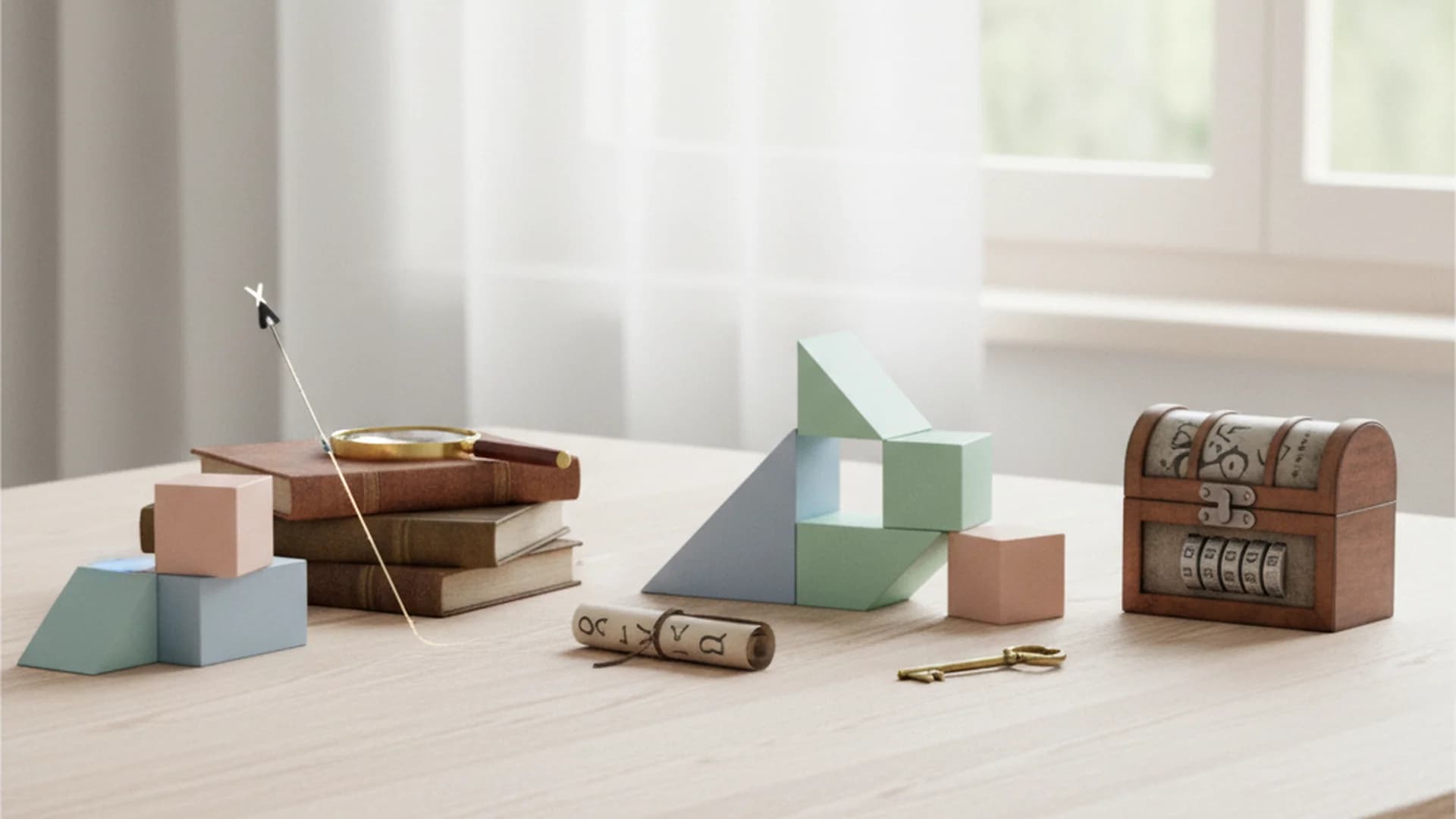
When you step into a dimly lit room and hear the heavy click of a door locking behind you, your brain immediately shifts into a high-state of arousal. The environment of a modern escape room is a fascinating laboratory for human problem-solving. Understanding the various escape room puzzle types is not just about winning the game; it is about understanding how our synapses fire when faced with complex, multi-modal challenges.
In 2025 and 2026, the escape room industry has evolved far beyond simple padlocks. With the global market projected to reach $1.23 billion by 2026, the complexity of these challenges has scaled alongside player expectations. Whether you are a corporate team-building leader or a puzzle enthusiast, mastering the mechanics behind the "lock" is essential for a successful exit.
The Cognitive Science of Escape Rooms
Before diving into the specific puzzles, it is important to understand why we find these environments so engaging. Escape rooms trigger a unique blend of "flow state" and social bonding. When a team solves a puzzle, the brain releases a surge of dopamine—the "reward" chemical—which reinforces collaborative behavior. This is likely why 57% of consumers now prefer immersive interactive entertainment over passive formats like cinema.
1. Core Puzzle Categories
Modern escape rooms are designed to test different areas of the brain. A well-designed room will never rely on a single skill set; instead, it will cycle through various escape room puzzle types to ensure every member of the team can contribute.
Logic & Deduction
These puzzles require players to use reasoning to determine a specific sequence or relationship. They are the "bread and butter" of the industry.
- Example: A series of journals where the dates of entries provide the order for a four-digit code.
- Example: "The blue book is to the left of the red one, which is not next to the green one."
Physical & Dexterity
These tasks require hand-eye coordination rather than raw intellect. They are often used to break up the "mental" heavy lifting of the room.
- Example: Guiding a metal ring along a copper wire without touching it.
- Example: Tilting a table to roll a marble through a labyrinth.
Visual & Search
Often referred to as "hidden in plain sight," these puzzles test your perception.
- Example: Using a UV flashlight to find symbols painted on the walls.
- Example: Identifying a pattern in the wallpaper that corresponds to a keypad layout.
Language & Wordplay
These puzzles involve ciphers, anagrams, or riddles. If you enjoy Cipher Wheel Puzzles, you will excel in this category.
- Example: A Caesar cipher where every letter is shifted three places to the right.
- Example: A riddle where the answer is an object located elsewhere in the room.
Sensory Puzzles
These are becoming increasingly popular in 2026. They engage the "non-traditional" puzzle senses: hearing, smell, and touch.
- Example: A Morse code sequence played through a radio.
- Example: Matching the scent of a "poison" in a bottle to a spice rack on the wall.
Advertisement
2. The Evolution of Escape Room Locks
The ultimate goal of most puzzles is to open a container or a door. While the puzzles provide the "code," the escape room locks are the physical barriers you must overcome.
| Lock Type | Mechanism | Best For |
|---|---|---|
| Mechanical | Key padlocks, 3-digit wheels | Classic/Industrial themes |
| Digital | Keypads, RFID sensors | Sci-fi/Modern spy themes |
| Environmental | Magnetic locks (Maglocks) | Immersive/Magic themes |
| Biometric | Fingerprint or Retinal scans | High-tech/Heist themes |
Mechanical Locks
These are the traditional padlocks most players expect. While some designers feel they are overused, they provide a tactile satisfaction that digital triggers often lack. Directional locks (up/down/left/right) are particularly popular because they allow for more creative clue placement than simple numbers.
Digital and Electronic Locks
In 2025, RFID (Radio Frequency Identification) has become a standard. This allows players to place an object—like a book or a chalice—on a specific pedestal to trigger a door opening. This "invisible" technology maintains immersion by removing the need for 20th-century padlocks in a medieval-themed room.
Environmental Triggers (Maglocks)
Magnetic locks are the gold standard for "Aha!" moments. When a circuit is completed—perhaps by placing several metal coins into a slot—an electromagnetic lock releases, often causing a secret door to pop open automatically.
3. Emerging Trends for 2025–2026
The industry is currently undergoing a digital transformation. We are moving away from static rooms toward dynamic, responsive environments.
AI-Generated Adaptive Difficulty
One of the most significant shifts in 2025 is the use of AI to monitor player progress. These systems track how long a team takes to solve each puzzle. If the AI detects the group is moving too slowly, it might subtly adjust the difficulty—perhaps by highlighting a clue with a spotlight or providing a hint through an "in-character" voiceover. This ensures a 40–60% success rate, which is the "sweet spot" for customer satisfaction.
"Phygital" and AR Integration
"Phygital" puzzles bridge the gap between the physical and digital worlds. Players might use an Augmented Reality (AR) tablet to see "ghosts" in the room or to reveal digital overlays on physical paintings. This allows for deep storytelling without cluttering the physical space.
Multi-Sensory "Haptic" Feedback
Advanced rooms now include environmental changes as part of the puzzle. Solving a "fire" puzzle might cause the room temperature to rise slightly, or a "jungle" room might release the scent of damp earth and rain.
4. Strategy: The 5-Minute Rule and Beyond
To escape successfully, you need more than just brainpower; you need a strategy. Among high-performing teams, three "rules" consistently emerge:
- The 5-Minute Rule: No single puzzle should take more than five minutes of stagnant effort. If you haven't made progress in that time, swap players or ask for a hint.
- The Feedback Loop: Every solve should result in an immediate "click," light, or sound. If you think you solved something but nothing happened, you are likely missing a step.
- Non-Linear Thinking: Modern rooms are designed so that 6 people don't have to stand around one lock. Divide and conquer. While two people work on Escape Room Puzzles of a logic nature, others should be searching for physical keys.
Advertisement
5. Common Mistakes to Avoid
Even experienced players fall into these traps. Avoiding them will significantly increase your escape rate.
- Red Herrings: In 2026 design, "red herrings" (clues that lead nowhere) are considered poor form. However, players often create their own by over-analyzing decorative items. If it doesn't look like a puzzle after two minutes, it's likely just furniture.
- Brute Forcing: Trying every combination on a 4-digit lock (0000 to 9999) is not only boring but often against the rules. Designers build "fail-safes" to prevent this.
- Hoarding Clues: Communication is the biggest bottleneck. If you find a key, shout it out! If you find a weird symbol, tell the group. Information silos are the primary reason teams fail.
Frequently Asked Questions
What are the most common types of locks I’ll encounter?
Players typically see numerical/word padlocks, traditional key locks, and "maglocks" (electromagnetic) that release when a puzzle is solved. Directional locks are also very common in modern rooms.
How many puzzles are usually in a 60-minute room?
Most rooms feature 10 to 20 puzzles. These range from quick "searches" that take 30 seconds to complex multi-step logic challenges that may take the group several minutes to untangle.
Is it cheating to ask for hints?
No. Game Masters (GMs) consider hints a core part of the experience. Experts recommend asking for a hint if the team has made zero progress for 5–10 minutes. The goal is to see the whole story, not to sit in the dark.
Do I need outside knowledge (like math or history)?
Standard escape rooms are designed to be "self-contained." Any information needed to solve a puzzle should be found within the room itself. If a puzzle requires a specific historical date, that date will likely be hidden in a newspaper prop or a letter within the game.
Conclusion
The world of escape room puzzle types is a testament to human creativity and our innate love for mystery. As we move through 2026, the lines between reality and the game will continue to blur through AI and "phygital" technology. However, the core of the experience remains the same: the "Aha!" moment when a sequence of escape room locks finally yields, and the door to freedom swings open.
By understanding the logic, physical requirements, and sensory inputs of these games, you aren't just a player—you're a master of the environment.
Ready to Start?
Test your logic skills with our digital challenges before heading to a real room.
Put it into practice


Keep reading
Puzzle Types
The Ultimate Guide to Escape Room Puzzles: From Local Rooms to Your Living Room
Explore the evolution of escape room puzzles in 2025. Learn expert strategies for solving at home escape room kits and understand the latest industry trends.
Aug 26, 2026 12 min
Puzzle Types
Math Riddles: The Ultimate Guide to Number-Based Brain Teasers
Discover the power of math riddles to boost cognitive function. Explore 2025 mathematical trends, expert solving tips, and the science of logical puzzles.
Jun 13, 2026 12 min
Puzzle Types
Mastering Puzzle Boxes: A Guide to Secret Compartments and Hidden Challenges
Explore the fascinating world of puzzle boxes. Learn their history, expert solving techniques, and why these secret compartment challenges are the ultimate brain workout.
Mar 31, 2026 12 min
Advertisement