Mastering Puzzle Boxes: A Guide to Secret Compartments and Hidden Challenges
Explore the fascinating world of puzzle boxes. Learn their history, expert solving techniques, and why these secret compartment challenges are the ultimate brain workout.
By Free To Play Puzzles Editorial Team 12 min read
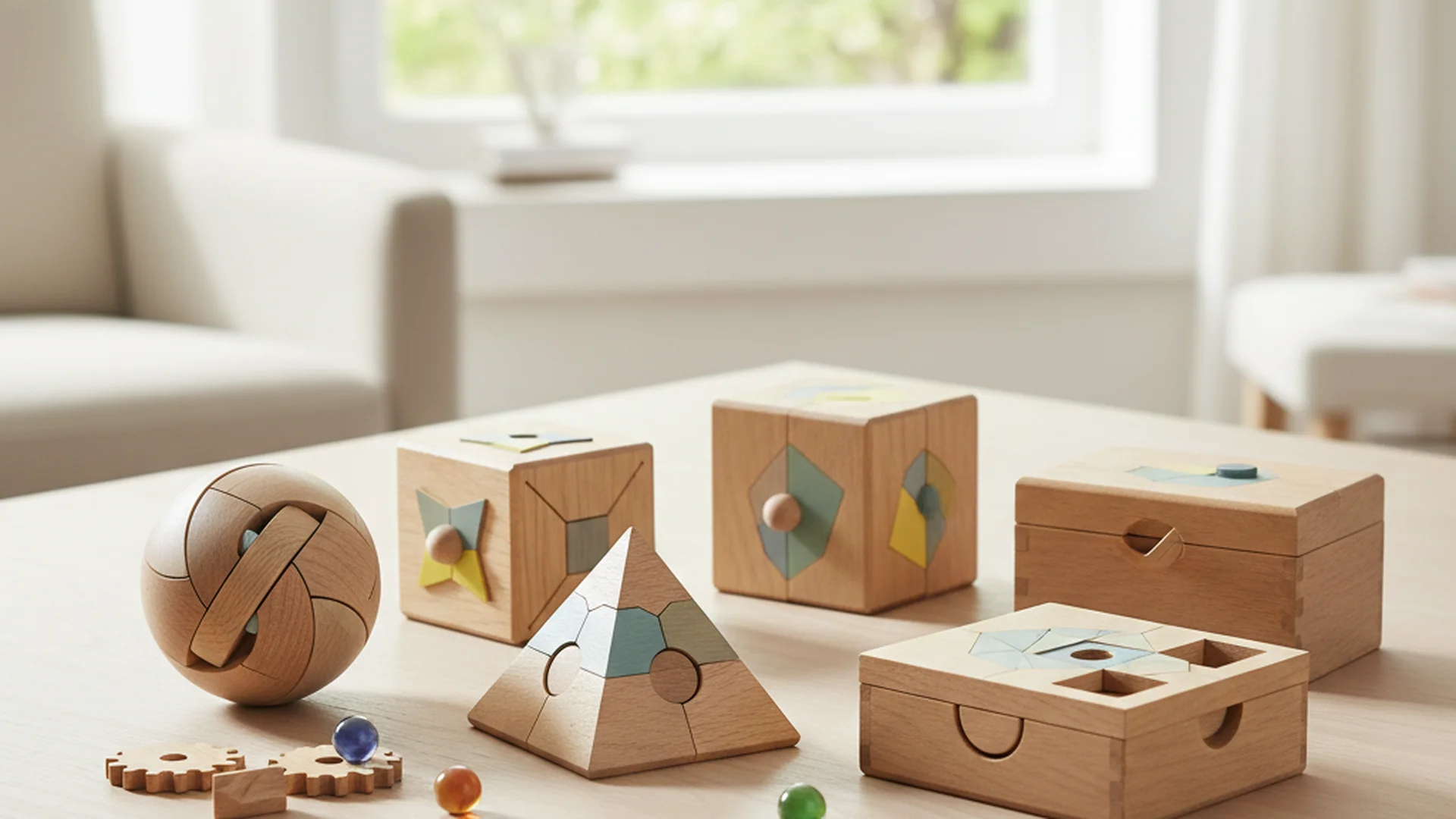
In an era dominated by high-definition screens and digital notifications, the tactile, silent challenge of puzzle boxes offers a rare form of mental sanctuary. The way the brain interacts with physical objects to solve complex problems is fascinating. There is something uniquely stimulating about a secret box—a mystery you can hold in your hand, where the solution isn't found in a line of code, but in the subtle slide of a wooden panel or the faint click of an internal tumbler.
The appeal of puzzle boxes (often referred to as secret box puzzles) is surging. Recent market data indicates a 22% year-over-year growth in sales, largely driven by the "digital detox" movement. People are hungry for "unplugged" engagement that challenges their spatial reasoning and patience. Whether you are a seasoned collector or a curious beginner looking for a unique way to store valuables, understanding the mechanics and history of these objects will deepen your appreciation for the craft.
The Hidden History: From Hakone to the World
To truly understand the puzzle box, we must look to the early 19th century in the Hakone region of Japan. During the Edo period, these boxes were known as himitsu-bako (secret boxes). They weren't originally intended as toys; they were practical tools for travelers.
Artisans used a specialized marquetry technique called yosegi-zaiku—the process of layering different colored woods to create intricate geometric patterns. These patterns weren't just for aesthetics; they served to hide the seams of the sliding panels. For a traveler on the dangerous roads of ancient Japan, a himitsu-bako was a secure way to carry tools, money, or secret documents. If a thief couldn't find the opening, they couldn't steal the contents.
Understanding the "Sun" Measurement
When shopping for traditional Japanese boxes, you will notice they are measured in "Suns." This is a traditional Japanese unit of length.
- 1 Sun = Approximately 3 cm (1.2 inches).
- 4 Sun Box = Approximately 12 cm long.
- 5 Sun Box = Approximately 15 cm long.
The larger the box, the more space the artisan has to incorporate complex internal movements. However, don't be fooled by size—some of the most difficult logic puzzles are contained within tiny 2-Sun boxes.
The Neuroscience of the Solve
Why does our brain crave the challenge of a secret box? From a neurological perspective, solving a physical puzzle engages the prefrontal cortex—the area responsible for executive function and planning—while simultaneously stimulating the parietal lobe, which processes spatial navigation.
When you finally find that hidden trigger, your brain releases a surge of dopamine. This "aha!" moment isn't just satisfying; it strengthens neural pathways associated with creative problem-solving. This is why many parents (approximately 68%) are now seeking these "unplugged" toys to help improve their children's focus and cognitive endurance. If you're interested in how these activities impact the mind, you can read more about puzzle benefits for all ages.
Advertisement
Anatomy of Difficulty: Moves and Mechanisms
While many retailers use a generic 1–10 scale, the most accurate way to judge a puzzle box's difficulty is by the number of moves required to open it.
| Level | Move Count | Description |
|---|---|---|
| Beginner | 2–10 Moves | Simple sliding panels, ideal for gifts or kids. |
| Intermediate | 12–30 Moves | Requires sequential logic; often involves "resetting" panels to move forward. |
| Advanced | 32–60 Moves | Includes hidden locks, gravity-fed pins, or rotational elements. |
| Expert | 100+ Moves | Masterpieces of engineering that can take hours or days to solve. |
Modern Innovations (2025–2026)
We are currently witnessing a "Puzzle 2.0" revolution. While traditional wood remains king, two major trends are shaping the future:
- 3D-Printed Geometries: Using high-precision printers like the Bambu Lab X1, designers are creating "impossible" internal paths that cannot be carved by hand. These often resemble 3D puzzles in their structural complexity.
- Electronic Integration: By 2026, we expect to see more "Smart Boxes" featuring NFC (Near Field Communication) and LED feedback. Imagine a box that only opens when you whistle a specific note or place it in a beam of sunlight.
Expert Solving Techniques: A Sensory Approach
Most beginners make the mistake of only using their eyes. To solve a high-quality puzzle box, you must use all your senses.
1. The Auditory Check
Hold the box to your ear and tilt it gently. Do you hear the "clack" of a wooden pin? Does it sound like a ball bearing is rolling? This tells you whether the box is gravity-dependent. Some boxes require you to spin them or tap them against your palm to dislodge an internal lock.
2. The "Pinky Pressure" Rule
3. Record the Opening
This is the most important advice we can give: Film your first successful opening. Closing a complex puzzle box is often significantly harder than opening it. You must reverse the sequence exactly, and if you've forgotten one of the 50 steps, you may be left with a pile of "open" panels that won't go back together.
Maintaining Your Collection
Because most high-end puzzle boxes are made of organic materials (wood), they are living objects that react to their environment.
- Climate Control: Wood swells in high humidity and shrinks in dry air. A box that opens perfectly in the summer might jam in the winter. Store your collection in a cool, dry place.
- Cleaning: Use only a dry microfiber cloth. Note: Never use liquid cleaners or oils like WD-40. These attract dust and can cause the wood fibers to degrade or permanently jam the tight tolerances of the mechanism.
- Grip: If a panel is stubborn but you're sure it's the right move, use a pair of thin rubber gloves. This provides the necessary traction without damaging the finish with your fingernails.
Advertisement
Common Mistakes to Avoid
- Ignoring the "Reset": Beginners often leave a box partially solved on a shelf. This exposes delicate internal sliders to dust and moisture. Always return the box to its "Start" state.
- Falling for "Red Herring Seams": Modern designers (like Akio Kamei) often carve fake lines into the wood. These look like sliding panels but are actually solid wood designed to distract you from the real mechanism.
- Confusing Price with Difficulty: A $500 box might be expensive because of the rare wood used or the artist's reputation, not because it’s hard to solve. If you want a challenge, look at the "move count," not the price tag.
Top Designers to Watch
If you are looking to invest in a masterpiece, keep an eye on these three legendary names:
- Akio Kamei (Japan): The undisputed "Godfather" of the modern movement. His works are often narrative, like a box that looks like a "broken" egg.
- Robert Yarger (Stickman): An American artist known for incredibly complex, gear-driven wooden machines that look like they belong in a steampunk novel.
- Kagen Sound: A designer who blends mathematics and music, creating boxes that might require you to play a "tune" by sliding panels in a specific rhythm.
For those who enjoy the thrill of discovery found in these boxes, you might also enjoy exploring escape room puzzle types, which often use similar mechanical logic on a larger scale.
Frequently Asked Questions
What is the difference between a puzzle box and a trick box?
In modern terminology, they are essentially the same. Historically, "trick boxes" referred to simpler mechanisms (like a single hidden button), while "puzzle box" refers to the multi-step sequential challenges we see today.
How do I find the solution if I am truly stuck?
Most reputable brands, such as Karakuri or Kubiya, include a solution link or a QR code in the packaging. If you bought a vintage box, YouTube is the best repository for visual solutions—just search the name of the box or the artist.
Are puzzle boxes safe for children?
Standardized wooden boxes are generally safe for ages 8 and up. For younger children, look for ASTM F963 or CPSIA certifications to ensure the finishes are non-toxic and there are no small parts that could pose a choking hazard.
Can they actually be used for storage?
Yes, but with a caveat. The more complex the internal mechanism, the less "empty" space there is inside. A very large box might only have enough internal room for a single wedding ring because the rest of the volume is filled with sliding pins and gears.
Conclusion
Puzzle boxes are more than just secret containers; they are a bridge between art, history, and cognitive science. They remind us that sometimes the most rewarding path is the one that requires the most patience. By engaging with these physical mysteries, we sharpen our minds, honor ancient craftsmanship, and find a much-needed moment of focus in a distracted world.
Whether you're starting with a 2-move Japanese himitsu-bako or a 3D-printed modern marvel, the journey of the "solve" is always worth the effort.
Ready to Start?
Explore our deep dives into other brain-teasing challenges.
Put it into practice
Keep reading
Puzzle Types
Math Riddles: The Ultimate Guide to Number-Based Brain Teasers
Discover the power of math riddles to boost cognitive function. Explore 2025 mathematical trends, expert solving tips, and the science of logical puzzles.
Jun 13, 2026 12 min
Puzzle Types
Mastering the Game: A Guide to All Escape Room Puzzle Types
Explore the diverse world of escape room puzzle types, from mechanical locks to AI-driven challenges. Expert insights.
Feb 21, 2026 12 min
Puzzle Types
Mastering Wire Puzzles: A Guide to Disentanglement Challenges
Discover the history, math, and expert techniques behind wire puzzles. Learn how to solve complex disentanglement challenges without force using topology.
May 15, 2025 9 min
Advertisement