Inside the Grid: How Crossword Constructors Create the Puzzles You Love
Discover the step-by-step process of how crossword constructors design puzzles. From theme development to software tools, learn the secrets of professional makers.
By Free To Play Puzzles Editorial Team 12 min read
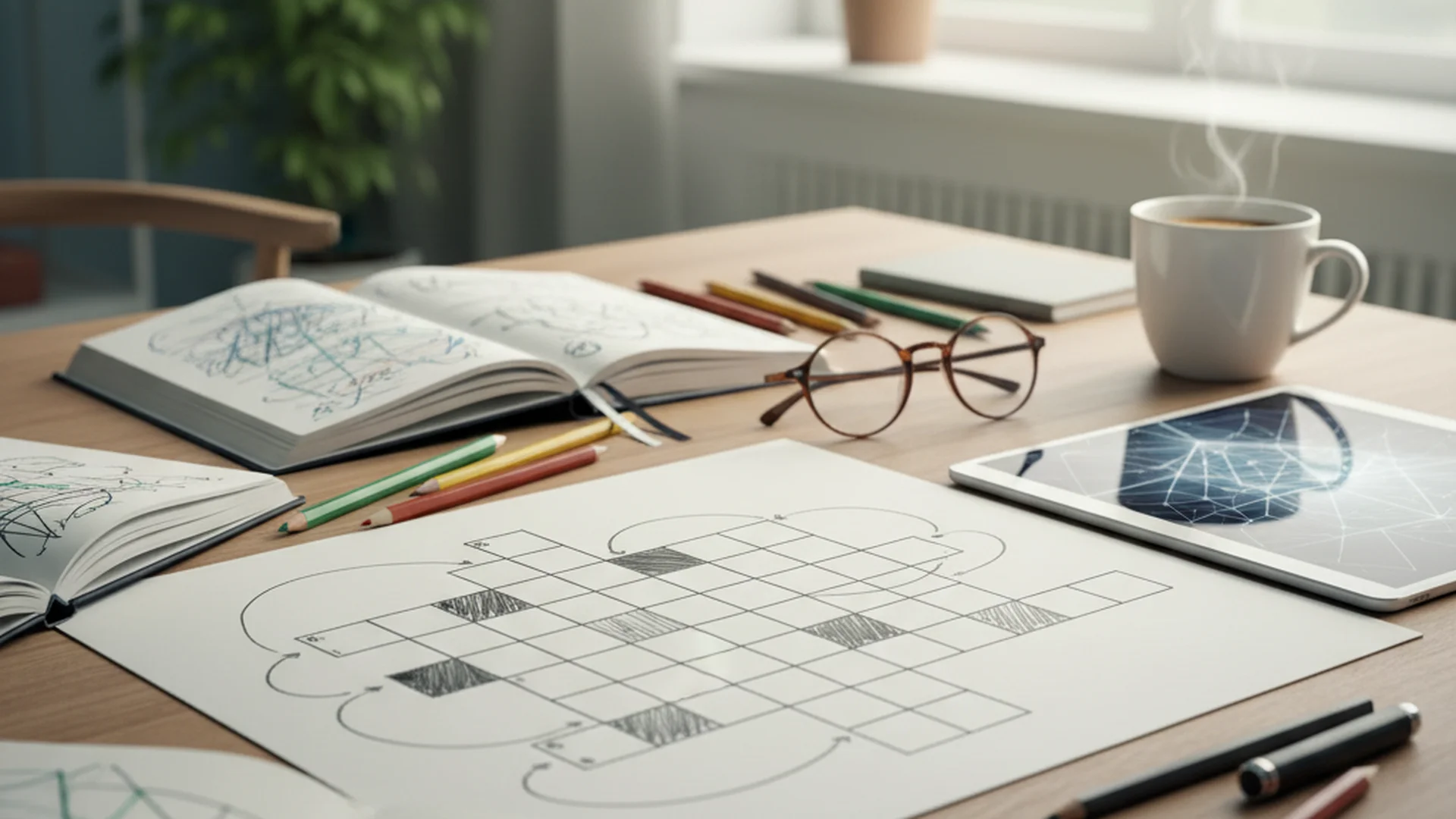
For many, the daily crossword is a quiet ritual of coffee and contemplation. But have you ever stopped to wonder about the person on the other side of the grid? The world of crossword constructors is a fascinating intersection of architectural design, linguistic acrobatics, and high-stakes statistical probability.
Learning how crosswords made in the modern era reveals that these puzzles aren't just collections of words; they are carefully engineered experiences. Every single square in a 15x15 grid is the result of hours of agonizing over "clean" fills and "sparkly" clues. Whether you are an aspiring maker or a dedicated solver, understanding the mechanics of construction will change the way you look at the black-and-white grid forever.
The Business of Being a Constructor
In 2025, the crossword industry remains a primarily freelance-driven market. Despite the ubiquity of puzzles in major publications like The New York Times, The Atlantic, and The Wall Street Journal, there are fewer than 20 people worldwide who make a full-time living solely from constructing. For most of us, it is a high-skill side hustle fueled by a love for wordplay.
The financial landscape for constructors has improved significantly in recent years. For a standard 15x15 weekday puzzle, the New York Times currently pays $500, which jumps to $750 once a constructor has three published puzzles under their belt. The massive 21x21 Sunday puzzles command even higher rates, reaching up to $2,250 for regular contributors. However, the competition is fierce; the NYT receives roughly 75 to 100 submissions every week, meaning the vast majority of work never sees the light of day.
Step 1: Theme Development (The "Hook")
The first and most critical step in how crosswords made is finding a theme. In most American-style crosswords (excluding the "themeless" puzzles often seen on Fridays and Saturdays), the constructor must find a "hook"—a set of 3 to 5 long phrases that share a clever connection.
Examples of Theme Types
- The Rebus: Where multiple letters occupy a single square (e.g., the word "HEART" inside one box).
- Hidden Connections: Phrases that all contain a secret word (e.g., COCKTAIL LOUNGE, BIRD’S EYE VIEW, and CHICKEN SCRATCH all containing birds).
- Puns and Wordplay: Altering common phrases for comedic effect (e.g., changing "A Star is Born" to "A Stir is Born" for a cooking-themed puzzle).
Advertisement
Step 2: Grid Architecture and Symmetry
Once the themes are selected, the constructor builds the "skeleton" of the puzzle. This involves placing the black squares. Most American crosswords adhere to 180-degree rotational symmetry. If you turn the puzzle upside down, the pattern of black squares should look exactly the same.
Constructors must follow several rigid rules during this phase:
- No Two-Letter Words: Every word must be at least three letters long.
- All-Over Connectivity: You cannot have "islands." Every white square must be reachable from any other white square.
- The 1/6th Rule: Generally, black squares should not exceed one-sixth of the total grid (usually 38–42 blocks for a standard 15x15).
Step 3: The "Fill" – Where Human Meets Machine
This is where the real labor begins. "The Fill" refers to the process of populating the remaining white squares around the theme entries. In 2025, no professional constructor works without software, but the software doesn't do the work for you.
Tools like CrossFire, Ingrid, or Crossword Compiler allow us to manage massive word lists. The software suggests words that fit the available gaps, but the constructor must decide which words are "good."
Sparkle vs. Glue
Constructors strive for "Sparkle"—fresh, modern phrases like RAGEBAIT or SCREEN TIME. Conversely, we try to avoid "Glue" or Crosswordese: Unusual Words like ALEE, ETUI, or NENE. These are the obscure words used solely to make a difficult corner of the grid work.
| Fill Type | Quality | Example |
|---|---|---|
| Marquee | Excellent | PIZZA PARTY |
| Fresh | Good | TIKTOK |
| Glue | Poor | ESNE (Ancient slave) |
| Obsolete | Reject | SNEE (Old knife) |
Step 4: The Art of Cluing
The final layer of construction is cluing. A standard 15x15 puzzle contains roughly 72 to 78 words, and each one needs a clue. This is the constructor's chance to show their personality.
Cluing difficulty is scaled by the day of the week. A Monday clue is literal (e.g., "The sun, for one" for STAR), while a Saturday clue might be a cryptic misdirection (e.g., "Giant in the sky?" for STAR). Editors like Will Shortz often rewrite up to 50% of a constructor’s clues to ensure they meet the specific difficulty level for that day's publication.
Advertisement
Modern Trends in 2025 and 2026
The world of crosswords is evolving rapidly. We are seeing a massive shift toward Digital-First Themes. Puzzles today frequently reference Gen Z culture and digital-native terminology to attract younger solvers. If you've solved a puzzle lately and seen "GOAT" (Greatest of All Time) or "OOF," you’re seeing this trend in action.
Another major trend is the rise of Independent Puzzles. Many top constructors are bypassing the "Old Guard" newspapers to start Substack newsletters or independent sites. These venues allow for "edgier" themes that wouldn't pass the "Breakfast Test" but resonate with a modern, online audience.
Furthermore, platforms like Puzzmo (acquired by Hearst) are gamifying the experience, making crosswords more social and community-focused. This shift is leading toward the first "Crossword Con," scheduled for New York in April 2026.
Common Mistakes to Avoid
If you are just starting out as a maker, avoid these frequent pitfalls that lead to immediate rejections:
- Reliance on AI Cluing: While AI can suggest fill, it is notoriously bad at creating clever puns. An editor can tell immediately if your clues lack a human touch.
- Duplicate Words: You cannot have the same word appear twice in a grid, even if it's part of a longer phrase (e.g., you can't have STAND and STANDBY in the same puzzle).
- Over-reliance on Abbreviations: Too many 3-letter abbreviations (like TBA, SRS, assoc) make a grid feel "stale."
- Ignoring the Solver: The most important rule for crossword constructors is that the puzzle must be solvable. If two obscure words cross each other (a "Natick"), the solver will feel cheated.
Frequently Asked Questions
Do constructors use computers to make the whole puzzle?
No. While we use software to manage word lists and check for symmetry, a human must choose the theme, select the best words from the software's suggestions, and write every single clue. A computer-generated puzzle usually lacks the "soul" and cleverness that makes crosswords fun.
Why are there no 2-letter words in crosswords?
Standard American crossword rules, established decades ago, require a minimum of 3 letters. Two-letter words are considered too easy and would clutter the grid with uninteresting "filler."
How long does it take to make one puzzle?
It varies wildly. A simple Monday puzzle might take 4–6 hours from start to finish. A complex Sunday or a highly intricate themed puzzle can take 20–30 hours or more, spread over several days of "simmering" on the ideas.
Can I submit a puzzle to the New York Times?
Yes! Anyone can submit. You should read their specific formatting guidelines and ensure your grid follows the standard rules of American vs British Crosswords. Be prepared for a wait, as their review process can take several months.
Conclusion
The work of crossword constructors is a labor of love that balances rigid constraints with infinite creativity. From the initial "Aha!" moment of a theme to the final polish of a tricky clue, making a puzzle is as much a game as solving one. Whether you're looking to improve your game by understanding 10 Crossword Solving Strategies the Pros Use or you're ready to pick up a grid-building tool yourself, the world of construction is more accessible than ever.
As we move into 2026, the boundaries of what a crossword can be continue to expand. With new tools, more diverse voices, and a global community of solvers, there has never been a better time to get lost in the grid.
Ready to build your own?
Download our professional word list and start constructing your first grid today.
Put it into practice
Keep reading
Crosswords
Mastering the Grid: How to Create Your Own Crossword Puzzle
Learn how to create crossword puzzles like a pro. From grid symmetry to inclusive cluing, our expert guide covers everything for the 2025 puzzle landscape.
Aug 18, 2026 12 min
Crosswords
Mastering Acrostic Puzzles: A Complete Guide to the Crossword’s Literary Cousin
Discover the logic and history of acrostic puzzles. Learn expert strategies, explore 2025 trends, and master the art of the Double-Crostic with this guide.
Jul 2, 2026 12 min
Crosswords
Mastering the Celebrity Crossword: Your Guide to Entertainment Puzzles
Dive into the world of the celebrity crossword. Learn expert strategies, market trends, and how to master entertainment-themed puzzles like a pro.
Jun 21, 2026 10 min
Advertisement