Einstein's Riddle Explained: The Ultimate Guide to the Zebra Puzzle
Master Einstein's Riddle with our complete guide. Learn the history, get a step-by-step solution, and discover variations of this legendary logic puzzle.
By Free To Play Puzzles Editorial Team 15 min read
Einstein's Riddle Explained: The Ultimate Guide to the Zebra Puzzle
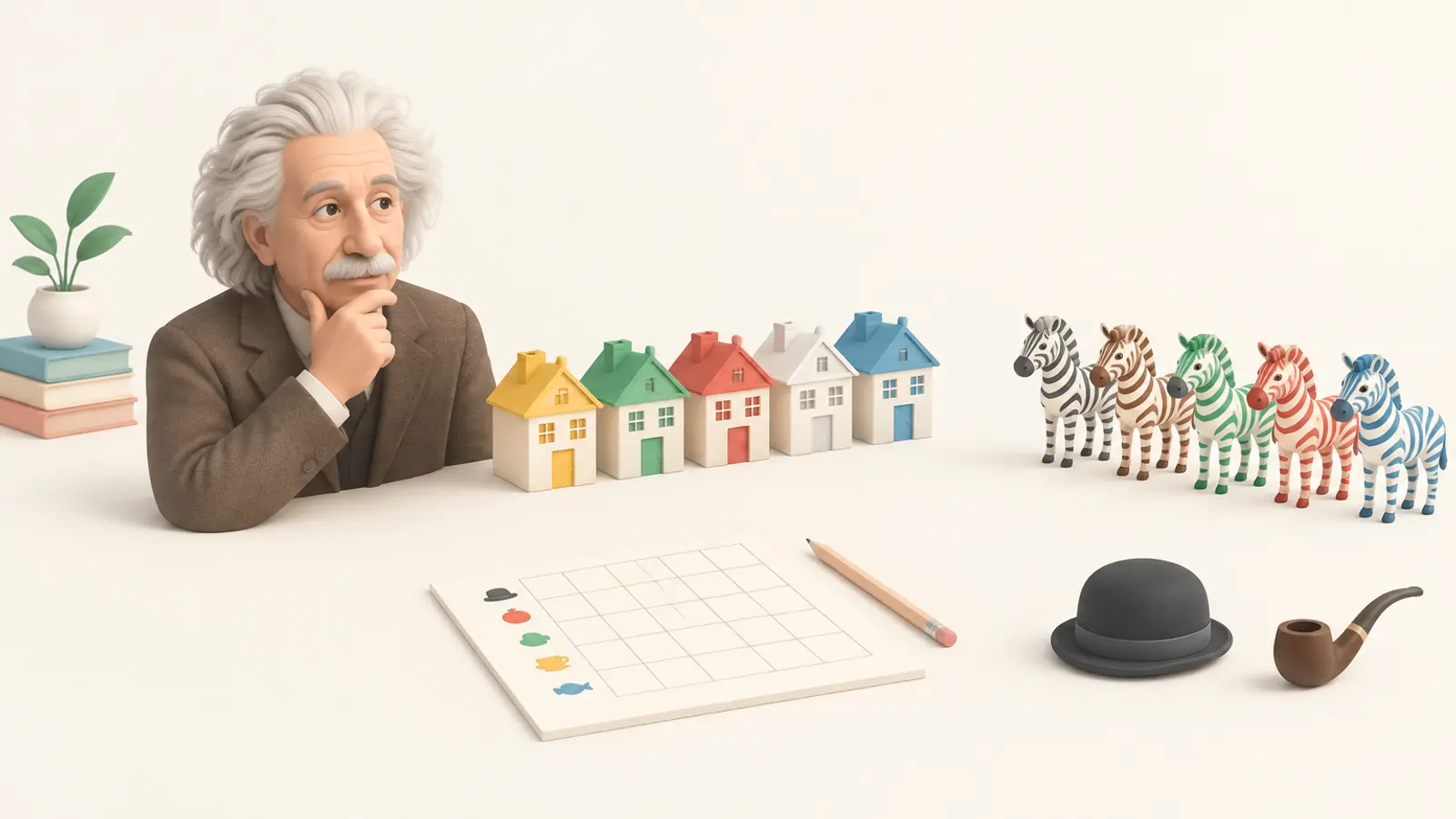
Legend has it that Albert Einstein created this riddle as a young man and claimed that only 2% of the world's population could solve it. While the attribution to Einstein is likely apocryphal, the challenge itself has captivated puzzle enthusiasts for decades and remains one of the most celebrated logic puzzles ever created.
Known by various names—Einstein's Riddle, the Zebra Puzzle, or Einstein's Five Houses—this intricate brain teaser demands careful logical deduction and systematic reasoning. In this comprehensive guide, we'll explore the riddle's history, present the complete puzzle, walk through a detailed solution strategy, and introduce you to fascinating variations.
What Is Einstein's Riddle?
Einstein's Riddle is a logic puzzle that involves deducing information about five houses, their owners, and various attributes associated with each. The solver must use a series of clues to determine which person owns a zebra and which person drinks water—facts not directly stated in any of the clues.
The puzzle epitomizes constraint satisfaction problems in logic and computer science. Every clue eliminates possibilities, and through systematic elimination and deduction, you narrow down the solution to one unique answer.
What makes this puzzle particularly challenging is the sheer number of variables: five houses, five nationalities, five beverages, five cigarette brands, and five pets. That's 25 pieces of information to organize correctly using only 15 clues.
The History and Mythology
While commonly attributed to Albert Einstein, there's no historical evidence that he created this puzzle. The earliest known publication dates to a 1962 Life International magazine issue, where it appeared without attribution to Einstein.
The association with Einstein likely emerged from the puzzle's reputation for difficulty and the claim that "only 2% of the population can solve it." This dramatic statement—also unverified—added mystique and made the puzzle famous worldwide.
The alternative name "Zebra Puzzle" comes from the fact that determining who owns the zebra is one of the puzzle's primary questions. This version became particularly popular in computer science and artificial intelligence circles as a benchmark for constraint satisfaction algorithms.
Regardless of its true origins, the puzzle has earned its place in logic puzzle history. It's been featured in countless puzzle books, used in academic settings to teach logical reasoning, and challenged millions of solvers across generations.
Advertisement
The Classic Einstein's Riddle
Here is the traditional version of the puzzle. Before reading the solution, you might want to try solving it yourself—grab a piece of paper and prepare for a genuine mental workout.
The Setup
There are five houses in five different colors in a row. In each house lives a person of a different nationality. The five owners drink a certain type of beverage, smoke a certain brand of cigar, and keep a certain pet. No owners have the same pet, smoke the same brand of cigar, or drink the same beverage.
The Clues
- The Brit lives in the red house
- The Swede keeps dogs as pets
- The Dane drinks tea
- The green house is on the immediate left of the white house
- The green house's owner drinks coffee
- The owner who smokes Pall Mall rears birds
- The owner of the yellow house smokes Dunhill
- The owner living in the center house drinks milk
- The Norwegian lives in the first house
- The owner who smokes Blend lives next to the one who keeps cats
- The owner who keeps the horse lives next to the one who smokes Dunhill
- The owner who smokes Bluemaster drinks beer
- The German smokes Prince
- The Norwegian lives next to the blue house
- The owner who smokes Blend lives next to the one who drinks water
The Questions
- Who owns the zebra?
- Who drinks water?
Understanding the Problem Structure
Before diving into the solution, let's understand what we're working with:
Variables to Determine
For each of the five houses (positions 1-5 from left to right), we need to determine:
- Nationality: Brit, Swede, Dane, Norwegian, German
- Color: Red, Green, White, Yellow, Blue
- Beverage: Tea, Coffee, Milk, Beer, Water
- Cigar: Pall Mall, Dunhill, Blend, Bluemaster, Prince
- Pet: Dogs, Birds, Cats, Horse, Zebra
That's 5 categories × 5 options = 25 pieces of information to place correctly.
Constraint Types
The clues provide different types of constraints:
- Direct associations (e.g., "The Brit lives in the red house")
- Position constraints (e.g., "The Norwegian lives in the first house")
- Adjacency constraints (e.g., "The green house is immediately left of the white house")
- Neighbor constraints (e.g., "The Norwegian lives next to the blue house")
Understanding these constraint types helps you know which clues to apply when.
Step-by-Step Solution Strategy
Solving Einstein's Riddle requires methodical organization. Here's the systematic approach:
Step 1: Create a Grid
Set up a grid with houses 1-5 across the top and all five categories (Nationality, Color, Beverage, Cigar, Pet) down the side. This gives you 25 cells to fill.
Step 2: Start with Absolute Facts
Some clues give you definite positions:
From Clue 9: The Norwegian lives in house 1.
From Clue 8: The center house (house 3) owner drinks milk.
Fill these in immediately. You now know:
- House 1: Norwegian
- House 3: Milk
Step 3: Apply Position-Based Clues
From Clue 14: The Norwegian lives next to the blue house.
Since the Norwegian is in house 1, the blue house must be house 2.
- House 1: Norwegian
- House 2: Blue
- House 3: Milk
From Clue 4: The green house is immediately left of the white house.
This means green and white are consecutive. Possible positions:
- Green in 1, White in 2 (impossible—house 2 is blue)
- Green in 2, White in 3 (impossible—house 2 is blue)
- Green in 3, White in 4
- Green in 4, White in 5
Since house 2 is blue, green must be in position 3 or 4.
From Clue 5: The green house's owner drinks coffee.
But house 3's owner drinks milk, so the green house cannot be house 3.
Therefore: Green is house 4, White is house 5.
- House 1: Norwegian
- House 2: Blue
- House 3: Milk
- House 4: Green, Coffee
- House 5: White
Step 4: Determine Remaining Colors
We have Red and Yellow left for houses 1 and 3.
From Clue 1: The Brit lives in the red house.
The Norwegian lives in house 1, so house 1 cannot be red (the Brit isn't Norwegian).
Therefore: House 1 is Yellow, House 3 is Red.
- House 1: Norwegian, Yellow
- House 2: Blue
- House 3: Red, Milk
- House 4: Green, Coffee
- House 5: White
Step 5: Apply Direct Association Clues
From Clue 1: The Brit lives in the red house.
House 3 is red, so the Brit lives in house 3.
- House 1: Norwegian, Yellow
- House 2: Blue
- House 3: Brit, Red, Milk
- House 4: Green, Coffee
- House 5: White
From Clue 3: The Dane drinks tea.
We know milk (house 3) and coffee (house 4) positions. Tea must be in house 1, 2, or 5.
From Clue 7: The owner of the yellow house smokes Dunhill.
House 1 is yellow, so:
- House 1: Norwegian, Yellow, Dunhill
- House 2: Blue
- House 3: Brit, Red, Milk
- House 4: Green, Coffee
- House 5: White
Step 6: Use Adjacency Clues
From Clue 11: The owner who keeps the horse lives next to the one who smokes Dunhill.
Dunhill is in house 1, so the horse is in house 2.
- House 1: Norwegian, Yellow, Dunhill
- House 2: Blue, Horse
- House 3: Brit, Red, Milk
- House 4: Green, Coffee
- House 5: White
From Clue 15: The owner who smokes Blend lives next to the one who drinks water.
We have Milk (house 3) and Coffee (house 4) placed. Water is in house 1, 2, or 5.
From Clue 12: The owner who smokes Bluemaster drinks beer.
So beer is in house 1, 2, or 5 (whichever doesn't have water and isn't house 3 or 4).
Step 7: Deduce Remaining Beverages
We have: Water, Tea, and Beer for houses 1, 2, and 5.
From Clue 15: Blend smoker lives next to water drinker.
Let's test possibilities. If water is in house 1, Blend must be in house 2. If water is in house 2, Blend is in house 1 or 3. If water is in house 5, Blend is in house 4.
From Clue 10: Blend smoker lives next to cat owner.
This creates another adjacency constraint for Blend.
Let's reason: If water is in house 1 (Norwegian), then Blend is in house 2. That means cats are next to house 2—either house 1 or house 3. House 2 has a horse, so cats would be in house 1 or 3.
Let's try: Water in house 1.
- House 1: Norwegian, Yellow, Dunhill, Water
- House 2: Blue, Horse, Blend
But from Clue 10, Blend is next to cats. Houses 1 and 3 are next to house 2. House 2 has a horse. Can house 1 have cats? Yes. Can house 3 have cats? Yes.
This is getting complex. Let's try another approach.
From Clue 3: The Dane drinks tea.
The Dane hasn't been placed yet. The Dane must be in house 2 or 5 (we have Norwegian in 1, Brit in 3, and two spots left for Swede, Dane, and German).
Actually, we have Norwegian (house 1), Brit (house 3), and three nationalities left: Swede, Dane, German for houses 2, 4, and 5.
If Dane drinks tea, and tea is in house 2 or 5, then Dane is in house 2 or 5.
From Clue 13: The German smokes Prince.
From Clue 2: The Swede keeps dogs.
Let's continue systematically. We know house 4 has coffee. The Dane drinks tea (not coffee), so the Dane is not in house 4. The Dane is in house 2 or 5.
If Dane is in house 2, then house 2 has tea. If Dane is in house 5, then house 5 has tea.
That leaves water and beer for the remaining positions among houses 1, 2, and 5.
Step 8: Solve by Elimination
Let's say Dane is in house 2 with tea:
- House 1: Norwegian, Yellow, Dunhill
- House 2: Dane, Blue, Tea, Horse
- House 3: Brit, Red, Milk
- House 4: Green, Coffee
- House 5: White
That leaves Swede and German for houses 4 and 5.
From Clue 2: Swede keeps dogs. From Clue 13: German smokes Prince.
Remaining beverages: Water and Beer for houses 1 and 5.
From Clue 12: Bluemaster smoker drinks beer.
From Clue 15: Blend smoker lives next to water drinker.
If water is in house 1, Blend is in house 2. If water is in house 5, Blend is in house 4.
We have Dunhill in house 1. Remaining cigars: Pall Mall, Blend, Bluemaster, Prince.
If Blend is in house 2:
- House 2: Dane, Blue, Tea, Horse, Blend
Then from Clue 10, cats are next to house 2 (house 1 or 3).
From Clue 6: Pall Mall smoker rears birds.
Remaining pets: Dogs, Birds, Cats, Zebra (Horse is in house 2).
If water is in house 1:
- House 1: Norwegian, Yellow, Dunhill, Water
Then beer is in house 5:
- House 5: White, Beer
From Clue 12: Bluemaster smoker drinks beer.
- House 5: White, Beer, Bluemaster
Remaining cigars for houses 3 and 4: Pall Mall and Prince.
From Clue 13: German smokes Prince.
German is in house 4 or 5. If German is in house 5:
- House 5: German, White, Beer, Bluemaster
But that contradicts Clue 13 (German smokes Prince, not Bluemaster).
So German is in house 4:
- House 4: German, Green, Coffee, Prince
Then Swede is in house 5:
- House 5: Swede, White, Beer, Bluemaster
From Clue 2: Swede keeps dogs.
- House 5: Swede, White, Beer, Bluemaster, Dogs
Remaining cigar for house 3: Pall Mall.
- House 3: Brit, Red, Milk, Pall Mall
From Clue 6: Pall Mall smoker rears birds.
- House 3: Brit, Red, Milk, Pall Mall, Birds
Remaining pets: Cats and Zebra for houses 1 and 4.
From Clue 10: Blend smoker lives next to cats.
Blend is in house 2, so cats are in house 1 or 3. House 3 has birds, so cats are in house 1.
- House 1: Norwegian, Yellow, Dunhill, Water, Cats
- House 4: German, Green, Coffee, Prince, Zebra
Advertisement
The Complete Solution
Let's compile our final answer:
| House | 1 | 2 | 3 | 4 | 5 |
|---|---|---|---|---|---|
| Nationality | Norwegian | Dane | Brit | German | Swede |
| Color | Yellow | Blue | Red | Green | White |
| Beverage | Water | Tea | Milk | Coffee | Beer |
| Cigar | Dunhill | Blend | Pall Mall | Prince | Bluemaster |
| Pet | Cats | Horse | Birds | Zebra | Dogs |
Answers to the Questions
Who owns the zebra? The German (in house 4)
Who drinks water? The Norwegian (in house 1)
Key Solving Techniques
Working through Einstein's Riddle teaches several valuable logical reasoning techniques:
1. Start with Absolutes
Always begin with clues that give definite positions or direct facts. These create your foundation.
2. Use Constraint Propagation
Every fact you establish eliminates possibilities elsewhere. If the Norwegian is in house 1, the Norwegian cannot be in houses 2-5.
3. Test Hypotheses
When stuck, make a reasonable assumption and follow its implications. If it leads to a contradiction, you know the opposite must be true.
4. Track Adjacency Carefully
Clues about neighbors are powerful but easy to misapply. Always verify both possible adjacent positions.
5. Maintain Organization
A clear grid is essential. Mark eliminated possibilities to avoid reconsidering them.
6. Look for Forced Moves
Sometimes only one option remains for a category in a house, even if you haven't directly deduced it—elimination provides the answer.
Variations and Similar Puzzles
Einstein's Riddle has inspired countless variations. Here are some popular alternatives:
The Fish Version
Some versions ask "Who owns the fish?" instead of "Who owns the zebra?" The structure remains identical, just with different wording.
Expanded Versions
More complex variants include:
- Six or seven houses instead of five
- Additional categories (like car brands or occupations)
- More obscure clues requiring deeper inference
Simplified Versions
For beginners or younger solvers:
- Three or four houses instead of five
- Fewer categories (perhaps only nationality, color, and pet)
- More direct clues with less ambiguity
The Hardest Variations
Puzzle creators have designed versions where:
- Clues are presented in deliberately misleading ways
- Some clues appear to contradict others (requiring careful interpretation)
- Multiple valid solutions exist unless you find hidden constraints
Digital Versions
Modern apps and websites offer:
- Interactive grids that auto-eliminate impossibilities
- Hint systems that nudge you toward the next deduction
- Timed challenges for competitive solving
The Cognitive Benefits
Solving logic puzzles like Einstein's Riddle offers significant mental benefits:
Improved Logical Reasoning
Working through complex deductions strengthens your ability to think systematically and identify relationships between pieces of information.
Enhanced Working Memory
Keeping track of multiple constraints simultaneously exercises your working memory capacity—the mental workspace that holds and manipulates information.
Better Problem-Solving Skills
The techniques you develop (breaking problems into steps, testing hypotheses, backtracking when stuck) transfer to real-world challenges.
Pattern Recognition
Regular puzzle-solving helps your brain identify patterns and structural similarities across different problems.
Patience and Persistence
Complex puzzles teach the value of sustained effort. The satisfaction of solving a difficult puzzle after extended work builds mental resilience.
Research in cognitive psychology suggests that engaging with challenging logic puzzles can help maintain cognitive function as we age, potentially reducing the risk of cognitive decline.
Tips for Solving Einstein's Riddle
If you're attempting this puzzle for the first time, here are some practical tips:
Create a Proper Grid
Don't try to hold everything in your head. Draw a clear 5×5 grid with house positions across the top and categories down the side. Leave space to write possibilities in each cell.
Use Pencil
You'll make mistakes. Being able to erase is crucial.
Mark Eliminations
When you determine what cannot go in a cell, mark it. This prevents wasted time reconsidering eliminated options.
Number Your Deductions
Write small numbers next to deductions indicating which clue(s) led to that conclusion. This helps when you need to backtrack.
Take Breaks
If you're stuck for more than 10 minutes, step away. Fresh eyes often spot what mental fatigue misses.
Check Your Logic
Before declaring a solution, verify that all 15 clues are satisfied by your answer. A single violation means something's wrong.
Start with What You Know
Don't jump to complex deductions. Milk goes in house 3. Norwegian goes in house 1. Start there.
Work Systematically
Rather than randomly applying clues, work through them in order, then circle back as new information emerges.
Common Mistakes to Avoid
Even experienced solvers make these errors:
Assuming Instead of Deducing
The puzzle requires pure logic. Every conclusion must follow necessarily from the clues, not from assumptions or hunches.
Misreading "Next To"
"Next to" means adjacent (immediately beside), not just somewhere nearby. This distinction is crucial.
Forgetting "Immediate Left"
Clue 4 says "immediate left," not just "left of." Green must be directly left of white, not just somewhere to the left.
Not Checking All Constraints
Before finalizing a deduction, verify it doesn't violate any existing clues.
Giving Up Too Soon
This puzzle can take 30-60 minutes for first-time solvers. That's normal. Persistence pays off.
Why Einstein's Riddle Endures
Decades after its creation, this puzzle remains popular because it hits a sweet spot:
It's challenging but solvable. The puzzle seems impossibly complex at first, but methodical reasoning always leads to the answer. No guessing required.
It's self-contained. You don't need special knowledge—just logic. Anyone can attempt it.
It's satisfying. The moment everything clicks into place and you find the zebra owner delivers genuine intellectual pleasure.
It's teachable. The puzzle demonstrates logical reasoning principles in a concrete, engaging way.
It's scalable. Variations can be made easier or harder, making the puzzle accessible across skill levels.
Ready for More Logic Challenges?
Einstein's Riddle represents the pinnacle of constraint-based logic puzzles. If you've mastered it—or if you're hungry for more mental challenges—our collection of free logic puzzles offers everything from beginner-friendly deduction games to expert-level brain teasers.
Logic puzzles train your mind to think more clearly, reason more effectively, and approach problems more systematically. Whether you're solving them for mental exercise, entertainment, or cognitive maintenance, puzzles like Einstein's Riddle offer rewards far beyond the simple satisfaction of finding the solution.
Frequently Asked Questions
Did Einstein really create this puzzle?
Almost certainly not. While the puzzle is commonly attributed to Einstein, no historical evidence supports this claim. It first appeared in print in 1962, years after Einstein's death, with no attribution.
Can only 2% of people solve it?
This claim is also unverified and likely exaggerated. The puzzle is challenging but not impossibly difficult. With patience and systematic reasoning, most people can solve it given enough time.
How long should it take to solve?
First-time solvers might need 30-90 minutes. With experience, you can solve it in 15-30 minutes. Expert solvers can complete it in under 10 minutes.
Is there only one solution?
Yes. The clues are carefully constructed to allow exactly one valid arrangement of all attributes across the five houses.
What if I get stuck?
Go back to the basics. Review each clue and verify your existing deductions. Often you've made a small error early on that cascades into confusion. Also, take a break—fresh eyes help.
Are there computer programs that solve it?
Yes. Constraint satisfaction algorithms can solve this puzzle almost instantly. It's frequently used as a benchmark in artificial intelligence research.
Why is it called the Zebra Puzzle?
Because determining who owns the zebra is one of the puzzle's two main questions. The zebra isn't mentioned in any clue, making its owner a pure deduction challenge.
Can children solve this puzzle?
Bright children aged 10-12 and up can attempt it, though they may need guidance. Simplified versions with fewer houses and categories work better for younger solvers.
Challenge your logical reasoning with our complete collection of free logic puzzles. From deduction grids to lateral thinking challenges, sharpen your mind one puzzle at a time!
Put it into practice
Keep reading
Number Logic
Grid Logic Puzzles: How to Solve Them
Master grid logic puzzles with expert strategies. Learn elimination techniques, deductive reasoning, and step-by-step solving methods to crack any logic grid puzzle.
Jan 19, 2025 14 min
Number Logic
Sudoku for Beginners: Complete Guide to Solving Your First Puzzle
Learn how to solve Sudoku puzzles from scratch. This beginner-friendly guide covers rules, basic strategies, and step-by-step techniques to master your first puzzle.
Jan 15, 2025 12 min
Logic Puzzles
Mastering the IQ Puzzle: The Ultimate Guide to Logic and SmartGames (2025-2026)
Discover the cognitive benefits and expert strategies for solving the IQ puzzle. Learn about 2025 trends, SmartGames, and how to sharpen your mind effectively.
Jun 20, 2026 12 min
Advertisement