Grid Logic Puzzles: How to Solve Them
Master grid logic puzzles with expert strategies. Learn elimination techniques, deductive reasoning, and step-by-step solving methods to crack any logic grid puzzle.
By Free To Play Puzzles Editorial Team 14 min read
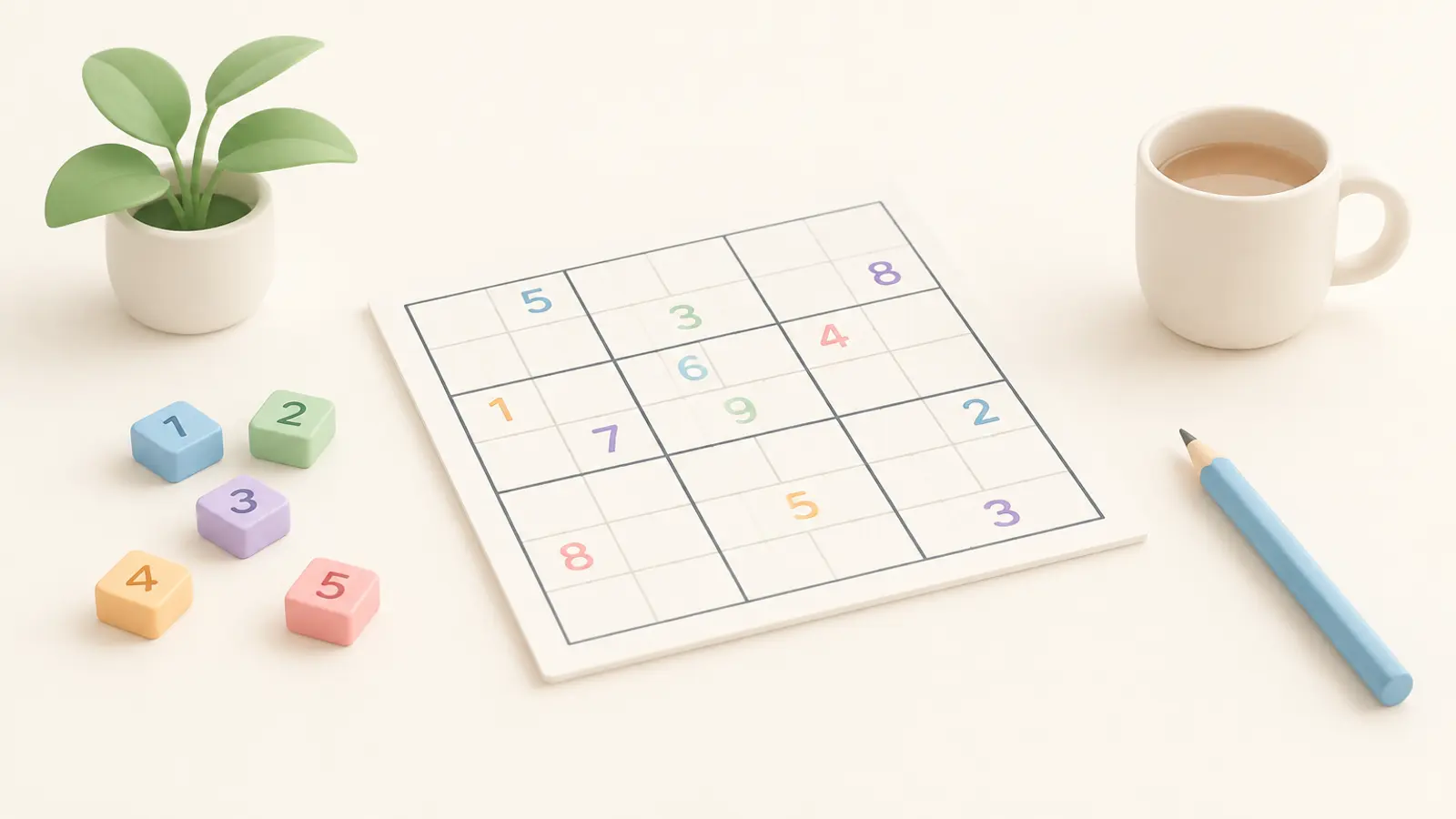
Grid Logic Puzzles: How to Solve Them
You're sitting in front of a grid logic puzzle, staring at a matrix of empty boxes and a series of clues. The puzzle seems to taunt you with its precise logic, promising that every single square has exactly one correct answer—if only you can figure out how to find it.
Grid logic puzzles, also known as logic grid puzzles or zebra puzzles, are some of the most satisfying brain teasers around. Unlike crosswords or Sudoku, they require pure deductive reasoning without any guessing. Every answer is hidden in the clues, waiting to be discovered through careful logical thinking.
This comprehensive guide will teach you everything you need to master grid logic puzzles, from understanding the basic structure to applying advanced elimination techniques that crack even the toughest challenges.
What Are Grid Logic Puzzles?
Grid logic puzzles present you with a scenario involving multiple categories of items and a set of clues that reveal relationships between them. Your job is to use pure logic to figure out which items in different categories belong together.
A Classic Example
Imagine this scenario:
Categories:
- People: Alice, Bob, Carol
- Pets: Cat, Dog, Fish
- Colors: Red, Blue, Green
Clues:
- Bob doesn't own the cat
- The person who likes red owns the fish
- Carol doesn't like blue
- Alice owns the dog
Your task is to determine who owns which pet and likes which color. The answer is deterministic—there's only one possible solution that satisfies all clues.
The Grid Structure
Grid logic puzzles use a matrix where:
- Each row represents one item from a category
- Each column represents one item from another category
- You mark boxes to show relationships (typically X for "no" and O or checkmark for "yes")
- Each row and column can have only ONE positive mark
The genius of this system is that every piece of information affects multiple parts of the grid, creating a chain reaction of logical deductions.
The Fundamental Rules
Before diving into solving strategies, understand these core principles:
Rule 1: One-to-One Relationships
Each item in one category relates to exactly one item in every other category. If Alice owns the dog, she cannot also own the cat or fish.
Rule 2: Elimination Is King
When you mark an X (eliminating a possibility), you're actually gathering information. If a row has Xs in all boxes except one, that last box must be a match.
Rule 3: Cross-Reference Everything
When you discover a match between two items, immediately mark all related eliminations. This creates a cascade effect that unlocks more clues.
Rule 4: All Information Is Interconnected
The puzzle is a closed system. Every clue, every mark, every deduction affects other parts of the grid. Nothing exists in isolation.
Advertisement
Setting Up Your Grid
Proper setup makes solving dramatically easier.
Step 1: Draw the Grid Structure
For a puzzle with three categories of three items each, you need three grids:
Grid 1: People vs. Pets Grid 2: People vs. Colors Grid 3: Pets vs. Colors
Each grid is a 3×3 matrix of empty boxes.
For puzzles with more categories (four, five, or six), you'll need more grids. A four-category puzzle requires six grids—one for each category pair combination.
Step 2: Label Everything Clearly
Write category names and item names clearly. Cramped, messy grids lead to mistakes. Use:
- Clear borders between boxes
- Distinct marks for yes (O, ✓) and no (X, -)
- Enough space to write neatly
Step 3: List All Clues
Write or print all clues where you can see them constantly. You'll reference them repeatedly throughout solving.
Step 4: Have Scratch Paper Ready
Complex deductions sometimes require working through possibilities. Keep scratch paper handy for testing logical chains.
Essential Solving Strategies
Now let's explore the techniques that unlock grid logic puzzles.
Strategy 1: Direct Elimination from Clues
Start with the easiest clues—those that directly state what is or isn't true.
Example Clue: "Bob doesn't own the cat"
Action:
- Find Bob's row in the People vs. Pets grid
- Find the Cat column
- Mark an X at their intersection
This seems simple, but it's foundational. Process every direct elimination clue first.
Example Clue: "Alice owns the dog"
Action:
- Mark O at the Alice-Dog intersection
- Mark X in all other boxes in Alice's row (she can't own cat or fish)
- Mark X in all other boxes in the Dog column (Bob and Carol can't own the dog)
This single positive mark creates multiple eliminations, which is exactly what you want.
Strategy 2: Last Box Standing
After marking several Xs in a row or column, check if only one box remains empty.
The Logic: If Alice can't own the cat (X) and can't own the fish (X), then she MUST own the dog. Mark it with an O.
Always Apply Immediately: Whenever you mark Xs, scan for any rows or columns where only one possibility remains. Mark it as a match, then mark the related eliminations.
This creates a beautiful chain reaction. One deduction leads to another, then another, cascading through the grid.
Strategy 3: Transitive Property Chains
When you know A relates to B, and B relates to C, then A must relate to C.
Example:
- Clue 1: Alice owns the dog
- Clue 2: The person who owns the dog likes blue
Deduction: Alice likes blue (even though no clue directly states this)
Action:
- Mark Alice-Blue as a match in the People vs. Colors grid
- Mark eliminations for Alice-Red and Alice-Green
- Mark eliminations for Bob-Blue and Carol-Blue
Strategy 4: Process of Elimination with Clues
Some clues give you partial information. Use elimination to extract the rest.
Example Clue: "The cat owner doesn't like red or green"
Analysis:
- There are only three colors: red, green, blue
- If not red and not green, then it must be blue
- Therefore: Cat owner likes blue
Action:
- Find the Cat column in the Pets vs. Colors grid
- Mark X at Cat-Red and Cat-Green
- Mark O at Cat-Blue
- Make all related eliminations
This technique transforms vague clues into concrete matches.
Strategy 5: Comparative Clues
Some clues compare items using words like "before," "after," "more," or "less."
Example Clue: "Alice is taller than the cat owner"
Deduction: Alice doesn't own the cat (you can't be taller than yourself)
Action: Mark X at Alice-Cat intersection
These comparative clues often hide simple eliminations within seemingly complex statements.
Strategy 6: Neither/Nor Deductions
Pay special attention to negative clues about multiple items.
Example Clue: "Neither Bob nor Carol owns the fish"
Analysis:
- Bob doesn't own the fish (mark X)
- Carol doesn't own the fish (mark X)
- Only Alice remains in the fish column
- Therefore: Alice owns the fish
Action:
- Mark X at Bob-Fish and Carol-Fish
- Notice Alice-Fish is the last box standing
- Mark O at Alice-Fish
- Mark all related eliminations
Strategy 7: Grouping and Category Logic
Some clues group items together.
Example Clue: "The people who own cats and dogs both like warm colors (red or orange)"
Analysis:
- Warm colors are red and orange
- Therefore neither the cat nor dog owner likes blue
- By elimination, the fish owner likes blue
Action:
- Mark X at Cat-Blue and Dog-Blue in Pets vs. Colors grid
- Notice Fish-Blue is the last box standing
- Mark O at Fish-Blue
- Continue with related deductions
Step-by-Step Solving Process
Let's walk through solving a complete puzzle from start to finish.
The Puzzle Setup
Scenario: Three friends (Alice, Bob, Carol) each own one pet (cat, dog, fish) and prefer one color (red, blue, green).
Clues:
- Bob doesn't own the cat
- The dog owner's favorite color is blue
- Carol doesn't like green
- Alice doesn't own the fish
- The person who likes red owns the cat
Step 1: Set Up Your Grids
Create three grids:
- People vs. Pets (3×3)
- People vs. Colors (3×3)
- Pets vs. Colors (3×3)
Step 2: Process Direct Eliminations
From Clue 1: Bob doesn't own the cat
- Mark X at Bob-Cat
From Clue 3: Carol doesn't like green
- Mark X at Carol-Green
From Clue 4: Alice doesn't own the fish
- Mark X at Alice-Fish
Step 3: Look for Last Box Standing
Check the People vs. Pets grid:
- Alice row: Can't own fish (X). Has two options: cat or dog
- Bob row: Can't own cat (X). Has two options: dog or fish
- Carol row: Has three options still
No clear winner yet. Continue gathering information.
Step 4: Process Linked Clues
From Clue 2: The dog owner's favorite color is blue
- We don't know who owns the dog yet, but we know: Dog = Blue
- Mark O at Dog-Blue in Pets vs. Colors grid
- Mark X at Dog-Red and Dog-Green
From Clue 5: The person who likes red owns the cat
- We know: Red = Cat
- Mark O at Cat-Red in Pets vs. Colors grid
- Mark X at Cat-Blue and Cat-Green
Step 5: Use the Transitive Property
Now check Pets vs. Colors grid:
- Cat = Red (from clue 5)
- Dog = Blue (from clue 2)
- By elimination: Fish = Green
Mark O at Fish-Green and mark Xs at the other Fish boxes.
Step 6: Cross-Reference Back
Now we know Fish = Green. Who can own the fish?
- Alice doesn't own fish (X from clue 4)
- Check who CAN'T like green:
- Carol doesn't like green (X from clue 3)
- Therefore, Bob must own the fish!
Mark O at Bob-Fish, then eliminate:
- X at Bob-Dog (can't own both)
- X at Alice-Fish and Carol-Fish (already done/confirmed)
Step 7: Continue the Chain
People vs. Pets grid now shows:
- Bob owns Fish (O)
- Bob can't own Cat (X from clue 1) or Dog (X from step 6)
- Alice can't own Fish (X from clue 4)
This means Alice and Carol own Cat and Dog in some order.
From Clue 1: Bob doesn't own cat (confirming our X) We need to figure out if Alice or Carol owns the cat.
Step 8: Use Color Information
We know:
- Cat owner likes red (from clue 5)
- Dog owner likes blue (from clue 2)
- Carol doesn't like green (clue 3)
Since there are only three colors (red, blue, green):
- Bob owns fish, and fish = green, so Bob likes green
- Carol doesn't like green (X from clue 3)
- Carol must like either red or blue
Let's test: If Carol owns the cat, then Carol likes red (from clue 5). If Carol owns the dog, then Carol likes blue (from clue 2).
Both are possible so far. We need more information.
Step 9: Return to Elimination
People vs. Colors grid:
- Bob-Green = O (because Bob owns fish and fish = green)
- Carol-Green = X (from clue 3)
- Alice must like either red or blue
- Carol must like either red or blue
People vs. Pets grid:
- Bob-Fish = O
- Alice and Carol split Cat and Dog
Since Cat = Red and Dog = Blue:
- Whoever owns cat likes red
- Whoever owns dog likes blue
Carol doesn't like green, so Carol likes red OR blue. Let's see which.
By elimination in the People vs. Colors grid for the Green column:
- Bob-Green = O
- Carol-Green = X
- Therefore: Alice-Green = X (last box standing rule)
So Alice likes either red or blue.
Step 10: Final Deduction
Now we know:
- Alice doesn't like green, doesn't own fish
- Alice must own cat or dog
- If Alice owns cat, Alice likes red
- If Alice owns dog, Alice likes blue
Let's use what we know about Carol:
- Carol doesn't like green
- Carol must own cat or dog
- Carol likes red or blue
There are only two people (Alice and Carol) to own two pets (cat and dog):
- One owns cat (and likes red)
- One owns dog (and likes blue)
We can assign either way, but let's check for constraints we might have missed.
Actually, let me reconsider. Let's see if we have enough info:
Bob = Fish = Green (confirmed)
That leaves Alice and Carol for Cat and Dog. Cat = Red Dog = Blue
No additional constraints tell us which person owns which. Let me re-read the clues...
Actually, I have all the clues. Let me check if the puzzle is fully constrained or if I missed something.
Wait—let me check the grids again more carefully. Sometimes one small mark reveals everything.
People vs. Pets:
- Alice-Fish = X
- Bob-Cat = X
- Bob-Fish = O (deduced)
- Bob-Dog = X (from Bob-Fish being O)
That means Bob owns only fish.
For Alice:
- Alice-Fish = X
- Alice owns Cat or Dog
For Carol:
- Carol owns Cat or Dog
Now, in the People vs. Colors grid:
- Bob-Green = O
- Bob-Red = X (can't have two colors)
- Bob-Blue = X (can't have two colors)
- Carol-Green = X
- Alice-Green = X (by elimination in green column)
So:
- Alice likes Red or Blue
- Carol likes Red or Blue
And we know:
- Cat owner likes Red
- Dog owner likes Blue
This still leaves two valid possibilities:
- Alice owns Cat (likes Red), Carol owns Dog (likes Blue)
- Alice owns Dog (likes Blue), Carol owns Cat (likes Red)
Hmm, let me verify I haven't missed a clue that would break one of these scenarios...
Re-reading all clues:
- Bob doesn't own the cat ✓ (Bob owns fish)
- The dog owner's favorite color is blue ✓ (works in both scenarios)
- Carol doesn't like green ✓ (Carol likes red or blue)
- Alice doesn't own the fish ✓ (Alice owns cat or dog)
- The person who likes red owns the cat ✓ (works in both scenarios)
It appears this puzzle as stated has two valid solutions! This would be an improperly constructed logic puzzle. Let me add a sixth clue to make it deterministic:
Clue 6: Alice's favorite color is not blue
With this additional clue:
- Alice doesn't like blue
- Therefore Alice likes red (only option left)
- Therefore Alice owns the cat (cat owner likes red)
- Therefore Carol owns the dog (only pet left)
- Therefore Carol likes blue (dog owner likes blue)
Final Solution:
- Alice: Cat, Red
- Bob: Fish, Green
- Carol: Dog, Blue
This walkthrough demonstrates several key points:
- Process direct eliminations first
- Use the transitive property to link grids
- Apply the last box standing rule repeatedly
- Double-check that the puzzle is properly constrained
- Each deduction should follow from pure logic
Advertisement
Advanced Techniques for Harder Puzzles
Once you've mastered the basics, these advanced methods tackle complex challenges.
Technique 1: Hypothetical Testing
When stuck, test a hypothesis:
- Assume something is true
- Follow the logical chain from that assumption
- If you hit a contradiction, the assumption was false—mark the opposite
- If no contradiction, the assumption might be true (but isn't proven)
Important: Only use this when pure deduction fails. Always prefer definitive logic.
Technique 2: Pattern Recognition
With practice, you'll recognize common puzzle patterns:
The Sandwich: If three items are ordered (first, second, third) and you know first and third, the middle one is determined by elimination.
The Split: When a clue says "either A or B" and another says "either B or C," then B is the common element worth investigating.
The Cascade: One deduction that unlocks three more, which unlock six more—these cascades often happen when you break through a difficult puzzle's bottleneck.
Technique 3: Constraint Mapping
For complex puzzles with ordering or numerical constraints:
- List all constraints separately
- Find which items appear in multiple constraints
- Those items are usually the key to unlocking the puzzle
- Solve for those items first
Technique 4: Working Backwards
Sometimes approaching clues in reverse order reveals connections you missed:
- Read the last clue
- Work backwards through the list
- This different perspective often highlights relationships you overlooked
Common Mistakes to Avoid
Even experienced solvers make these errors:
Mistake 1: Marking Without Cross-Referencing
When you mark a match (O), you MUST immediately mark all related eliminations. Missing these creates incorrect possibilities later.
Fix: Develop a routine—every O triggers automatic elimination marking.
Mistake 2: Assuming Instead of Deducing
The temptation to guess is strong when stuck. Resist it.
Fix: If you can't make a pure logical deduction, review all clues again. The answer is there.
Mistake 3: Misreading Clues
Clues are precisely worded. "Not red" is different from "not red or blue."
Fix: Read each clue three times before processing it. Misreading wastes enormous time.
Mistake 4: Forgetting About Cross-Category Implications
A deduction in the People vs. Pets grid affects the Pets vs. Colors grid and the People vs. Colors grid.
Fix: After each deduction, check all three grids (or more in larger puzzles) for implications.
Mistake 5: Messy Grid Marks
Unclear marks lead to errors. Was that an X or a checkmark?
Fix: Use distinct, clear symbols. When in doubt, redraw the grid neatly.
Mistake 6: Not Tracking Used Clues
Using the same clue twice (or forgetting to use one) derails solving.
Fix: Check off clues as you use them. Before finishing, verify you've used every clue.
Tips for Faster Solving
Want to speed up your solving time?
Practice Regularly
Like any skill, frequency matters more than duration. Solve one puzzle daily rather than ten puzzles once a month. Try our free logic puzzles to build your daily practice habit.
Start with Easier Puzzles
Three-category puzzles with 5-6 clues build fundamental skills. Don't jump to six-category monsters immediately.
Develop a Consistent System
Use the same symbols, the same grid setup, the same order of operations. Consistency reduces mental load.
Time Yourself
Track your solving time to measure improvement. Speed comes naturally as pattern recognition develops.
Review Your Solutions
After solving, analyze which clues you processed first and which deductions came easily. Learn from your successful strategies.
Take Strategic Breaks
Stuck on a puzzle? Take a 10-minute break. Your subconscious often solves problems while you rest.
The Cognitive Benefits of Grid Logic Puzzles
Beyond entertainment, these puzzles train valuable mental skills:
Deductive Reasoning You're constantly applying logical rules to reach conclusions—a skill that transfers to programming, mathematics, and analytical thinking.
Working Memory Holding multiple relationships in mind while processing new information strengthens working memory capacity.
Attention to Detail Success requires catching subtle differences in clue wording—training precision thinking.
Systematic Thinking Breaking complex problems into methodical steps is a life skill that logic puzzles develop beautifully.
Patience and Persistence The satisfaction of cracking a difficult puzzle after sustained effort builds mental resilience.
Research in cognitive psychology shows that regular logic puzzle practice correlates with improved analytical reasoning scores and better decision-making in complex situations.
Puzzle Variations to Try
Once you've mastered standard grid logic puzzles, explore these variations:
Einstein's Riddle
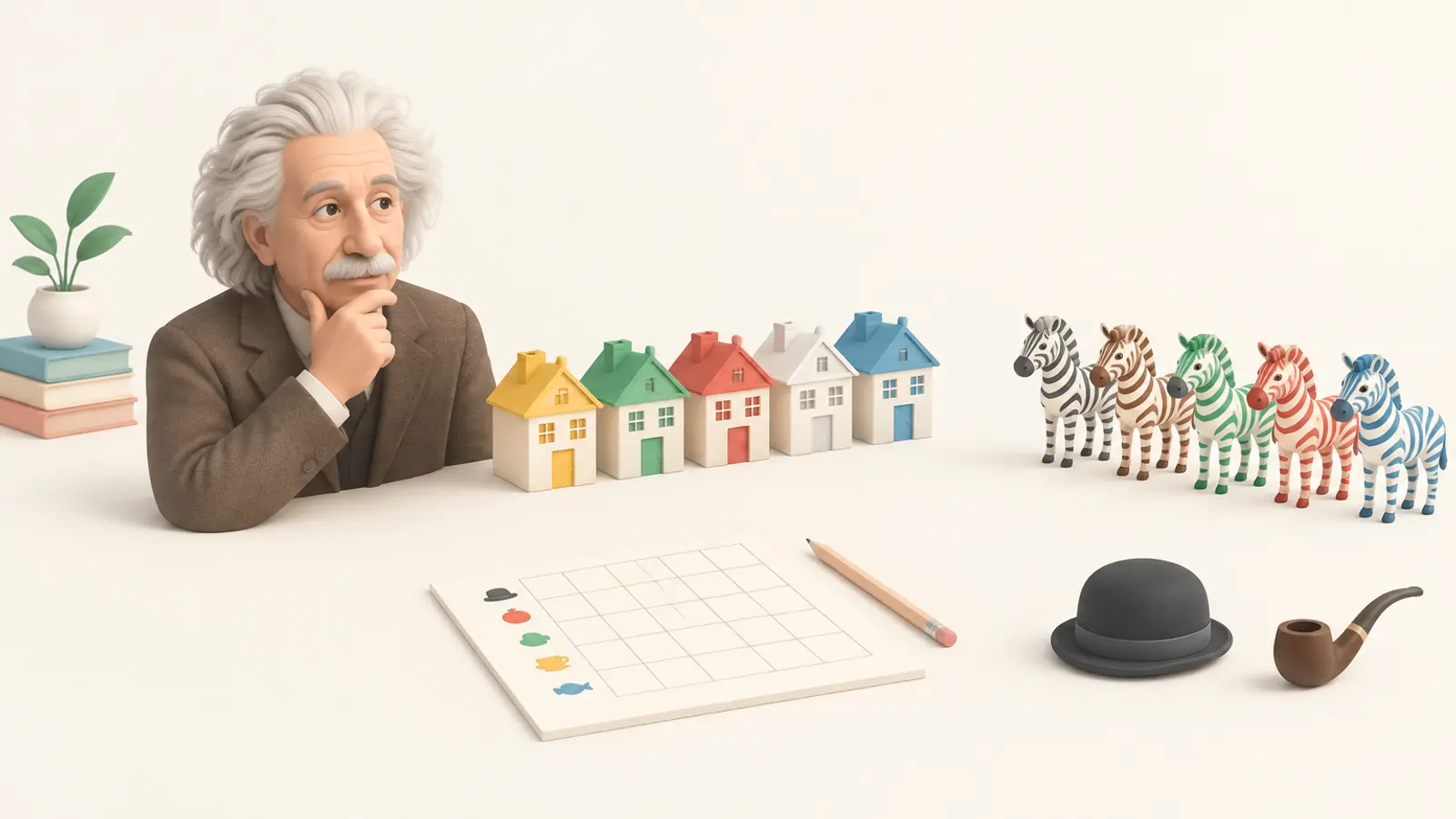
The famous "zebra puzzle" attributed to Einstein features five houses, five nationalities, five pets, five drinks, and five cigarette brands—25 items across five categories with 15 clues. It's the ultimate grid logic challenge.
Themed Logic Puzzles
Puzzles built around specific scenarios—detectives solving crimes, chefs preparing meals, travelers planning routes—add story elements to pure logic.
Progressive Difficulty
Start with 3×3 grids, then move to 4×4, then 5×5. Each size increase dramatically raises complexity.
Time-Limited Challenges
Competitive solving adds pressure and tests your efficiency under stress.
Ready to Solve?
You now have all the tools needed to tackle grid logic puzzles with confidence:
- Set up your grid carefully with all categories clearly labeled
- Process direct eliminations first from straightforward clues
- Apply the last box standing rule constantly
- Use the transitive property to link information across grids
- Cross-reference every deduction to mark all related eliminations
- Work systematically rather than randomly jumping between clues
- Trust pure logic and avoid guessing
The beauty of grid logic puzzles lies in their definitiveness. There's no ambiguity, no tricks, no wordplay—just pure, clean logical deduction. When you place that final mark and the entire solution clicks into place, you experience the profound satisfaction of having reasoned your way to truth.
Try Free Logic Puzzles Now and experience the addictive satisfaction of solving through pure deduction. We offer puzzles from beginner to expert difficulty, perfect for building your logical reasoning skills.
Frequently Asked Questions
How long does it take to solve a grid logic puzzle?
Beginners might spend 20-30 minutes on a simple 3×3 puzzle. With practice, you'll solve these in 5-10 minutes. Complex 5×5 puzzles can take 30-60 minutes even for experienced solvers.
Can every grid logic puzzle be solved without guessing?
Yes—properly constructed logic puzzles have exactly one solution reachable through pure deduction. If you need to guess, either the puzzle is flawed or you've missed a deduction.
What's the difference between grid logic puzzles and Sudoku?
Sudoku uses a single grid with number placement rules. Grid logic puzzles use multiple grids with relationship-based clues. Both require logical deduction, but the reasoning process differs significantly.
What if I make a mistake early in the puzzle?
One incorrect mark can derail everything. If you reach an impossible situation (like needing two matches in one row), backtrack to find your error. This is why working in pencil helps.
Are there logic puzzle apps or online solvers?
Many apps exist, but solving on paper builds stronger reasoning skills. Online solvers that mark eliminations automatically reduce the cognitive benefit—you're outsourcing the logic to software.
How do I know if I'm improving?
Track your solving times and the difficulty levels you can complete. As you improve, you'll also notice yourself making deductions faster and spotting patterns immediately.
Start building your logical reasoning skills today with our free logic puzzles. Multiple difficulty levels available—no signup required!
Put it into practice
Keep reading
Number Logic
Einstein's Riddle Explained: The Ultimate Guide to the Zebra Puzzle
Master Einstein's Riddle with our complete guide. Learn the history, get a step-by-step solution, and discover variations of this legendary logic puzzle.
Jan 19, 2025 15 min
Logic Puzzles
Grid Logic Puzzles: How to Solve Them
Master the art of deductive reasoning with our comprehensive guide to grid logic puzzles. Learn expert strategies, common mistakes, and 2025 trends.
Mar 11, 2026 12 min
Number Logic
2048 Strategy Guide: How to Win Every Time
Master 2048 with proven strategies. Learn the corner technique, tile management, and advanced tactics to reach 2048 and beyond.
Jan 18, 2025 11 min
Advertisement