2048 Strategy Guide: How to Win Every Time
Master 2048 with proven strategies. Learn the corner technique, tile management, and advanced tactics to reach 2048 and beyond.
By Free To Play Puzzles Editorial Team 11 min read
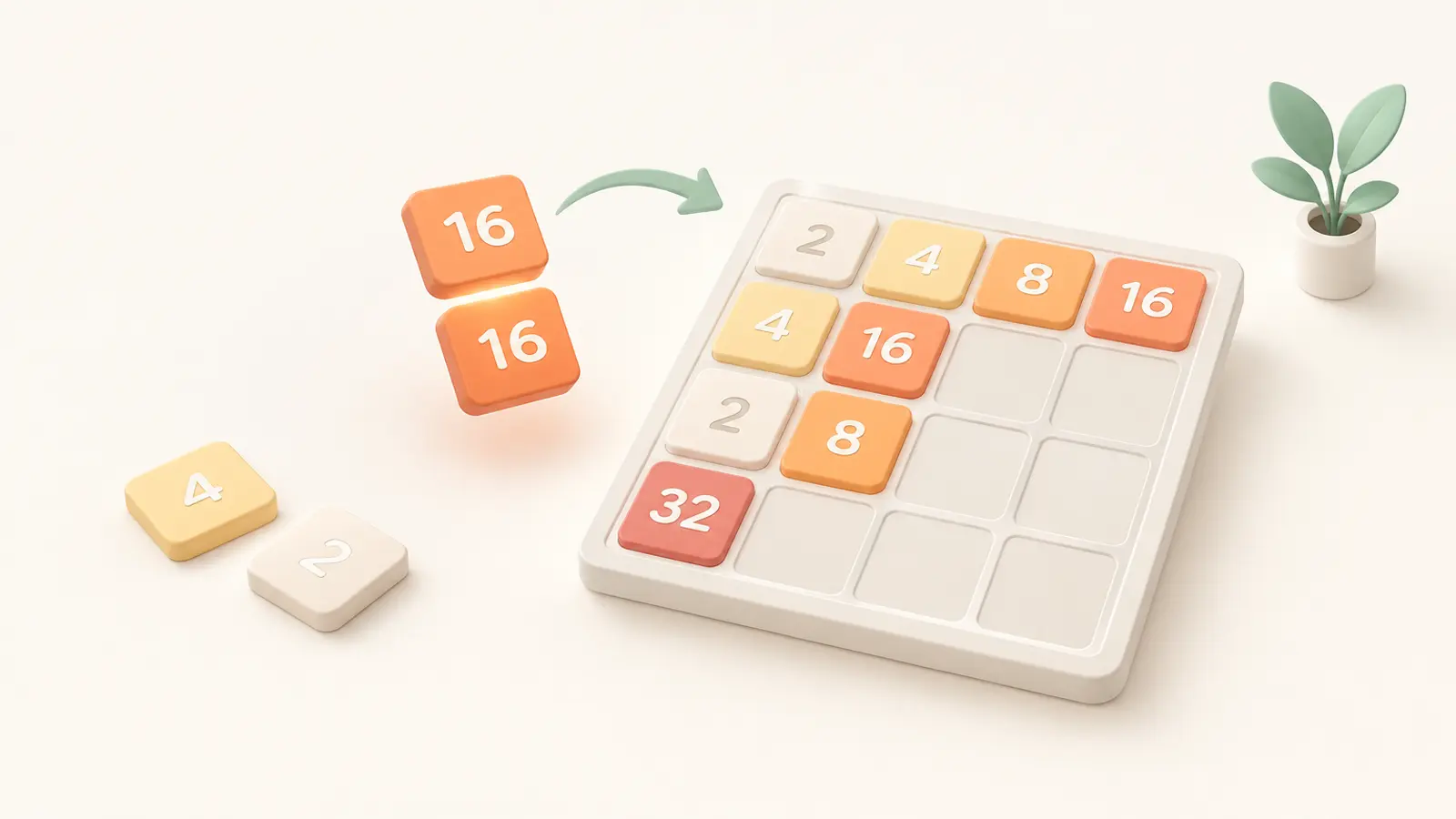
2048 Strategy Guide: How to Win Every Time
If you've ever played 2048 and watched your carefully built tile structure collapse into an unplayable mess, you know the frustration. This deceptively simple sliding puzzle can feel random at first, but there's actually a methodical approach that dramatically increases your odds of reaching 2048—and beyond.
In this comprehensive guide, we'll break down the proven strategies that expert players use to consistently win at 2048. Whether you're a complete beginner or you've been stuck at the 512 or 1024 tile, these techniques will level up your game.
How 2048 Works: Rules and Mechanics
Before diving into advanced strategies, let's make sure we understand exactly how 2048 operates.
The Basic Rules
2048 is played on a 4×4 grid with numbered tiles. Here's how it works:
- Starting position: You begin with two tiles, each showing either a 2 or a 4
- Movement: Use arrow keys (or swipe on mobile) to slide all tiles in one direction
- Merging: When two tiles with the same number touch, they merge into one tile with their sum
- New tiles: After each move, a new tile (usually a 2, occasionally a 4) appears in a random empty space
- Winning condition: Create a tile with the value 2048
- Losing condition: The grid fills completely with no valid moves remaining
Understanding Tile Generation
Here's something crucial that many players don't realize: new tiles aren't completely random. The game spawns:
- 90% chance: A new 2 tile
- 10% chance: A new 4 tile
This 10% probability means that in a typical game of 100-150 moves, you'll see 10-15 random 4 tiles appear. While you can't control when or where they spawn, understanding this mechanic helps explain why games sometimes feel "lucky" or "unlucky."
The Math Behind 2048
To reach the 2048 tile, you need:
- Eight 2s to make one 4
- Sixteen 2s to make one 8
- Thirty-two 2s to make one 16
- And so on, doubling each time
The 2048 tile requires combining the equivalent of 1,024 individual 2 tiles. The grid only holds 16 tiles, which is why tile management is so critical—you're constantly juggling limited space.
The Corner Strategy: Your Foundation for Success
The single most important strategy in 2048 is the corner technique. This isn't just a helpful tip—it's the fundamental approach that separates players who occasionally win from those who consistently win.
How the Corner Strategy Works
The principle is simple:
- Choose one corner (most players prefer bottom-right or bottom-left)
- Keep your highest value tile in that corner at all times
- Build descending value chains from that corner
- Never move in the direction that pulls your highest tile away from its corner
Why This Works
When your largest tile floats around the middle of the board, it creates chaos. It blocks merges, creates awkward gaps, and forces you into defensive moves. By anchoring it in a corner, you:
- Maximize available space for new tiles
- Create predictable merge patterns along edges
- Prevent fragmentation of your tile values
- Maintain control over tile positioning
Implementing the Corner Technique
Let's say you choose the bottom-right corner:
- Build your foundation: Slide tiles down and right initially to establish your highest tile in the corner
- Use three directions only: Move right, down, and left—but avoid moving up
- Exception handling: Only move up when absolutely necessary, and immediately return tiles to the bottom afterward
Think of the corner as "home base." Your highest tile lives there permanently, and the surrounding tiles form a protective structure around it.
Advertisement
Building Tile Chains and Maintaining Order
Once you've mastered the corner strategy, the next level is creating organized tile structures.
The Descending Chain Pattern
Imagine your tiles arranged like stairs descending from your corner:
512 | 256 | 128 | 64
32  | 16  |  8  |  4
2   |  2  |  4  |
    |     |     |
This descending pattern keeps values organized so tiles can merge efficiently. When a 64 merges into 128, the space it leaves is naturally filled by the tiles below it.
Row and Column Management
Your two primary edges (the bottom and right in a bottom-right corner strategy) should be:
- Kept full whenever possible to prevent new tiles from spawning in inconvenient locations
- Arranged in descending order from your corner
- Maintained through disciplined movement patterns
Here's the golden rule: Fill your edges before you fill the center.
The Snake Pattern
Advanced players often visualize a "snake" pattern:
[Highest] ← ← ← ← [2nd Highest]
    ↓                   ↑
[3rd High] → → → → [4th Highest]
    ↓                   ↑
[Continue descending...]
This pattern naturally emerges when you follow the corner strategy consistently. It keeps tiles organized and creates a predictable flow for merges.
When to Break the Rules Strategically
While the corner strategy is fundamental, rigidly following it in every situation leads to disaster. Expert players know when to violate the rules.
Scenario 1: The Blocked Merge
Sometimes your descending chain gets disrupted, and you need to make a forbidden move to create a crucial merge:
Before:
1024 | 512 | 256 | 128
64   | 32  | 16  | 8
4    | 2   | 64  | 32  ← Problem: This 64 needs to merge
Solution: Make a temporary upward move to create the merge, then immediately restore your structure.
Scenario 2: The Space Crisis
When your board is nearly full and a bad tile spawns in the middle, you might need to temporarily move your highest tile to create breathing room:
The key: Make these violations quick and purposeful. One or two moves to fix the problem, then immediately return to your core strategy.
Scenario 3: Setting Up a Chain Reaction
Sometimes you need to "load" a move by arranging tiles in a specific pattern:
512 | 256 |  2  |  4
256 | 128 |  8  | 16
2   |  64 | 32  | 32  ← These 32s can trigger a cascade
By moving right, the 32s merge, creating space that allows subsequent merges. This might require moving in a "forbidden" direction first to set up the alignment.
Common Mistakes That End Games Early
Understanding what not to do is just as important as knowing the right strategies.
Mistake 1: Random Movement Without Purpose
Every move should have a reason. Ask yourself:
- "What merge does this create?"
- "Where will the new tile likely spawn?"
- "Does this maintain my corner structure?"
Moving without intention scrambles your tile organization and creates unfixable situations.
Mistake 2: Panic Moves When Space Gets Tight
When the board fills up, new players frantically move in all directions hoping for luck. Instead:
- Pause and analyze all available moves
- Look for multi-tile merges that create space
- Accept that sometimes you need to sacrifice small tiles to preserve your structure
Mistake 3: Ignoring the Edges
Letting your primary edges (bottom and right in a bottom-right strategy) become empty or disorganized is a fast track to failure. New tiles spawning in these locations disrupt your entire structure.
Always keep edges full and organized.
Mistake 4: Pursuing Small Merges Over Structure
A common trap: you see two 4s in opposite corners and move to merge them, destroying your tile organization in the process. That merge isn't worth breaking your structure.
Principle: Preserving structure is more valuable than individual merges.
Mistake 5: Not Planning for the Next Move
Expert players think two or three moves ahead:
- "If I move left, where will the new tile spawn?"
- "After the merge, will I still have a valid move?"
- "Am I creating a situation where I'll be forced into a bad position?"
This forward thinking prevents the "I didn't see that coming" moments.
Advertisement
Advanced Techniques for Reaching Higher Tiles
Ready to push beyond 2048 to 4096, 8192, or even higher? These advanced tactics will get you there.
The Patience Game
Reaching 4096 or 8192 requires extreme patience. You'll often have moves that don't create any merges—that's normal. The key is:
- Make the safest move that maintains structure
- Wait for the right tiles to spawn in positions that allow clean merges
- Accept that games will take 30+ minutes at higher levels
Maximizing Merge Efficiency
Create situations where one move triggers multiple merges:
Before:        After moving right:
8  8  16  32   | | 16 | 16 | 32
4  4   2   4   | |  8 |  2 |  4
The two 8s merge, which creates space for the 4s to merge. Two merges from one move doubles your efficiency.
Corner Switching (Advanced)
In rare situations, switching corners can save a game:
- You've built to 1024 in bottom-right
- Board state makes maintaining bottom-right impossible
- Your tiles are positioned to allow a shift to bottom-left
This is risky and should only be attempted when:
- You have significant experience
- The current structure is genuinely unsalvageable
- You can visualize the complete transition
Most players should avoid corner switching entirely.
Managing the Endgame
When pursuing 4096+, the endgame requires special attention:
Space management becomes critical. You need to:
- Keep at least 2-3 empty cells at all times when possible
- Create merges before you desperately need space
- Avoid filling the board unless you have a clear sequence of merges planned
Tile value distribution matters. Your ideal board has:
- One very high tile (2048+)
- A descending chain of supporting tiles
- Minimal "orphaned" low-value tiles
The Probability Advantage
Remember that 90% of new tiles are 2s. This means:
Good moves are those that give the new tile multiple useful spawn locations. Even if a 2 spawns in the "worst" available spot, it shouldn't break your structure.
Bad moves create situations where only one or two spawn locations are acceptable. When a 4 appears in the wrong spot (which happens 10% of the time), your game ends.
The Math Behind Tile Probabilities
Understanding the mathematics of 2048 gives you an edge.
Tile Requirements by Level
Here's what you need to reach each milestone:
- 2048 tile: 1,024 value units (equivalent to 1,024 "2" tiles)
- 4096 tile: 2,048 value units
- 8192 tile: 4,096 value units
With a 4×4 grid holding 16 tiles maximum, you're constantly cycling tiles through merges.
Expected Game Length
A typical winning game (reaching 2048) involves:
- 130-160 moves on average
- 13-16 lucky "4" spawns (10% probability)
- 117-144 "2" spawns (90% probability)
Games pursuing 4096 often exceed 300 moves.
The Random Factor
Even with perfect strategy, randomness matters. Studies of optimal 2048 play show:
- Win rate with optimal strategy: ~90% for reaching 2048
- Win rate for 4096: ~20-30% with expert play
- Win rate for 8192: ~3-5% even with perfect play
The higher you go, the more the random tile spawns impact your success. This is why even experts don't win every game.
Calculating Move Value
Advanced players mentally assign value to moves based on:
- Merge value created: Direct points scored
- Position value: Maintaining structure and edge control
- Probability value: Number of "good" spawn locations created
The best moves score high in all three categories.
Putting It All Together: Your Action Plan
Let's consolidate everything into a practical, step-by-step approach you can use in your next game.
Phase 1: Early Game (0-256 Tile)
- Choose your corner and commit to it
- Fill your primary edges (bottom and right for bottom-right corner)
- Build a descending pattern from your corner
- Use only three directions as much as possible
- Focus on structure over scores
Don't worry about your score yet—focus entirely on building a solid foundation.
Phase 2: Mid Game (512-1024 Tile)
- Maintain your corner and edges religiously
- Plan 2-3 moves ahead before each move
- Create multi-merge opportunities when possible
- Accept that not every move creates a merge
- Keep 2-4 empty spaces available at all times
This phase requires patience. Resist the urge to make hasty moves.
Phase 3: Late Game (2048+ Tile)
- Move even more deliberately—consider each move carefully
- Prioritize structure over everything—even big merges
- Manage space aggressively—never let the board fill completely
- Accept unfavorable spawns—they happen, work around them
- Stay patient—the right merges will come
Many games are lost in late game by rushing. Slow down.
Practice Routine for Improvement
Want to improve quickly? Here's a proven practice approach:
- Play 2-3 games daily with full concentration
- Stick to one corner until it's second nature
- Review losing games—where did structure break down?
- Gradually reduce "forbidden" moves—track how often you violate your direction rules
- Celebrate milestones—first 512, 1024, 2048, etc.
Try our free 2048 game to put these strategies into practice immediately.
Level Up Your 2048 Game Today
You now have the complete strategy toolkit that expert players use to consistently win at 2048. The corner strategy, descending chains, strategic rule-breaking, and probability awareness—these techniques transform 2048 from a game of chance into a game of skill.
Remember the core principles:
- Anchor your highest tile in one corner—this is non-negotiable
- Build organized, descending chains—structure beats chaos every time
- Plan ahead—think two or three moves into the future
- Stay patient—especially as tiles grow larger
- Practice deliberately—focus on technique, not just winning
The difference between occasionally reaching 2048 and consistently achieving it comes down to disciplined strategy execution. These aren't just tips—they're the fundamental principles that make winning reproducible rather than lucky.
Play 2048 Now and test these strategies yourself. Start with the corner technique, build your descending chains, and watch your high scores climb. With practice, you'll not only reach 2048 regularly but push well beyond it.
Frequently Asked Questions
Is there a guaranteed way to win 2048?
While no strategy guarantees 100% success due to random tile spawns, the corner strategy combined with proper tile management gives you approximately 90% success rate for reaching 2048. Expert players using optimal techniques win the vast majority of their games.
How long does it take to beat 2048 for the first time?
Most players achieve their first 2048 tile after 20-50 games once they learn the corner strategy. Complete beginners without strategy might take 100+ attempts. The key is deliberate practice with proper technique rather than just playing repeatedly.
Which corner is best for the corner strategy?
All four corners work equally well—choose based on personal preference. Most players prefer bottom-right or bottom-left because the controls (down and right/left arrows) feel natural. The important thing is consistency: pick one corner and stick with it every game.
Can you reach 4096 or 8192 tiles?
Yes, but it's significantly harder. Reaching 4096 requires expert execution and favorable tile spawns, with success rates around 20-30%. The 8192 tile is extremely rare, requiring near-perfect play and luck, achieved in only 3-5% of games even by experts. Some players have reached 16384 and beyond with exceptional skill and persistence.
What should I do when the board is almost completely full?
Stay calm and analyze systematically: (1) Look for any possible merges that create space, (2) Choose the move that creates the most empty cells or the best merge opportunities, (3) Avoid panic moves that break your corner structure, and (4) Sometimes sacrificing small tiles to preserve structure is the right choice. Remember that one good merge can cascade into several, creating breathing room.
Ready to become a 2048 master? Play our free 2048 game and put these strategies to the test. No signup, no ads—just pure puzzle-solving fun!
Put it into practice

Keep reading
Number Logic
Grid Logic Puzzles: How to Solve Them
Master grid logic puzzles with expert strategies. Learn elimination techniques, deductive reasoning, and step-by-step solving methods to crack any logic grid puzzle.
Jan 19, 2025 14 min

Number Logic
Einstein's Riddle Explained: The Ultimate Guide to the Zebra Puzzle
Master Einstein's Riddle with our complete guide. Learn the history, get a step-by-step solution, and discover variations of this legendary logic puzzle.
Jan 19, 2025 15 min
Number Logic
Sudoku for Beginners: Complete Guide to Solving Your First Puzzle
Learn how to solve Sudoku puzzles from scratch. This beginner-friendly guide covers rules, basic strategies, and step-by-step techniques to master your first puzzle.
Jan 15, 2025 12 min
Advertisement