Advanced Sudoku Techniques: X-Wing and Swordfish
Master advanced Sudoku strategies with our in-depth guide to X-Wing and Swordfish patterns. Learn step-by-step techniques to solve expert-level puzzles.
By Free To Play Puzzles Editorial Team 14 min read
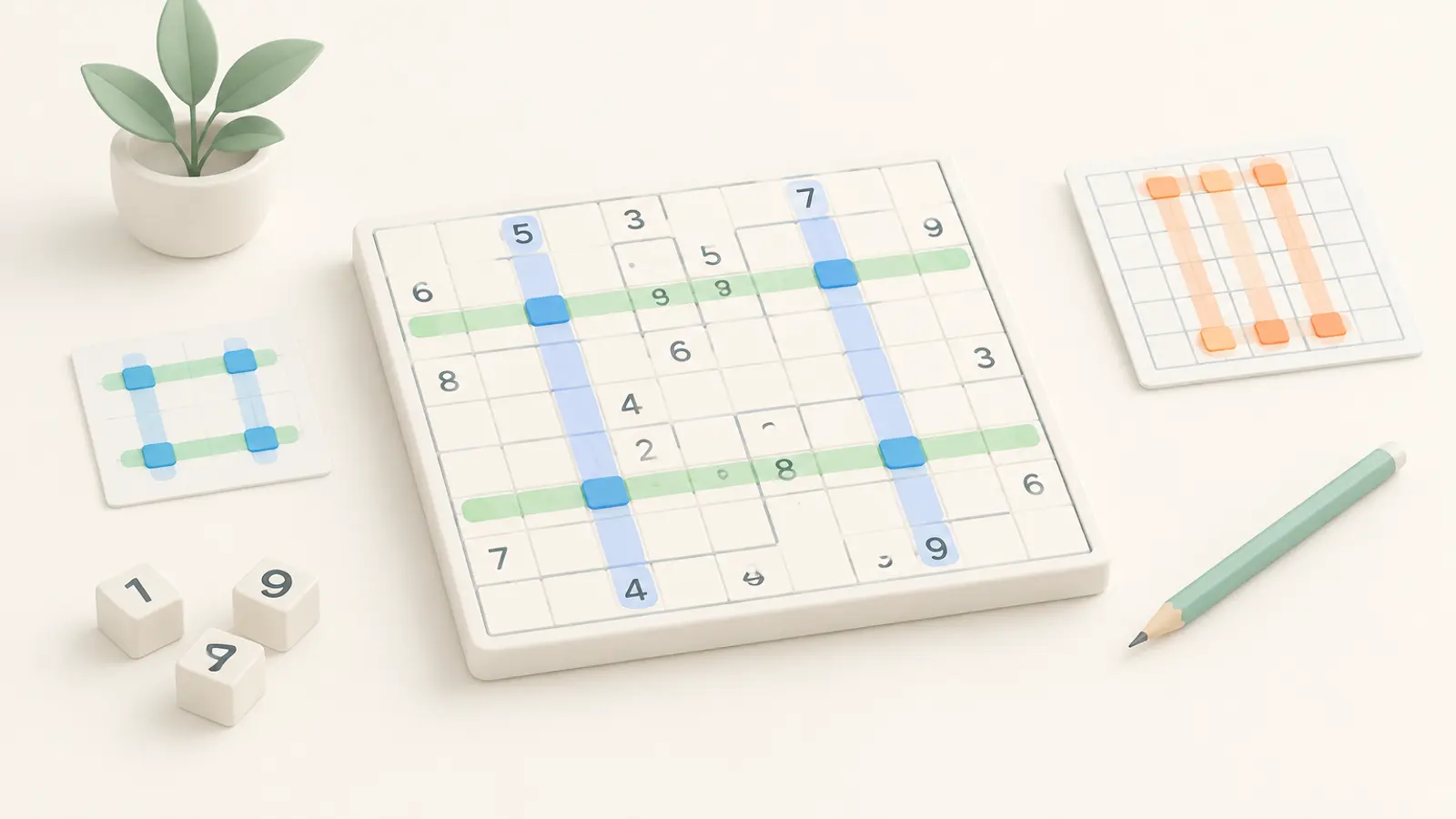
Advanced Sudoku Techniques: X-Wing and Swordfish
You've mastered basic Sudoku strategies like scanning and singles. You can breeze through easy and medium puzzles. But when you tackle hard or expert-level Sudoku, you hit walls where basic techniques simply don't work. That's where advanced pattern recognition techniques like X-Wing and Swordfish come in.
These powerful elimination strategies help you break through seemingly impossible situations by identifying geometric patterns in candidate numbers. While they sound complex, once you understand the logic behind them, you'll wonder how you ever solved difficult puzzles without them.
In this comprehensive guide, we'll explore two of the most useful advanced Sudoku techniques, complete with visual examples and step-by-step instructions to help you recognize and apply these patterns confidently.
Why Learn Advanced Techniques?
Before diving into the techniques themselves, let's understand why they matter.
Beyond Basic Logic
Basic Sudoku strategies—scanning, naked singles, and hidden singles—work wonderfully for easy to medium puzzles. However, expert constructors deliberately design harder puzzles to resist these simple approaches. At some point, you'll find yourself in situations where:
- No cells have only one candidate
- No hidden singles exist in any row, column, or box
- Basic elimination doesn't reveal any new placements
This is when advanced pattern recognition becomes essential.
The Power of Pattern Recognition
Advanced techniques don't introduce new rules—Sudoku still has the same three constraints (rows, columns, and boxes must each contain 1-9). Instead, these techniques help you spot logical implications that aren't immediately obvious.
X-Wing and Swordfish are "fish" patterns—a family of techniques named for their distinctive shapes when visualized on the grid. They help you eliminate candidates by recognizing structural impossibilities.
Building Your Mental Toolkit
Think of Sudoku solving as having a toolbox. Basic techniques are your hammer and screwdriver—you'll use them constantly. Advanced techniques like X-Wing and Swordfish are specialized tools you need less often, but when you need them, nothing else works.
Let's open that advanced toolbox.
Understanding Candidate Notation
Before learning advanced techniques, you need to be comfortable with pencil marks (also called candidate notation).
What Are Pencil Marks?
In each empty cell, you lightly note all possible numbers that could go there based on current constraints. For example, if a cell could be 2, 5, or 8, you'd write those numbers small in that cell.
Why Pencil Marks Are Essential
Basic solvers can often skip pencil marks and work directly. Advanced solvers absolutely need them because techniques like X-Wing rely on analyzing patterns across multiple cells' candidates.
Digital vs. Paper Solving
When solving on paper, write small numbers in cell corners. Most digital Sudoku apps have a "notes" or "pencil mark" mode that handles this for you. Either way, keeping accurate candidates is crucial—advanced techniques fall apart with incorrect pencil marks.
Now let's explore our first advanced pattern.
Advertisement
The X-Wing Technique
The X-Wing is one of the most elegant and satisfying patterns in Sudoku. Once you see it, you'll start spotting it regularly in difficult puzzles.
What Is an X-Wing?
An X-Wing occurs when a candidate number appears in exactly two cells in two different rows (or columns), and these cells align perfectly in two columns (or rows). The pattern forms a rectangle—the corners of which create an "X" shape.
When you find this pattern, you can eliminate that candidate from all other cells in those columns (or rows).
The Logic Behind X-Wing
Here's why X-Wing works:
Imagine the number 7 appears as a candidate in only two cells in Row 1 (let's say columns 3 and 7), and only two cells in Row 5 (also columns 3 and 7). This creates a rectangle.
Now consider the possibilities:
- If R1C3 is 7, then R5C3 cannot be 7 (same column), so R5C7 must be 7
- If R1C7 is 7, then R5C7 cannot be 7 (same column), so R5C3 must be 7
Either way, the 7s in these two rows MUST occupy columns 3 and 7. This means no other cell in columns 3 or 7 can contain a 7.
Visual Example of X-Wing
Let's visualize this with a practical example:
     C1  C2  C3  C4  C5  C6  C7  C8  C9
R1   .   .   27  .   .   .   27  .   .
R2   .   .   237 .   .   .   237 .   .
R3   .   .   27  .   .   .   27  .   .
R4   .   .   .   .   .   .   .   .   .
R5   .   .   27  .   .   .   27  .   .
R6   .   .   237 .   .   .   237 .   .
In this diagram, numbers represent candidates (7 is a candidate along with other numbers shown).
Looking at Rows 1 and 5:
- Row 1 has 7 as a candidate in only C3 and C7
- Row 5 has 7 as a candidate in only C3 and C7
This is an X-Wing pattern! The four corners form a rectangle: R1C3, R1C7, R5C3, R5C7.
Elimination: You can now remove 7 as a candidate from all other cells in columns 3 and 7. In our example, this means removing 7 from:
- R2C3 (changes from 237 to 23)
- R2C7 (changes from 237 to 23)
- R3C3 (changes from 27 to 2)
- R3C7 (changes from 27 to 2)
- R6C3 (changes from 237 to 23)
- R6C7 (changes from 237 to 23)
These eliminations often cascade into solving multiple cells.
Step-by-Step: Finding an X-Wing
Here's a systematic approach to spotting X-Wings:
Step 1: Choose a Candidate Number
Pick a number to analyze (usually one that appears frequently but isn't solved everywhere). Let's say you choose 4.
Step 2: Scan Rows for Bi-Value Possibilities
Go through each row and mark which rows have exactly two cells where 4 could go. For example:
- Row 2: 4 is possible in C3 and C8
- Row 6: 4 is possible in C3 and C8
- Row 7: 4 is possible in C1, C4, and C9 (skip this—needs exactly two)
Step 3: Look for Alignment
Check if any two rows have their two candidates in the same columns. In our example, Rows 2 and 6 both have candidates in C3 and C8—this is an X-Wing!
Step 4: Eliminate
Remove the candidate (4) from all other cells in the aligned columns (C3 and C8).
Step 5: Check Columns Too
Repeat the process looking at columns instead of rows. An X-Wing can exist in either orientation.
Common X-Wing Mistakes
Mistake 1: More Than Two Candidates
An X-Wing requires EXACTLY two candidates in each row/column. If Row 1 has three cells with candidate 7, it cannot form an X-Wing.
Mistake 2: Imperfect Alignment
The candidates must align perfectly. If Row 1 has candidates in C3 and C7, but Row 4 has candidates in C3 and C8, this is NOT an X-Wing (columns don't match).
Mistake 3: Eliminating from Rows Instead of Columns
If your X-Wing is in rows (candidates in two rows, aligned in two columns), you eliminate from those columns. If it's in columns, you eliminate from rows. Don't mix this up.
When to Look for X-Wings
Check for X-Wings when:
- You're stuck with no obvious singles
- You have good pencil mark coverage
- You notice a number appearing in limited positions across several rows or columns
X-Wings appear more commonly in medium-hard to expert puzzles. In easier puzzles, simpler techniques usually suffice.
The Swordfish Technique
Once you understand X-Wing, Swordfish is a natural extension—it's essentially a three-dimensional version of the same concept.
What Is a Swordfish?
A Swordfish occurs when a candidate number appears in two or three cells across three rows, and these candidates align in exactly three columns (or vice versa). Think of it as an X-Wing that connects three lines instead of two.
The name comes from the shape: when you connect all the candidates, the pattern supposedly resembles a swordfish (though you might need imagination to see it!).
The Logic Behind Swordfish
The reasoning mirrors X-Wing but extends to three rows/columns:
If the number 6 appears as a candidate in:
- Row 1: columns 2, 5, 8 (or subset of these)
- Row 4: columns 2, 5, 8 (or subset of these)
- Row 7: columns 2, 5, 8 (or subset of these)
Then the 6s in these three rows MUST occupy some combination of columns 2, 5, and 8. Therefore, 6 can be eliminated from all other cells in columns 2, 5, and 8.
Key Swordfish Requirement
Each of the three rows must have the candidate appearing in TWO or THREE cells (not one, not four). But critically, across all three rows, the candidates must align within exactly three columns total.
Visual Example of Swordfish
     C1  C2  C3  C4  C5  C6  C7  C8  C9
R1   .   36  .   .   36  .   .   .   .
R2   .   368 .   .   368 .   .   368 .
R3   .   36  .   .   .   .   .   36  .
R4   .   36  .   .   36  .   .   36  .
R5   .   368 .   .   368 .   .   368 .
R6   .   .   .   .   .   .   .   .   .
R7   .   36  .   .   .   .   .   36  .
R8   .   368 .   .   368 .   .   368 .
Looking at Rows 1, 4, and 7:
- Row 1 has 6 as candidate in C2 and C5
- Row 4 has 6 as candidate in C2, C5, and C8
- Row 7 has 6 as candidate in C2 and C8
Across these three rows, the candidate 6 appears ONLY in columns 2, 5, and 8. This is a Swordfish!
Elimination: Remove 6 from all other cells in columns 2, 5, and 8:
- R2C2: 368 becomes 38
- R2C5: 368 becomes 38
- R2C8: 368 becomes 38
- R3C2: 36 becomes 3
- R3C8: 36 becomes 3
- R5C2: 368 becomes 38
- R5C5: 368 becomes 38
- R5C8: 368 becomes 38
- R8C2: 368 becomes 38
- R8C5: 368 becomes 38
- R8C8: 368 becomes 38
That's a lot of eliminations from one pattern!
Step-by-Step: Finding a Swordfish
Step 1: Choose a Candidate Number
Select a number that appears in limited positions. Swordfish patterns are rarer, so you might need to check several numbers.
Step 2: Find Three Rows with Limited Candidates
Identify three rows where your chosen number appears as a candidate in only 2-3 cells each.
Step 3: Check Column Alignment
Look at which columns contain these candidates. If all the candidates across your three rows fall within exactly three columns total, you have a Swordfish.
Step 4: Verify the Pattern
Double-check: three rows, candidates appearing in 2-3 cells per row, aligning in exactly three columns total.
Step 5: Eliminate
Remove the candidate from all other cells in those three columns (excluding the Swordfish cells themselves).
Step 6: Check Column-Based Swordfish
Repeat the process by examining columns instead of rows.
Swordfish Variations
Swordfish can be tricky because it has legitimate variations:
Variation 1: 2-2-2 Pattern
Each of the three rows has exactly two candidates, all aligning in three columns.
Variation 2: 2-2-3 Pattern
Two rows have two candidates each, one row has three candidates, all within the same three columns.
Variation 3: 2-3-3 Pattern
One row has two candidates, two rows have three candidates each, all within three columns.
Variation 4: 3-3-3 Pattern
Each row has three candidates, forming a complete 3×3 grid of candidates.
All are valid Swordfish patterns as long as they align in exactly three columns.
Common Swordfish Mistakes
Mistake 1: More Than Three Rows or Columns
Swordfish requires exactly three rows aligned in exactly three columns (or vice versa). Four rows in four columns is a different technique called Jellyfish.
Mistake 2: Candidates in Four or More Columns
If your three rows have candidates spreading across four or more columns, it's not a Swordfish. The pattern only works when contained within three columns.
Mistake 3: Only One Candidate in a Row
Each row in the Swordfish must have at least two candidates. A row with only one candidate can't participate in the pattern.
When to Look for Swordfish
Swordfish is rarer than X-Wing. Look for it when:
- X-Wing searches turn up nothing
- You're working on expert-level puzzles
- You notice a candidate clustered in three specific rows or columns
- You've exhausted simpler advanced techniques
Practicing Advanced Techniques
Learning about X-Wing and Swordfish is one thing—spotting them in real puzzles takes practice.
Building Pattern Recognition
Start with Puzzle Walkthroughs
Find expert Sudoku solvers on YouTube or tutorial sites who demonstrate these techniques. Watching someone identify patterns in real-time accelerates learning.
Use Pencil Marks Religiously
You simply cannot find these patterns without comprehensive candidate notation. Fill in all pencil marks before hunting for fish patterns.
Focus on One Number at a Time
When searching for X-Wing or Swordfish, analyze one candidate number across the entire grid. Check all rows for that number, note where it appears, then look for patterns.
Practice on Hard Puzzles
Easy and medium puzzles rarely require advanced techniques. Challenge yourself with hard and expert difficulties where these patterns appear regularly.
Combining Techniques
Advanced solvers don't use techniques in isolation:
Technique Chain
A typical solving sequence on a hard puzzle might be:
- Fill in all pencil marks using basic scanning
- Look for naked/hidden singles
- Check for naked/hidden pairs and triples
- Search for X-Wing patterns
- Update pencil marks based on eliminations
- Return to singles (often revealed by X-Wing eliminations)
- If still stuck, search for Swordfish
- Continue cycling through techniques
Cascading Eliminations
The beauty of advanced techniques is that eliminating candidates often triggers chains of simpler discoveries. An X-Wing might eliminate enough candidates to reveal a hidden single, which fills a cell, which creates a naked single, and so on.
Tools and Resources
Online Solvers with Hints
Many websites offer Sudoku puzzles with hint systems that explain advanced techniques when you're stuck. These are excellent learning tools.
Sudoku Apps with Technique Highlighting
Some mobile apps highlight when patterns like X-Wing are available, helping you train your eye to recognize them.
Puzzle Books with Solutions
Dedicated Sudoku books for advanced solvers often include detailed solution walkthroughs showing exactly where techniques apply.
Advertisement
Beyond X-Wing and Swordfish
Once you've mastered these techniques, a whole world of advanced Sudoku strategies awaits:
Other Fish Patterns
Finned X-Wing/Swordfish: Variations where one extra candidate exists but doesn't break the pattern entirely.
Jellyfish: The four-row/column version of Swordfish (very rare).
Coloring and Chains
Simple Coloring: Using two colors to mark candidates that are linked by logic, revealing contradictions.
X-Chains: Following alternating patterns of candidates to make eliminations.
XY-Chains: Linking cells that have exactly two candidates to create logical chains.
Wing Patterns
XY-Wing: A three-cell pattern that creates powerful eliminations.
XYZ-Wing: An extension involving a fourth candidate.
W-Wing: A pattern involving two cells with identical candidates connected by a strong link.
Advanced Subsets
Naked Quads: Four cells in a unit that contain only four specific candidates.
Hidden Quads: Four numbers that appear only in four cells within a unit.
Each technique has its place, though X-Wing and Swordfish remain among the most practical for regular solvers.
The Mental Benefits of Advanced Solving
Mastering complex Sudoku techniques does more than help you solve puzzles—it provides cognitive benefits:
Enhanced Spatial Reasoning
Recognizing patterns across rows and columns strengthens your spatial awareness and ability to visualize geometric relationships.
Improved Problem-Solving
Learning to apply the right technique at the right time develops strategic thinking applicable far beyond puzzles.
Greater Attention to Detail
Spotting a Swordfish requires meticulous candidate tracking, building habits of thoroughness and precision.
Delayed Gratification
Working through a challenging puzzle using advanced techniques teaches patience and persistence toward long-term goals.
Mental Flexibility
Knowing multiple solving approaches keeps your mind adaptable, switching strategies when one doesn't work.
Ready to Level Up Your Sudoku Skills?
X-Wing and Swordfish might seem daunting at first, but with practice, they'll become natural parts of your solving toolkit. Remember:
- Master pencil marks first - Accurate candidates are essential
- Start with X-Wing - It's more common and easier to spot than Swordfish
- Analyze one number at a time - Don't try to see all patterns simultaneously
- Practice on hard puzzles - These techniques shine on expert difficulties
- Be patient - Pattern recognition improves with repetition
The satisfaction of cracking an expert Sudoku using an elegant X-Wing or Swordfish elimination is immensely rewarding. You'll feel like a true puzzle master.
Practice Advanced Sudoku Techniques on our free online puzzles. Start with medium difficulty and work your way up to expert level. Challenge yourself, and watch your skills soar.
Frequently Asked Questions
How often do X-Wing and Swordfish appear in puzzles?
X-Wing appears in most hard and expert puzzles, often multiple times. Swordfish is less common, appearing primarily in expert-level puzzles designed to require advanced techniques.
Can I solve expert Sudoku without these techniques?
Some expert puzzles can be solved with simpler techniques like hidden pairs and triples, but many genuinely require X-Wing, Swordfish, or other advanced methods. Well-constructed expert puzzles deliberately resist basic approaches.
Should I memorize the patterns or understand the logic?
Understand the logic first. Once you grasp WHY these techniques work, recognizing the patterns becomes natural. Memorization without understanding leads to errors and missed opportunities.
What if I find a pattern but eliminations don't help?
Sometimes you'll spot a valid X-Wing or Swordfish that doesn't immediately break open the puzzle. That's okay—the eliminations still move you forward. Continue with other techniques, and earlier eliminations often become crucial later.
Are there simpler ways to solve hard puzzles?
X-Wing and Swordfish represent intermediate advanced techniques. Some puzzles can be solved with slightly simpler methods like pointing pairs or box/line reduction. However, these fish patterns are efficient and worth learning.
How long does it take to get good at spotting these patterns?
With focused practice, most solvers start reliably spotting X-Wings within a few weeks. Swordfish takes longer—maybe 1-2 months of regular practice on expert puzzles. Everyone learns at their own pace.
Ready to put your advanced skills to the test? Try our free online Sudoku puzzles ranging from beginner to expert difficulty. No registration required—just pure logical challenge!
Put it into practice


Keep reading
Number Logic
Sudoku for Beginners: Complete Guide to Solving Your First Puzzle
Learn how to solve Sudoku puzzles from scratch. This beginner-friendly guide covers rules, basic strategies, and step-by-step techniques to master your first puzzle.
Jan 15, 2025 12 min

Sudoku
Advanced Sudoku Techniques: Mastering the X-Wing and Swordfish
Unlock the secrets of advanced Sudoku with our deep dive into X-Wing and Swordfish techniques. Learn how to spot these patterns and solve the hardest puzzles.
Sep 20, 2026 12 min

Sudoku
Sudoku Y-Wing Technique: Master Advanced Logic to Crack Expert Grids
Master the Sudoku Y-Wing (XY-Wing) technique with our comprehensive guide. Learn to identify pivots and pincers to solve "Hard" to "Expert" puzzles like a pro.
Dec 7, 2025 12 min
Advertisement