Sudoku for Beginners: Complete Guide to Solving Your First Puzzle
Learn how to solve Sudoku puzzles from scratch. This beginner-friendly guide covers rules, basic strategies, and step-by-step techniques to master your first puzzle.
By Free To Play Puzzles Editorial Team 12 min read
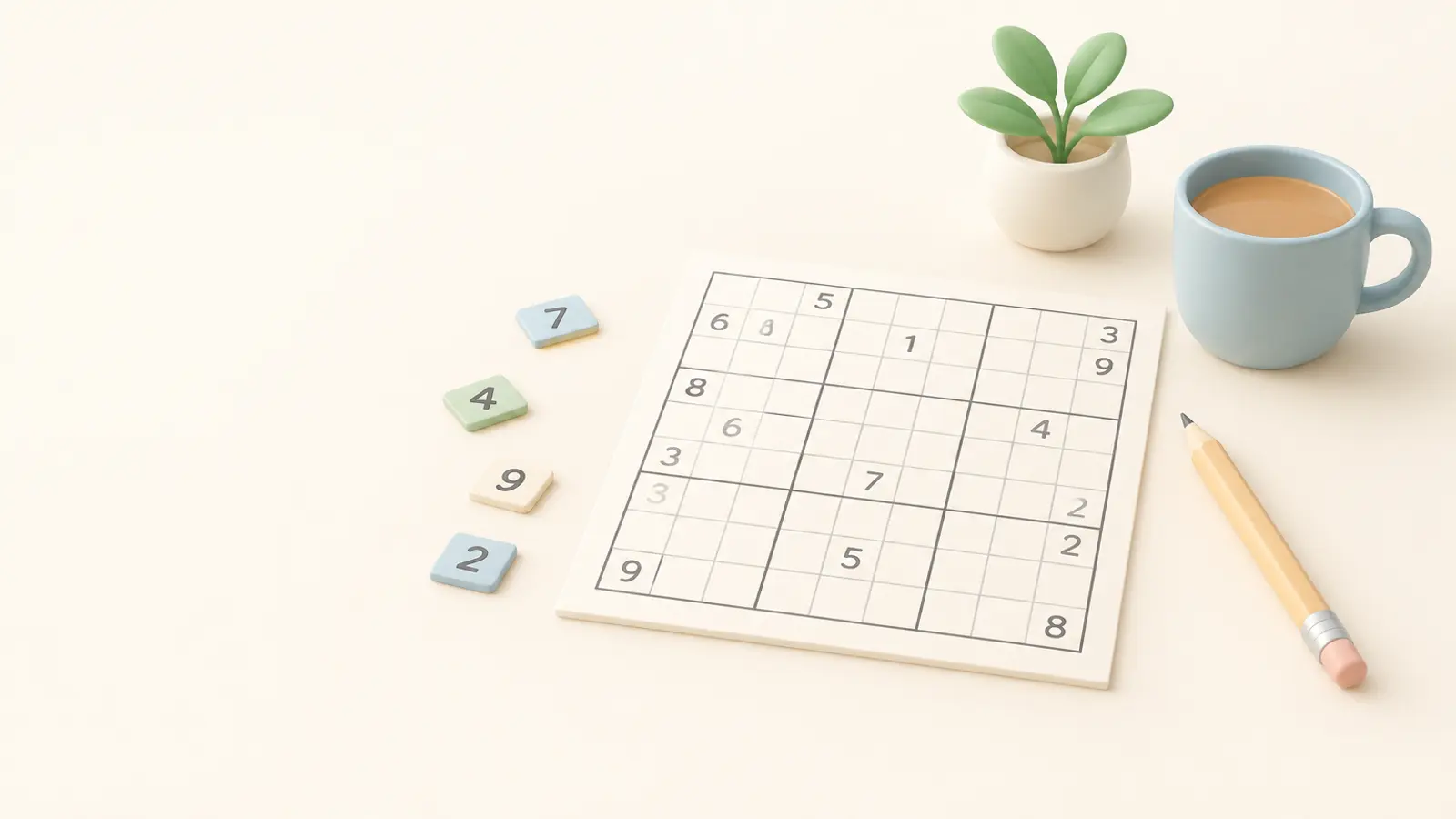
Sudoku for Beginners: Complete Guide to Solving Your First Puzzle
If you've ever stared at a Sudoku grid wondering where to even begin, you're not alone. This classic number puzzle might look intimidating at first, but once you understand the basic rules and strategies, you'll find it's both approachable and incredibly satisfying to solve.
In this comprehensive guide, we'll walk you through everything you need to know to solve your first Sudoku puzzle—and set you on the path to becoming a confident solver.
What Is Sudoku?
Sudoku is a logic-based number placement puzzle that originated in Japan in the 1980s, though its roots trace back to 18th-century Swiss mathematician Leonhard Euler's "Latin squares." The name "Sudoku" comes from the Japanese phrase "Sūji wa dokushin ni kagiru," meaning "the digits must remain single."
Despite using numbers, Sudoku requires no math skills whatsoever. You could replace the numbers 1-9 with letters, symbols, or colors—the puzzle works the same way. It's purely about logic and pattern recognition.
The Basic Rules of Sudoku
Before diving into strategies, let's understand the three simple rules that govern every Sudoku puzzle:
Rule 1: Each Row Must Contain 1-9
Every horizontal row in the 9×9 grid must contain each digit from 1 to 9 exactly once. No repeats allowed.
Rule 2: Each Column Must Contain 1-9
Every vertical column must also contain each digit from 1 to 9 exactly once.
Rule 3: Each 3×3 Box Must Contain 1-9
The grid is divided into nine 3×3 boxes (also called "regions" or "blocks"). Each of these boxes must contain the digits 1 to 9 exactly once.
That's it—three rules. The challenge lies in figuring out which numbers go where while satisfying all three rules simultaneously.
Advertisement
Understanding the Sudoku Grid
A standard Sudoku puzzle consists of:
- 81 cells arranged in a 9×9 grid
- 9 rows running horizontally
- 9 columns running vertically
- 9 boxes (3×3 regions)
- Given numbers (clues) already filled in
- Empty cells you need to solve
The difficulty of a puzzle depends on how many clues are provided and their positions. Easy puzzles might have 35-40 given numbers, while fiendish puzzles might only have 17-25.
Essential Beginner Strategies
Now let's explore the fundamental techniques that will help you solve any easy to medium Sudoku puzzle.
Strategy 1: Scanning (Cross-Hatching)
Scanning is the most basic and important technique. Here's how it works:
- Pick a number (start with 1)
- Look at each 3×3 box and find where that number already appears
- Use row and column elimination to find where the number must go in boxes that don't have it
For example, if a box is missing the number 5:
- Draw an imaginary line through any row containing a 5
- Draw an imaginary line through any column containing a 5
- The remaining empty cells in that box are candidates for the 5
- If only one cell remains, that's where the 5 goes
Strategy 2: Single Candidate (Naked Singles)
Sometimes a cell has only one possible number that can go there:
- Look at an empty cell
- Check its row—which numbers are already used?
- Check its column—which numbers are already used?
- Check its 3×3 box—which numbers are already used?
- If only one number from 1-9 is missing from all three, that's your answer
This technique becomes more powerful as you fill in more cells.
Strategy 3: Hidden Singles
A hidden single occurs when a number can only go in one cell within a row, column, or box—even if that cell could theoretically hold other numbers.
For example, in a row you might have several empty cells, but when you analyze where the number 7 can go, only one cell allows it. That cell must be 7.
Strategy 4: Pencil Marks (Candidates)
As puzzles get harder, keeping track of possibilities becomes essential:
- In each empty cell, lightly write all possible numbers (1-9 that don't violate any rules)
- As you solve cells, update the pencil marks in related cells
- When a cell's pencil marks reduce to one number, fill it in
Many solvers use small numbers in the corners of cells for this technique.
Step-by-Step: Solving Your First Puzzle
Let's walk through the solving process:
Step 1: Survey the Grid
Before making any moves, scan the entire puzzle:
- Which numbers appear most frequently in the given clues?
- Are any rows, columns, or boxes nearly complete?
- Do you spot any obvious placements?
Starting with the most common numbers gives you more opportunities for cross-hatching.
Step 2: Start with Easy Wins
Look for:
- Rows with 7-8 numbers already filled (only 1-2 to find)
- Columns with 7-8 numbers already filled
- Boxes with 7-8 numbers already filled
These "almost complete" areas are your quickest wins.
Step 3: Apply Cross-Hatching Systematically
Work through numbers 1-9 in order:
- Find all instances of 1 in the grid
- For each box missing a 1, use elimination to place it
- Move to 2, then 3, and so on
- After completing 1-9, start over—new placements create new opportunities
Step 4: Switch to Singles When Stuck
When scanning doesn't yield results:
- Look for cells with few candidates
- Apply the single candidate technique
- Check for hidden singles in rows, columns, and boxes
Step 5: Repeat Until Solved
Continue alternating between scanning and singles. Each number you place opens new possibilities. Stay patient—the puzzle will gradually reveal itself.
Advertisement
Common Beginner Mistakes to Avoid
Learning from common errors will accelerate your progress:
Mistake 1: Guessing Too Early
Sudoku is a logic puzzle—every cell has a definite answer that can be deduced. If you find yourself guessing, step back and look for cells or numbers you've overlooked.
Mistake 2: Forgetting the Box Rule
New solvers often focus on rows and columns while forgetting about the 3×3 boxes. Always check all three constraints.
Mistake 3: Not Updating Pencil Marks
If you use pencil marks but forget to erase eliminated candidates, you'll eventually make errors. Stay disciplined about updating them.
Mistake 4: Rushing
Speed comes with practice. When starting out, accuracy matters more than pace. Double-check your logic before writing a number permanently.
Mistake 5: Ignoring the Obvious
Sometimes the answer is right in front of you. Before applying complex techniques, make sure you haven't missed an easy placement.
Tips for Faster Improvement
Want to get better at Sudoku quickly? Here's what works:
Practice Daily
Consistency beats intensity. Solving one puzzle daily builds pattern recognition faster than occasional marathon sessions. Try our free Sudoku puzzles to build your daily habit.
Start with Easy Puzzles
There's no shame in easy puzzles—they reinforce fundamental techniques. Master easy before moving to medium, and medium before hard.
Time Yourself (Eventually)
Once comfortable with basic techniques, timing yourself adds fun pressure and helps identify where you slow down.
Learn One New Technique at a Time
Don't try to learn X-Wing, Swordfish, and other advanced techniques all at once. Master basics thoroughly first.
Analyze Your Mistakes
When you make an error, don't just fix it—understand why it happened. This prevents the same mistake twice.
The Cognitive Benefits of Sudoku
Beyond entertainment, Sudoku offers real mental benefits:
- Improved concentration from sustained focus
- Enhanced logical thinking through deductive reasoning
- Better memory from tracking candidates and patterns
- Reduced stress through meditative, focused activity
- Delayed cognitive decline according to some research
A study published in the International Journal of Geriatric Psychiatry found that adults who regularly engaged in number puzzles like Sudoku showed cognitive function equivalent to people 10 years younger.
Ready to Start?
You now have everything you need to solve your first Sudoku puzzle. Remember:
- Understand the three rules (rows, columns, and boxes each contain 1-9)
- Start with scanning to find easy placements
- Use singles when scanning doesn't work
- Be patient and trust the logic
- Practice regularly to build skill
The satisfaction of completing a Sudoku puzzle—especially your first one—is unmatched. That moment when the last number clicks into place and the entire grid makes sense is pure puzzle magic.
Play Free Sudoku Now and put these techniques into practice. We offer puzzles from easy to expert, so you can progress at your own pace.
Frequently Asked Questions
How long does it take to solve a Sudoku puzzle?
For beginners, an easy puzzle might take 10-20 minutes. With practice, you'll solve easy puzzles in 5-10 minutes and tackle harder difficulties.
Is Sudoku good for your brain?
Research suggests regular puzzle-solving supports cognitive health. Sudoku specifically exercises logical reasoning, concentration, and pattern recognition.
What's the minimum number of clues in a valid Sudoku?
Mathematically, a valid Sudoku puzzle must have at least 17 clues to have a unique solution. Most published puzzles have 22-35 clues.
Can every Sudoku be solved without guessing?
Yes—properly constructed Sudoku puzzles have exactly one solution that can be reached through pure logic. If you need to guess, you've missed something.
What should I do when I'm completely stuck?
Take a break, then return with fresh eyes. Systematically check each row, column, and box for singles. If using pencil marks, verify they're all updated correctly.
Start your Sudoku journey today with our free online Sudoku puzzles. No signup required—just click and play!
Put it into practice

Keep reading
Number Logic
Einstein's Riddle Explained: The Ultimate Guide to the Zebra Puzzle
Master Einstein's Riddle with our complete guide. Learn the history, get a step-by-step solution, and discover variations of this legendary logic puzzle.
Jan 19, 2025 15 min

Logic Puzzles
Mastering the IQ Puzzle: The Ultimate Guide to Logic and SmartGames (2025-2026)
Discover the cognitive benefits and expert strategies for solving the IQ puzzle. Learn about 2025 trends, SmartGames, and how to sharpen your mind effectively.
Jun 20, 2026 12 min
Sudoku
Mini Sudoku: The Ultimate Quick Puzzle for Fast Brain Training
Explore the science behind Mini Sudoku and 4x4 puzzles. Learn how these 'brain snacks' improve memory by 18% and discover expert strategies for 60-second solves.
Mar 8, 2026 10 min
Advertisement