Ancient Puzzles: A Journey Through Historical Brain Games
Explore the fascinating history of ancient puzzles, from Sumerian riddles to Archimedes’ Stomachion. Discover how historical brain games shaped human logic.
By Free To Play Puzzles Editorial Team 12 min read
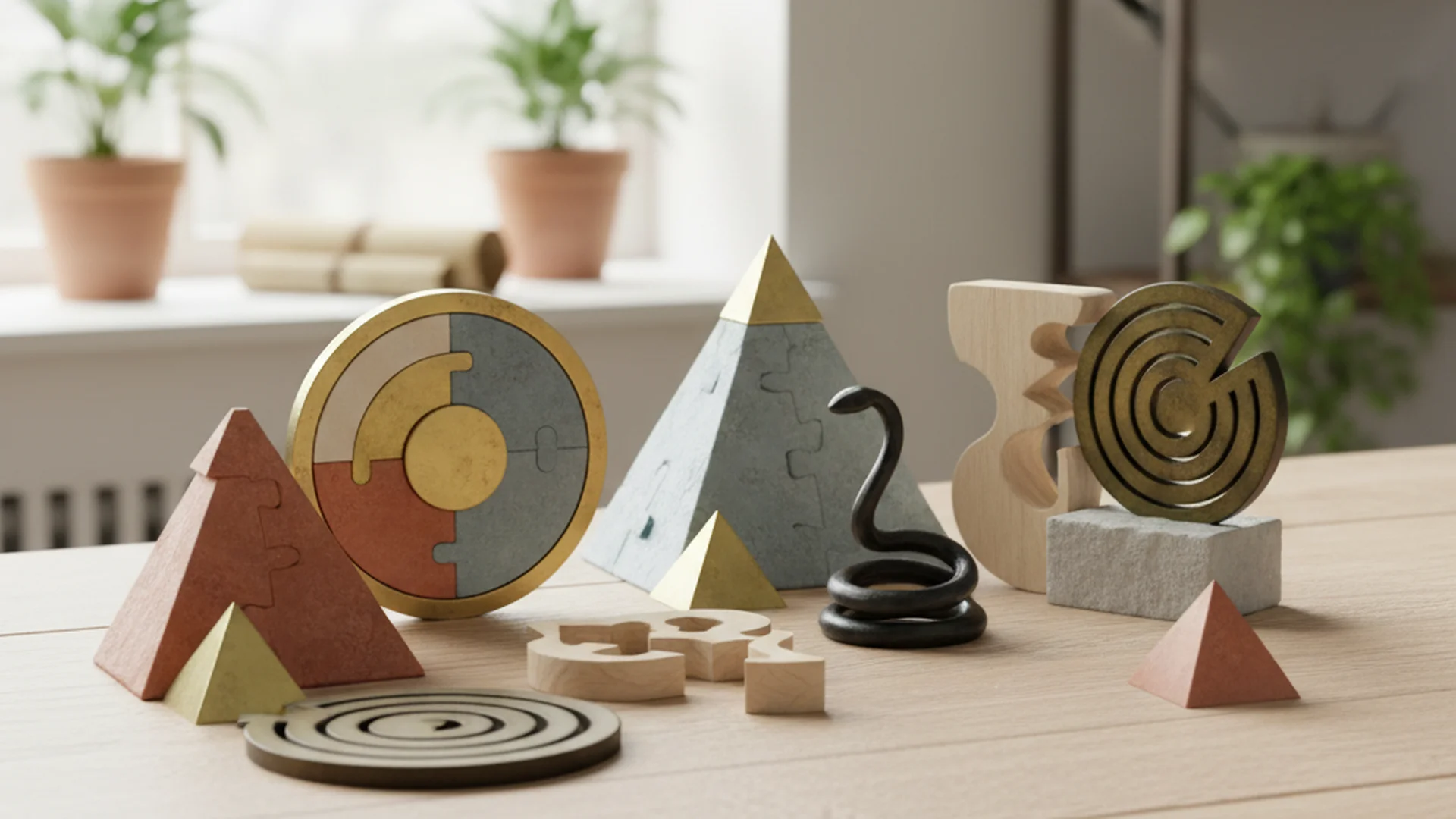
For as long as humans have possessed the gift of language and the spark of curiosity, we have been obsessed with ancient puzzles. These challenges are more than just a way to pass a rainy afternoon; they are intellectual artifacts that provide a direct window into the minds of our ancestors. Whether it was a shepherd in the Fertile Crescent posing a riddle to his peers or a Greek mathematician dissecting complex polygons, historical brain games have always been a fundamental part of the human experience.
The drive to solve the "unsolvable" is a thread that runs through the tapestry of human history. Today, we might open a smartphone app to play Sudoku, but 4,000 years ago, a student in a Sumerian schoolhouse was likely grappling with a cuneiform tablet that challenged their deductive reasoning in much the same way. Understanding these origins helps us appreciate the Puzzle History Overview and how our cognitive cravings have remained remarkably consistent over millennia.
The Cradle of Cognition: Sumerian Riddles and the Ishango Bone
The written history of ancient puzzles begins in Sumer, roughly between 2300 and 2600 BCE. On clay tablets recovered by archaeologists, we find the first recorded instances of linguistic play. One of the most famous Sumerian riddles reads: "A house you enter blind, but come out of with sight." The answer, "a school," suggests that even in the dawn of civilization, people recognized the transformative power of education and the "eye-opening" nature of logic.
However, the history of brain games might go back even further into our prehistoric past. In the Democratic Republic of the Congo, archaeologists unearthed the Ishango Bone. This 20,000-year-old artifact is covered in deliberate notches. While some scholars view it as a simple tally stick, many mathematicians believe the groupings of notches represent prime number sequences or a primitive mathematical game. If true, it would make the Ishango Bone the world's oldest physical puzzle, predating organized agriculture and written language.
Why Ancient Civilizations Loved Puzzles
In ancient societies, puzzles served several critical functions:
- Education: Riddles were used to teach metaphors and lateral thinking to students.
- Social Status: In many cultures, such as the Norse and Greeks, winning a "riddle contest" was a way to prove one's intelligence and social standing.
- Philosophy: Puzzles like the "Riddle of the Sphinx" weren't just for entertainment; they were metaphors for the human condition.
Archimedes and the Birth of Geometric Dissection
While the Sumerians were mastering the art of the riddle, the ancient Greeks were taking a more mathematical approach to historical brain games. The most famous example is Archimedes’ Stomachion.
The Stomachion is a dissection puzzle consisting of 14 pieces of varying shapes that fit together to form a square. For centuries, it was viewed as a simple toy, much like a Tangram. However, in the early 2000s, researchers using high-tech imaging on the "Archimedes Palimpsest" discovered that the legendary mathematician was actually using the puzzle to explore combinatorics—the branch of mathematics concerned with counting combinations.
In 2003, mathematician Bill Cutler used modern computer modeling to answer a question Archimedes himself likely pondered: how many ways can these 14 pieces be rearranged to form a perfect square? The answer is exactly 536 unique ways. This reveals that what looked like a simple game was actually a sophisticated tool for understanding geometric space.
| Puzzle Name | Origin | Estimated Date | Type |
|---|---|---|---|
| Sumerian Riddle | Sumer | 2300 BCE | Linguistic |
| Ishango Bone | Africa | 18,000 BCE | Mathematical |
| Stomachion | Greece | 200 BCE | Geometric |
| Tangram | China | 1790 AD | Dissection |
| Antikythera | Greece | 150 BCE | Mechanical |
Advertisement
The Myth and Mystery of the Tangram
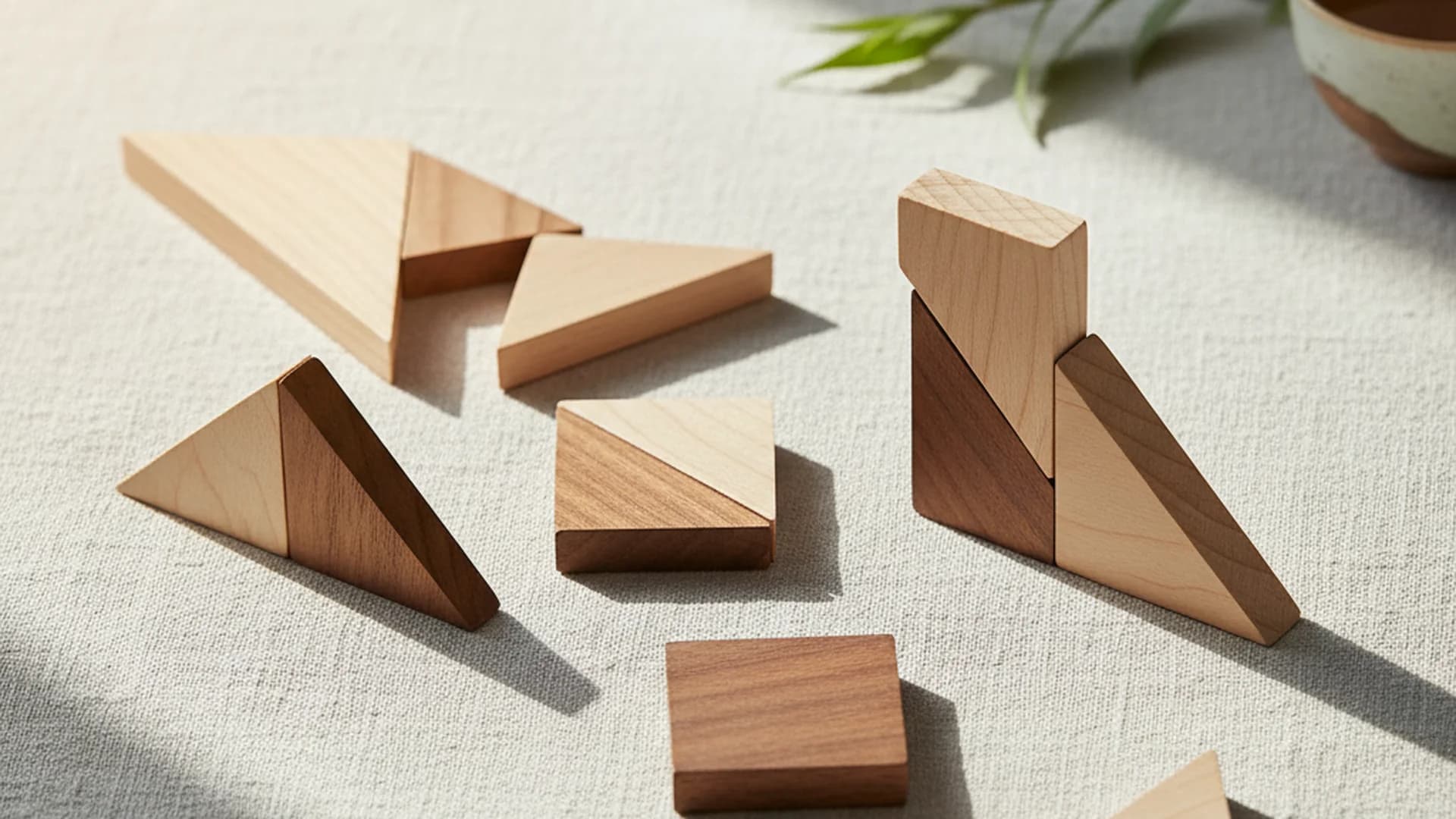
If you mention "ancient puzzles" to most people, they will immediately think of the Tangram. This seven-piece dissection puzzle is iconic, but its history is often shrouded in misinformation.
Common lore suggests the Tangram is 4,000 years old, invented by a man named "Tan" who dropped a tile and spent his life trying to put it back together. In reality, the Tangram was developed in Imperial China (Qing Dynasty) during the late 18th century. It likely evolved from older Song Dynasty (960–1279 AD) "banquet table" arrangements, where guests would arrange modular tables into pleasing shapes.
The "4,000-year-old" myth was actually popularized by a 1903 book titled The Eighth Book of Tan, written by the famous American puzzle-maker Samuel Loyd. Loyd was a master of marketing and deliberately fabricated the ancient origin story to give his puzzles more prestige—a move that successfully sparked a global craze.
Mechanical Marvels: The Antikythera Mechanism
Not all ancient puzzles were made of wood or clay. Some of the most impressive were mechanical. The Antikythera Mechanism, discovered in a shipwreck off the coast of Greece, is often called the world's first analog computer. Dated to approximately 150 BCE, this complex device of bronze gears was used to predict astronomical positions and eclipses.
While not a "puzzle" in the sense of a toy, the Antikythera Mechanism represents a level of mechanical sophistication that puzzles researchers even today. It reminds us that ancient peoples were not "primitive" thinkers; they possessed a grasp of gear ratios and celestial mechanics that wouldn't be seen again in Europe for another millennium.
The Cognitive Science Behind Historical Brain Games
Why have we remained so attached to these games for thousands of years? Modern neuroscience suggests that engaging with complex logic puzzles stimulates the prefrontal cortex. This part of the brain is responsible for:
- Spatial Reasoning: Visualizing how shapes like those in a Sliding Puzzle fit together.
- Deductive Logic: Narrowing down possibilities, a skill vital for Sudoku or ancient riddles.
- Dopamine Release: The "Aha!" moment when a puzzle is solved triggers a reward response in the brain.
Historical figures like Plato and Aristotle believed that puzzles were essential for a healthy mind. Today, we call this Brain Training, and the global market for these cognitive tools is expected to reach $5.6 billion by 2032.
Expert Recommendations for Solving Ancient Puzzles
If you want to master the challenges of antiquity, experts suggest the following strategies:
- Think Like the Era: Ancient riddles often rely on metaphors related to nature, agriculture, or tools that were common 2,000 years ago but are rare today.
- Break It Down: Professor Marcel Danesi, a leading semiotician, recommends breaking geometric puzzles like the Stomachion into modular subsections rather than trying to solve the whole square at once.
- Collaborative Play: In the past, riddles were social events. If you're stuck, use "group solving" to gain a fresh perspective.
- Take an Incubation Break: When a mechanical puzzle has you frustrated, step away for 15 minutes. This allows your subconscious to reorganize the problem.
Advertisement
Recent Trends: The High-Tech Future of Ancient Games (2025–2026)
The years 2025 and 2026 have seen a massive resurgence in ancient puzzles, driven by new technology and a cultural shift toward "Slow Play."
AI as the Super-Solver
In 2024, AI models like DeepMind’s Aeneas began solving "giant puzzles" that had stumped archaeologists for decades. This includes reassembling thousands of fragmented Latin inscriptions and identifying over 300 new geoglyphs in the Nazca Desert. AI is essentially acting as a digital archaeologist, piecing together the broken puzzles of our past.
Immersive and Phygital Gaming
Museums are no longer just places to look at objects. The National Museum of Classic Books in Beijing recently launched an interactive puzzle game where visitors use clues from ancient scrolls to solve a mystery. Furthermore, "Phygital" (physical + digital) games now allow players to use AR (Augmented Reality) on their smartphones to virtually "reconstruct" the Labyrinth of Knossos or the Antikythera Mechanism while sitting in their living rooms.
The Slow Play Movement
As a reaction to the frantic pace of digital life, 2026 has seen the rise of the "Slow Play" movement. Enthusiasts are rejecting speed-solving in favor of meticulously crafted wooden puzzles based on 10th-century Viking and Saxon designs. These puzzles emphasize the tactile feel of the wood and the meditative process of the solve.
Common Mistakes to Avoid
When exploring the world of historical brain games, it's easy to fall into a few common traps:
- Underestimating Ancient Intelligence: Never assume ancient people were less capable because they lacked computers. The Antikythera Mechanism proves they were mechanical geniuses.
- Mistaking Riddles for Jokes: In many ancient traditions, a riddle was a serious philosophical or life-or-death test. Treat them with the same gravity as a modern IQ test.
- Trusting "Prestige" Myths: As seen with the "Einstein’s Riddle" (which Einstein likely never wrote) or the Tangram hoax, always check the source of a puzzle's "ancient" claim.
- Rushing the Solve: Ancient puzzles were often designed for contemplation. If you solve it in 30 seconds, you might be missing the mathematical beauty the designer intended.
Frequently Asked Questions
What is the most famous ancient riddle?
The most famous is undoubtedly the Riddle of the Sphinx from Greek mythology: "What goes on four legs in the morning, two legs at noon, and three in the evening?" The answer is a human: crawling as a baby (morning), walking as an adult (noon), and using a cane in old age (evening).
Who actually invented the Tangram?
The Tangram was invented in China during the late 18th century (Qing Dynasty). While it was inspired by much older furniture-arranging games from the Song Dynasty, the specific seven-piece puzzle we know today is only about 250 years old.
Are ancient puzzles actually good for your brain?
Yes. Modern neuroscience shows that the logic-testing riddles and geometric dissections of the past stimulate the prefrontal cortex, which aids in developing spatial reasoning, deductive logic, and memory retention.
Did ancient people use puzzles to hide treasure?
While popular in movies like Indiana Jones or National Treasure, there is very little archaeological evidence of "puzzle-trap" rooms. Most "treasure puzzles" were actually advanced mechanical locks or cryptic maps rather than logic-gated doors in a temple.
What is the Antikythera Mechanism?
It is an ancient Greek analog computer and orrery used to predict astronomical positions and eclipses for calendar and astrological purposes. It is considered the most complex piece of machinery from the ancient world.
Conclusion
The world of ancient puzzles is a testament to the enduring nature of human curiosity. From the clay tablets of Sumer to the bronze gears of Greece, these historical brain games have challenged us to think harder, look closer, and dream bigger. By engaging with these puzzles today—whether through a physical wooden set or a Logic Puzzles app—we are participating in a tradition of intellectual play that spans the entire history of our species.
As we look toward the future of gaming, with AI and AR bringing these ancient mysteries to life in new ways, we find that the more things change, the more they stay the same. We are still the same creatures who sat in a Sumerian schoolhouse, eager to see the world "with sight" through the power of a well-placed riddle.
Ready to Test Your Mind?
Step into history and challenge your logic with our collection of classic games.
Put it into practice

Keep reading
History
Victorian Puzzles: The Golden Age of Brain Teasers and Parlor Games
Explore the fascinating history of Victorian puzzles. Learn about hand-cut wooden jigsaws, puzzle purses, and the 2025 revival of 19th-century brain teasers.
Sep 5, 2025 12 min
Logic Puzzles
The Tangram History: From Ancient Chinese Skill to Modern Brain Health
Explore the complete tangram history, from its origins in the Qing Dynasty to modern cognitive research. Learn the math, myths, and benefits of this seven-piece puzzle.
Sep 25, 2026 12 min
Brain Health
Puzzles for Depression: Can Brain Games Help Your Mood?
Explore how puzzles for depression and brain games can act as digital therapeutics. Learn about dopamine loops, cortisol reduction, and the latest 2025 mental health trends.
Oct 15, 2026 12 min
Advertisement