Mastering the 2048 Corner Strategy: The Definitive Guide to Winning
Learn the 2048 corner strategy to master the board. Discover techniques like the Snake Pattern and Directional Lock to reach the 2048 tile and beyond.
By Free To Play Puzzles Editorial Team 12 min read

In the world of mathematical puzzles, few games have captured the global imagination quite like 2048. At first glance, it appears to be a simple game of sliding tiles, but as any seasoned player knows, the complexity scales exponentially. To achieve high scores, the most effective method used by experts worldwide is the 2048 corner strategy. This technique involves anchoring your highest-value tile in a single corner and building your numerical empire around it.
The 2048 corner strategy is fascinating because it mirrors how the human brain processes spatial organization and hierarchical logic. By reducing the complexity of the board from a 4x4 grid into a structured flow, you minimize cognitive load and drastically increase your chances of success. Whether you are a beginner or looking to break the world record, mastering this specific 2048 corner technique is your primary path to victory.
The Fundamentals of the 2048 Corner Strategy
The core philosophy of the 2048 corner strategy is order over chaos. In a standard game of 2048, tiles spawn randomly. If you move tiles in all four directions (Up, Down, Left, Right) without a plan, your high-value tiles will eventually end up in the center of the board. Once a 512 or 1024 tile is surrounded by 2s and 4s, it becomes an obstacle rather than an asset.
The Restricted Move-Set
To implement the 2048 corner strategy successfully, you must adopt a "restricted move-set." If you choose the bottom-right corner as your anchor, your primary moves should be Down and Right.
- Primary Moves: Down and Right (keep the high tile anchored).
- Secondary Move: Left (use only to fill rows or create merges).
- Forbidden Move: Up (never use this unless the board is completely jammed).
Research indicates that expert players avoid the "forbidden" direction roughly 95% of the time. This discipline keeps the largest tiles from shifting out of their designated zones, maintaining a stable environment for new tiles to merge.
Building the Snake Pattern
The 2048 corner strategy evolves into what experts call the "Snake Pattern" or "Chain Strategy." Once your largest tile is in the corner (let’s say the bottom-right), you don't just stack numbers randomly next to it. You arrange them in descending order.
How the Cascade Works
Imagine your bottom row looks like this: [128, 256, 512, 1024].
If you manage to create another 128 tile in the second row and move it down, a beautiful "cascade effect" occurs:
- The 128s merge into 256.
- That 256 merges with the existing 256 to create 512.
- That 512 merges with the existing 512 to create 1024.
- Finally, your two 1024 tiles merge to create the 2048 tile.
This linear organization is the only way to reach tiles like 16,384 or the theoretical maximum of 131,072. Without this descending order, the probability of reaching the 1024 tile drops to below 5-10% for casual players.
Advertisement
Advanced Rules: The Row Lock
One of the most common ways the 2048 corner strategy fails is when a player is forced to move their high tile out of the corner. This usually happens when the "forbidden" direction is the only move left. To prevent this, you must master the Row Lock Rule.
Maintaining a Full Row
Always ensure that the row containing your highest tile is full (4 tiles). If you are using the bottom-right corner and your bottom row is [ empty, 256, 512, 1024 ], and you swipe Left to merge two tiles in the upper rows, a new "2" or "4" could spawn in the bottom-right corner, pushing your 1024 tile to the left.
To avoid this, keep your foundation row packed. This "locks" the large tile in place, ensuring that horizontal moves don't displace your progress. For a deeper understanding of the basic mechanics before applying these advanced tips, check out the 2048 Rules: How to Play.
Real-World Examples and Records
To understand the power of the 2048 corner strategy, we can look at competitive play and statistical data.
- The Speedrun Record: The world speed record for reaching the 2048 tile is a staggering 1 minute and 34 seconds. This was achieved by a player who moved almost exclusively in three directions, keeping the largest tile anchored in the corner to minimize the time spent "thinking" about tile placement.
- The AI Training Models: Modern AI trainers, such as those found on specialized GitHub repositories, use the corner strategy as their baseline logic. These bots simulate millions of moves to find the "perfect" move, and they almost never deviate from the corner-anchor principle.
- The Suika Game Connection: In 2024 and 2025, the "Suika Game" (Watermelon Game) became a global sensation. Players quickly realized that the same logic from the 2048 corner technique—keeping large items at the bottom and small ones on top—was the key to high scores in physics-based puzzles as well.
| Strategy Component | Purpose | Success Probability Increase |
|---|---|---|
| Corner Anchor | Stability | +40% |
| Snake Pattern | Merging Flow | +30% |
| Row Lock | Prevention of Displaced Tiles | +20% |
| 3-Direction Move-set | Reducing Chaos | +10% |
Common Mistakes to Avoid
Even with the best intentions, the 2048 corner strategy can be tricky to execute perfectly. Players often fall into "cognitive traps" during high-pressure moments.
The "Flat Board" Trap
This occurs when you have a full row of high-value tiles, such as [1024, 512, 256, 128], and the rest of the board fills up with small tiles that cannot be merged. If your only available move is the "forbidden" direction (Up), you are forced to dislodge your 1024 tile.
The Fix: When the board is 75% full, stop "fast swiping." Slow down and look 2–3 moves ahead. Ensure that you always leave at least one move available in your primary or secondary directions. If you're struggling with these transitions, our 2048 Strategy Guide: How to Win Every Time offers additional tactical depth.
Trapping "Dead Tiles"
A "dead tile" is a small number (like a 2) that gets stuck behind a large number (like a 512) in your anchor corner. Since you cannot easily move the 512, the 2 can never be merged. This effectively "kills" that square for the rest of the game, giving you only 15 squares to work with instead of 16.
Panic Swiping
When the board gets crowded, the human brain enters a "fight or flight" response. This leads to panic swiping—moving in all four directions rapidly to find any possible merge. This is the fastest way to lose.
Advertisement
Recent Trends: 2048 in 2025 and 2026
The game of 2048 has seen a significant resurgence recently. In the 2025 competitive community, there has been a shift toward "Pure 2048" challenges. These are runs where the "Undo" button is strictly forbidden. In this environment, the precision of the 2048 corner technique is more critical than ever, as a single mistake cannot be reversed.
Additionally, players are now using AI-enhanced trainers to simulate "flat board" scenarios. By practicing these high-density situations, players are learning how to recover from "impossible" positions where their corner tile has been displaced. You can explore more about these modern versions in our guide to 2048 Mobile Apps.
Learning these patterns is excellent for Brain Training, as it improves pattern recognition and long-term planning skills. The Cognitive Benefits of maintaining focus on a singular strategy while managing chaotic inputs are well-documented in neurological studies.
Frequently Asked Questions
Which corner is the best to use?
Most experts prefer the bottom-left or bottom-right. There is no mathematical advantage to any specific corner, but sticking to one allows your brain to build "muscle memory" for that specific orientation.
What do I do if I’m forced to move my high tile out of the corner?
Don't panic. This is known as a "forced displacement." Swipe in the forbidden direction, but make your very next move a swipe back into the corner to "re-anchor" the tile. The danger isn't moving the tile once; the danger is a new tile spawning in the corner while your high tile is displaced.
Should I focus on the largest tile only?
No. While the corner strategy is named after the anchor tile, the strategy is actually about the tiles surrounding it. Focus on creating a chain of mid-range tiles (8, 16, 32) near the corner. These smaller tiles are the fuel that feeds your larger tiles.
Is the corner strategy cheating?
Not at all. It is an optimization strategy. Just as there are optimal ways to solve a Rubik’s Cube or play Chess, the 2048 corner strategy is the logical conclusion of the game's mechanics.
Can I reach 2048 without this strategy?
It is possible through luck and "brute force" swiping, but your success rate will be extremely low (less than 10%). Using the corner technique raises your success rate to over 90% once mastered.
Conclusion
The 2048 corner strategy is the definitive key to mastering this addictive puzzle. by anchoring your highest tile, strictly limiting your move-set, and building a descending snake pattern, you transform a game of chance into a game of skill. Remember to keep your foundation row locked, avoid the forbidden move at all costs, and slow down when the board gets crowded.
As you practice, you'll find that these patterns become second nature, leading to higher scores and a more rewarding gaming experience. Whether you're playing on your commute or aiming for a personal best, these techniques will serve as your roadmap to the elusive 2048 tile and beyond.
Ready to Start?
Apply the corner strategy and see how high you can score today.
Put it into practice

Keep reading

Number Games
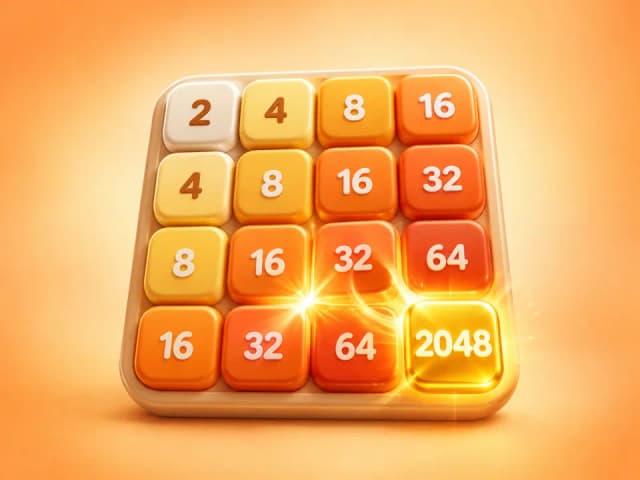
2048: Complete Game Guide & Strategy Handbook
Master the 2048 tile with our 2025 game guide. Learn the corner strategy, snake pattern, and expert tips to join the elite 1% of winners.
Oct 11, 2026 20 min
Number Games
Mastering Arithmagon Puzzles: The Ultimate Strategy Guide
Discover the logic behind arithmagon puzzles. Learn solving strategies, the mathematical "Rule of Two," and how these triangle number puzzles boost mental math.
Aug 7, 2026 10 min
Number Games
Mastering Number Crossword Puzzles: The Ultimate Strategy Guide
Discover the world of number crossword puzzles, also known as cross-figures. Learn rules, solving strategies, and the cognitive benefits of math-based grids.
May 7, 2026 9 min
Advertisement