Navigating Success: The Ultimate Guide to Mazes for Kids
Discover the developmental benefits of mazes for kids. Learn about age-appropriate puzzles, the latest 2025-2026 trends, and expert tips for cognitive growth.
By Free To Play Puzzles Editorial Team 12 min read
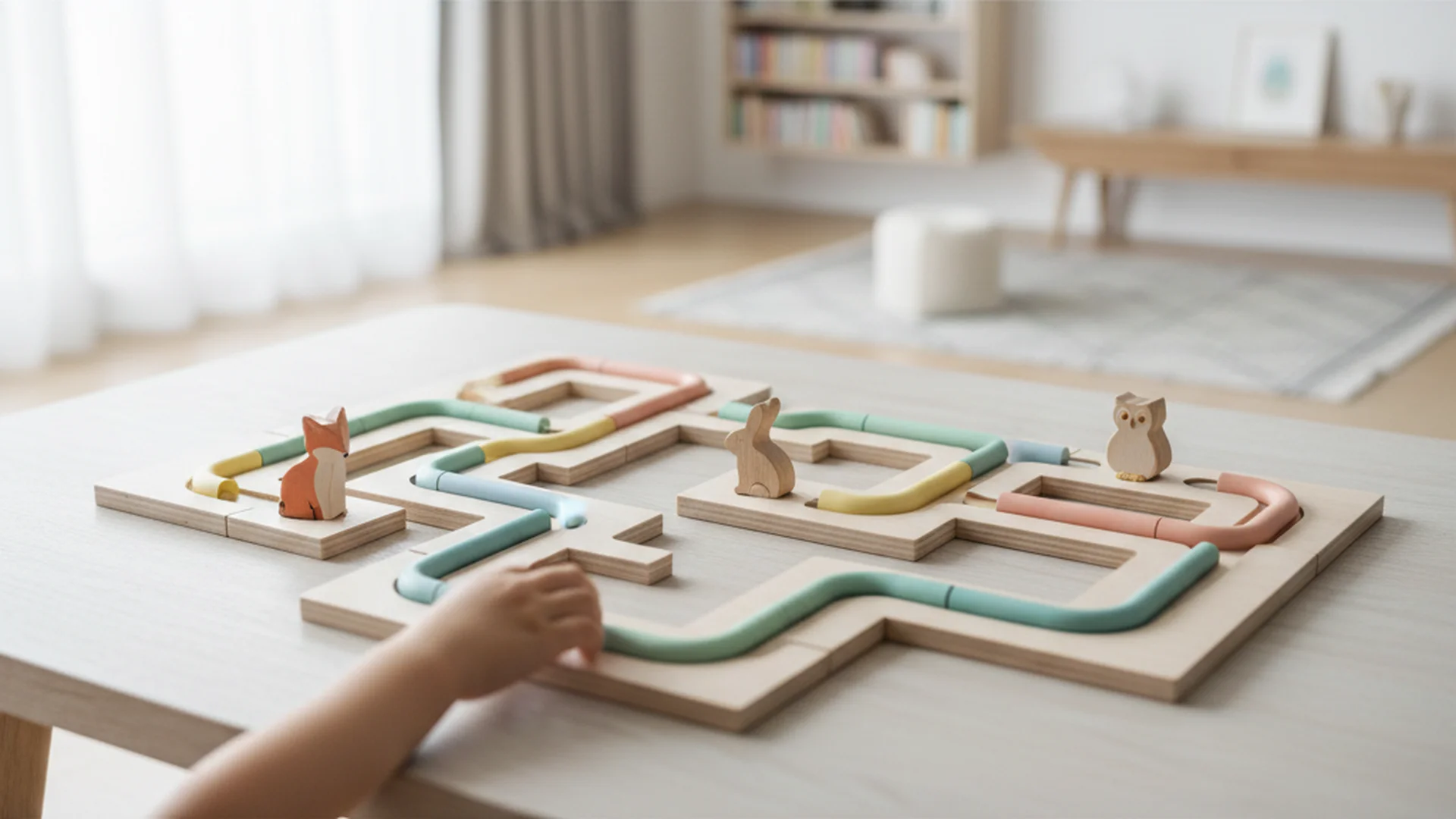
Finding the right mazes for kids is about more than just providing a few minutes of quiet time. As a mathematical logic instructor, I have seen firsthand how these winding paths serve as a "cognitive gym" for developing minds. Whether it is a simple finger maze for a toddler or a complex 3D logic cube for a pre-teen, children mazes offer a unique combination of spatial reasoning, persistence, and fine motor practice that few other toys can match.
In today’s digital-heavy environment, the humble maze is undergoing a massive resurgence. From physical hedge mazes breaking world records to AI-powered digital platforms that adapt to a child’s learning pace, the landscape of puzzle-solving is more exciting than ever.
The Science Behind the Path: How Mazes Rewire the Brain
It might look like a simple game, but neuroscientists have discovered that solving mazes activates the regions of the brain responsible for spatial navigation and memory retention. Researcher James Olds has highlighted that these puzzles function as a complete "cognitive workout," particularly during the "plastic period" of brain development.
For children between the ages of 4 and 8, the brain is exceptionally receptive to new neural pathways. When a child scans a maze to find a route, they are engaging in "executive functioning"—the ability to plan, focus attention, and remember instructions. This is the same mental muscle used later in life for complex math and logical problem-solving.
Maze vs. Labyrinth: Understanding the Difference
Before diving into the types of puzzles available, it is important to clear up a common misconception. While the terms are often used interchangeably, they represent two very different experiences:
- Maze: A "multicursal" puzzle. This means it has branching paths, choices, and—most importantly—dead ends. It requires active problem-solving and decision-making.
- Labyrinth: A "unicursal" path. There is only one way in and one way out, leading you to the center without any branches. These are often used for mindfulness and relaxation rather than logic testing.
For cognitive development, we focus primarily on the maze, as the "trial and error" nature of the puzzle is what builds resilience and critical thinking.
Advertisement
Age-Appropriate Progressions
Not all mazes are created equal. Introducing a puzzle that is too difficult can lead to frustration, while one that is too easy won't provide the necessary stimulus. Here is a breakdown of how to choose the right level for your child.
| Age Group | Recommended Maze Type | Developmental Focus |
|---|---|---|
| 2–3 Years | Finger Mazes & Large Grooves | Sensory exploration and hand-eye coordination |
| 4–5 Years | Simple Printed Paper Mazes | Fine motor skills and "staying within the lines" |
| 6–7 Years | 3D Mazes & Themed Narratives | Spatial awareness and narrative thinking |
| 8+ Years | Logic Mazes & Rule-based Challenges | Executive functioning and strategic planning |
The Toddler Phase (Ages 2-3)
At this stage, children should focus on "finger mazes." These are often found in sturdy board books or as wooden wall toys. The goal is simply to follow a path from start to finish without the pressure of complex intersections.
The Early Learner (Ages 4-5)
This is the "sweet spot" for printed mazes for kids. At this age, the maze becomes a pre-writing tool. Using a pencil to navigate a path helps the child practice the precision needed for letter formation.
2025-2026 Trends: The Future of Maze Play
The educational toy market is projected to reach nearly $99 billion by 2034, and the innovation in the puzzle sector reflects this growth. We are moving beyond the basic black-and-white photocopy.
1. AI-Driven Personalization
New platforms emerging in 2026, such as BasuTots, are revolutionizing how children interact with digital puzzles. These systems use AI learning engines to evaluate how long a child pauses at a junction or how many times they hit a dead end. The software then modulates the next puzzle's complexity in real-time to maintain an "optimal challenge level."
2. Multi-Sensory Electronics
Products like the Spark Cubix (popular throughout 2025) have reimagined mazes as 3D electronic cubes. These use LED illumination and sound effects to guide the player, providing immediate sensory feedback that traditional paper cannot offer.
3. Sustainable and Eco-Friendly Materials
There is a significant shift toward sustainability. Brands like Melissa & Doug have transitioned their popular magnetic number mazes to FSC-certified wood and recycled bio-plastics, meeting the 2026 consumer demand for environmentally conscious play.
4. Hybrid Physical-Digital Play
2026 releases from companies like Highlights for Children now feature "QR-integrated" books. A child solves a physical maze on paper, then scans a code to unlock a 3D digital version of the same maze, bridging the gap between tactile and screen-based learning.
Expert Recommendations: The "Scaffolded Tracing" Method
To get the most out of children mazes, occupational therapists recommend a three-step approach. This prevents the "rushing" habit and maximizes the cognitive benefit:
- Trace with a Finger: This is the planning phase. The child "pre-scans" the route, identifying potential dead ends before making a mark.
- Trace with a Pencil: This is the execution phase. The focus is on staying in the middle of the path and handling the pencil correctly.
- Trace with a Marker: This is the precision phase. Because markers are harder to erase and leave a bolder line, the child must be extra careful, reinforcing the fine motor control learned in step two.
Advertisement
Real-World Examples of Amazing Mazes
Mazes aren't just for the kitchen table; they are architectural marvels that inspire awe in children and adults alike.
- The Yancheng Dafeng Dream Maze: Located in China, this is the world's largest hedge maze. It covers over 35,000 square meters and has a path length of 9.5 kilometers. It serves as a physical manifestation of the logic puzzles children solve on paper.
- The Magnetic Number Maze: A classic classroom tool that uses a magnetic wand to move beads through a maze. It combines logic with counting, showing how mazes can be used to teach multiple subjects simultaneously.
- Logic Mazes (Rule-Based): For older kids, "Logic Mazes" introduce specific rules, such as "You can only turn right" or "You must pass through all red circles." These are excellent for building the mental flexibility found in Logic Puzzles.
Common Mistakes to Avoid
As a parent or educator, it is easy to fall into a few traps that can turn a fun activity into a chore.
- Introducing Difficulty Too Fast: If a maze has 20 dead ends and the child is only four years old, they will likely give up. The goal is "fun-ability." It should be challenging but solvable within a few attempts.
- Focusing on Speed: Parents often celebrate how fast a child completes a maze. However, the real benefits come from the process. Encourage "slow and steady" strokes to build the hand-eye coordination necessary for Puzzle Benefits.
- Ignoring the Story: Abstract lines can be boring. Experts suggest using mazes with a narrative, such as "Help the bee find the flower." This engages the child’s imagination and makes the "work" feel like an adventure.
Frequently Asked Questions
What is the difference between a maze and a labyrinth?
A maze is a multicursal puzzle with branches and dead ends designed to challenge your logic. A labyrinth is a single, non-branching path (unicursal) used primarily for meditation or mindfulness.
At what age can kids start doing mazes?
Children can start as early as 2 years old with simple finger mazes. By age 4, they are usually ready for basic printed mazes, and by age 8, they can handle complex rule-based logic mazes.
Are digital mazes as good as paper ones?
Both have unique benefits. Paper mazes are superior for developing fine motor skills and the "tripod grip" used in writing. Digital mazes, especially those using AI like BasuTots, are excellent for adaptive difficulty and keeping a child engaged with interactive elements.
How do mazes help with handwriting?
Mazes are a primary pre-writing tool. Navigating tight corners and staying within the lines teaches children the spatial awareness and muscle control required to form letters correctly.
Conclusion
Whether you are looking to boost your child's cognitive abilities or simply want to provide a screen-free activity that challenges their mind, mazes for kids are an unbeatable resource. By following the age-appropriate guides and using techniques like scaffolded tracing, you can turn a simple afternoon activity into a significant developmental milestone.
If your child enjoys these types of challenges, they might also find success with other logic-based activities. For more ideas on how to keep young minds sharp, check out our guide on Easy Riddles for Kids or explore the tactile world of 3D Puzzles Guide.
Looking for more brain-teasing fun?
Explore our full collection of logic and strategy puzzles for all ages.
Put it into practice


Keep reading
Puzzle Types
The Ultimate Guide to Escape Room Puzzles: From Local Rooms to Your Living Room
Explore the evolution of escape room puzzles in 2025. Learn expert strategies for solving at home escape room kits and understand the latest industry trends.
Aug 26, 2026 12 min
Puzzle Types
Rubiks Cube Guide: Master the Ultimate 3D Puzzle (2025 Edition)
Unlock the secrets of the 3D puzzle with our comprehensive Rubiks cube guide. Learn the Layer-by-Layer method, CFOP, and 2025 speedcubing tech.
Jul 7, 2026 12 min
Puzzle Types
Math Riddles: The Ultimate Guide to Number-Based Brain Teasers
Discover the power of math riddles to boost cognitive function. Explore 2025 mathematical trends, expert solving tips, and the science of logical puzzles.
Jun 13, 2026 12 min
Advertisement