Rubiks Cube Guide: Master the Ultimate 3D Puzzle (2025 Edition)
Unlock the secrets of the 3D puzzle with our comprehensive Rubiks cube guide. Learn the Layer-by-Layer method, CFOP, and 2025 speedcubing tech.
By Free To Play Puzzles Editorial Team 12 min read
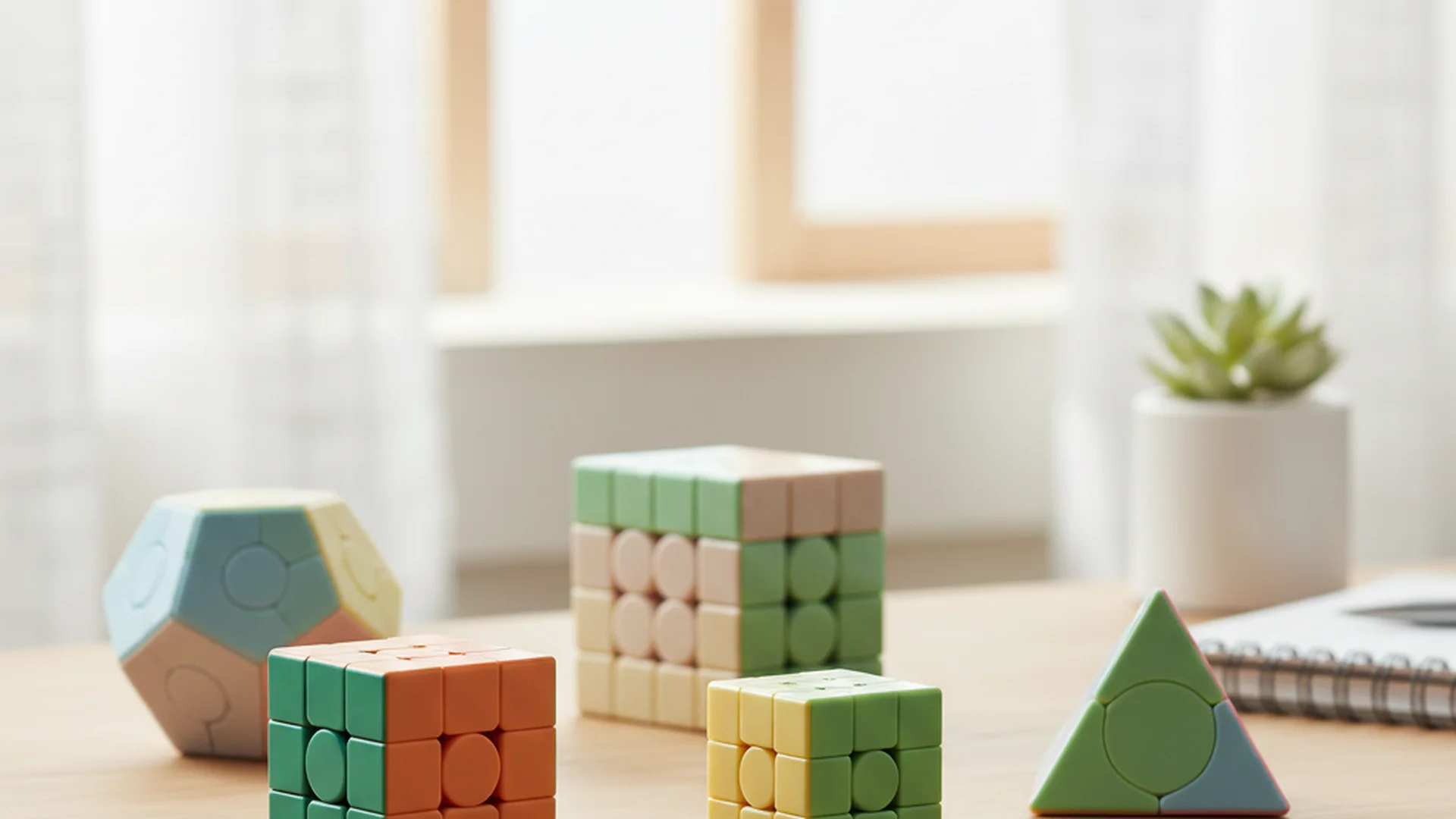
Since its debut on the international stage in the late 1970s, the Rubik’s Cube has transcended its status as a mere toy to become a global cultural phenomenon and a respected mind sport. Whether you are a curious beginner holding a scrambled mess or an aspiring speedcuber looking to shave seconds off your time, this rubiks cube guide provides the definitive roadmap for 2025 and beyond. Learning to solve rubiks cube configurations is a journey of patience, spatial reasoning, and eventually, blistering speed.
The Anatomy of a Legend: Origins and Mechanics
To truly master the cube, one must first understand what they are holding. Invented in 1974 by Ernő Rubik, a Hungarian professor of architecture, the cube was originally intended as a teaching tool to help students grasp 3D geometry. Rubik himself took over a month to solve his own invention for the first time.
The Mathematical Complexity
A standard 3x3 cube is not just a plastic block; it is a mechanical marvel with approximately 43 quintillion (43,252,003,274,489,856,000) possible configurations. To put that in perspective, if you had one cube for every configuration, you could cover the entire surface of the Earth—including the oceans—with 273 layers of cubes.
Despite this staggering complexity, mathematicians proved in 2010 (using Google’s infrastructure) that any cube can be solved in 20 moves or fewer. This optimal figure is famously known as "God’s Number."
Piece Types
The most fundamental step in any rubiks cube guide is recognizing that you don't move "stickers"—you move "pieces."
- Center Pieces: These have one color and never move relative to each other. They define the color of the face.
- Edge Pieces: These have two colors and sit between the corners. There are 12 in total.
- Corner Pieces: These have three colors and sit at the vertices. There are 8 in total.
Understanding Cube Notation
Before you can follow algorithms to solve rubiks cube puzzles, you must speak the language of "Notation." Notation uses single letters to represent a 90-degree clockwise turn of a specific face.
| Notation | Meaning |
|---|---|
| R | Right face (clockwise) |
| L | Left face (clockwise) |
| U | Up/Top face (clockwise) |
| D | Down/Bottom face (clockwise) |
| F | Front face (clockwise) |
| B | Back face (clockwise) |
Advertisement
The Beginner's Method: Layer-by-Layer (LBL)
The gold standard for beginners in 2025 remains the Layer-by-Layer method. Unlike trying to solve the cube "color by color," this method focuses on horizontal tiers. This approach is highly recommended for building the foundational Logic Puzzles skills needed for advanced cubing.
Step 1: The White Cross
The goal is to create a white cross on the top face where the side colors of the edge pieces match the adjacent center pieces (e.g., the white-red edge piece must align with both the white center and the red center).
Step 2: The First Layer Corners
Insert the four corner pieces into their correct positions. Once finished, the entire top "T" shape on each side should be formed.
Step 3: The Second Layer (Edges)
Flip the cube so the white face is on the bottom. You will now use algorithms to move edge pieces from the top layer into the middle layer.
- Algorithm (Right): U R U' R' U' F' U F
- Algorithm (Left): U' L' U L U F U' F'
Step 4: The Yellow Cross and Final Layer
This involves four sub-steps:
- Yellow Cross: Creating the cross on the top face.
- Aligning Edges: Ensuring the yellow edges match the side centers.
- Positioning Corners: Putting corners in the right spot (even if they are rotated wrongly).
- Orienting Corners: The final rotation to complete the cube.
Speedcubing: Transitioning to CFOP
For those who find the LBL method too slow, the CFOP method (Cross, F2L, OLL, PLL) is the next level. This is the method used by world record holders to achieve sub-5-second solves.
- Cross: Still the first step, but usually solved on the bottom to improve visibility.
- F2L (First Two Layers): Instead of solving corners and edges separately, you pair them up and insert them together. This reduces the number of steps significantly.
- OLL (Orientation of the Last Layer): Solving the entire top face color in one of 57 possible algorithms.
- PLL (Permutation of the Last Layer): Shuffling the top layer pieces into their final positions using one of 21 algorithms.
Technological Advancements in 2025-2026
The "plastic-on-plastic" feel of the 1980s is long gone. Modern cubes are high-tech instruments. If you are serious about your rubiks cube guide journey, you need to understand current hardware.
MagLev and Ball-Core Tech
In 2025, traditional springs are being replaced by MagLev (magnetic levitation). Two magnets repelling each other create the tension, resulting in a friction-less turn that feels like the layers are floating. Additionally, "Ball-Core" magnets in the center of the cube provide "auto-aligning" capabilities, where the layers snap into place if they are within 15-30 degrees of a full turn.
The Rise of Smart Cubes
Smart Cubes like the MoYu WeiLong V11 AI have changed how we practice. These cubes connect via Bluetooth to your smartphone or tablet.
- Real-time Analysis: The app tracks every move, showing you exactly where you hesitated.
- Global Racing: You can battle players in Cape Town or Shenyang from your living room.
- AI Coaching: Algorithms suggest more efficient paths for the specific scramble you just solved.
Advertisement
Expert Recommendations for Hardware
| Category | Model (2025-2026) | Key Feature |
|---|---|---|
| Flagship | GAN 16 MagLev | Ultra-lightweight, customizable magnets |
| Best Performance | MoYu WeiLong V11 | Exceptionally fast, used by many pros |
| Best Value | QiYi M Pro | Professional feel for under $25 |
| Eco-Friendly | QiYi Eco-Series | Made from 100% recycled plastics |
Common Mistakes to Avoid
Even with a detailed rubiks cube guide, beginners often fall into the same traps.
- Solving Face-by-Face: As mentioned, you must solve by layers. If you solve the white face without regard for the sides, you will never be able to complete the rest of the puzzle.
- Losing Track of Orientation: Always pick a "front" and "top" face and keep them consistent during an algorithm. If you rotate the entire cube mid-algorithm, the sequence will fail.
- Lack of Finger Tricks: Beginners often use their whole hand to turn a face (wrist turns). Professionals use their index and ring fingers (finger tricks) for speed and to keep the cube stable.
- Over-tightening: If your cube is hard to turn, don't force it. Most modern cubes allow you to adjust the tension with a small screwdriver or a built-in adjustment tool.
The Competitive Landscape in 2026
The World Cube Association (WCA) continues to see record-breaking participation. As of late 2025, the limits of human speed are being pushed to the absolute edge.
World Records
- 3x3 Single: 3.05 seconds by Xuanyi Geng. This solve featured an incredibly efficient "X-Cross" and a lucky PLL skip.
- 3x3 Average: 3.90 seconds by Yiheng Wang. Consistency is the hallmark of modern speedcubing, with top-tier players regularly averaging sub-5 seconds.
- Robotic Solving: A university robot in May 2025 achieved a solve of 0.103 seconds, which is faster than the blink of a human eye.
Upcoming Events
The 2026 Continental Championships are set to be the largest in history. Host cities include:
- Africa: Cape Town, South Africa.
- Asia: Shenyang, China.
- Europe: Arnhem, Netherlands.
- South America: Bogotá, Colombia.
Participating in these events is a great way to experience the community. Even if you aren't "fast," the cubing community is famously welcoming to newcomers.
Frequently Asked Questions
What is the best way for a beginner to start?
The "Layer-by-Layer" (LBL) method is the gold standard. Start by mastering the "White Cross," then move to the first layer, second layer, and finally the top layer. Focus on one step at a time until you can do it without looking at a guide.
Do I need to be good at math to solve it?
No. While the cube is a mathematical object, solving it is a test of pattern recognition and muscle memory. If you can remember a phone number or follow a recipe, you can learn to solve rubiks cube puzzles.
How long does it take to learn?
Most people can learn the basic beginner method in 2 to 5 hours of focused practice. It is best to spread this over 2 or 3 days to allow your brain to "encode" the movements into muscle memory.
What is CFOP?
CFOP stands for Cross, F2L (First Two Layers), OLL (Orientation of the Last Layer), and PLL (Permutation of the Last Layer). It is an advanced solving method that uses over 70 algorithms to minimize the number of moves required.
Are expensive cubes worth it?
For a beginner, a $10-$15 magnetic "budget" cube is plenty. However, as you get faster (under 30 seconds), the customization options and reduced friction of a flagship cube ($50+) become much more beneficial.
Conclusion
Mastering the Rubik’s Cube is more than just a party trick; it is a gateway to improved cognitive function and a global community of enthusiasts. By following this rubiks cube guide, you’ve taken the first step toward conquering one of the world's most enduring challenges. Remember that every world record holder started exactly where you are now—staring at a scrambled cube and wondering where to begin.
The benefits of this practice extend beyond the cube itself. Engaging with such puzzles provides significant Brain Training and Puzzle Benefits, sharpening your mind for other challenges like 3D Puzzles or even the Sliding Puzzle.
Keep practicing, stay patient, and most importantly, have fun with the process. The 43 quintillion possibilities are waiting for you.
Ready to Challenge Your Mind?
Explore our full range of brain-teasing games and strategy guides.
Put it into practice

Keep reading
Puzzle Types
Navigating Success: The Ultimate Guide to Mazes for Kids
Discover the developmental benefits of mazes for kids. Learn about age-appropriate puzzles, the latest 2025-2026 trends, and expert tips for cognitive growth.
Sep 6, 2026 12 min
Puzzle Types
The Ultimate Guide to Escape Room Puzzles: From Local Rooms to Your Living Room
Explore the evolution of escape room puzzles in 2025. Learn expert strategies for solving at home escape room kits and understand the latest industry trends.
Aug 26, 2026 12 min
Puzzle Types
20 Best Hidden Object Games: A Cognitive Scientist’s Guide for 2025-2026
Discover the best hidden object games for brain health and relaxation. Expert reviews of top hidden object games, strategy tips, and 2026 trends for all ages.
Aug 3, 2026 12 min
Advertisement