Logic vs Memory Puzzles: Which Is Better for Your Brain Health?
Explore the neuroscientific differences between logic vs memory puzzles. Learn how reasoning and recall games impact cognitive reserve and dementia delay.
By Free To Play Puzzles Editorial Team 12 min read
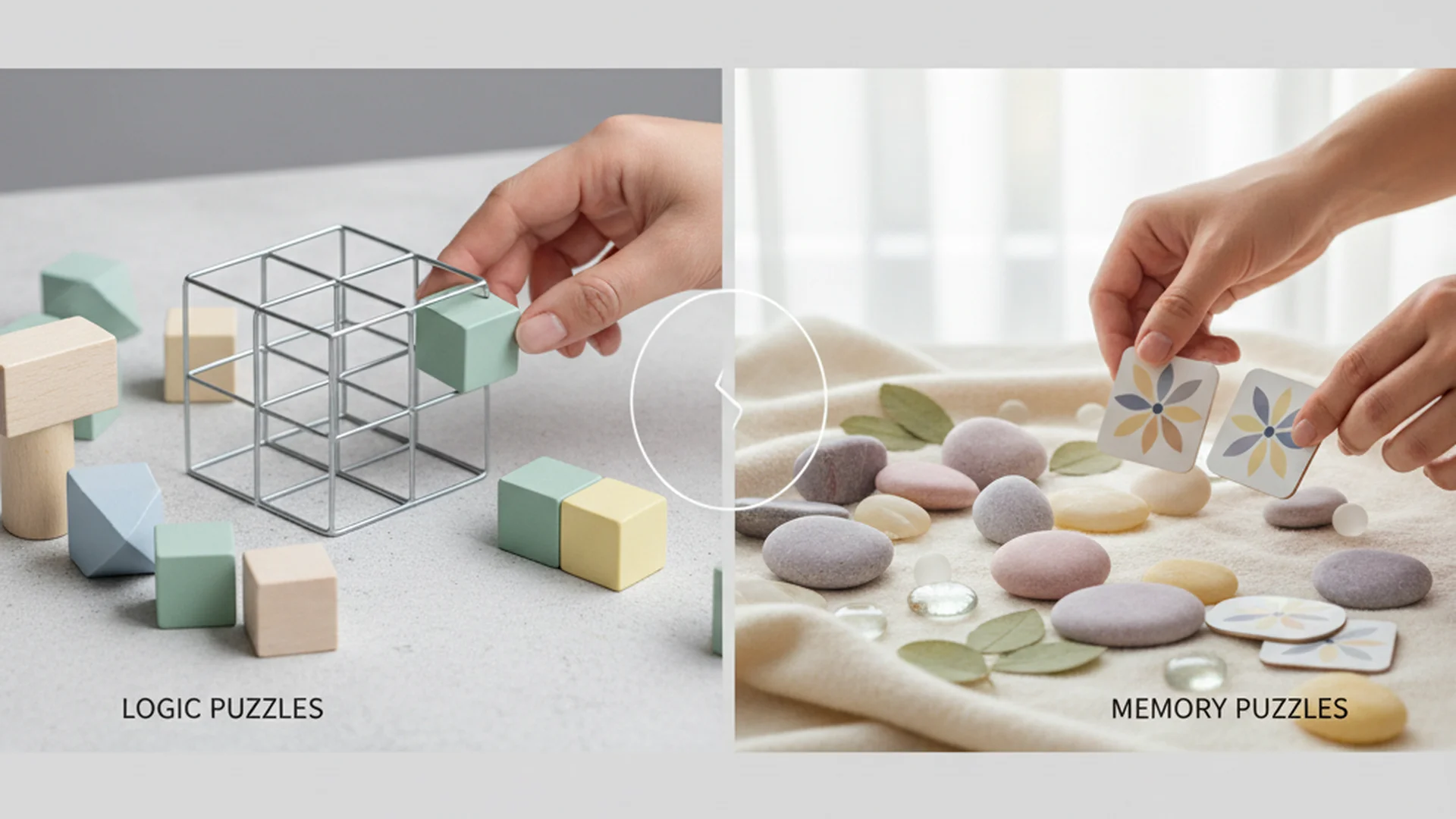
One of the most common brain-training questions is: "Which game will keep my mind sharpest?" Often, the conversation boils down to a choice between logic vs memory puzzles. While both are staples of a healthy cognitive lifestyle, they serve fundamentally different functions within the neural architecture.
Understanding the distinction between reasoning vs recall games is more than just academic interest—it is a roadmap for maintaining your "cognitive reserve." Whether you are solving a complex grid in Sudoku or trying to remember the location of cards in Memory Match, you are engaging different regions of the brain. As we navigate the technological shifts of 2025, from AI-powered tutors to physical 3D logic kits, choosing the right mental workout has never been more vital.
Defining the Contenders: Logic vs. Memory
To choose the right mental exercise, we must first define what these puzzles actually do to our grey matter.
What are Logic Puzzles?
Logic puzzles rely on deductive reasoning. This is the process of taking a set of known facts and using them to determine what must be true. When you play Logic Puzzles or solve Minesweeper, you aren't necessarily reaching into a database of stored facts. Instead, you are using "if-then" statements to navigate a problem. This primarily exercises the prefrontal cortex, the area of the brain responsible for complex planning, decision-making, and executive function.
What are Memory Puzzles?
Memory puzzles, on the other hand, focus on recall and retrieval. These games test your ability to access stored information, whether it was learned five seconds ago (short-term memory) or five years ago (long-term memory). Games like Simon Says or Word Search lean heavily on the hippocampus. This region is critical for forming new memories and navigating spatial environments.
The Science of Brain Health and Aging
One of the most compelling reasons to engage in these activities is the documented impact on long-term brain health.
Delaying Cognitive Decline
A landmark 2022 study published in NEJM Evidence provided clear data on the power of puzzles. The research found that older adults who regularly engaged in crossword puzzles—which are a unique blend of memory (vocabulary recall) and logic (fitting words into a grid)—showed significantly less brain shrinkage than those who relied purely on digital brain-training apps.
Furthermore, frequent cognitive stimulation has been shown to delay the onset of dementia symptoms by approximately 2.5 years. While puzzles cannot "cure" or "prevent" Alzheimer’s, they build a more robust network of neural connections. This is known as "cognitive reserve"—a buffer that allows the brain to continue functioning normally even as physical pathology develops.
The "Pay Attention" Chemical: Acetylcholine
Every time you tackle a new logic challenge, your brain increases the production of acetylcholine. This neurotransmitter is essential for focus and neuroplasticity. This is particularly important because our natural acetylcholine levels decline by roughly 2.5% per decade between the ages of 20 and 80. By forcing the brain to engage with new patterns, you are essentially "supplementing" your brain's focus chemistry through activity.
| Feature | Logic Puzzles (Reasoning) | Memory Puzzles (Recall) |
|---|---|---|
| Primary Brain Region | Prefrontal Cortex | Hippocampus |
| Cognitive Skill | Deductive Reasoning | Data Retrieval |
| Example Game | Sudoku | Memory Match |
| Key Benefit | Problem Solving | Information Retention |
Advertisement
Modern Trends in Puzzles (2025–2026)
The puzzle landscape has changed dramatically in the last year. We are moving away from simple 2D grids into more immersive, integrated experiences.
AI-Powered Logic Tutors
In 2025, we have seen the rise of "Adaptive AI" in games. Unlike old-school programs that simply told you if an answer was wrong, new versions of classic games now feature AI tutors. These systems analyze your mistakes and teach the underlying logic in real-time. This shifts the focus from "getting the answer" to "learning the process," which is where the true cognitive benefit lies.
The Return to Physicality: 3D and Mechanical Puzzles
There is currently a massive trend toward "functional art" puzzles. These are 3D mechanical kits made from sustainable materials like bamboo. Solving a 3D Tangram or a mechanical clock kit requires spatial reasoning—a specific type of logic that involves visualizing objects in three dimensions.
AR/VR Integration
Augmented Reality (AR) has allowed logic puzzles to move into our physical living spaces. You can now use a headset or smartphone to "walk through" a logic maze or solve a virtual Rubik's Cube that appears to float on your coffee table. This blending of physical movement and mental reasoning is a powerful tool for Cognitive Benefits.
Best Practices for a Sharper Mind
How you play is just as important as what you play. To maximize your results, follow these expert recommendations.
Prioritize Novelty
The brain is an efficiency machine. Once you become a master at a specific type of puzzle, your brain enters "autopilot." If you can solve a Crossword in five minutes without thinking, you are no longer fostering neuroplasticity. To keep the brain growing, you must switch types. If you love word games, try Math Puzzles.
Escalate Difficulty
A puzzle that is too easy provides almost zero cognitive benefit. You want to stay in the "flow state"—the sweet spot where the challenge is just high enough to be difficult but not so high that it causes frustration.
The Whole-Body Approach
Puzzles do not exist in a vacuum. Experts from the Memory and Brain Wellness Center emphasize that mental games are most effective when paired with:
- Physical Exercise: Increases blood flow to the brain.
- Healthy Diet: The Mediterranean-DASH Intervention for Neurodegenerative Delay (MIND) diet is highly recommended.
- Social Interaction: Playing games like Connect Four or Hangman with others adds a layer of social cognition that solo puzzles lack.
Common Mistakes and Misconceptions
Many people fall into the same mental traps regarding brain training.
The Left-Brain vs. Right-Brain Myth
It is a common misconception that logic is "left-brain" and memory/creativity is "right-brain." Modern fMRI scans show that the whole brain is deeply interconnected. For example, solving a Sliding Puzzle requires both logic (the sequence of moves) and spatial creativity (visualizing the final image). Do not limit yourself to one "side" of your brain.
Equating Memory with Intelligence
High recall—such as the ability to remember trivia—is often mistaken for high intelligence. However, logical reasoning (the ability to solve new problems and adapt to new information) is a much stronger indicator of "fluid intelligence." While memory is the "database" of your mind, logic is the "processor." You need both to be effective.
The "App Only" Trap
While digital platforms like Brain Training are convenient, relying solely on a smartphone can be detrimental. Sitting still for long periods is bad for brain health. Whenever possible, choose physical puzzles or games that require social interaction.
Advertisement
Frequently Asked Questions
Is Sudoku a logic or memory game?
Sudoku is primarily a logic game. While you do need to remember which numbers you have already placed, the core of the game is deductive "if-then" reasoning. You don't solve it by recalling facts; you solve it by eliminating possibilities based on rules.
Do these games actually make you "smarter"?
In neuroscience, we distinguish between Near Transfer and Far Transfer. Near Transfer means you get better at the specific game you are playing. Far Transfer means those skills translate to real-life tasks. While puzzles mostly provide near transfer, they build a "cognitive reserve" that keeps the brain resilient against age-related decline.
Should I focus on logic or memory if I’m over 60?
You should focus on both, but prioritize whichever feels more "uncomfortable." If you have always been good with names and facts (memory), your brain will benefit more from the challenge of Logic Puzzles. A balanced routine is the gold standard for healthy aging.
Can puzzles prevent Alzheimer's Disease?
No puzzle can "prevent" the disease, as Alzheimer's is a complex biological condition. However, a mentally active lifestyle can delay the symptoms. By building stronger neural networks, your brain can function better for a longer period of time, even if the underlying disease is present.
Conclusion
The debate of logic vs memory puzzles shouldn't be about choosing a winner. Instead, it should be about understanding how to use both to build a more resilient mind. Use logic puzzles to sharpen your problem-solving "muscles" and memory games to maintain the "database" of your life's experiences.
By staying curious, seeking out novelty, and moving beyond the digital screen into physical and social challenges, you can maximize your cognitive potential well into the future.
Ready to Start?
Challenge your reasoning and recall today.
Put it into practice

Keep reading

Comparisons
Puzzles vs Language Learning: Which Is Better for Your Brain Health?
Explore the ultimate brain training comparison: puzzles vs languages. Discover which activity offers the best protection against cognitive decline and dementia.
Mar 18, 2026 12 min
Comparisons
Visual vs Verbal Puzzles: Which Is Better for Your Brain Health?
Explore the science of visual vs verbal puzzles. Learn how spatial and language brain regions interact and discover the best way to train your mind in 2025.
Jun 10, 2025 12 min
Comparisons
Puzzles vs Music Brain: Which Cognitive Workout Wins?
Explore the neurobiology of puzzles vs music. Learn how learning an instrument and solving puzzles impact cognitive longevity, IQ, and dementia prevention.
Feb 17, 2026 12 min
Advertisement