Puzzles vs Music Brain: Which Cognitive Workout Wins?
Explore the neurobiology of puzzles vs music. Learn how learning an instrument and solving puzzles impact cognitive longevity, IQ, and dementia prevention.
By Free To Play Puzzles Editorial Team 12 min read
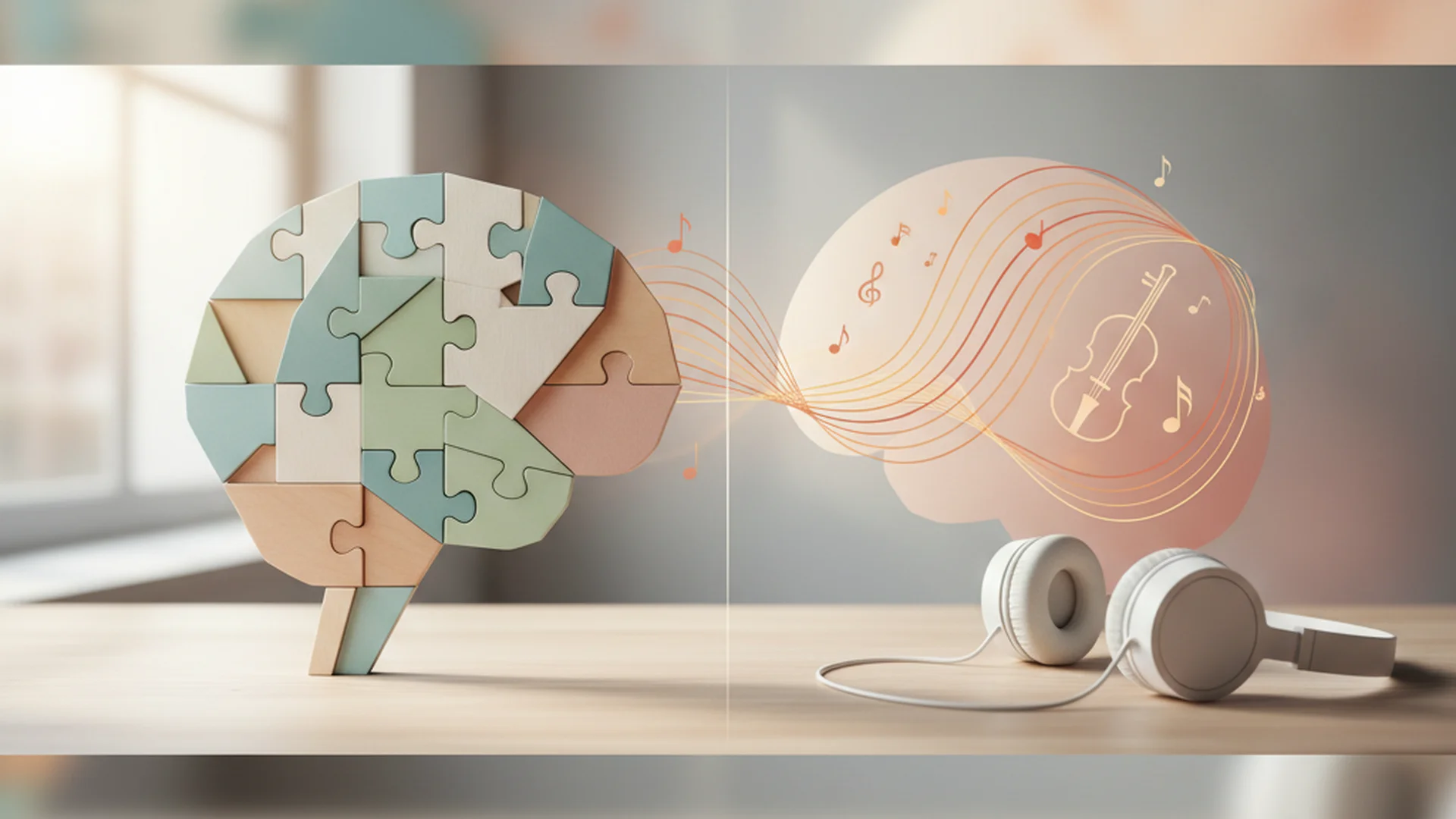
In the world of cognitive health, we often look for the ultimate "magic bullet"—the one activity that will keep our minds sharp well into our eighties and nineties. Puzzle fans know the "puzzle brain" state well: dissecting words and working through logical grids. However, neuroscientists have long debated the comparison of puzzles vs music and which provides the superior mental edge.
While puzzles are phenomenal for building cognitive reserve, learning a musical instrument is often described by researchers as a "full-body workout for the brain." Both offer unique advantages, but they operate on different neural tracks. Whether you are deciding between picking up a Sudoku book or a violin, understanding how these activities reshape your gray matter is the first step toward lifelong mental agility.
The Neurobiology of the Music Brain
When you sit down to play an instrument, your brain doesn't just "turn on"—it ignites. Unlike almost any other human activity, playing music engages every major area of the central nervous system. You are simultaneously using your visual cortex (to read music), your auditory cortex (to listen to the notes you produce), and your motor cortex (to control your fingers or breath).
The "Whole Brain" Advantage
Professional musicians have been found to have up to 130% more gray matter in their auditory cortex and 102% more activity than non-musicians. This isn't just about talent; it’s about structural change. The constant communication required between the left and right hemispheres of the brain forces the corpus callosum—the bridge of fibers connecting the two sides—to thicken. This allows messages to travel across the brain faster and through more diverse routes.
Piano: The Gold Standard
If you are looking for the maximum cognitive return on investment, the piano is frequently cited as the gold standard. It requires linear reading, multi-hand coordination, and foot-pedal use. This "multitasking" environment is why a University of Zurich study found that children who took music lessons for just one year showed an IQ increase of up to 7 points.
The Power of the Puzzle Brain
If music is a full-body workout, puzzles are the "targeted gym session" for your logic and memory tracks. Puzzles force the brain to find connections between disparate pieces of information. This is why 10 Crossword Solving Strategies the Pros Use often involve lateral thinking rather than just rote memorization.
Delaying Dementia Symptoms
Research shows that regular puzzle-solving can delay the onset of dementia symptoms by approximately 2.5 years. It is important to clarify a common misconception: puzzles do not stop the underlying pathology of Alzheimer’s. Instead, they build "cognitive reserve." This means your brain becomes so efficient and has so many "back-up routes" for information that it can continue to function normally even after some damage has occurred.
Near-Transfer vs. Far-Transfer
When comparing learning instrument vs puzzles, we must look at "transfer."
- Near-transfer: Puzzles are excellent at this. If you do Sudoku, you get better at logic and pattern recognition. If you do crosswords, you get better at verbal retrieval.
- Far-transfer: Music excels here. The skills you learn playing an instrument—disciplined practice, auditory processing, and motor coordination—apply to almost every other area of life, from learning a new language to improved physical coordination.
Advertisement
Comparison: Learning Instrument vs Puzzles
| Feature | Musical Instrument | Puzzles (Crosswords/Logic) |
|---|---|---|
| Brain Engagement | Whole-brain (Visual, Motor, Auditory) | Specific (Logic, Memory, Verbal) |
| Transfer Benefit | Far-transfer (Affects many life skills) | Near-transfer (Affects specific tasks) |
| Dementia Impact | Lower overall risk of development | Delays symptom onset (2.5 years) |
| Physical Component | High (Fine motor skills/Breath) | Low (Mostly sedentary) |
| Social Aspect | High (Bands, Orchestras, Choirs) | Usually Solitary (Unless competitive) |
The Challenge Rule: Why Your Habit Might Be Failing You
One of the biggest mistakes in both the music and puzzle worlds is staying in the "comfort zone." If you have been doing the same difficulty of crossword for twenty years, you are no longer training your brain; you are simply relaxing. While relaxation has value, it does not trigger neuroplasticity.
To see real change, you must follow the Challenge Rule. This means:
- For Puzzlers: If you are an expert at crosswords, try Logic Puzzles or Number Games.
- For Musicians: If you can play your scales perfectly, learn a new genre or a complex piece that forces you to "stumble" during practice.
Recent Trends: The Future of Cognitive Training (2025–2026)
As we move into 2025 and 2026, the landscape of brain training is shifting from generic apps to personalized "mental prescriptions."
Neural Resonance Theory (NRT)
Recent 2025 research from UConn explores Neural Resonance Theory. This suggests that brain rhythms physically synchronize with musical beats—a process called entrainment. This suggests that rhythm-based games can help repair neural pathways in patients with early-stage cognitive decline. We are seeing a rise in "Rhythm-Puzzles" that combine the two worlds.
Augmented Reality (AR) Puzzles
A major trend for 2025 involves AR Puzzles. These puzzles change their internal logic as you solve them, preventing the "plateau effect." By shifting the rules mid-game, the brain is forced to remain in a state of high-alert learning, which is significantly more effective than traditional static puzzles.
Personalized "Brain Clocks"
By 2026, neuroimaging studies are helping individuals identify their "brain age" and which activities they respond to best. Some people are "creative-dominant" and see massive gray matter gains through music, while others are "strategy-dominant" and thrive on tasks similar to Chess vs Sudoku Brain.
Advertisement
Common Mistakes to Avoid
- Doing the Same Puzzle Daily: As mentioned, if it's easy, it's not training. You need to rotate through different types of Brain Training.
- Sticking to Solo Play: Experts now emphasize that playing music in a group or solving puzzles with a partner provides a "social-cognitive" double-boost that is more effective against aging than solo work.
- Ignoring the "Flow State": Many people try to "grind" through practice. However, entering a flow state (where you lose track of time) increases dopamine, making the cognitive effort feel less taxing and more sustainable.
- Passive vs. Active: Watching a video about how to play guitar is not the same as playing it. Your motor cortex must be engaged for the "whole brain" benefit to occur.
The "Combo" Strategy: Using Both Worlds
You don't have to choose between puzzles vs music. In fact, using them together can be a powerful cognitive strategy.
Professional solvers often use instrumental music (like Baroque or Lo-fi) as a background for puzzling. Research suggests this can improve focus by up to 68%. However, avoid music with lyrics while puzzling, as it creates "cognitive interference," forcing your brain to choose between processing the words in the song and the words in the puzzle.
To see how puzzles compare to other activities, you might also be interested in:
- Puzzles vs Reading Benefits
- Puzzle vs Video Games Benefits
- Crossword vs Sudoku Benefits
Frequently Asked Questions
Is it better to do a puzzle or play an instrument?
If you have to choose one for overall brain structure, music is slightly better due to its "far-transfer" benefits and "whole-brain" engagement. However, puzzles are more accessible and better for sharpening specific logical faculties.
Am I too old to start learning an instrument?
No. A 2023 study found that seniors (60+) showed improved verbal memory in as little as 10 weeks of starting a new instrument. The brain remains plastic throughout life.
Does listening to music help with puzzles?
Yes, but only instrumental music. Lyrics tend to distract the verbal processing center of the brain, which is crucial for word-based puzzles.
Which instrument is best for the brain?
The piano is often considered the best because it requires the most complex coordination between both hands, eyes, and feet, maximizing the communication between brain hemispheres.
How much time should I spend on these activities?
Consistency over intensity is key. 15–20 minutes of daily practice is far more effective for brain health than a single three-hour "marathon" session once a week.
Conclusion
When we look at puzzles vs music, it is clear that both have a seat at the table of cognitive health. Puzzles are your tactical tools—they keep your logic sharp and build a reserve that keeps you functional even as you age. Music is your strategic powerhouse—it reshapes your brain’s architecture and creates a faster, more interconnected network.
The best "mental prescription" is one that includes variety. Solve your morning crossword, but don't be afraid to pick up that harmonica or book a piano lesson. The struggle of learning something new is exactly what your brain needs to stay young.
Ready to Start?
Challenge your brain today with our collection of logic and word games.
Put it into practice
Keep reading
Comparisons
Puzzles vs Language Learning: Which Is Better for Your Brain Health?
Explore the ultimate brain training comparison: puzzles vs languages. Discover which activity offers the best protection against cognitive decline and dementia.
Mar 18, 2026 12 min
Comparisons
Puzzles vs Reading: Which Is the Ultimate Workout for Your Brain?
Compare the cognitive benefits of puzzles vs reading. Discover how crosswords and books impact memory, stress, and dementia risk based on 2025 research.
Feb 20, 2026 12 min
Comparisons
Word Puzzles vs Number Puzzles: Which Is Best for Your Brain?
Explore the ultimate debate of word vs number puzzles. Discover which cognitive benefits suit your goals, from verbal intelligence to logical reasoning.
Dec 15, 2025 12 min
Advertisement