The Definitive History of Asteroids: From Vector Origins to the 2026 Revival
Explore the complete asteroids game history, from its 1979 arcade debut to the latest 2025-2026 haptic revivals and blockchain integrations.
By Free To Play Puzzles Editorial Team 12 min read
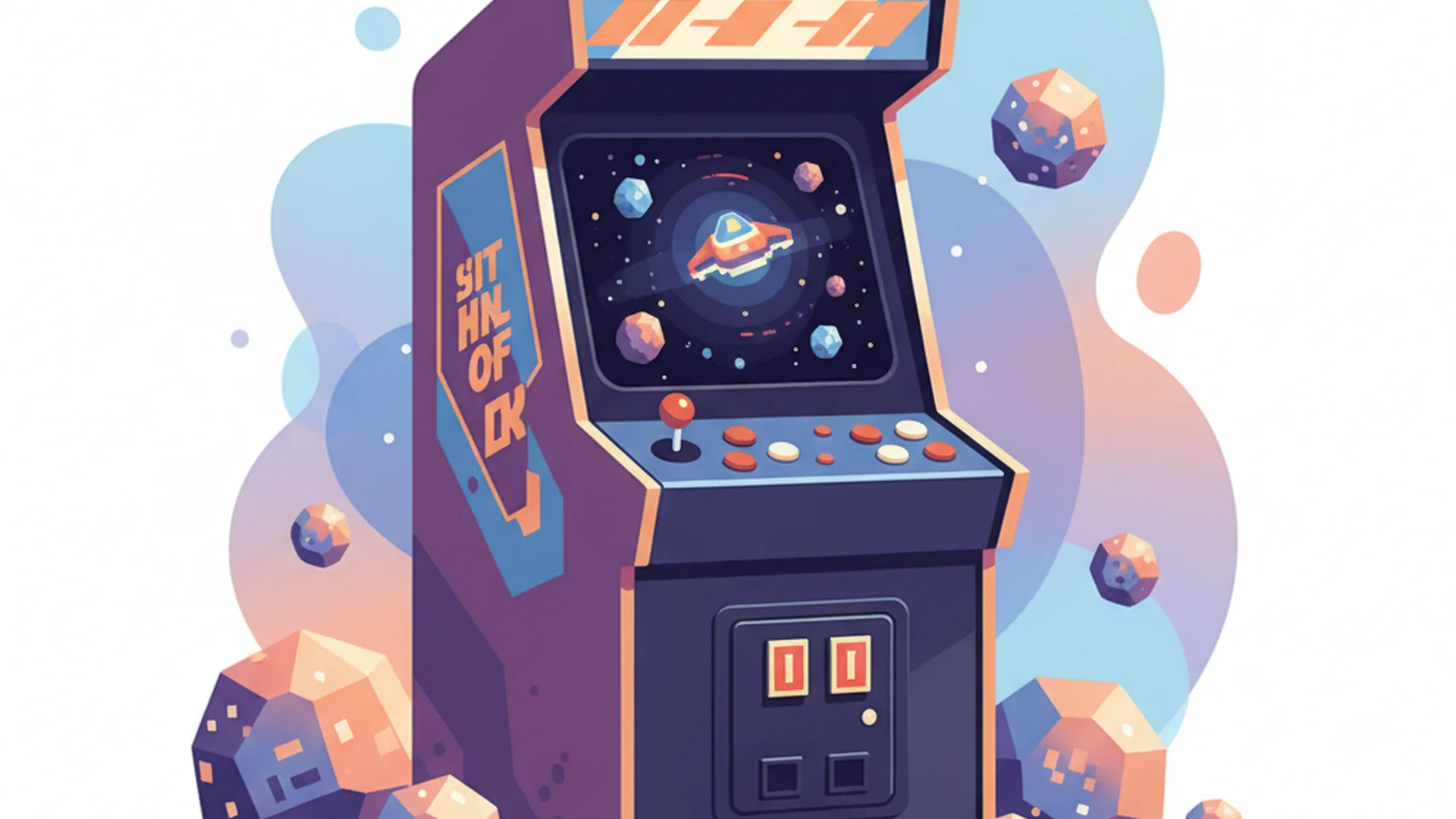
In the pantheon of the Golden Age of arcades, few titles command as much respect as Asteroids. Released by Atari in late 1979, the game transformed the landscape of interactive entertainment. While previous titles focused on static screens or rigid movements, the asteroids game history began with a revolution in physics and display technology. For players in 1980, the experience of piloting a lone triangular ship through a field of drifting space debris wasn't just a game—it was a high-resolution window into a digital cosmos.
The Genesis: Lyle Rains and Ed Logg
The story of the asteroids arcade history begins with a conversation between Lyle Rains and Ed Logg. Rains, then the Vice President of Engineering at Atari, had the seed of an idea: a game where players had to clear a screen of floating rocks. He envisioned a game of "high-tension vacuuming" where the screen would continuously populate with obstacles.
Ed Logg, the legendary programmer who would later work on Centipede and Gauntlet, took Rains' concept and refined it. He introduced the idea of the rocks breaking into smaller, faster pieces—a mechanic that created a "cascading" difficulty level that kept players pumping quarters into the machines.
The Vector Revolution
One of the most defining characteristics of Asteroids was its use of monochrome vector graphics. Unlike most games of the era that used "raster" graphics (pixels drawn in horizontal lines across the screen), Asteroids used an X-Y vector monitor.
Gameplay Mechanics That Changed Everything
When Asteroids hit the arcades, it introduced several concepts that are now staples of game design. Chief among these was inertia-based movement. In games like Space Invaders, the player moved left or right and stopped instantly. In Asteroids, if you engaged your thrust and let go, your ship continued to drift.
The Anatomy of the Ship
The player’s ship is a simple isosceles triangle. This shape wasn't just an artistic choice; it was a technical necessity. Using vector lines, a triangle was the most efficient way to indicate directionality to the player. To survive, players had to master four distinct controls:
- Rotate Left/Right: To aim.
- Thrust: To move (and create inertia).
- Fire: To destroy rocks and UFOs.
- Hyperspace: The "panic button" that teleports you randomly.
The "Mr. Bill" and "Sluggo" UFOs
The developers added two types of flying saucers to keep players from staying in one place for too long. Internally, the developers named these after Saturday Night Live characters. The large saucer ("Mr. Bill") fires randomly and is relatively easy to avoid. However, the small saucer ("Sluggo") is a marksman. It calculates your trajectory and "leads" its shots, making it the primary threat for high-score seekers.
Advertisement
A Financial Powerhouse: Breaking Records
By 1980, Asteroids had become a cultural phenomenon. It famously displaced Space Invaders as the most popular arcade game in the United States. Atari couldn't manufacture the cabinets fast enough.
| Metric | Achievement |
|---|---|
| Total Units Sold | 70,000+ |
| Arcade Revenue (1980) | $500 Million (in quarters) |
| Atari 2600 Sales | 3.8 Million Copies |
| Longest Standing Record | 28 Years (Scott Safran) |
The success was so massive that arcade operators often had to install larger coin boxes to accommodate the thousands of quarters the machines were collecting weekly.
Bringing the Void Home: The Atari 2600 Port
The transition from arcade to home console was a monumental task. The original arcade game used vector monitors, which standard home televisions could not replicate. The Atari 2600 port had to be converted to raster pixels, which changed the aesthetic of the game significantly.
Despite the graphical differences, the 2600 version was a technical triumph. It was the first home cartridge to utilize bank-switching technology. This allowed the developers to jump between different banks of memory, effectively doubling the cartridge's capacity from 4KB to 8KB. This extra space was necessary to fit the complex logic required for tracking dozens of moving objects simultaneously.
For more on mastering the controls of this era, check out our guide on Asteroids Ship Controls.
Expert Strategies for High Scores
To truly understand the asteroids game history, one must look at how the best players in the world approached the game. In 1982, Scott Safran set a score of 41,338,740. This record stood until 2010, proving the depth of the game's mechanics.
The "Slow Play" Methodology
Amateur players often make the mistake of shooting everything as fast as possible. This fills the screen with tiny, fast-moving rocks. Experts recommend keeping the number of "large" asteroids high and only breaking them down one at a time. This keeps the screen manageable.
Hunting the Small Saucer
The small saucer appears after you reach 10,000 points. While dangerous, it is worth 1,000 points. Advanced players will often leave one single, slow-moving asteroid on the screen and simply "hunt" the saucers as they appear to maximize their score without advancing to a more difficult wave.
Advertisement
The Modern Era: 2025 and 2026 Resurgence
As we look at the state of Asteroids in 2025 and 2026, the game is experiencing a massive technological revival. It is no longer just a "retro" title; it has become a platform for modern innovation.
Alan-1 and Haptic Arcades
In late 2024 and throughout 2025, Atari partnered with Alan-1 Inc. to release a commercial-grade "Recharged" cabinet. This isn't just a screen in a box. These new units include:
- Mechanical Shakers: The cabinet vibrates when you thrust or collide.
- Wind Effects: Small fans simulate the "rush" of space flight.
- High-Resolution Vector Emulation: Modern monitors that replicate the "glow" of the original 1979 tubes.
Blockchain and On-Chain Gaming
In an interesting twist for 2025, Atari launched Asteroids on the Base Network (a Layer-2 Ethereum blockchain). Players can now compete in global tournaments where high scores are minted as NFTs. This has created a new competitive "on-chain" leaderboard, bringing the 1980s high-score chase into the web3 era.
Cultural Impact in 2026
The aesthetic of Asteroids has seen a resurgence in popular media. Director Doug Liman’s 2025 film Asteroid, while a sci-fi thriller, heavily borrowed the "retro-futurist" vector aesthetic for its user interfaces and promotional materials. This "glow-on-black" look has become a shorthand for the 1970s space-tech era.
Common Mistakes to Avoid
Even with decades of asteroids arcade history to learn from, new players often fall into the same traps.
- The Invincibility Corner: In the original 1979 ROM, there was a bug where sitting in a specific corner made you nearly invisible to the small saucer. Most modern versions (including the 2025 Recharged versions) have fixed this. Don't rely on it!
- Over-Thrusting: The inertia in this game is unforgiving. "Tapping" the thrust button is almost always better than holding it down. If you gain too much momentum, you become a projectile yourself.
- Shooting the Last Rock Too Early: Never clear the final asteroid until you have repositioned yourself in the center of the screen. New waves spawn from the edges, and if you are sitting there, a rock will spawn directly on top of you.
For more tips on classic arcade titles, you might enjoy our Breakout Game Strategy Guide.
Frequently Asked Questions
What is the objective of Asteroids?
The primary objective is to survive as long as possible while destroying asteroids and flying saucers. The game is technically endless, though the score "rolls over" at 99,990 points.
Why is the ship a triangle?
The ship is an isosceles triangle because it was the most efficient shape to render using 1979 vector line technology while still clearly showing the player which way they were facing.
What does "hyperspace" do in the game?
Hyperspace teleports your ship to a random location on the screen. It is a gamble; while it can save you from a collision, there is a programmed chance of instant death or landing on another hazard.
Is the original Asteroids arcade game in color?
No. The original 1979 arcade version used a monochrome (black and white) vector monitor. Atari later released Asteroids Deluxe, which added a blue-tinted plastic overlay to give the illusion of color, and the Atari 2600 home version used standard color pixels.
How can I play Asteroids today?
You can play the original version through various Arcade Game Emulators, on the Atari 50 collection, or via modern handhelds like the 2025 Gamestation Go.
Conclusion
The asteroids game history is more than just a timeline of a successful product; it is the history of how we learned to interact with digital physics. From the sharp, glowing lines of Ed Logg’s original vector code to the haptic-feedback cabinets of 2025, Asteroids remains a masterclass in "easy to learn, impossible to master" design. Whether you are playing on a dusty original cabinet or minting a high score on the blockchain, the thrill of dodging that final, speeding pebble remains as potent as it was in 1979.
Ready to Master the Void?
Test your skills and learn the secret techniques used by world-record holders.
Put it into practice

Keep reading

Arcade Games
The Unstoppable Rise: A Complete History of Tetris from Soviet Labs to Global Phenomenon
Explore the full tetris history, from its 1984 origin in Moscow to the modern "rolling" revolution. Learn who invented Tetris and how it became a global icon.
Sep 25, 2026 12 min

Arcade Games
Free Asteroids Online: The 2026 Guide to Modern Retro Gaming
Discover the best ways to play free asteroids online in 2026. Explore modern HTML5 versions, pro strategies, and the cognitive benefits of this Atari classic.
Jul 31, 2026 12 min

Arcade Games
Pac-Man Complete Guide: History, Strategy, and Cultural Legacy (1980–2026)
The ultimate Pac-Man guide covering 45 years of history, ghost AI secrets, expert strategies, and the 2025–2026 anniversary updates.
Apr 17, 2026 20 min
Advertisement