The Birthday Paradox Explained: Why Our Brains Struggle with Probability
Explore the Birthday Paradox: why only 23 people are needed for a 50% chance of a shared birthday. Learn the math, cognitive biases, and cybersecurity impact.
By Free To Play Puzzles Editorial Team 12 min read
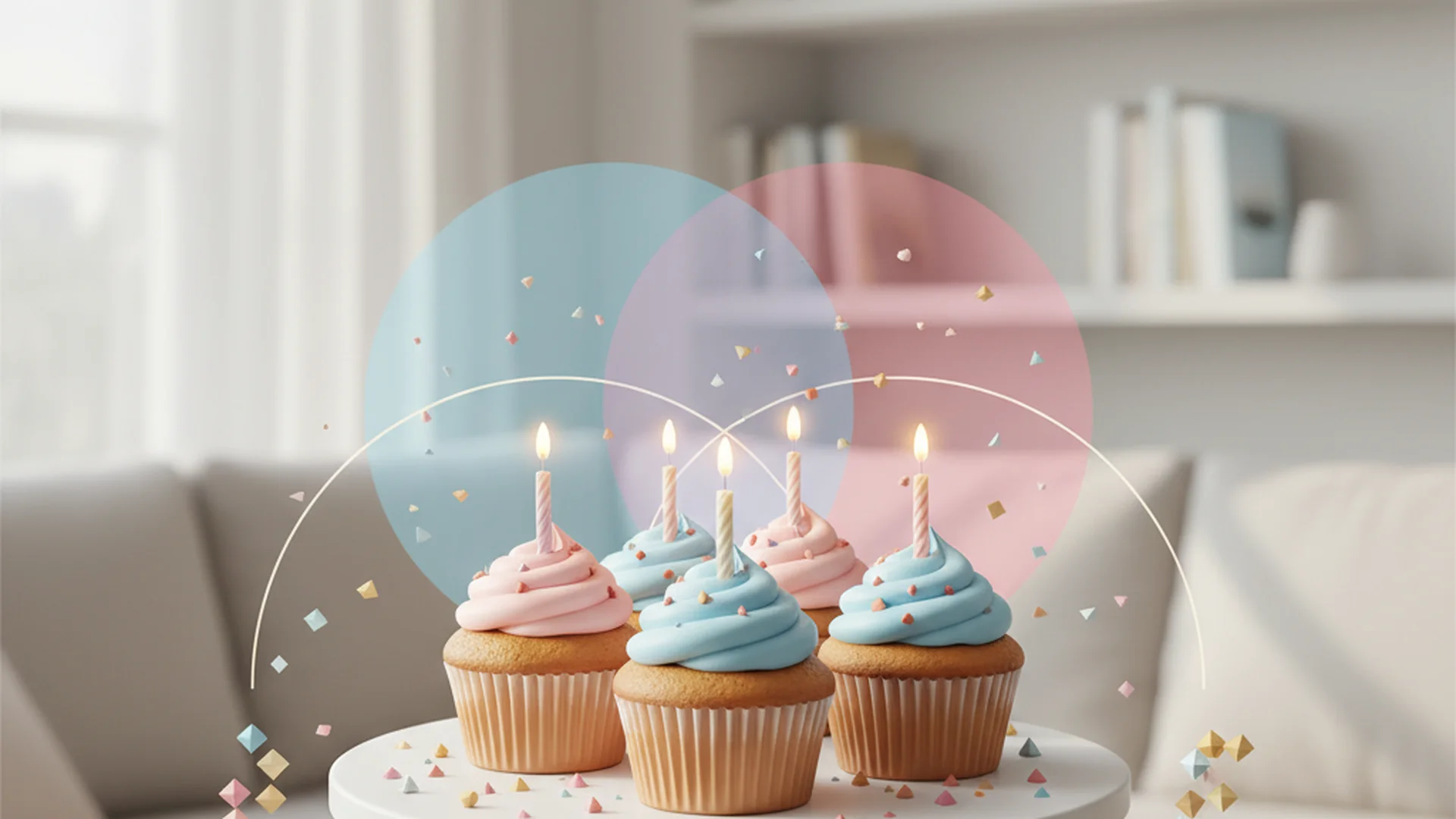
Imagine you are standing in a room with 22 other people. Perhaps it is a small office gathering or a university seminar. If I were to bet you $20 that at least two people in that room share the exact same birthday, would you take the bet? Most people would—and most people would lose. This is the heart of the birthday paradox, a fascinating probability brain teaser that challenges our fundamental understanding of how the world works.
This paradox is particularly compelling. It isn't just a mathematical quirk; it is a window into the limitations of the human brain. Our gray matter evolved to handle linear threats—like a predator running toward us at a constant speed—not the exponential complexities of combinatorial mathematics. In this guide, we will dismantle the mystery of the birthday paradox, explore why your intuition is lying to you, and see how this logic keeps your digital life secure in 2025.
What Exactly is the Birthday Paradox?
The birthday paradox (formally known as the "birthday problem") states that in a random group of just 23 people, there is a 50.7% chance that at least two of them share a birthday. By the time you reach 70 people, that probability skyrockets to a staggering 99.9%.
To many, this feels impossible. Our intuition suggests that since there are 365 days in a year (excluding leap years), we should need roughly half that number—about 183 people—to reach a 50% probability. This mental error occurs because we confuse the probability of someone sharing our birthday with the probability of any two people in the group sharing a day.
The Power of Pairs: Why Your Intuition Fails
The secret to solving the birthday paradox lies in how we count the "opportunities" for a match. When you enter a room of 23 people, you aren't just comparing your birthday to 22 others. You are looking at every possible combination of people.
In a group of 23 people, we can calculate the number of unique pairs using the formula $n(n-1)/2$. For $n=23$, that math looks like this: $(23 \times 22) / 2 = 253$.
There are 253 unique pairings in that small room. When you realize that you have 253 chances for a match to occur, the "magic" number of 23 starts to feel much more reasonable.
The Comparison Table
The following table illustrates how the probability grows as the group size increases:
| Group Size | Number of Pairs | Probability of Match |
|---|---|---|
| 5 | 10 | 2.7% |
| 10 | 45 | 11.7% |
| 20 | 190 | 41.1% |
| 23 | 253 | 50.7% |
| 30 | 435 | 70.6% |
| 50 | 1,225 | 97.0% |
| 70 | 2,415 | 99.9% |
Advertisement
The Mathematical Proof (The Complement Rule)
To prove the birthday paradox, mathematicians use a shortcut called the Complement Rule. Instead of trying to calculate the odds of one match, two matches, or triple matches, we calculate the odds that no one shares a birthday and subtract that from 1.
Imagine you are filling a room one by one:
- Person 1: Has a 365/365 chance of having a unique birthday.
- Person 2: To be unique, they must have any birthday except Person 1's (364/365).
- Person 3: Must avoid the first two birthdays (363/365).
The calculation for 23 people looks like this: $P(\text{Match}) = 1 - (\frac{365}{365} \times \frac{364}{365} \times \frac{363}{365} \dots \times \frac{343}{365})$
When you multiply these 23 fractions together, you get approximately 0.4927. This is the probability that no one shares a birthday. $1 - 0.4927 = 0.5073$, or 50.7%.
Why Our Brains Struggle with Probability
When it comes to Cognitive Benefits and brain health, it helps to think of the human brain as a "pattern-seeking machine." We are excellent at spotting a face in a crowd or a rustle in the grass, but we are notoriously bad at "exponential thinking."
- Linear Bias: We tend to think that if 365 days are available, the probability should grow by roughly 1/365 with every person added. We fail to account for the fact that each new person creates a "web" of connections to every other person already in the room.
- The "Me" Perspective: Evolutionarily, we are the center of our own universe. When we hear "shared birthday," our brain instinctively calculates the odds of someone matching us. To have a 50% chance of someone matching your specific birthday, you would actually need a group of 253 people.
- Small Sample Size Fallacy: We often overestimate the likelihood of rare events in small groups while underestimating the inevitability of common events in medium groups.
Engaging in Brain Training can help mitigate these biases by exposing the mind to non-intuitive logical structures, much like the Fermat Last Theorem Story which shows how long-held "obvious" assumptions can be proven or disproven through rigorous logic.
Real-World Applications: From Passwords to Quantum Computing
The birthday paradox isn't just a party trick; it is a cornerstone of modern computer science and security.
1. Cybersecurity and Hash Collisions
In the world of cryptography, we use "hash functions" to turn data (like your password) into a fixed string of characters. A "collision" occurs when two different inputs produce the exact same hash. If a hacker can find a collision, they can bypass security. This is known as a Birthday Attack.
In 2025 and 2026, as computing power reaches new heights, security experts are moving away from older standards like MD5 or SHA-1 toward SHA-3 (256-bit or 512-bit). This is because the birthday paradox proves that you don't need to try every possible combination to find a "match" or a collision; you only need to try a fraction of them.
2. AI and Data Science Bias
Modern AI models often "hallucinate" or find patterns where none exist. Data scientists use the birthday paradox as a primary example to teach AI developers about statistical inevitability. If a dataset is large enough, "unlikely" coincidences are actually guaranteed to happen. Understanding this prevents developers from over-fitting their models to what are essentially "statistical birthdays."
3. Quantum Cryptography
As we look toward 2026, research into "Quantum Birthday Attacks" is accelerating. Quantum algorithms, such as Grover’s algorithm, can theoretically find collisions even faster than the classical paradox suggests. This is forcing a global shift toward post-quantum cryptography to ensure our data remains safe from future technologies.
Advertisement
Common Mistakes to Avoid
To truly master the birthday paradox, you must avoid these four common pitfalls:
- Mistake 1: Confusing "Any Match" with "My Match." Always remember that the paradox is about any two people in the room, not a specific person.
- Mistake 2: Forgetting the Pigeonhole Principle. People often ask, "When does the chance become 100%?" Based on the Pigeonhole Principle, you need 366 people (367 for a leap year) to guarantee a match.
- Mistake 3: Assuming Linear Growth. The probability doesn't go up by the same amount for each person. It accelerates as the number of pairs grows quadratically.
- Mistake 4: Ignoring Leap Years. While the math changes slightly (366 possible days instead of 365), the 50% threshold remains at 23 people. The probability just dips from 50.73% to roughly 50.62%.
Frequently Asked Questions
Is it actually a paradox?
No, not in the sense of a logical contradiction. It is a "veridical paradox," meaning it is a result that is mathematically certain but highly counter-intuitive. It "feels" like a paradox because our brains aren't built to calculate combinations intuitively.
Does this apply to things other than birthdays?
Absolutely. It applies to any scenario where you are looking for "collisions" in a fixed set of possibilities. This includes serial numbers on products, credit card security codes, and even the DNA sequences used in forensic science.
Why do I need 253 people to match MY birthday?
This is a different mathematical problem. When you specify one person (yourself), you lose the "power of pairs." You are no longer looking at 253 different combinations; you are only looking at 22 comparisons. To get a 50% chance of a match for a specific date, you need $365 \times \ln(2)$, which is approximately 253.
What happens if the group is larger than 23?
The probability increases very quickly. At 30 people, the chance is 70%. At 50 people, it is 97%. By the time you have a group of 70 people (the size of a large wedding or a lecture hall), the chance of a shared birthday is 99.9%. It is almost a statistical certainty.
Conclusion: Embracing the Counter-Intuitive
The birthday paradox is a humbling reminder that our intuition is a tool evolved for survival on the savannah, not for calculating the intricacies of 21st-century data. Whether you are a student of mathematics, a cybersecurity professional, or simply a fan of a good probability brain teaser, the lesson remains the same: the world is often much more connected than it seems.
The next time you find yourself in a room of 25 or 30 people, try the experiment. Ask around for birthdays. When you find a pair of "birthday twins," you can smile knowing that it wasn't a miracle—it was just the beautiful, inevitable logic of the universe.
CTA: Test Your Brain | Challenge your logic and improve your cognitive flexibility with our collection of puzzles. | Play Logic Games | /logic-puzzles
Put it into practice

Keep reading
Culture
Cicada 3301 Explained: Unraveling the Internet’s Greatest Mystery
Dive deep into the enigma of Cicada 3301. Explore the history, cryptography, and the unsolved Liber Primus in this comprehensive guide to the internet mystery puzzle.
Sep 8, 2026 12 min

Culture
The Ship of Theseus: Deciphering the Ultimate Identity Paradox Puzzle
Explore the Ship of Theseus, a mind-bending identity paradox puzzle that challenges our understanding of persistence, matter, and the nature of the self.
Apr 5, 2026 12 min
Culture
Zenos Paradoxes Explained: The Ancient Logic Puzzles That Still Defy Reality
Explore Zeno’s Paradoxes of motion and plurality. From Achilles and the Tortoise to the Quantum Zeno Effect, learn how these 2,500-year-old puzzles shape modern science.
Aug 25, 2025 12 min
Advertisement