The Ship of Theseus: Deciphering the Ultimate Identity Paradox Puzzle
Explore the Ship of Theseus, a mind-bending identity paradox puzzle that challenges our understanding of persistence, matter, and the nature of the self.
By Free To Play Puzzles Editorial Team 12 min read
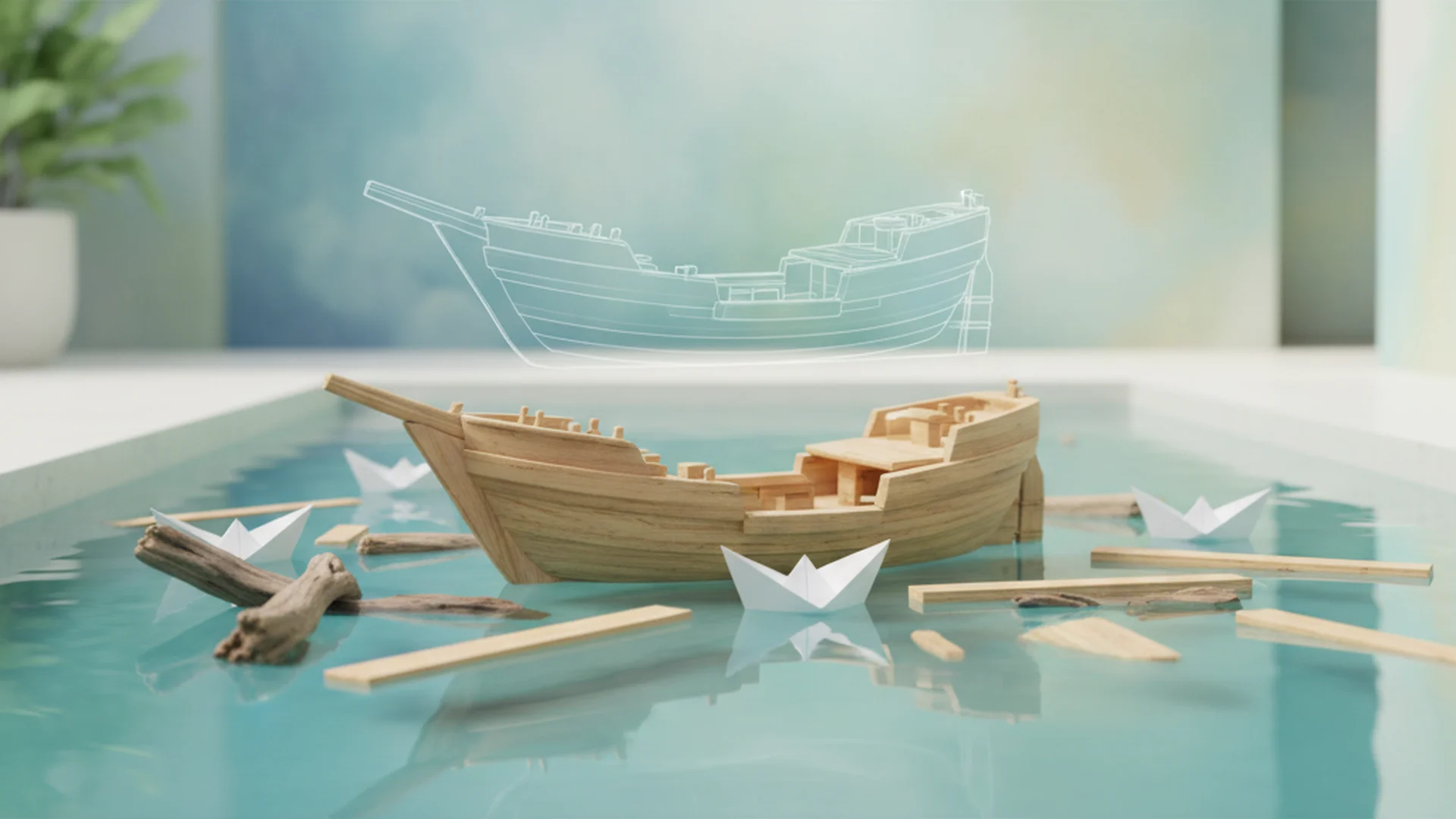
Imagine a legendary wooden ship docked in a harbor, preserved as a monument to a great hero. Over the centuries, the wood begins to rot. One by one, the planks are removed and replaced with new, sturdy timber. Eventually, not a single piece of the original ship remains. Is it still the same vessel? This is the ship of theseus, a classic identity paradox puzzle that has captivated philosophers, scientists, and historians for nearly two millennia.
As a retro gaming historian, I often encounter this puzzle in my own work. When we "restore" a classic arcade cabinet, replacing the capacitors, the screen, and the joystick, at what point does it stop being an original 1980s machine and start being a modern replica? Much like the Birthday Paradox Explained, the Ship of Theseus forces us to confront the fact that our common sense often clashes with cold, hard logic.
The Origins of the Puzzle
The first recorded mention of this thought experiment comes from the Greek historian Plutarch in his work Life of Theseus, written around 75 CE. He described a ship used by Theseus and the youth of Athens, which the citizens preserved by replacing old planks as they decayed. This led to a famous debate among philosophers regarding whether the ship remained the same or became a different entity.
The Athenian Dilemma
For the Athenians, the ship was a symbol of their heritage. Maintaining it was a matter of civic duty. However, the logical problem is profound: if you replace one plank, it is surely still the same ship. But if you replace every single plank, the material connection to the original hero is severed.
The Hobbesian Complication
In the 17th century, philosopher Thomas Hobbes took the puzzle a step further by adding a "Second Ship" variable. Imagine a scavenger gathers all the old, discarded planks and uses them to build a second ship. Now, we have two vessels:
- Ship A: The one in the harbor with all new parts.
- Ship B: The one built from the original, scavenged parts.
Which one is the "true" Ship of Theseus? If you say Ship A, you are prioritizing functional continuity. If you say Ship B, you are prioritizing material history. This creates a true logical crisis with no easy exit.
Scientific and Psychological Perspectives
While this began as a philosophical exercise, modern science has provided fascinating data on how we perceive identity. In a massive cross-cultural study conducted between 2020 and 2024, involving 3,000 people across 22 locations, researchers found "sharp interpersonal disagreement" rather than a consensus.
The 51% Rule
Interestingly, experimental philosophy in 2025 suggests a psychological "threshold" for identity. Most observers tend to maintain that an object is the same as long as a "core majority"—typically over 50%—of its original components or functional continuity is preserved. Once you cross that 49-51% line, human intuition begins to fracture.
The Human Ship of Theseus
You are, quite literally, a walking version of this paradox. Biology teaches us that humans undergo a cellular "Ship of Theseus" process approximately every 7 to 10 years. Almost every cell in your body is replaced, yet you maintain a singular legal, social, and personal identity. You are still the person who might have enjoyed the Four Color Theorem in high school, even if not a single atom in your brain is the same as it was then.
| Aspect | Material Change | Persistence of Identity |
|---|---|---|
| Human Body | 100% (approx) | Persistent (Legal/Social) |
| Classic Car | Partial to Full | Persistent (Title/VIN) |
| Digital File | 0% (Copies) | Identical (Bit-for-Bit) |
| AI Model | Continuous | Debated (Version-based) |
Advertisement
Applying Aristotle’s Four Causes
To navigate this identity paradox puzzle, many experts recommend returning to Aristotle’s framework of the "Four Causes." By breaking down why a thing exists, we can better categorize its identity.
- Material Cause: What the ship is made of (the wood and nails).
- Formal Cause: The design, shape, and structure of the ship.
- Efficient Cause: The craftsmen who built and repaired it.
- Final Cause: The purpose of the ship (sailing and honoring Theseus).
Modern systems often prioritize the Formal and Final causes. As long as the ship looks like the Ship of Theseus and serves the purpose of being the Ship of Theseus, we accept it as such, regardless of the Material cause.
The 2025-2026 Digital Frontier
In the current era, the Ship of Theseus has moved from the shipyard to the server room. Two major trends in 2025 have revitalized this ancient debate: Agentic AI and Digital Twins.
AI Identity Persistence
As "Agentic AI" models are updated, fine-tuned, and retrained on new data, they effectively replace their "digital planks." Developers are currently debating whether an AI agent maintains a persistent identity across versions or if "Version 2.0" is an entirely different entity. If an AI's weights and biases are 90% different than they were at launch, is it still the same "assistant"?
Digital Twins and Industry
In 2026, industrial companies use "Digital Twins"—virtual models that mirror physical assets in real-time. When a physical machine has all its parts replaced through maintenance, the Digital Twin remains the "anchor" of its identity. The digital version provides the continuity that the physical matter lacks.
Real-World Examples of the Paradox
The Ship of Theseus isn't just for textbooks; it appears in our daily lives and popular culture constantly.
- The Star Trek Teleporter: This is a modern sci-fi favorite. A teleporter breaks you down into atoms and reassembles a perfect copy of you at a different location. Did you "travel," or did you die while a perfect replica was born?
- The Sugababes/Lineup Changes: In the music world, the band The Sugababes famously replaced every original member over time. Eventually, the original members formed a new group while the "official" group had none of the founding artists.
- Grandfather’s Axe: A common folk version of the puzzle: "This is my grandfather's original axe; my father replaced the handle, and I replaced the head." Is it still the grandfather's axe?
Advertisement
Common Mistakes to Avoid
When exploring the Ship of Theseus, people often fall into several logical traps:
- Looking for a "Right" Answer: This is a paradox, not a riddle. There is no consensus because identity is a human construct, not a physical law.
- Assuming Gradual Change is Safer: Many feel that replacing planks over 100 years is "better" for identity than replacing them all in one day. Logically, the end state is identical, but our brains struggle more with sudden changes.
- Ignoring the Second Ship: Don't forget Hobbes' scavenger! The real crisis isn't just about the replaced parts; it's the fact that you could potentially have two identical "originals" at the same time.
- Limiting it to Physical Objects: This applies to languages, cultures, and even digital assets in games like 2048.
Frequently Asked Questions
At what point does it become a new ship?
This touches on the Sorites Paradox (the problem of vagueness). There is no specific plank—be it the first or the 501st—that triggers a change. Identity is often viewed as a gradient rather than a binary switch.
If I am a different set of cells than I was at age five, am I still the same person?
Most philosophers argue yes, based on "Psychological Continuity." Your memories, personality, and consciousness provide a thread of connection that transcends your physical matter.
Which ship has the right to the name?
This is usually a social or legal designation. In most modern contexts, the "Continuous Ship" (the one that stayed in the harbor) keeps the name, while the "Reassembled Ship" is viewed as a replica or a historical curiosity.
How does "Four-Dimensionalism" solve this?
Four-Dimensionalists view objects as "space-time worms." The Ship of Theseus isn't just a 3D object; it is a 4D entity that extends from its construction to its eventual destruction. Each "version" of the ship is just a different temporal slice of the same worm.
Conclusion
The ship of theseus remains the quintessential identity paradox puzzle because it highlights the fragility of how we define the world. Whether we are discussing the cells in our bodies, the code in our favorite Logic Puzzles, or the persistence of an AI, we are always grappling with the balance between matter and form.
Understanding this paradox doesn't just make you better at philosophy; it helps you appreciate the Puzzle Benefits of thinking critically about the world around you. Identity is not a static state, but a continuous process of becoming.
Want more brain-teasers?
Explore our collection of logic and identity puzzles today.
Put it into practice
Keep reading
Culture
The Four Color Theorem: Decoding the Ultimate Map Coloring Puzzle
Explore the history, logic, and controversy of the Four Color Theorem. From Victorian puzzles to computer-assisted proofs, learn why this math law changed everything.
Apr 27, 2026 12 min

Culture
The Birthday Paradox Explained: Why Our Brains Struggle with Probability
Explore the Birthday Paradox: why only 23 people are needed for a 50% chance of a shared birthday. Learn the math, cognitive biases, and cybersecurity impact.
Aug 14, 2026 12 min
Culture
The Global Tapestry of Logic: A Journey Through World Puzzle Traditions
Explore the rich history and future of world puzzle traditions. From ancient Tangrams to 2026 AR trends, discover how puzzles shape international culture.
May 9, 2026 12 min
Advertisement