The Four Color Theorem: Decoding the Ultimate Map Coloring Puzzle
Explore the history, logic, and controversy of the Four Color Theorem. From Victorian puzzles to computer-assisted proofs, learn why this math law changed everything.
By Free To Play Puzzles Editorial Team 12 min read
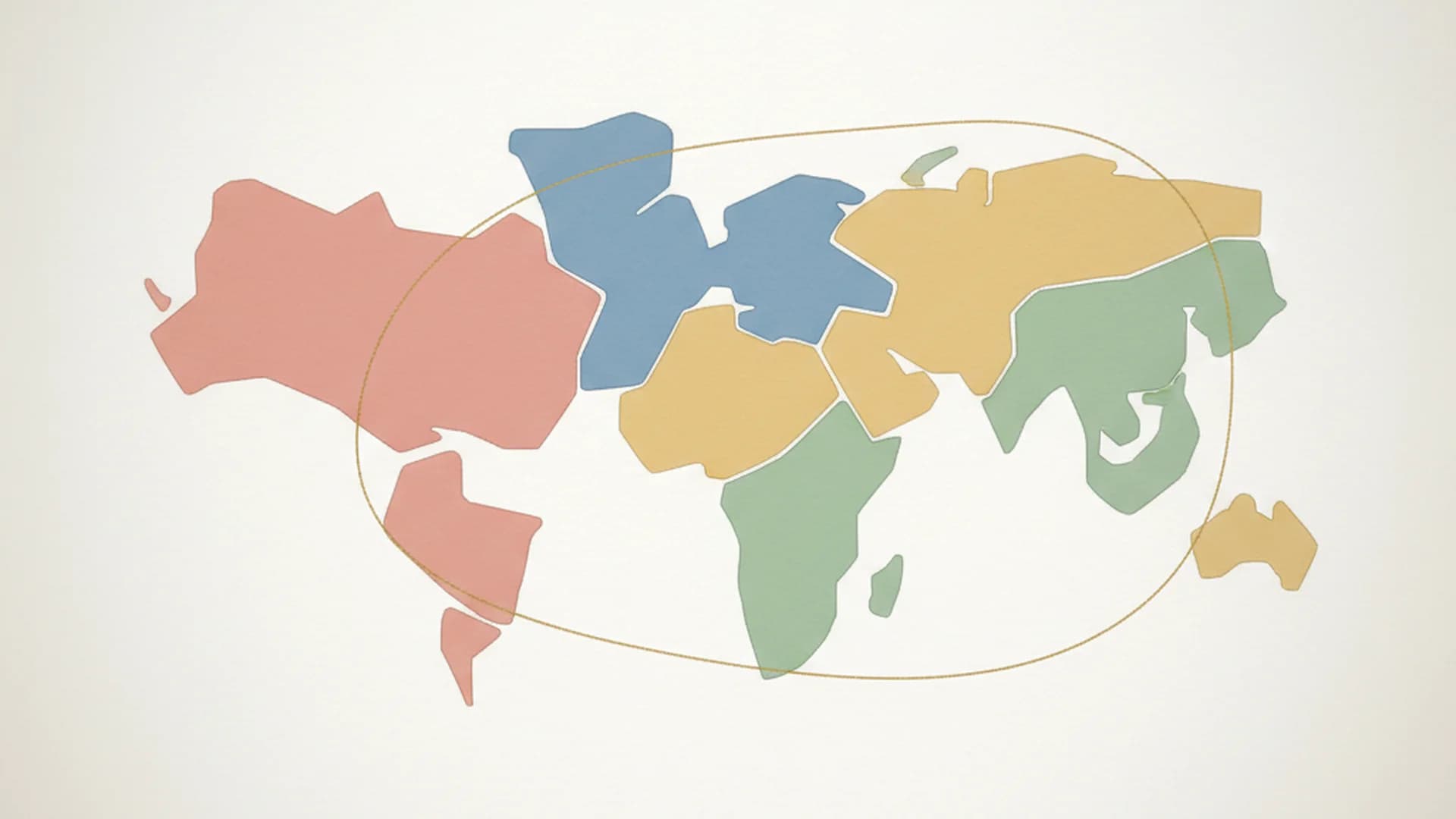
Imagine you are a Victorian cartographer tasked with coloring the counties of England. You want to ensure that no two bordering counties share the same color, but you are low on ink. How many distinct colors do you actually need? This simple map coloring puzzle led to the birth of the four color theorem, a cornerstone of modern graph theory that baffled the world’s greatest minds for over a century.
The four color theorem is a fundamental principle in topology and mathematics. At its core, the theorem states that no more than four colors are required to color the regions of any map on a flat plane (or the surface of a sphere) so that no two adjacent regions share the same color. While it sounds intuitive, the journey from a simple observation to a rigorous mathematical proof involved decades of failed attempts, a revolutionary use of early computing, and a fundamental shift in how we define "truth" in mathematics.
The Origins of the Map Coloring Puzzle
The story begins in October 1852. Francis Guthrie, a student at University College London, noticed something peculiar while coloring a map of the counties of England. He found that he never needed more than four colors to complete the task. Curious, he asked his brother Frederick if this was a known mathematical law. Frederick passed the question to his professor, Augustus De Morgan, who in turn shared it with the wider mathematical community.
For decades, the problem was treated as a charming curiosity. It appeared simple, much like the logic found in Math Puzzles today. However, as mathematicians tried to provide a universal proof that would apply to any possible map—not just existing ones—they realized the problem was deceptively complex.
The 124-Year Struggle for Proof
The late 19th century saw several "proofs" that initially gained widespread acceptance, only to be debunked years later.
- Alfred Kempe (1879): Kempe published a proof that was accepted for 11 years. He introduced "Kempe chains," a method of swapping colors in sections of a map to resolve conflicts.
- Percy Heawood (1890): Heawood shattered Kempe’s success by pointing out a fatal flaw in the chain logic. While Kempe’s work didn't prove the Four Color Theorem, Heawood used it to successfully prove the Five Color Theorem (showing that five colors are definitely enough).
- Peter Tait (1880): Tait offered a different approach using 3-edge-coloring of cubic graphs. His proof also stood for a decade before being found insufficient.
These failures highlighted that the four color theorem was a different breed of beast, similar to the legendary difficulty found in the Fermat Last Theorem Story.
1976: The Computer Revolution
The breakthrough finally arrived in 1976 at the University of Illinois. Kenneth Appel and Wolfgang Haken realized that the number of ways a map could be structured was vast but finite. They identified a set of "unavoidable configurations"—patterns that must exist in any map—and proved that each of these was "reducible," meaning it could always be colored with four colors.
This was no small feat. The proof required:
- 1,200 hours of computer time on high-end machines of the era.
- Checking 1,936 specific configurations.
- A massive volume of manual double-checking by the researchers.
This was the first time a major mathematical theorem had been proven using computer assistance. It sparked a philosophical crisis in the math world: If a human being cannot read and verify every step of a proof in a single lifetime, is it truly a proof?
Advertisement
Modern Refinements and Formal Verification
The original 1976 proof was "ugly" by mathematical standards—it was bulky, relied heavily on specific computer code, and was difficult for others to replicate perfectly. In the decades since, mathematicians have worked to streamline the logic.
In 1996, Neil Robertson, Daniel Sanders, Paul Seymour, and Robin Thomas simplified the proof by reducing the number of unavoidable configurations from 1,936 down to 633. This made the computer-assisted portion significantly more efficient.
The ultimate validation came in 2005. Georges Gonthier, working at Microsoft Research, used the Coq formal proof assistant to verify the theorem. Unlike previous efforts that used custom-written code, Gonthier’s approach used a general-purpose logic engine to verify every single logical step. This removed the "human error" element from the computer’s work, providing what is now considered a "fully formalized" proof.
The Mathematics of Planar Graphs
To understand why the four color theorem works, we must look at it through the lens of graph theory. Mathematicians don't see "countries" and "borders"; they see vertices and edges.
By placing a dot (vertex) in the center of each region and drawing a line (edge) between dots that represent adjacent regions, you create a dual graph. The theorem states that for any planar graph (a graph where edges don't cross), the "chromatic number"—the minimum number of colors needed for the vertices—is at most 4.
| Concept | Map Equivalent | Mathematical Term |
|---|---|---|
| Region | Country/State | Vertex (Node) |
| Border | Shared Line | Edge |
| Color | Ink Shade | Chromatic Number |
Why 3 Colors Aren't Enough
A common question is: "Why can't we just use three colors?" The answer lies in a simple configuration known as an island.
Imagine one central region (A) surrounded by three other regions (B, C, and D) that all touch each other in a ring.
- B, C, and D all touch each other, so they need 3 different colors.
- Region A touches B, C, and D.
- Therefore, Region A cannot be any of the three colors used for B, C, or D.
- A fourth color is mandatory.
Advertisement
Real-World Applications and Limitations
Does the four color theorem actually help cartographers? Interestingly, the answer is usually "no." While the math is sound, real-world geography often breaks the "planar" rules required by the theorem.
The Exclave Problem
The theorem only works if every country is a single, contiguous shape. In reality, many countries have exclaves. For example, Alaska is part of the United States but is separated by Canada. If the rules require Alaska and the mainland US to be the same color, the map is no longer "planar" in a mathematical sense, and more than four colors may be required.
Aesthetic Cartography
Most mapmakers use 5 or 6 colors regardless of the theorem. This is because they want to ensure that coastal colors contrast well with the ocean or to highlight specific geopolitical alliances. The theorem is a landmark of Logic Puzzles and pure math, but it isn't a handbook for modern map design.
Common Mistakes to Avoid
When discussing or teaching the four color theorem, avoid these frequent pitfalls:
- The Point Adjacency Error: Regions that meet only at a single point (like the "Four Corners" of the US: Utah, Colorado, Arizona, New Mexico) are not considered adjacent under the theorem. They must share a boundary line.
- The Enclave Fallacy: Many people think a "hole" in a map (like Lesotho inside South Africa) breaks the rule. It doesn't. You can still color that configuration with just two colors.
- Thinking It's "Solved" by Hand: Be careful not to claim there is a "human-readable" proof. While we have verified it with computers, a purely manual proof that fits in a standard textbook does not yet exist.
The Future: AI and the 2026 Outlook
As we move into 2026, the four color theorem continues to evolve through the lens of Artificial Intelligence. Recent research has seen the application of Reinforcement Learning (RL) to optimize the coloring process for massive graphs. While the theorem proves that four colors are enough, finding the optimal way to assign those colors to a map with 10,000+ regions is still a computational challenge. AI agents are now being trained to solve these large-scale "map coloring puzzles" faster than traditional greedy algorithms.
Furthermore, the Coq proof of the theorem is now maintained as a living GitHub repository, ensuring that as logic software evolves, the proof remains robust and accessible to the next generation of mathematicians.
Frequently Asked Questions
Is there a human-readable proof yet?
No. As of early 2026, there is no purely manual proof that is widely accepted by the mathematical community. The proof remains "inescapably computational" due to the vast number of cases (633 configurations) that must be checked for reducibility.
Why do some maps use more than four colors?
Mapmakers (cartographers) often use more than four colors for aesthetic reasons, to provide better contrast, or to account for exclaves (like Alaska) which technically violate the theorem's requirement for contiguous regions.
Does the theorem work on a Möbius strip?
No. The theorem only applies to "simply connected" surfaces like a flat plane or a sphere. On a Möbius strip, you may need up to 6 colors. On a Torus (a donut shape), you need 7.
What is a "chromatic number"?
In graph theory, the chromatic number is the smallest number of colors needed to color the vertices of a graph so that no two adjacent vertices share the same color. The Four Color Theorem proves that for any planar graph, the chromatic number is at most 4.
Conclusion
The four color theorem is a testament to the persistence of human curiosity. What began as a student's casual observation in 1852 transformed into a century-long quest that eventually redefined how we use technology to solve problems. Whether you are a fan of Logic Puzzles or a student of history, the story of the four color theorem reminds us that even the simplest questions can lead to the deepest truths.
Want to test your logic?
Dive into our collection of challenging puzzles and games to sharpen your strategic mind.
Put it into practice



Keep reading

Culture
The Seven Bridges of Königsberg: How an 18th-Century Puzzle Created Modern Science
Explore the history and mathematics of the seven bridges of Königsberg. Learn how Leonhard Euler’s solution founded graph theory and topology, and its impact on AI today.
Feb 2, 2026 12 min

Culture
The Ship of Theseus: Deciphering the Ultimate Identity Paradox Puzzle
Explore the Ship of Theseus, a mind-bending identity paradox puzzle that challenges our understanding of persistence, matter, and the nature of the self.
Apr 5, 2026 12 min

Culture
The Fermat Last Theorem Story: Solving the World’s Most Stubborn Mystery
Explore the 358-year journey of Fermat’s Last Theorem, from a margin note to Andrew Wiles’s historic proof. Discover the history and math behind this puzzle.
Aug 7, 2026 12 min
Advertisement