Puzzles That Stumped the World: From Einstein to Modern Enigmas
Explore the world's most famous hard puzzles and legendary brain teasers. From the Rubik’s Cube to AI-driven challenges, discover what makes these enigmas so difficult.
By Free To Play Puzzles Editorial Team 12 min read
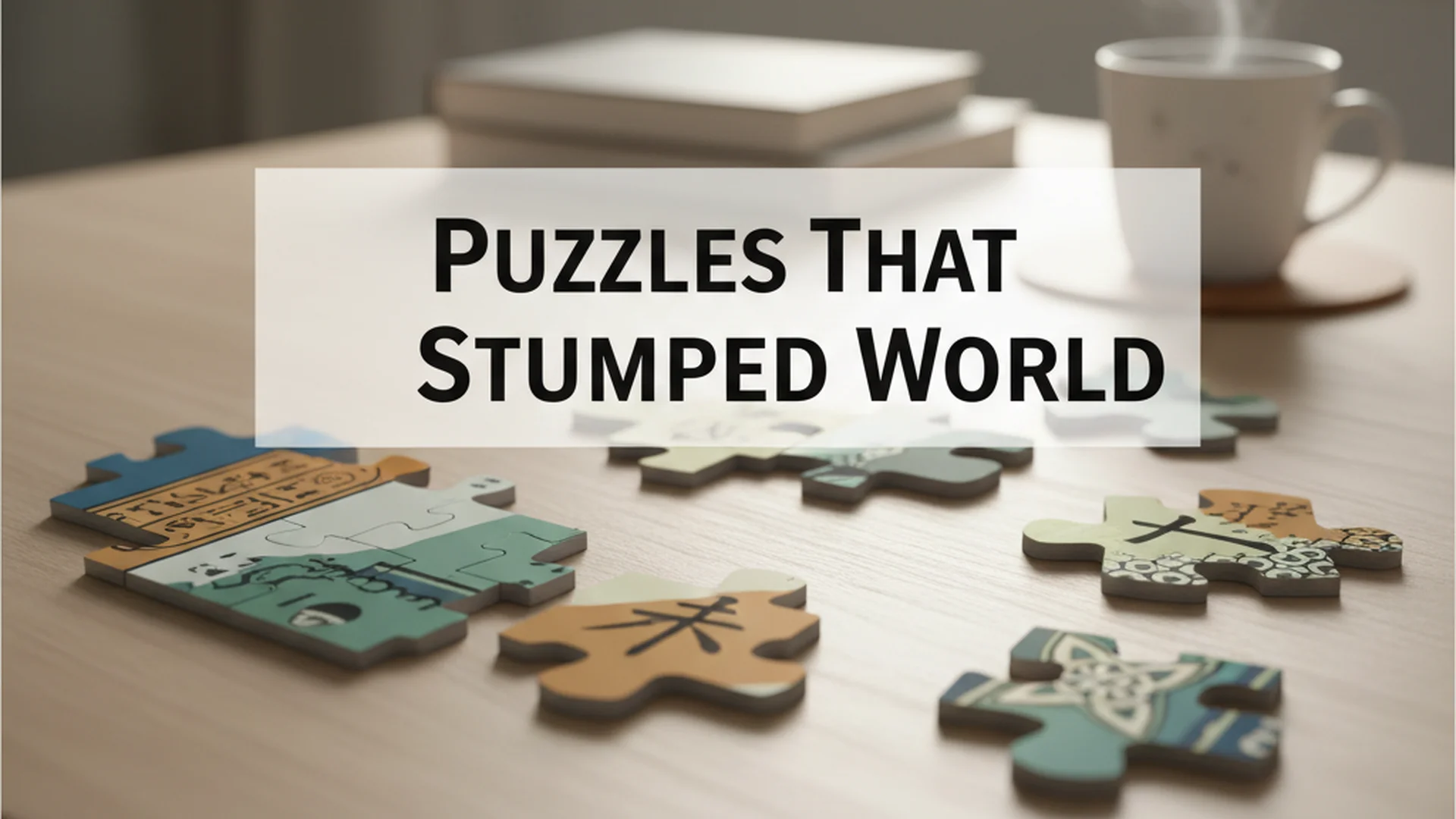
Since the dawn of civilization, humanity has had an insatiable appetite for the impossible. We are drawn to enigmas that push our cognitive boundaries and force us to rethink the laws of logic. Throughout history, certain famous hard puzzles have risen above the rest, becoming cultural touchstones that have stumped geniuses, mathematicians, and casual enthusiasts alike. Whether it is a mechanical cube with quintillions of possibilities or a logic riddle that famously confused thousands of PhDs, these legendary brain teasers do more than just entertain—they reveal the inner workings of the human mind.
As a logic instructor and tournament director, I have seen firsthand how these puzzles can humble even the most confident solvers. In this guide, we will break down the most iconic challenges in history, the strategies required to conquer them, and the high-tech trends shaping the future of puzzling in 2025 and 2026.
The Icons: Puzzles That Changed History
Some puzzles become so famous that they transcend the world of games and enter the realm of pop culture. These are the "heavy hitters"—the ones that almost everyone recognizes, but very few truly master.
The Rubik’s Cube: 43 Quintillion Ways to Fail
Invented in 1974 by Ernő Rubik, this 3D combination puzzle was originally intended as a tool to help students understand three-dimensional geometry. It quickly became the world's best-selling puzzle, with over 450 million units sold. The staggering complexity of the cube lies in its math: there are 43,252,003,274,489,856,000 (43 quintillion) possible arrangements.
Despite this, the human spirit—and a lot of mathematical optimization—has brought the Fastest Rubiks Cube Solve down to just 3.47 seconds. For most of us, however, it remains a monumental challenge of spatial reasoning and memory.
The World’s Hardest Sudoku
In 2012, Finnish mathematician Arto Inkala set out to create a Sudoku that would break the traditional difficulty scales. While most challenging Sudoku puzzles are rated on a 1-to-5 star scale, Inkala’s creation was designed to "score an 11."
What makes it so difficult? Most puzzles require you to look one or two steps ahead (branching logic). This specific grid requires solvers to think 10 steps ahead simultaneously. It is a test of pure mental endurance. If you find yourself struggling with standard grids, you might want to look into Fastest Sudoku Solvers to see how the professionals manage their mental load.
Einstein’s Riddle
Often attributed to Albert Einstein (though historical evidence is shaky), this grid-based logic puzzle describes five houses of different colors, each occupied by a person of a different nationality, who drinks a different beverage, smokes a different brand of cigar, and keeps a different pet.
The legend claims Einstein predicted only 2% of the population could solve it. While modern logic instructors believe anyone with a systematic approach can solve it, the sheer number of variables makes it one of the most Logic Puzzles ever devised.
The Probability Trap: The Monty Hall Problem
Perhaps no puzzle has caused more academic fury than the Monty Hall Problem. Based on the game show Let’s Make a Deal, the setup is simple:
- There are three doors. Behind one is a car; behind the others are goats.
- You pick a door (say, Door #1).
- The host, who knows what’s behind the doors, opens another door (Door #3), revealing a goat.
- He then asks: "Do you want to switch your choice to Door #2?"
When this was published in Parade magazine in 1990, roughly 10,000 readers—including hundreds of professors—wrote in to claim that it didn't matter if you switched. They were wrong. Mathematically, switching doubles your chances of winning from 1/3 to 2/3.
Advertisement
Mechanical Masterpieces and the "Hardest Ever"
Beyond paper and plastic, some of the most legendary brain teasers are physical objects designed to deceive the eyes and hands.
Stave’s "Olivia" Jigsaw
If you think a Largest Jigsaw Puzzle is the ultimate challenge, think again. Size isn't everything. Stave Puzzles' "Olivia" is a wooden jigsaw that costs approximately $2,500 and is designed to be a "trick" puzzle. It features:
- An uneven, deceptive border.
- Pieces that fit together perfectly in 10,000 wrong ways.
- Only one mathematically correct solution.
Solvers often spend months on this single image, proving that complexity often lies in the "false fit"—the moment when a puzzle makes you believe you are right when you are actually wrong.
The Hardest Logic Puzzle Ever
In 1996, logician George Boolos published a puzzle involving three gods: True, False, and Random.
- True always speaks the truth.
- False always lies.
- Random speaks randomly.
- They answer in a mystery language where "da" and "ja" mean "yes" and "no," but you don't know which is which.
To solve it, you are allowed only three "yes/no" questions. This is widely considered the peak of formal logic puzzles because it requires a "nested" questioning strategy that accounts for both the god's identity and the mystery language simultaneously.
Expert Recommendations: How to Conquer the Impossible
To solve world-class puzzles, you must move beyond the "trial and error" phase. Professionals use specific frameworks to manage complexity.
1. Systematic Sorting (The Jigsaw Method)
For physical puzzles, experts recommend sorting by piece shape rather than just color. In high-end wooden puzzles, the "knobs and holes" (tabs and blanks) are the key.
- Two-knob pieces: Standard connectors.
- Three-hole pieces: Often indicate a junction or a corner in deceptive cuts.
2. The "Fresh Eyes" Technique
Cognitive looping is a real phenomenon where the brain stops seeing new patterns because it is stuck on an incorrect assumption.
- The 15-Minute Rule: If you haven't made progress in 15 minutes, walk away.
- Physical Reset: Change the lighting or rotate the puzzle board. Seeing a pattern from a 90-degree angle can break a mental block.
3. Logical Mapping
Never try to hold more than three variables in your head at once. For puzzles like Einstein's Riddle, use a Logic Grid. By marking what cannot be true, the truth eventually reveals itself through the process of elimination.
Common Mistakes to Avoid
Even the most seasoned puzzlers fall into these traps. Awareness of these "mental bugs" can significantly improve your solve time.
- The "Border First" Trap: While helpful for a 500-piece landscape, this strategy is a disaster for "Krypt" puzzles (solid color) or trick jigsaws where the edges are cut to look like interior pieces.
- Hasty Assumptions: In riddles, people often perform math when they should be reading the literal words. For example, if a riddle says "all but 9 die," the answer is 9, not the result of a subtraction.
- Forcing the Fit: This is the cardinal sin of mechanical puzzling. If a piece requires even a tiny amount of force, it is almost certainly a "false fit." Forcing it can damage the puzzle and lead to a permanent error in your layout.
- Piece Count Obsession: Don't assume a 2,000-piece puzzle is harder than a 500-piece one. A solid-color 500-piece "impossible" puzzle is statistically much more difficult than a high-detail, large-count landscape.
Advertisement
Trends for 2025–2026: The High-Tech Evolution
The world of famous hard puzzles is entering a new era. We are seeing a shift from static cardboard to dynamic, interactive experiences.
AI-Adaptive Puzzles
In 2025, digital puzzle platforms have begun using AI to monitor user behavior. If the AI detects a solver is entering a "cognitive loop" (repetitive incorrect moves), it dynamically adjusts the challenge. Instead of giving a direct hint, it might subtly highlight a region of the screen or provide a "hint that doesn't spoil," such as a cryptic clue about the next logical step.
Immersive AR/VR Solving
By 2026, "immersive puzzling" is expected to be a major trend. Using VR headsets, players can step inside 3D logic rooms. Imagine a Rubik's Cube the size of a house where you must physically move the layers, or a jigsaw puzzle where the pieces are "scaled" to the size of a wall, allowing you to walk through the image as you build it.
Eco-Luxury and Functional Art
There is a massive shift away from plastic. The trend for 2025 involves sustainable wood and bamboo puzzles. These aren't just toys; they are "functional" 3D puzzles that, once completed, become working mechanical clocks or celestial orreries. They serve as home decor, proving that the beauty of a puzzle lies in both the process and the result.
| Puzzle Type | Difficulty Level | Primary Skill Required |
|---|---|---|
| Rubik's Cube | Hard | Spatial Memory |
| Arto Inkala Sudoku | Expert | Multi-step Lookahead |
| Monty Hall Problem | Medium | Probability Logic |
| Einstein's Riddle | Hard | Deductive Reasoning |
| Stave Olivia | Extreme | Pattern Recognition |
Frequently Asked Questions
What is "The Hardest Logic Puzzle Ever"?
This refers to a logic puzzle popularized by George Boolos in 1996. It involves three gods with different truth-telling habits and a mystery language. It is considered the hardest because it requires a specific hierarchy of questions to solve.
Are 1,000-piece puzzles always harder than 500-piece ones?
No. Difficulty is usually determined by "image complexity" and "cut style." A 500-piece puzzle of a clear blue sky is significantly harder than a 1,000-piece puzzle of a colorful, detailed map.
How do you solve the "Nine Dots" puzzle?
This puzzle requires you to connect nine dots in a square grid using only four straight lines without lifting your pen. The solution requires drawing lines that extend outside the boundary of the dots, which is where the phrase "thinking outside the box" originated.
What is the "river crossing" riddle?
This is a classic logic puzzle (like the wolf, goat, and cabbage) where you must transport items across a river under specific constraints (e.g., the wolf can't be left alone with the goat). It teaches basic resource management and sequential logic.
Why do some puzzles have "whimsy" pieces?
Whimsy pieces are shapes cut to look like recognizable objects (like a bird or a teapot). They are common in high-end wooden puzzles and are designed both for aesthetic charm and to make the surrounding pieces harder to identify by their edges.
Conclusion
The world of puzzles is a testament to the human desire for growth and challenge. Whether it’s the mathematical purity of the Rubik's Cube or the deceptive simplicity of a probability riddle, these famous hard puzzles remind us that the journey is often more valuable than the solution. As we move into 2026, with AI and VR changing how we play, the core of puzzling remains the same: it is a battle between the enigma and the mind.
By applying systematic sorting, avoiding common traps like "border-first" thinking, and knowing when to take a break, anyone can tackle even the most legendary brain teasers. So, find a puzzle that stumps you, clear your desk, and prepare to see the world in a whole new way.
Want to Test Your Skills?
Challenge yourself with our curated collection of logic games and riddles.
Put it into practice

Keep reading

Culture
Zenos Paradoxes Explained: The Ancient Logic Puzzles That Still Defy Reality
Explore Zeno’s Paradoxes of motion and plurality. From Achilles and the Tortoise to the Quantum Zeno Effect, learn how these 2,500-year-old puzzles shape modern science.
Aug 25, 2025 12 min

Culture
The Mathematics of the Tower of Hanoi: From Ancient Legends to Modern Algorithms
Explore the fascinating tower of hanoi math, including the $2^n - 1$ formula, recursive algorithms, and the puzzle's connection to fractals and LLM benchmarks.
Mar 26, 2025 12 min

Culture
The Fermat Last Theorem Story: Solving the World’s Most Stubborn Mystery
Explore the 358-year journey of Fermat’s Last Theorem, from a margin note to Andrew Wiles’s historic proof. Discover the history and math behind this puzzle.
Aug 7, 2026 12 min
Advertisement