Beyond the High Score: The Evolution of Educational Arcade Games
Explore how educational arcade games are transforming learning. Discover the cognitive benefits, 2025 trends like AI and VR, and why gaming is the future of education.
By Free To Play Puzzles Editorial Team 12 min read
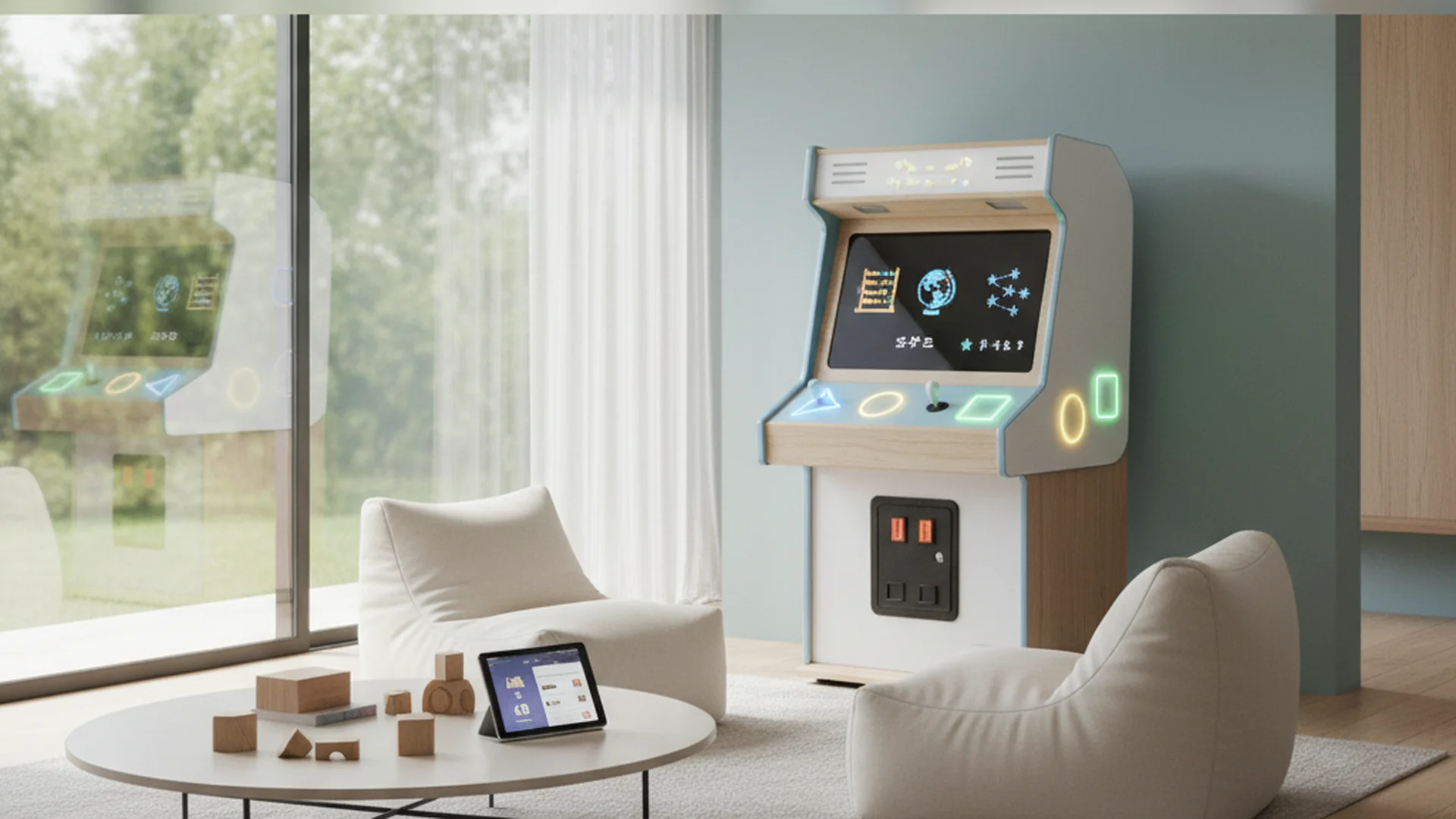
For decades, the flickering glow of a cabinet screen was often viewed by parents and educators as a distraction—a place where quarters and productivity went to die. However, as we move through 2025, the narrative has shifted dramatically. Educational arcade games are no longer just simple classroom diversions; they have evolved into sophisticated, AI-driven instruments for cognitive development. As a historian of the medium, I have watched the "blip-blip" of early cabinets transform into complex systems that train the prefrontal cortex and sharpen executive function.
The marriage of fast-paced gameplay and pedagogical theory is creating a new frontier for students and adults alike. By leveraging the inherent "stickiness" of arcade mechanics, we are finding ways to teach everything from basic arithmetic to high-level cloud computing.
The Science of the Arcade: Why Our Brains Love to Learn Through Play
The primary appeal of the arcade format is the immediate feedback loop. In a traditional classroom setting, a student might wait days to receive a graded paper. In an arcade environment, the results of an action are instantaneous. This speed is central to understanding arcade brain benefits.
A landmark 2024 NIH study involving nearly 2,000 children revealed that those who played video games for at least three hours a day performed significantly better on tests of impulse control and working memory compared to non-gamers. This isn't just about "getting better at games"; it’s about neuroplasticity. Neuroimaging shows that action-style arcade gamers display more efficient information processing in the brain regions associated with visual attention.
The Dopamine Loop and Skill Retention
When a player clears a difficult level or solves a puzzle under pressure, the brain releases dopamine. This neurotransmitter doesn't just make us feel good; it reinforces the neural pathways associated with the successful strategy. This is why a student playing a game like Tetris might develop better spatial awareness than one simply looking at a geometry textbook.
Defining the Modern Educational Arcade Game
It is vital to distinguish between "edutainment" and true "Game-Based Learning" (GBL). Historically, edutainment followed the "chocolate-covered broccoli" model: you answer a math question, and as a reward, you get to play a 10-second mini-game. This separation tells the brain that the learning part is a chore and the gaming part is the fun.
True educational arcade games weave the learning into the core mechanics. Consider these three real-world examples of how mechanics translate to knowledge:
- Geography Navigation: Instead of memorizing a map, a player must "pilot" a ship across a digital globe using real-world coordinates and wind patterns. The act of "playing" the ship is the act of learning the map.
- Physics via Artillery: Games modeled after classics like Artillery or Scorched Earth require players to calculate angles and velocity. This provides a kinesthetic understanding of physics.
- Resource Management: Modern arcade sims require players to balance ecological health with industrial growth, teaching the complexities of sustainability through immediate systemic feedback.
Advertisement
From Classics to Classrooms: The Cognitive Power of Retro Mechanics
We often look to the future for innovation, but many "vintage" arcade games offer profound cognitive benefits. The simplicity of their design forces players to master specific mental shortcuts.
Spatial Reasoning and Tetris
The "Tetris Effect" is a well-documented phenomenon where the brain begins to see patterns in the real world after prolonged play. For those looking for the best way to sharpen their mind, exploring Best Tetris Versions can reveal how different iterations of the game emphasize speed, pattern recognition, or long-term planning.
Physics and Multitasking in Asteroids
The classic Asteroids cabinet is a masterclass in Newtonian physics. To succeed, a player must understand inertia, thrust, and momentum. Modern adaptations of these mechanics are used to teach basic aeronautics. Mastering the Asteroids ship controls isn't just about a high score; it's about internalizing how objects move in a vacuum.
| Skill Category | Classic Game Influence | Modern Educational Application |
|---|---|---|
| Spatial Logic | Tetris | Architecture & Engineering |
| Physics/Inertia | Asteroids | Aerospace Basics |
| Logic/Sequencing | Frogger | Introductory Coding |
| Resource Allocation | Pac-Man | Economics & Logistics |
2025-2026 Trends: The AI and VR Revolution
As we look at the current landscape, the integration of Artificial Intelligence and Virtual Reality has pushed educational arcade games into a new dimension. We are moving away from flat screens toward immersive environments that cater to kinesthetic learners.
AI-Powered Personalization
Tools like Snorkl and SchoolAI (released/updated in 2025) now use AI to adjust game difficulty in real-time. If the system detects a student is struggling with a specific mathematical concept, the game doesn't just get "easier"—it reframes the challenge using a different visual metaphor. This ensures the player stays in the "Flow State"—the zone between boredom and anxiety.
VR/AR Immersion
Titles like Math Masters VR and EarthChasers are transforming geography from a 2D map into a 3D adventure. In EarthChasers, players walk through digital biomes, interacting with the flora and fauna to solve ecological puzzles. This level of immersion ensures that the brain treats the "game" as a lived experience, significantly boosting long-term memory.
STEM-Arcade Cross-Ups
Major tech players are entering the space with tools like AWS Cloud Quest and Google Cloud Arcade. These platforms use classic arcade mechanics—leveling up, boss battles, and equipment upgrades—to teach high-level cloud computing and machine learning. It turns a dense, dry subject into a quest for digital mastery.
Best Practices for Educators and Parents
Simply handing a child a tablet is not enough. To truly unlock the arcade brain benefits, there must be a strategy behind the play.
1. Team-Based Play
Experts from the MIT Education Arcade recommend grouping students in teams of 2–4. This transforms a solitary activity into a lesson in collaborative problem-solving. When players must verbalize their strategies ("If you move the block there, I can clear the line!"), they are engaging in metacognition—thinking about their own thinking.
2. The "Debrief" is Essential
The learning is solidified after the screen turns off. Teachers and parents should facilitate a discussion post-play. Ask questions like:
- "What strategy failed, and why?"
- "How did the game's gravity feel different from real-world gravity?"
- "Why was it harder to manage resources as the levels progressed?"
3. Alignment with Standards
Ensure the games align with recognized educational frameworks like Common Core or NGSS (Next Generation Science Standards). This ensures that the time spent gaming is actually contributing to the student's formal education goals.
Advertisement
Common Mistakes to Avoid
Even with the best intentions, it is easy to mismanage game-based learning. Here are the most frequent errors I see in both homes and classrooms:
- Treating Gaming as a Solitary Activity: Modern arcades are social. Use multiplayer modes to build leadership.
- The "Chocolate-Covered Broccoli" Approach: If the "learning" and "fun" are separate, the student will only value the fun. Seek games where the play is the lesson.
- Ignoring Accessibility: In 2025, there is no excuse for a lack of "one-switch" modes or color-blind settings. Ensure every student can participate.
- Over-Reliance on Digital: Don't forget that Math Puzzles and physical logic games can complement the arcade experience perfectly.
Frequently Asked Questions
What defines an "Educational Arcade Game"?
An educational arcade game is a piece of software where the core gameplay mechanics are inextricably linked to a learning objective. Success in the game requires the player to master an educational concept (like physics, math, or linguistics) rather than just clicking through a quiz to get a reward.
Do these games replace traditional teaching?
No. They are supplemental tools designed to provide a "safe failure" environment. In an arcade game, you can fail 100 times and get "Game Over," but you immediately want to try again. This builds resilience and allows students to experiment with concepts before applying them to high-stakes formal assessments.
Are they better than "Brain Training" apps?
Research suggests that fast-paced, complex arcade games (like Asteroids or StarCraft) provide broader cognitive benefits than specialized brain-training apps. While a puzzle app might only make you better at that one specific puzzle, an arcade game improves reaction speed, multitasking, and visual attention—skills that transfer to the real world.
How much "screen time" is too much for learning?
The quality of screen time matters more than the quantity. Experts recommend "sprints" of 15–30 minutes for maximum retention. While some studies show benefits at up to 3 hours a day, those are usually in the context of leisure rather than focused, curriculum-based learning.
The Future: Arcade Games for All Ages
The benefits of the arcade aren't limited to the K-12 crowd. As a gaming analyst, I have seen remarkable data regarding seniors. Cognitive studies show that "vintage" arcade games like Pac-Man or Pong are highly effective for maintaining hand-eye coordination and delaying cognitive decline.
Whether you are a student learning about the stars through Asteroids: Complete Guide or a senior keeping your mind sharp with Arcade Games, the message is clear: the arcade is a classroom without walls.
Ready to Learn?
Explore our collection of brain-boosting challenges and classic mechanics today.
Put it into practice


Keep reading
Arcade Games
The Neuroscience of Play: Unlocking Arcade Games Brain Benefits
Discover how arcade games boost neuroplasticity, improve impulse control, and can even reverse brain aging by up to 4 years according to 2025 research.
Sep 12, 2026 12 min
Arcade Games
Asteroids High Score Strategies: Master the Classic and 2025 Editions
Master the ultimate asteroids strategy for high scores. Learn crowd control, saucer farming, and endurance techniques from the world's top arcade players.
Sep 2, 2026 12 min
Arcade Games
Mastering the Tap: The Ultimate Flappy Bird Strategy to Beat Your High Score
Unlock the best flappy bird strategy with insights from a cognitive neuroscientist. Learn how to master the 2025 relaunch, improve focus, and shatter your high score.
Aug 20, 2026 12 min
Advertisement