Wordoku Guide: How to Master Letter Sudoku Puzzles
Learn how to solve Wordoku (Letter Sudoku) with expert strategies. Discover 2025 cognitive research, hidden word logic, and tips for mastering these puzzles.
By Free To Play Puzzles Editorial Team 10 min read
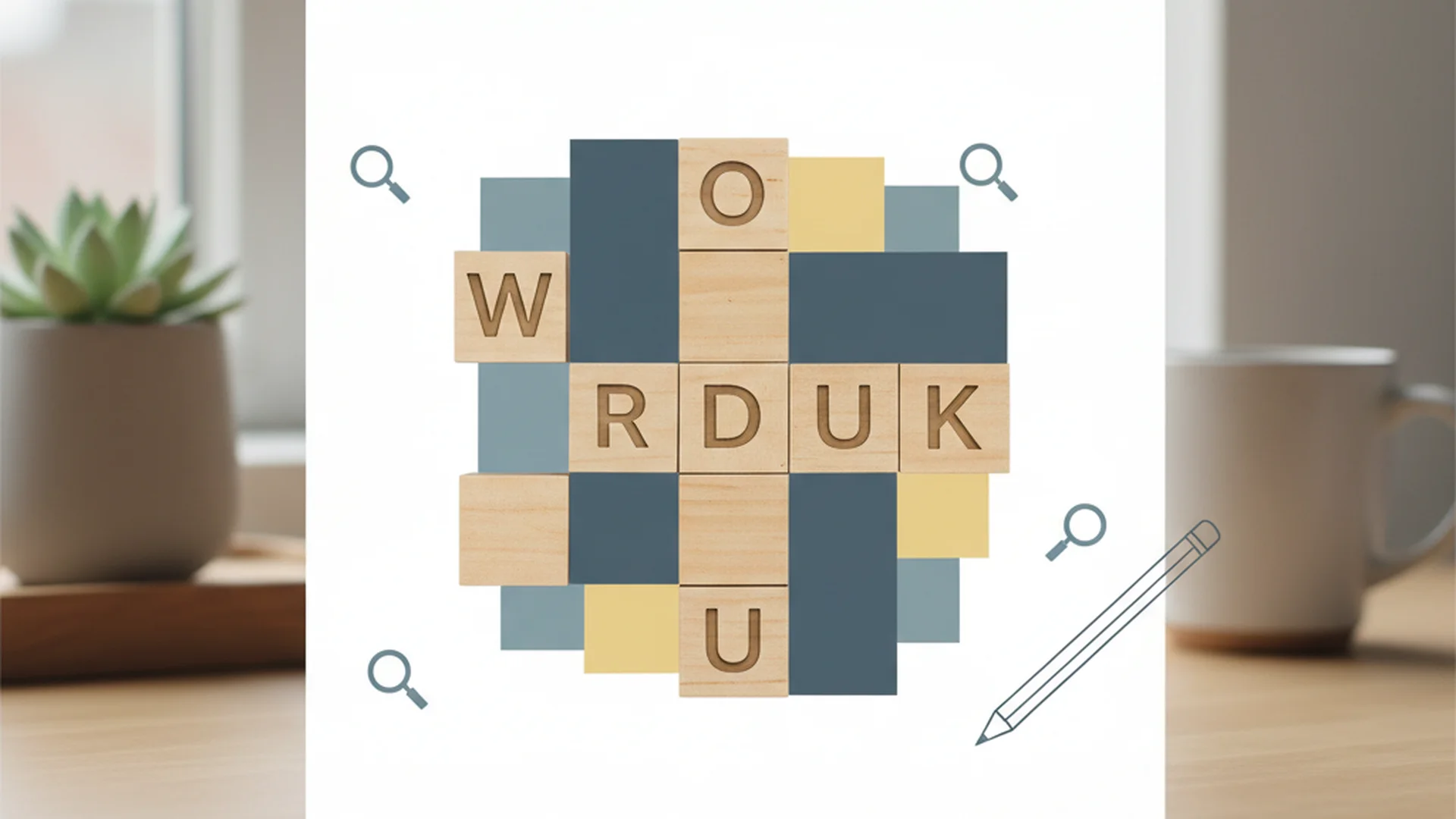
If you have ever found yourself staring at a traditional 9x9 grid and wishing for a linguistic twist, then Wordoku is the puzzle for you. Often referred to as letter sudoku puzzles or Alphabet Sudoku, Wordoku swaps the standard numbers 1 through 9 for nine unique letters. While the transition seems simple, it challenges the brain’s spatial reasoning and pattern recognition in entirely new ways.
As a logic instructor, I have seen many seasoned Sudoku players stumble when they first encounter a letter-based grid. We are socially conditioned to see numbers as symbols of order, whereas letters are symbols of language. In Wordoku, you must strip away the phonetic meaning of the letters and treat them as pure logical placeholders.
In this guide, we will explore the 2025 research surrounding cognitive health, master the "hidden word" strategy, and look at the latest technology driving the puzzle world in 2026.
What is Wordoku?
Wordoku is a logic-based placement puzzle. Just like traditional Sudoku, the objective is to fill a 9×9 grid so that each column, each row, and each of the nine 3×3 subgrids (also called "boxes" or "blocks") contains all of the letters chosen for that specific puzzle.
The defining characteristic of Wordoku is the inclusion of a 9-letter "hidden word." Usually, this word appears along one of the main diagonals or within a specific row or column once the puzzle is correctly solved. This hidden word isn't just a fun bonus; it is a critical tool for deduction.
The Science of Solving: 2025 Research
Recent landmark studies have shed light on why variants like Wordoku are so effective for brain health. The 2025 PROTECT Study update revealed that regular engagement with logic puzzles can reduce the risk of dementia by up to 27%.
Neuroimaging research conducted in late 2025 shows that Wordoku activates the prefrontal cortex (responsible for decision-making) and the parietal lobe (spatial reasoning) more intensely than standard crosswords. In fact, Sudoku variants outperformed crosswords in prefrontal engagement by a margin of 75% to 58%. This is likely because the brain has to work harder to categorize letters as non-sequential symbols compared to the natural 1-9 progression of numbers.
| Feature | Number Sudoku | Wordoku (Letter Sudoku) |
|---|---|---|
| Primary Symbols | 1, 2, 3, 4, 5, 6, 7, 8, 9 | 9 Unique Letters (e.g., A, B, C...) |
| Logic Path | Rows, Columns, Boxes | Rows, Columns, Boxes + Hidden Word |
| Cognitive Load | Medium (Sequential Recognition) | High (Random Symbol Recognition) |
| Key Victory Condition | Full Grid Completion | Full Grid + Word Discovery |
Advertisement
Expert Strategies for Letter Sudoku Puzzles
To excel at Wordoku, you need to move beyond simple guessing. As the scale of a 9x9 grid allows for over 6.67 sextillion combinations, logic is your only reliable compass.
1. Leverage the Hidden Word
The most effective strategy is to identify the 9-letter word as early as possible. Most Wordoku puzzles provide the nine letters used in a "key" at the top. If the key spells "BRIGHTENS," and you notice the main diagonal is forming that word, you can use those positions to fill in the rest of the grid.
For example, if the letter 'B' must go in the top-left corner (1,1) to satisfy the diagonal word, you have immediately eliminated 'B' as a candidate for the rest of Row 1 and Column 1. This is a common strategy discussed in our Diagonal Sudoku Guide.
2. Scanning and Cross-Hatching
Start by choosing a single letter—let's say 'A'. Scan every 3x3 box to see where 'A' is already placed. By "cross-hatching" (drawing mental lines through the rows and columns that already contain 'A'), you can often narrow down the placement of that letter in empty boxes to a single cell.
3. The "Pencil Mark" Strategy
In 2025, digital puzzle platforms have perfected "Candidate Mode." This allows you to place small "pencil marks" in the corner of a cell to note possible letters. This is essential for Expert Sudoku Techniques.
4. Identifying Naked Pairs
If you find two cells in the same row that can only contain the letters 'S' and 'T', you have found a "Naked Pair." Even if you don't know which cell gets which letter, you know that no other cell in that row can contain an 'S' or a 'T'. This allows you to eliminate those candidates from the rest of the row, often breaking a stalemate in difficult puzzles.
Real-World Examples
Example 1: The Diagonal Shortcut
Imagine a Wordoku with the letters: A, E, I, O, U, L, N, S, T. You suspect the hidden word is "SUNLIGHT" (wait, that's only 8 letters—let's use "EQUATIONS"). If you see "E" at (1,1) and "Q" at (2,2), you can logically assume the diagonal will follow the spelling of the word. This "Shortcut Logic" helps you bypass some of the harder Hidden Singles in Sudoku.
Example 2: The Letter Confusion
A player is stuck because they are looking for the number '5' but the puzzle uses letters B, D, F, G, H, J, K, L, M. The player realizes they were subconsciously looking for '5' in a row. By refocusing on the letter 'H', they notice that the 3rd column and 5th column already have an 'H', leaving only one spot in the middle 3x3 box.
Example 3: The AI Hint
In early 2026, a player uses an AR-enhanced app. The app highlights a "Swordfish" pattern involving the letter 'E'. By identifying that 'E' can only appear in two specific columns across three different rows, the player is able to eliminate 'E' from all other cells in those columns, solving a "Very Hard" rated puzzle. This is a classic application of Advanced Sudoku Techniques: X-Wing and Swordfish.
2025-2026 Trends in Wordoku
The world of letter sudoku puzzles is evolving rapidly due to technological integration.
- AI-Enhanced Learning: New apps in 2025, such as the latest updates to Sudoku.com, no longer just give you the answer when you're stuck. Instead, they provide "Logic Tutorials" that explain the specific pattern (like a "Naked Triple") to help you improve.
- AR (Augmented Reality) Puzzles: Pointing your smartphone at a printed Wordoku in a newspaper now allows for digital overlays. You can solve it on your screen while the app tracks your progress and highlights logical inconsistencies in real-time.
- Competitive Multi-Sudoku: 2026 has seen the rise of "Battle Wordoku." In this format, two players solve the same grid simultaneously. The first person to identify the 9-letter hidden word gains a massive time bonus, blending logic with speed.
Advertisement
Common Mistakes to Avoid
Even experts make mistakes. If you find yourself hitting a wall, check to see if you've fallen into one of these traps:
- The Guessing Trap: Never place a letter because it "looks right." Wordoku is a deductive science. One wrong placement will cascade, making the entire grid unsolvable. If you are stuck, refer to our guide on Common Sudoku Mistakes to Avoid.
- Ignoring the Diagonal: Many beginners treat Wordoku exactly like regular Sudoku and ignore the diagonal word. In many curated puzzles, the diagonal is a required clue. Without it, the puzzle might mathematically have multiple solutions, but only one "logical" one.
- Treating it Like a Word Game: Do not try to guess the letters based on English phonics (e.g., "There's a T, so the next letter must be an H"). The letters are symbols, and their placement is governed by the grid, not by language rules.
- Over-Marking Candidates: Filling every cell with 5 or 6 small letters makes it impossible to see the "big picture." Keep your pencil marks clean.
Frequently Asked Questions
Do I need to be good at spelling or have a large vocabulary?
No. Like traditional Sudoku, Wordoku is a logic puzzle. The letters are merely symbols. While the hidden word is a fun feature and a helpful clue, you do not need to know the word to solve the puzzle using standard logic.
How does Wordoku differ from regular Sudoku?
The rules are identical: no repeats in rows, columns, or 3x3 boxes. The main difference is the use of letters and the inclusion of a hidden 9-letter word, often along a diagonal.
Is Wordoku harder than number Sudoku?
Many people find it slightly more difficult initially because our brains recognize the sequence 1–9 faster than a random set of letters. However, once you become accustomed to the symbols, the difficulty is the same.
Can Wordoku have repeated letters?
Inside the 9x9 grid, no letter can repeat in a row, column, or box. However, the hidden word might contain duplicate letters (like "CASHMERE," which has two E's). In these instances, the puzzle will usually treat them as distinct symbols (e.g., E1 and E2) or use a 9-letter word with no repeating letters.
Conclusion
Wordoku offers a refreshing and cognitively stimulating twist on the classic Sudoku format. By engaging different parts of the brain and providing the added satisfaction of unearthing a hidden word, it has become a favorite for puzzle enthusiasts in 2025 and 2026. Whether you are using the latest AR tools or a simple pencil and paper, the key to success remains the same: disciplined logic and patient observation.
Ready to Start?
Challenge your brain with our daily puzzles and master the logic.
Put it into practice

Keep reading

Sudoku
Greater Than Sudoku: A Master Guide to Comparison Puzzles
Master Greater Than Sudoku with our expert guide. Learn advanced solving strategies, inequality chain logic, and how to tackle zero-clue comparison puzzles.
Jun 8, 2026 10 min
Sudoku
The Complete Sudoku Guide: From Beginner to Master (2025-2026 Edition)
Master Sudoku with our comprehensive 2025 guide. Learn everything from basic rules and Snyder notation to advanced X-Wing and Swordfish techniques.
Mar 27, 2026 25 min
Sudoku
Mini Sudoku: The Ultimate Quick Puzzle for Fast Brain Training
Explore the science behind Mini Sudoku and 4x4 puzzles. Learn how these 'brain snacks' improve memory by 18% and discover expert strategies for 60-second solves.
Mar 8, 2026 10 min
Advertisement