Tetris vs 2048: The Ultimate Battle of Spatial Strategy and Logic
A deep dive into the legendary Tetris vs 2048 comparison. Discover the history, mechanics, and strategies behind these two iconic puzzle giants.
By Free To Play Puzzles Editorial Team 12 min read
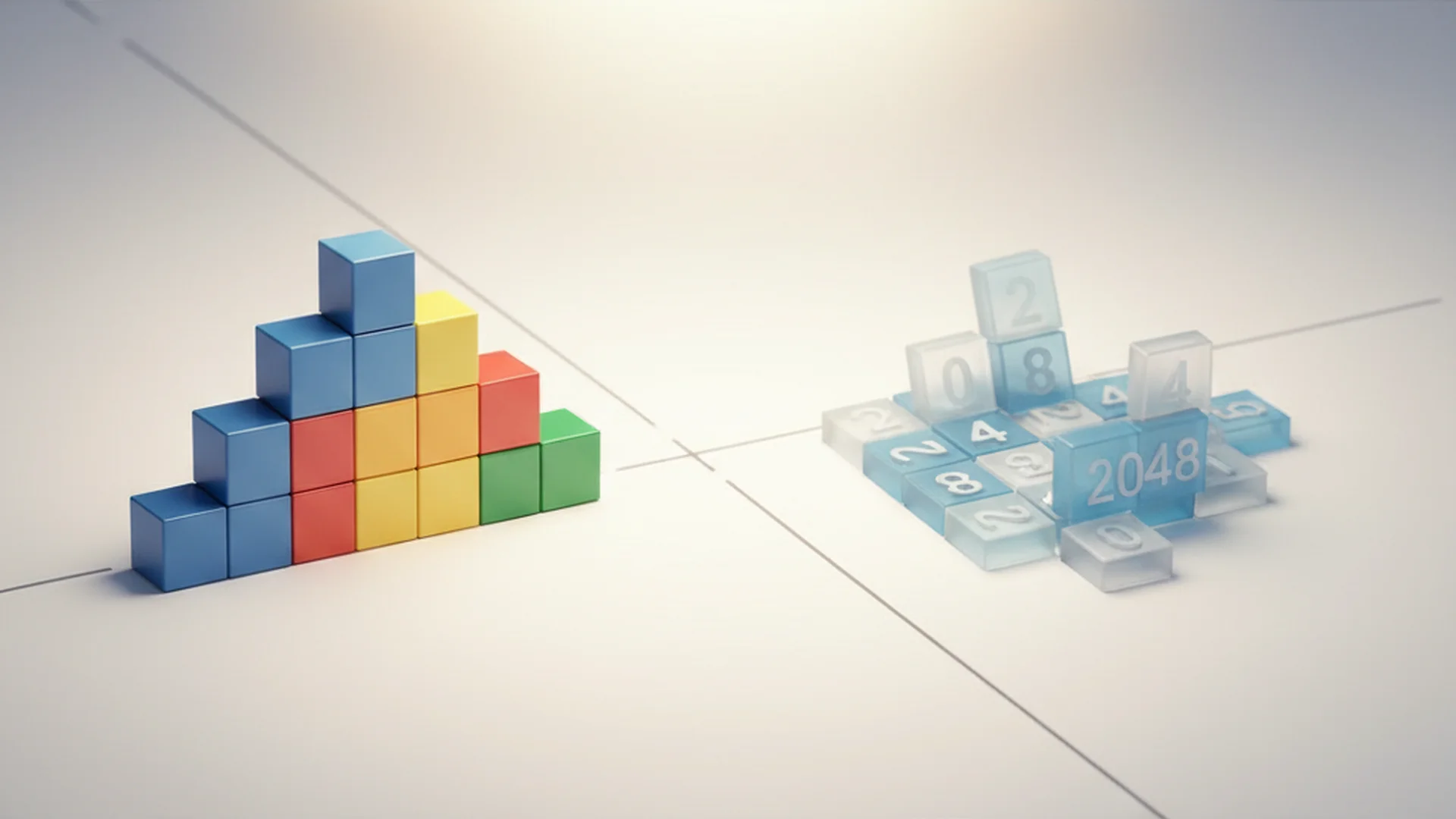
In the pantheon of puzzle gaming, two names stand above the rest as cultural phenomena: Tetris and 2048. While they both challenge our spatial reasoning and logic, the debate of Tetris vs 2048 represents a clash between the "old guard" of arcade reflexes and the "new school" of mobile-first viral mathematics. One game relies on the relentless descent of geometric shapes, while the other utilizes a clean, numerical grid.
Whether you prefer the high-speed pressure of falling blocks vs sliding tile puzzles, both games have captured the minds of millions. As we move through 2025 and 2026, these titles continue to evolve, integrating modern AI and accessibility features that keep them relevant in a sea of high-definition competitors.
The Origin Stories: From Moscow to the Viral Web
To understand the core differences in the tetris vs 2048 debate, we must look at their disparate origins. Tetris was the brainchild of Alexey Pajitnov, a researcher at the Academy of Science of the USSR in 1984. Built on an Electronika 60, the game was a digital translation of the physical pentomino puzzles Pajitnov enjoyed as a child. It didn't just become a game; it became a global obsession, eventually selling over 520 million copies across platforms like the Game Boy and modern consoles.
In contrast, 2048 is a product of the open-source era. Developed by 19-year-old Gabriele Cirulli in 2014, the game was originally a weekend project inspired by Threes and 1024. Because Cirulli released the code on GitHub, the game exploded into thousands of variants, becoming a viral hit that defined the mobile gaming landscape of the mid-2010s.
Mechanics: Falling Blocks vs Sliding Tiles
The fundamental difference lies in the physics of the gameplay. Tetris is a game of "gravity." You are constantly fighting against the clock as tetrominoes fall into a 10x20 well. Your goal is to create horizontal lines without gaps, which then disappear to make room for more pieces.
2048, however, is a turn-based experience. There is no gravity. Instead, you use a sliding mechanic on a 4x4 grid. When two tiles with the same number touch, they merge into one, doubling their value. The game only ends when the board is full and no moves remain, or when you reach the elusive 2048 tile.
Cognitive Demands
- Tetris: Primarily tests spatial rotation and reaction speed. As the levels increase, the "lock delay" (the time you have to move a piece once it touches the stack) becomes nearly non-existent.
- 2048: Tests long-term planning and pattern recognition. It is less about "twitch" reflexes and more about maintaining a consistent logic to prevent a gridlock.
Advertisement
The Science of the "Tetris Effect" vs 2048's Math Appeal
One of the most fascinating aspects of Tetris is its impact on the human brain. The "Tetris Effect" is a documented phenomenon where players see falling blocks in their mind's eye even after they've stopped playing. More significantly, clinical studies from institutions like the Karolinska Institutet have shown that playing Tetris shortly after a traumatic event can reduce PTSD flashbacks by up to 64%. It acts as a "cognitive vaccine" by occupying the visual processing resources the brain uses to store traumatic memories.
2048, while lacking a "2048 Effect" in the clinical sense, taps into the Zeigarnik Effect. This is the psychological tendency to remember uncompleted tasks better than completed ones. Every time you merge a 128 into a 256, your brain is rewarded with a hit of dopamine, but the sight of the "unfinished" 512 tile keeps you sliding.
Strategic Mastery: How to Win
To excel in either game, you cannot simply play randomly. Expert players use specific methodologies to achieve high scores.
Tetris Pro Strategies
- The Well: Build your stack on the left side, keeping it as flat as possible, and leave a one-block wide gap on the far right. This is the "well" reserved for the "I-piece" (the long bar) to score a 4-line "Tetris."
- Hypertapping and Rolling: In the professional Tetris circuit, players no longer hold the D-pad. They use "hypertapping" (vibrating the thumb) or "rolling" (drumming fingers on the controller) to move pieces at speeds faster than the game’s internal repeat rate.
- Flat Stacking: Avoid creating "dependencies" where you need a specific piece to fill a hole. A flat surface is a safe surface.
2048 Winning Strategies
- The Corner Strategy: This is the golden rule. Pick one corner (usually the bottom-left) and never let your highest tile leave that spot. You can learn more about this in our guide on the 2048 Corner Strategy.
- Three-Direction Rule: Try to only move your tiles in three directions (e.g., Left, Right, and Down). Never press "Up" unless it is the only possible move, as it risks pulling your high-value tiles out of the corner.
- The Snake Path: Arrange your tiles in a descending order of value that "snakes" across the rows. This ensures that when you merge a tile, it is immediately adjacent to the next value in the chain.
Common Mistakes to Avoid
Even seasoned players fall into traps that end their sessions prematurely. When comparing tetris vs 2048, the mistakes are often mirrors of each other.
In Tetris:
- Covering Holes: Beginners often panic when they miss a placement and "roof" over an empty space. This makes it impossible to clear the lines below until the "roof" is cleared.
- Waiting for the Long Bar: Relying exclusively on a Tetris (4 lines) can be dangerous. If the I-piece doesn't appear, your stack will "top out." Sometimes, clearing singles or doubles is the smarter survival move.
In 2048:
- The "Random Slide": When the board gets messy, many players start sliding in all directions hoping for a merge. This is the fastest way to hit a gridlock.
- Ignoring the 4s: Most tiles spawn as a "2," but 10% spawn as a "4." If you don't account for a potential "4" spawn in your empty spaces, it can block your snake chain.
- Center Stacking: Keeping high tiles in the middle of the board limits your movement and makes it harder to organize new tiles.
| Feature | Tetris | 2048 |
|---|---|---|
| Primary Goal | Clear Lines | Reach 2048 Tile |
| Grid Size | 10 x 20 | 4 x 4 |
| Pressure | Real-time / Speed | Turn-based / Space |
| Skill Focus | Spatial Reflexes | Logical Consistency |
| End State | Topping Out | Gridlock |
Advertisement
Recent Trends: The Puzzle Landscape in 2025-2026
As we look at the current state of these games, several new trends have emerged. The rise of "Block Blast" clones in late 2025 has introduced a "no-gravity" version of Tetris that focuses on fitting blocks into a static grid, which currently sees over 823,000 monthly searches.
Furthermore, AI integration is changing how we play. Modern versions of Sliding Puzzles and Tetris now use AI agents to monitor a player's frustration levels. If the game detects you are about to quit, it might subtly adjust the "random" piece generation to provide a helpful merge or a long bar, maintaining the "Flow State."
Accessibility has also taken a leap forward. With the adoption of WCAG 2.2 standards in 2025, many puzzle platforms have introduced advanced Haptic Feedback. This allows visually impaired players to "feel" the difference between a square piece and a T-piece through distinct vibration patterns on their mobile devices.
Frequently Asked Questions
Which is harder: Tetris or 2048?
Tetris is generally considered harder in terms of physical execution and reaction time. However, 2048 is arguably harder to "master" for high scores (beyond the 2048 tile), as the mathematical margin for error becomes thinner the higher the numbers go.
Does playing 2048 improve math skills?
While 2048 uses powers of 2, it is primarily a spatial logic game. It improves your ability to recognize multiples and doubles quickly, but it does not necessarily translate to complex arithmetic or algebraic skills.
Why are these games so addictive?
Both games utilize the Zeigarnik Effect, where our brains are hardwired to want to complete "unfinished" lines or tiles. The constant cycle of creating a problem (a new block) and solving it (clearing or merging) creates a dopamine loop.
Conclusion
In the battle of tetris vs 2048, there is no objective winner—only a preference for the type of challenge you seek. Tetris is the ultimate test of your ability to stay calm under the pressure of falling blocks, demanding split-second decisions and physical dexterity. 2048 is the ultimate test of your sliding logic and patience, rewarding those who can maintain a strict organizational system over hundreds of moves.
Both games offer incredible cognitive benefits, from stress reduction to improved spatial awareness. Whether you are aiming for a world-record high score in Tetris or trying to finally hit that 4096 tile in 2048, you are participating in a rich history of digital puzzle-solving that continues to thrive in 2026.
Ready to Test Your Skills?
Choose your challenge and start playing the world's best puzzle games today.
Put it into practice

Keep reading
Comparisons
NYT Games vs Other Puzzles: The 2025-2026 Ultimate Comparison
Explore the 2025 landscape of digital puzzles. A deep dive into NYT Games vs competitors, including Wordle strategies, new game releases like Pips, and expert tips.
Jun 14, 2026 12 min
Comparisons
Puzzles vs Reading: Which Is the Ultimate Workout for Your Brain?
Compare the cognitive benefits of puzzles vs reading. Discover how crosswords and books impact memory, stress, and dementia risk based on 2025 research.
Feb 20, 2026 12 min
Arcade Games
The Ultimate Tetris 99 Strategy Guide: Dominating the Battle Royale
Master the board with our expert Tetris 99 strategy guide. Learn about badge multipliers, attacker baiting, T-spins, and 2026 meta trends to win.
Oct 7, 2025 12 min
Advertisement