What Puzzle Should I Start With: A Beginner’s Guide to the Perfect First Pick
Not sure what puzzle to start with? Our guide covers piece counts, image types, and expert strategies to ensure your first jigsaw puzzle is a success.
By Free To Play Puzzles Editorial Team 12 min read
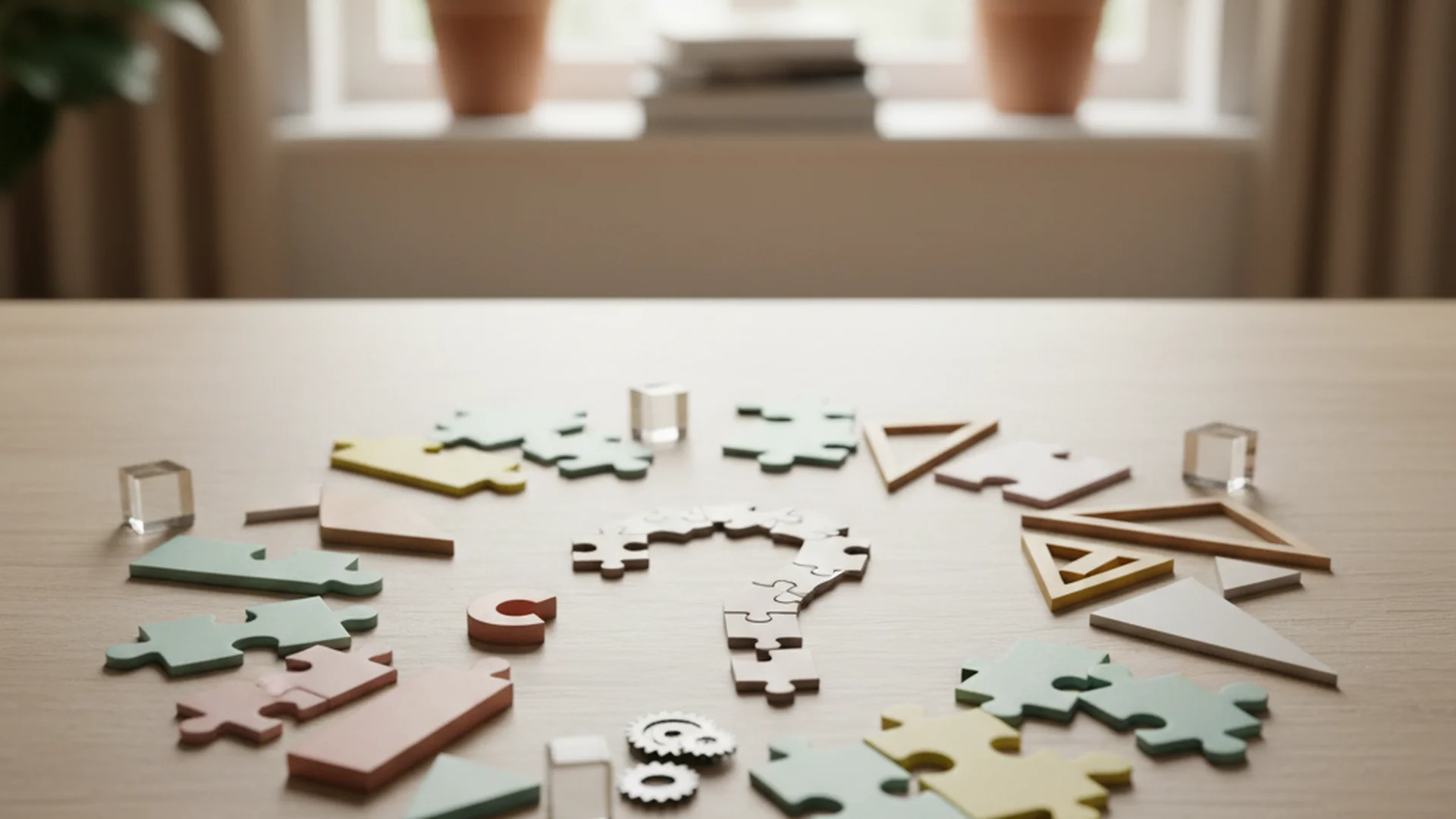
In the hyper-saturated digital landscape of 2025, a quiet revolution is taking place on dining tables across the globe. As digital fatigue reaches an all-time high, millions are turning back to the tactile, analog satisfaction of the jigsaw puzzle. However, for a newcomer, walking into a hobby shop or browsing online can be overwhelming. You might find yourself staring at thousands of boxes, wondering exactly what puzzle to start with to ensure you actually enjoy the process rather than ending up with a headache and a box of "cardboard dust."
As a strategic gameplay analyst, I approach puzzles not just as a pastime, but as a mental exercise in pattern recognition and spatial logic. Choosing your first puzzle is your first strategic move. Pick one that is too easy, and you’ll be bored in an hour; pick one that is too difficult, and the "puzzle burnout" will ensure it’s your last.
Why 2025 is the Year of the Puzzler
The global jigsaw puzzle market has exploded, valued at approximately $2.68 billion in 2024 and projected to soar to $3.53 billion by 2033. This growth isn't just about nostalgia. It’s driven by a collective desire for "screen-free" leisure. Interestingly, while 75% of puzzle enthusiasts are women, we are seeing a massive surge among Millennials and Gen Z who use puzzles as a form of "active meditation."
Before we dive into the mechanics of your first purchase, it is worth understanding the cognitive value of this hobby. Many beginners ask Are puzzles good for brain function? The answer is a resounding yes. Puzzles engage both the left and right hemispheres of the brain, improving short-term memory and problem-solving skills.
The Golden Rule: The "Sweet Spot" Piece Count
The biggest mistake a beginner can make is overestimating their patience. While 1,000-piece puzzles are the most popular size—outselling 500-piece versions by a staggering 4 to 1—they are rarely the best puzzle beginners should tackle first.
The 300 to 500 Piece Advantage
For your first foray, aim for the 300 to 500-piece range. Here is why the math works in your favor:
- Time Commitment: A 300-500 piece puzzle typically takes 2 to 4 hours. This allows you to finish a project in a single afternoon or over two relaxed evenings.
- Space Management: A standard 500-piece puzzle measures roughly 18" x 24". You can easily fit this on a standard coffee table while still having room for sorting trays.
- Confidence Building: Completing a puzzle provides a dopamine hit. Finshing a 500-piece set feels like a victory, whereas being "stuck" on a 1,000-piece set for three weeks feels like a chore.
| Piece Count | Est. Completion Time | Workspace Needed | Difficulty Level |
|---|---|---|---|
| 300 Pieces | 1.5 - 2.5 Hours | Small Table | Very Easy |
| 500 Pieces | 3 - 4 Hours | Medium Table | Easy/Moderate |
| 1,000 Pieces | 8 - 12 Hours | Large Dining Table | Moderate/Hard |
Advertisement
Visual Literacy: Choosing the Right Image
Not all images are created equal. A 500-piece puzzle of a clear blue sky is significantly harder than a 1,000-piece puzzle of a busy candy shop. When deciding what puzzle to start, you must evaluate the "visual literacy" of the artwork.
Seek Out High Contrast
For your first puzzle, avoid "monochromatic" art—images with large areas of a single color, such as oceans, forests, or foggy landscapes. Instead, look for:
- Collages: These are the "Easy Mode" of the puzzle world. Every piece likely belongs to a specific, identifiable object (a vintage soda can, a specific flower, a postage stamp).
- Maps: Colorful maps offer text clues and distinct geographic borders that make sorting a breeze.
- Busy Cityscapes: Look for images with lots of "stuff"—colorful windows, signs, people in different colored outfits, and varied architecture.
Brands and Material Quality
In 2025, the quality of the "snap" matters. Cheap puzzles have thin pieces that peel or, worse, fit into places they don't actually belong. For a frustration-free start, stick to reputable brands known for their "Softclick" or "Perfect Snap" technology.
- Ravensburger: The gold standard. Their cardboard is thick, and the "linen finish" reduces glare from overhead lights.
- Buffalo Games: Known for their "Perfect Snap" and for including a full-size fold-out poster of the image in every box.
- Galison: Excellent for modern, chic designs and "puzzles as decor."
- Elena Essex: Features vibrant, high-contrast gradients that are perfect for beginners.
The Strategy: How to Approach Your First Puzzle
Once you’ve picked your 500-piece high-contrast masterpiece, don't just dump the box. Follow these strategic steps to ensure success.
1. The "Sort-Once" Rule
Spend the first 20 minutes sorting. Use the lid and the bottom of the box (or dedicated sorting trays) to categorize pieces by:
- The Border: Find all pieces with at least one flat edge.
- Dominant Colors: If there is a big red barn, put all the red pieces together.
- Distinct Textures: Separate "striped" pieces from "polka dot" pieces.
2. Lighting is Key
Many beginners fail because they work under dim, yellowish incandescent light. This makes dark blues, purples, and blacks look identical.
3. Work on "Islands"
Don't try to grow the puzzle purely from the edges inward. Instead, build "islands"—small, recognizable sections of the image. Assemble that specific character or that brightly colored sign on the side, then move the entire "island" into its approximate position within the frame.
Advertisement
2025-2026 Trends: Puzzles Evolving
The hobby is no longer just flat cardboard. If you want something unique for your first attempt, consider these modern iterations:
- AR-Integrated Puzzles: Some modern sets "come to life" via a smartphone app once finished.
- Wooden Whimsies: Wooden puzzles are the fastest-growing segment. They often feature "whimsy pieces"—individual pieces shaped like animals or objects that match the puzzle's theme.
- Gradient Puzzles: While they look intimidating, gradients (e.g., a puzzle that fades from red to yellow) are actually quite intuitive because you are always looking for the "next shade."
To understand more about the specific terms used in the industry, check out our Puzzle Glossary.
Common Mistakes to Avoid
Even with the best intentions, beginners often fall into these traps:
- The "Border First" Trap: While it is standard advice to start with the edges, if the border is a solid, dark color (like a black frame), it is the hardest part of the puzzle. If the border is tough, leave it for later and start with the bright colors in the middle.
- Losing Pieces in "Puzzle Dust": When you first open a box, there is often cardboard dust at the bottom. Some tiny pieces can get trapped in this. Always dump the box into a tray and sift through the dust to ensure no pieces are left behind.
- Ignoring the Poster: Many beginners try to work only from the small image on the box lid. If your puzzle includes a full-size poster, use it! It allows you to see the fine details of the brushstrokes or textures.
- The "Big Box" Ambition: Buying a 2,000-piece puzzle because you "love the picture" is the fastest way to quit. Unless you have a dedicated room that you don't mind losing for a month, stay small.
Frequently Asked Questions
How many pieces should a beginner adult start with?
A beginner adult should ideally start with 300 to 500 pieces. This range offers enough of a challenge to be engaging without requiring a multi-week commitment or a massive workspace.
Is a 1,000-piece puzzle too hard for a first-timer?
It isn't impossible, but it is a significant jump in difficulty. A 1,000-piece puzzle takes approximately 8 to 12 hours of active work. For a first-timer, this can lead to frustration. If you do choose a 1,000-piece set, ensure the image is a "collage" with many distinct colors.
Should I start with the edges or the middle?
For 90% of puzzles, starting with the edges (the border) is the best strategy as it defines your workspace. However, if the border is a solid, dark color, it is often easier to start with a highly recognizable focal point in the middle and work outwards.
How much space do I need for a 500-piece puzzle?
You need roughly 18" x 24" for the finished puzzle, but you should double that space (roughly 24" x 36") to allow room for sorting your pieces.
What are the best brands for high-quality pieces?
Ravensburger, Buffalo Games, Galison, and Elena Essex are widely considered the best for beginners due to their high-quality cardboard, clear printing, and precise piece-cutting.
Conclusion
Choosing what puzzle to start with is about finding the balance between challenge and relaxation. By starting with a 300-500 piece high-contrast image, you set yourself up for a successful "win" that will leave you wanting more. As you get more comfortable, you can explore Best Puzzles for Specific Goals to see how different puzzle types can help with memory, relaxation, or even workplace team building.
Once you find your rhythm, you’ll discover that the "final click" of a jigsaw puzzle is one of the most satisfying sounds in the world. It’s a moment of order in a chaotic world—and a perfect way to reclaim your focus from the digital noise.
Ready to Start?
Find your perfect beginner puzzle and start your journey today.
Put it into practice
Keep reading
Reference
Mastering Crossword Terminology: The Ultimate Puzzle Solving Dictionary
Unlock the grid with our guide to crossword terminology. Learn essential terms, 2025 trends, and expert strategies from a cognitive neuroscientist.
Aug 4, 2026 12 min
Reference
Puzzle Difficulty Levels Explained: Finding Your Cognitive Flow State
Unlock the science behind puzzle difficulty levels. From Sudoku givens to the quadratic growth of jigsaws, learn how to choose the perfect challenge for your brain.
Jul 26, 2026 12 min
Reference
Physical Puzzles Overview: The Complete Guide to Mechanical Challenges
Explore the 2025 tactile revival with our physical puzzles overview. Learn about mechanical puzzle types, maintenance tips, and the latest trends in functional art.
Mar 25, 2026 12 min
Advertisement