STEM Puzzles in the Classroom: Building the Next Generation of Problem Solvers
Discover how STEM puzzles transform classrooms into problem-solving hubs. Learn expert strategies, research-backed benefits, and 2026 trends for science and math education.
By Free To Play Puzzles Editorial Team 12 min read
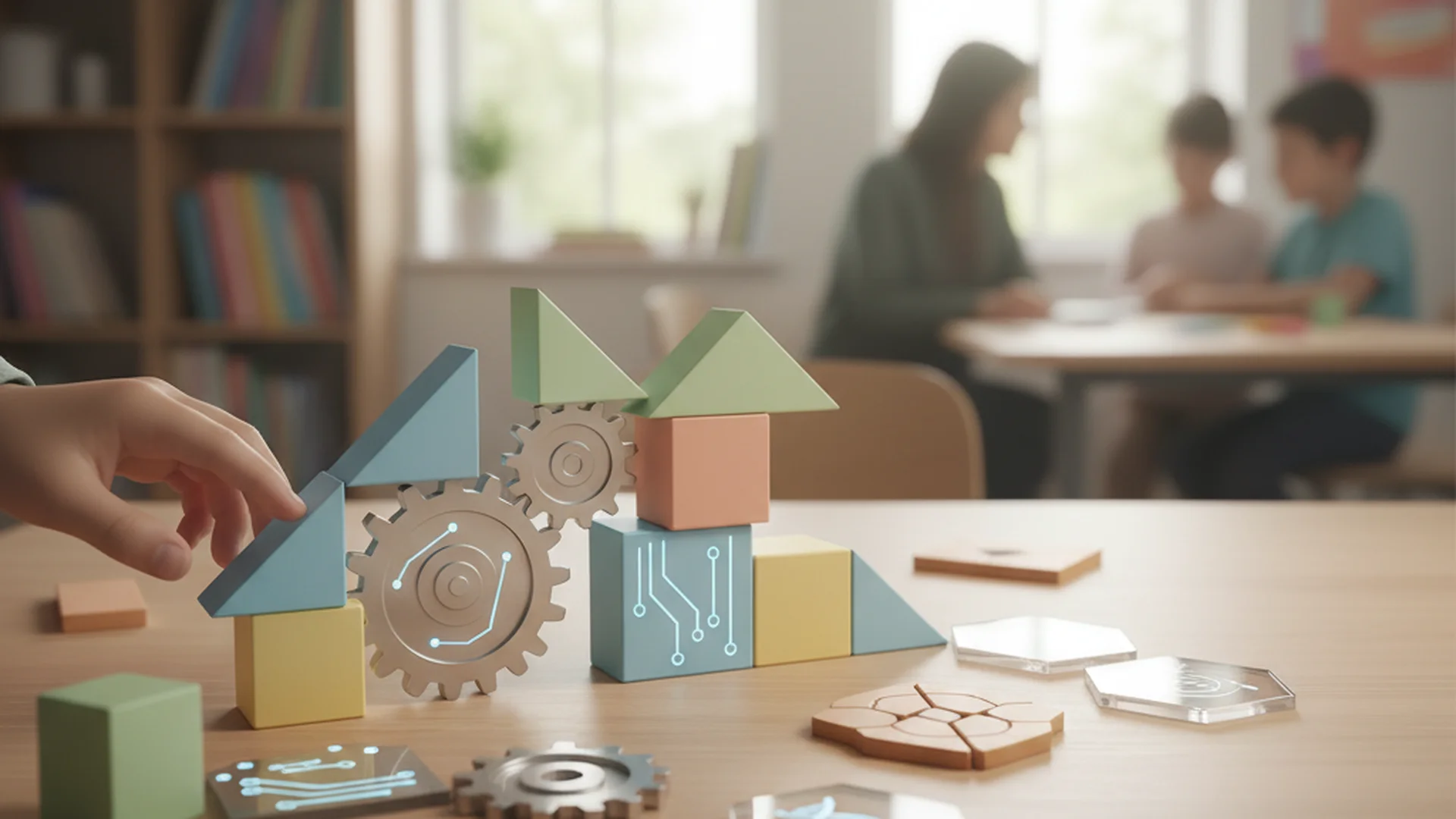
In the modern education landscape, the traditional lecture is rapidly giving way to more interactive, hands-on experiences. As a crossword constructor, I spend my days thinking about how to challenge the human brain, and there is no better place to see this in action than the modern science math puzzles classroom. Integrating STEM puzzles into daily routines transforms lessons from static information delivery into dynamic, problem-solving adventures.
By providing a "low-floor, high-ceiling" environment, these puzzles allow diverse learners to enter the challenge at their own level while still providing enough depth to push even the most advanced students. Whether it’s a 3D structural challenge or a logic-based math riddle, the classroom becomes a laboratory for the mind.
The Science of Why STEM Puzzles Work
The benefits of puzzles in a classroom setting are not just anecdotal; they are backed by rigorous cognitive science. When we introduce STEM puzzles to students, we are doing more than just keeping them busy—we are re-wiring their brains for future success.
Spatial Reasoning: The Predictor of Success
Research from the University of Chicago has highlighted a staggering correlation between early puzzle play and later academic achievement. They found that children who engage with puzzles between the ages of 2 and 4 develop significantly better spatial skills by age 4.5. These spatial transformation skills—the ability to mentally rotate shapes or visualize objects in 3D space—serve as a primary predictor of later success in complex STEM courses and professional careers.
In the classroom, this means that a student solving a Tangram or a 3D building challenge is actually building the mental architecture required for advanced calculus, architectural design, and organic chemistry.
The Cognitive Bridge
Solving puzzles helps students bridge the gap between the left brain (logical, sequential) and the right brain (creative, movement). This connection occurs via the corpus callosum. By engaging both hemispheres, puzzles increase overall problem-solving capacity across all life domains.
What Makes a Puzzle a "STEM" Puzzle?
Not every game or riddle fits the criteria for a high-quality STEM education tool. To be truly effective within a science and math context, a puzzle should satisfy four key criteria:
- Generality: The puzzle should apply a universal principle that can be used in other contexts (e.g., gravity, logic gates, or ratios).
- Simplicity: The rules should be easy to grasp, even if the solution is difficult to find.
- The “Eureka” Factor: There must be a moment of sudden discovery where the logic "clicks."
- Entertainment: If the student isn't engaged, the "diffuse-mode thinking" required for deep learning won't activate.
Advertisement
Implementing Puzzles in a Tight Curriculum
One of the biggest hurdles for educators is the lack of time. However, puzzles shouldn't be seen as an "extra" activity for after the "real work" is done. Instead, they should be the "anchor" of the lesson.
1. Anchor Activities and Bell Ringers
Start the first five minutes of class with a logic challenge. Using Bell Ringer Puzzles can settle a class instantly and prime their brains for the analytical thinking required in science and math.
2. Transition Brain-Teasers
Use puzzles to fill the gaps between lessons. A quick 3D visualization puzzle can help students reset their focus before moving from a literacy block to a math block.
3. Standards-Based Puzzles
Puzzles are excellent for reinforcing specific standards. For example, a geometry puzzle focusing on area and perimeter allows students to apply abstract formulas to a concrete, tactile problem. For more on this, explore how to integrate Math Skills Through Puzzles.
The Power of "Epic Failure"
In a traditional classroom, failure is often penalized with a low grade. In the world of STEM puzzles, failure is the "meat and potatoes" of learning.
Failing Forward
Experts recommend that teachers stay out of the way when they see a student about to hit a dead end. When a student encounters a "dead end" in a logic puzzle, they are forced to rethink their entire strategy. This is where the deepest learning occurs.
I often encourage teachers to use the term "Epic Failure" to destigmatize mistakes. When a design fails, the student should be encouraged to "fail forward" by identifying exactly why it didn't work. Was the base too narrow? Was the logic loop infinite?
Scaffolding with "Good Hints"
If a group is truly stuck, don't give them the answer. Instead, provide a hint that points toward a method.
- Bad Hint: "The answer is 42."
- Good Hint: "What would happen to the balance if you flipped the base?"
Three Real-World Examples of Classroom STEM Puzzles
1. The Bridge-Building Stress Test (Physics/Engineering)
Using only straws, tape, and paper clips, students must create a bridge that spans a 12-inch gap and holds a specific weight.
- The STEM connection: This forces students to understand tension, compression, and load-bearing capacity.
- The Puzzle element: They have limited materials, requiring them to optimize their "spend."
2. The Logic Grid (Mathematics/Logic)
Using a matrix to solve a situational riddle (e.g., "Five scientists are in five different labs...").
- The STEM connection: This builds the deductive reasoning skills essential for computer programming and scientific hypothesis testing.
- The Puzzle element: Each clue eliminates possibilities, narrowing the field through logic. For more complex logic, see our guide on Critical Thinking Puzzles.
3. The 3D Shape Rotation (Geometry/Spatial Reasoning)
Students are given a 2D "net" of a shape and must predict what the 3D object will look like once folded.
- The STEM connection: Directly relates to the University of Chicago findings on spatial success.
- The Puzzle element: It requires mental "rotation" and visualization without physical aids initially.
Advertisement
Budget-Friendly STEM Puzzle Solutions
Setting up a science math puzzles classroom does not need to be expensive. While high-tech kits are wonderful, some of the most effective tools are found in the recycling bin.
| Material | STEM Application | Puzzle Idea |
|---|---|---|
| Cardboard Tubes | Structural Engineering | Marble runs with logic gates |
| Index Cards | Geometry/Balance | Building the tallest tower with zero tape |
| Plastic Bottles | Fluid Dynamics | Creating a "Cartesian Diver" logic puzzle |
| Dry Erase Markers | Logic/Algorithms | Drawing paths for classmates to follow blindly |
Future Trends: STEM Puzzles in 2025–2026
As we move into 2025 and 2026, the way we interact with puzzles in the classroom is evolving.
AI as a "Puzzle Co-Pilot"
AI platforms are now being used to generate personalized puzzles. These tools can adapt in real-time to a student's difficulty level, providing "just-in-time" scaffolding. If a student solves a math riddle too quickly, the AI can instantly inject a new variable to keep the challenge relevant.
VR/AR Visualization
Augmented Reality (AR) is turning 2D puzzles into 3D models that students can literally walk around. This helps students visualize complex concepts like molecular structures or celestial mechanics in a way that a textbook never could.
Sustainability Themes
The "Green City" puzzle is a rising trend. Students must solve logic problems regarding solar grid placement or resource allocation to keep a virtual city running without hitting a carbon limit.
Tactile Coding
There is a shift away from screens toward "tactile coding." Students use physical blocks or robots (like KaiBot) to solve a physical maze before translating those movements into digital code.
Common Mistakes to Avoid
Even with the best intentions, it is easy to misapply STEM puzzles in a classroom setting.
1. Focusing Only on Engineering
Many "STEM" tasks are just "building" tasks. A true STEM puzzle should integrate the M (Math) or S (Science). If students are building a tower, ask them to calculate the cost-per-inch or explain the center of gravity.
2. Over-Organization
A classroom that is "too clean" can stifle the creative process. Students need the freedom to make a mess, experiment with materials, and leave "work-in-progress" projects out to revisit later.
3. The "Gifted Only" Myth
A major misconception is that STEM puzzles are only for "advanced" students. In reality, these puzzles are highly effective for students with learning differences or those who struggle with traditional text-based learning because they are hands-on and visual.
4. Treating Puzzles as Extra-Curricular
Don't wait until Friday afternoon to pull out the puzzles. Integration is key. If you are teaching a unit on weather, use a logic puzzle about pressure systems. If you're teaching ratios, use a puzzle involving mixing chemical "potions." For planning tips, see our Puzzle Lesson Plans.
Frequently Asked Questions
Are all puzzles considered STEM?
Not necessarily. To be a "STEM" puzzle, it should involve universal principles of science, technology, engineering, or math. It should require logical deduction, spatial reasoning, or the application of a scientific law. A simple jigsaw puzzle is great for fine motor skills, but a puzzle where you must balance weights on a lever is a STEM puzzle.
What should I do when I see students about to fail a puzzle?
Stay out of the way! Failure is a critical part of the learning process. If you step in too early, you rob the student of the "Eureka" moment. Wait until they are truly frustrated, then offer a "method-based" hint rather than the solution.
Isn't setting up STEM puzzles expensive?
No. Many of the most effective puzzles use "found materials" like straws, tape, cardboard, and paper clips. The value is in the challenge and the logic, not the price tag of the materials.
How do I assess student progress with puzzles?
Assessment doesn't always need a letter grade. Observe the student's process: How do they handle failure? Are they trying new strategies? Can they explain the logic behind their solution? You can find more strategies in our guide on Puzzle Assessment Students.
How do puzzles fit into a tight curriculum?
Puzzles are best used as "anchor activities," lesson starters, or "transition brain-teasers." They reinforce standards in a way that sticks, often making the rest of the lesson more efficient because the students' brains are already engaged.
Conclusion: The Path to Mastery
Integrating STEM puzzles into the classroom is about more than just fun and games; it is about providing students with the cognitive tools they need to navigate an increasingly complex world. By embracing the "Epic Failure," encouraging spatial reasoning, and utilizing both high-tech and low-tech tools, we can create a learning environment where every student has the chance to be a scientist, an engineer, or a mathematician.
The "Eureka" moment a student feels when they finally solve a difficult logic puzzle is the same feeling a scientist feels when they discover a new breakthrough. By fostering that feeling in the classroom today, we are ensuring a brighter, more innovative tomorrow.
Ready to Start?
Bring the power of puzzles into your classroom today with our curated collections.
Put it into practice


Keep reading
Education
Mastering the Classroom: The Ultimate Puzzles for Teachers Guide
Explore how puzzles for teachers transform active learning. Discover classroom puzzle activities, AI integration, and cognitive strategies for the 2025-2026 school year.
Apr 28, 2026 12 min
Education
Puzzles in the Classroom: A Teacher’s Implementation Guide for 2025 and Beyond
Unlock student potential with our comprehensive teacher puzzle guide. Learn how to implement puzzles in the classroom to boost dopamine, memory, and focus.
Apr 27, 2026 12 min
Education
Mastering Math Skills Through Puzzles: A Guide for 2025 and Beyond
Discover how math puzzles learning outperforms traditional methods. Learn expert strategies, research-backed benefits, and 2025 trends for students and educators.
Aug 17, 2026 12 min
Advertisement