Tetris Rules Explained: Mastering the Science of the Stack
Master the essential Tetris rules and advanced strategies. Learn about the 7-bag system, T-spins, and expert stacking techniques to improve your high score.
By Free To Play Puzzles Editorial Team 12 min read

Since its inception in 1984 by Soviet engineer Alexey Pajitnov, Tetris has evolved from a simple computer test into a global cultural phenomenon. Whether you are a casual player on your phone or a competitive enthusiast, understanding the fundamental tetris rules is essential for high-score mastery. At its core, Tetris is a game of spatial logic and rapid decision-making, challenging players to arrange falling geometric shapes into solid horizontal lines. With over 520 million units sold, it remains the ultimate test of human efficiency and reflexes in the gaming world.
The Fundamental Tetris Rules
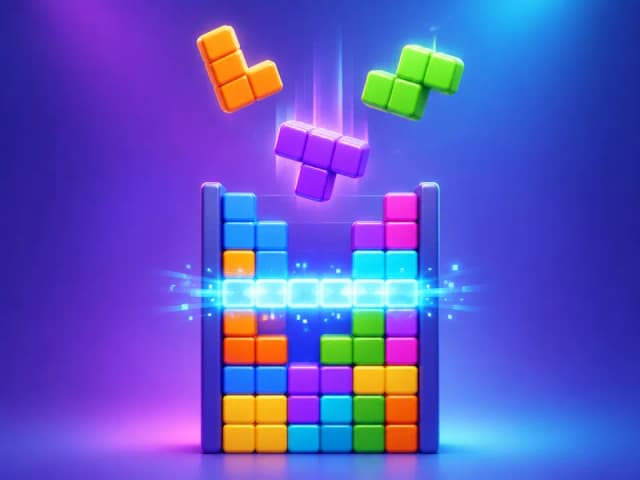
To learn how to play tetris effectively, you must first understand the objective. The game is played on a vertical grid (usually 10 columns wide and 20 rows high) called the "Matrix."
Geometric shapes called "Tetrominoes" fall from the top of the screen. Your goal is to move, rotate, and drop these pieces to create solid horizontal lines. When a line is completed without any gaps, it disappears, and you earn points. If your stack of blocks reaches the top of the Matrix—a state known as "topping out"—the game is over.
The Seven Tetrominoes
Every official Tetris game uses seven distinct shapes, each composed of four square blocks (minos). These are often identified by their letter-like appearance:
- I-Piece (The Long Bar): Essential for clearing four lines at once.
- O-Piece (The Square): Stable but can be difficult to place in jagged stacks.
- T-Piece: The most versatile piece for advanced maneuvers like T-Spins.
- S and Z-Pieces: Zig-zag shapes that require careful planning to avoid creating gaps.
- J and L-Pieces: L-shaped blocks used for filling corners and maintaining a flat stack.
Modern Mechanics: The "Hold" and "Random Bag"
If you haven't played since the 1980s, you might notice that modern tetris rules have introduced features that make the game more strategic and less reliant on pure luck.
The Hold Queue
One of the most important additions to modern Tetris is the "Hold" button. This allows you to "store" a piece in a special slot for later use. If the current piece doesn't fit your stack, you can swap it with the held piece.
The 7-Bag System
In early versions of the game, piece generation was truly random, which often led to frustrating "droughts" where you wouldn't see an I-piece for 30 or 40 turns. To fix this, modern games use the 7-Bag System.
The game shuffles all seven Tetrominoes like a deck of cards and deals them to you one by one. Once the "bag" is empty, it shuffles a new deck. This means you are guaranteed to receive exactly one of each piece every seven turns, allowing for much more predictable and mathematical play—a concept I frequently emphasize in my work with Sudoku logic.
Advertisement
Expert Stacking: How to Play Tetris Like a Pro
To achieve high scores, you cannot simply clear lines as they come. You must stack with intent. The most efficient way to score is to perform a "Tetris"—clearing four lines simultaneously using an I-piece.
The 9-1 Stack
The gold standard of Tetris strategy is building a stack that is nine columns wide, leaving a single open column (a "well") on either the far left or far right.
- Build the Foundation: Keep your stack as flat as possible. Avoid creating "caves" or "overhangs" that are impossible to fill.
- Maintain the Well: Ensure the 10th column remains completely empty.
- The Delivery: Wait for an I-piece to appear in your "Next Queue" or pull it from your Hold slot to clear four lines at once.
Advanced Maneuvers: T-Spins and Wall Kicks
Once you master the basic tetris rules, you can move on to T-Spins. A T-Spin occurs when you rotate a T-piece into a T-shaped hole that is obstructed by other blocks at the last possible second.
The game’s engine uses "Wall Kicks" to allow pieces to rotate even if they are pressed against a wall or another block. By timing your rotation perfectly, the T-piece will "kick" into an empty space that it couldn't normally reach. In competitive play, a "T-Spin Double" often rewards more points or sends more "garbage lines" to an opponent than a standard Tetris.
The Evolution of Speed: Hypertapping and Rolling
In the 2020s, the world of competitive Tetris was rocked by new input methods. Historically, players used "DAS" (Delayed Auto-Shift), where you hold the D-pad to move pieces. However, as levels get faster, DAS becomes too slow.
- Hypertapping: This involves vibrating your thumb on the D-pad at speeds exceeding 10 presses per second.
- Rolling: Discovered around 2021, this technique involves "rolling" four fingers across the bottom of the controller to push the D-pad into your stationary thumb. This allows for nearly double the speed of hypertapping and has enabled players to reach "Level 255" and beyond in the original NES version.
For more on the fascinating history of how these techniques developed, check out our History of Tetris guide.
Advertisement
Common Mistakes to Avoid
Even seasoned players fall into bad habits. If you want to master the tetris rules, avoid these common pitfalls:
1. Stacking in a "Pyramid"
Many beginners build their stack highest in the center of the Matrix. This is a fatal error. A center-high stack makes it extremely difficult to move pieces to the left and right edges as the game speeds up. Always aim for a flat surface or a slight slope toward your well.
2. Bar Dependency
Relying solely on the I-piece to save your game is known as "bar dependency." If you build your stack too high while waiting for a long bar, a single misplacement can end your run. Learn to clear "singles" and "doubles" to keep your stack height manageable.
3. Rotating in One Direction
Most players have a "preferred" rotation button. However, at high speeds, rotating a piece three times clockwise instead of once counter-clockwise wastes valuable milliseconds. Learning to use both rotation buttons is a hallmark of an advanced player.
| Technique | Skill Level | Benefit |
|---|---|---|
| 9-1 Stacking | Beginner | High scoring via Tetrises |
| Holding Pieces | Intermediate | Strategic flexibility |
| T-Spins | Advanced | High scoring & efficiency |
| Rolling | Pro | Survival at extreme speeds |
Tetris in 2025 and 2026: What's New?
The world of Tetris is more active than ever. In February 2025, Tetris Forever received a major update, introducing "Time Warp" modes that require players to switch between the History of Pong era graphics and modern 4K visuals mid-game.
Furthermore, ARIKA (the developers behind the legendary Grand Master series) is slated to release a new high-difficulty title in early 2025 focusing on precision speedruns. If you prefer a physical experience, Spin Master is launching new Tetris-inspired board games in Fall 2025, bringing the digital tetris rules to your tabletop.
Frequently Asked Questions
How do you "win" at Tetris?
In traditional Tetris, there is no "winning" screen. The goal is to survive as long as possible and achieve the highest score. However, in "Sprint" modes, you "win" by clearing 40 lines in the shortest time possible.
What is the "Tetris Effect"?
The "Tetris Effect" is a documented psychological phenomenon where people who play the game for long periods begin to see falling blocks in their dreams or visualize how real-world objects (like groceries on a shelf) can fit together. It is often cited in Classic Arcade Games: Ultimate Retro Gaming Guide as a testament to the game's addictive logic.
Is modern Tetris rigged?
No. While some players feel the game is "predictable" due to the 7-bag system, this system was actually designed to make the game fairer. It prevents the "bad luck" of never receiving a specific piece, ensuring that every game is theoretically playable for a long duration.
What is a "Kill Screen"?
In the original NES Tetris, Level 29 was long considered the "Kill Screen" because the pieces fell faster than the controller could move them. However, with techniques like "Rolling," modern players have pushed far past this, reaching levels where the game's code eventually glitches and crashes.
Conclusion
Understanding the tetris rules is about more than just knowing how to move blocks; it is about mastering a system of logic, probability, and physical dexterity. From the humble beginnings in a Moscow lab to the high-speed "Rolling" era of 2025, Tetris remains the gold standard of puzzle games. By focusing on flat stacking, managing your Hold queue, and avoiding bar dependency, you can transition from a casual player to a high-scoring expert. Much like the History of Space Invaders, Tetris proves that the simplest mechanics are often the most enduring.
Ready to Play?
Put your knowledge of Tetris rules to the test.
Put it into practice


Keep reading
Arcade Games
Tetris Line Clears Explained: Mastering Singles, Doubles, Triples, and Tetrises
Master the art of the Tetris line clear. Learn scoring multipliers, T-spins, and pro-level strategies from the 2025 competitive scene to maximize your high score.
Jul 24, 2025 12 min
Arcade Games
Tetris Piece Names: All 7 Tetriminos Explained
Discover the official names and history of the 7 Tetris pieces. From I-pieces to T-spins, learn how to master Tetriminos for high-scoring gameplay.
Oct 21, 2025 9 min
Arcade Games
Tetris Rotation Systems: SRS vs. Classic Mechanics Explained
Master the mechanics of the Tetris rotation system. Explore SRS, classic wall kicks, and professional strategies to improve your gameplay and brain health.
Aug 20, 2025 12 min
Advertisement