The Tetris Effect: Why the World’s Most Famous Game Haunts Your Dreams
Discover the psychology behind the Tetris effect. Learn how this phenomenon rewires the brain, reduces PTSD flashbacks, and improves cognitive health.
By Free To Play Puzzles Editorial Team 12 min read
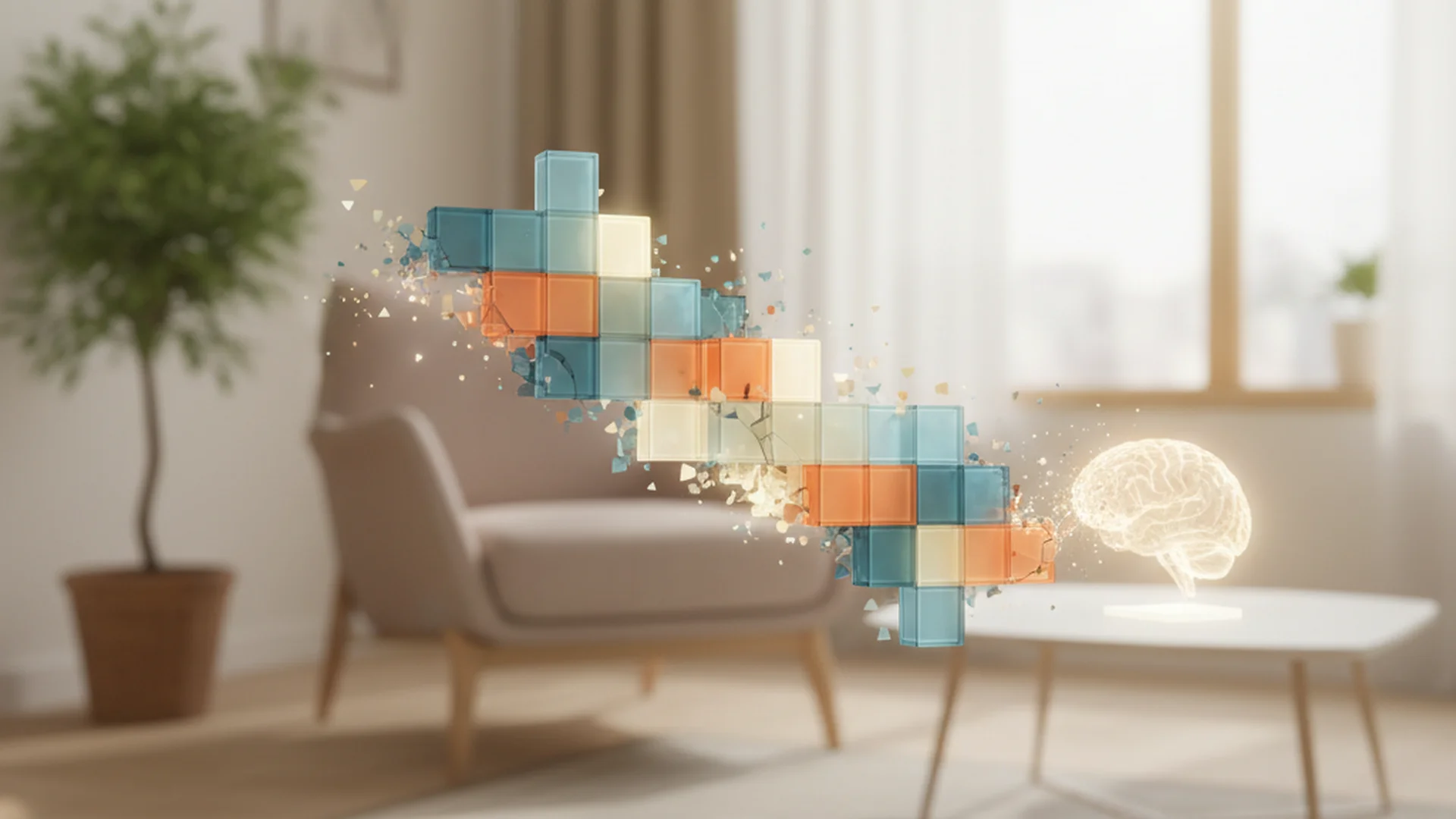
Have you ever spent an afternoon rotating geometric shapes, only to find those same shapes falling behind your eyelids the moment you try to sleep? You aren't losing your mind—you are experiencing the tetris effect. This phenomenon, technically known as tetris syndrome, represents a fascinating intersection of gaming and neuroscience. Repetitive tasks can re-map our neural pathways, and few examples are as clear or as medically promising as the world's favorite block-stacking puzzle.
The tetris effect occurs when a person devotes so much time and attention to a repetitive activity that it begins to pattern their thoughts, mental images, and dreams. While it originated with the eponymous 1980s puzzle game, modern psychology now recognizes it as a powerful example of neuroplasticity and a promising tool for trauma recovery.
The Discovery of the Tetris Syndrome
The term "Tetris Effect" was first coined by journalist Jeffrey Goldsmith in 1994, but it wasn't until the turn of the millennium that it received rigorous scientific scrutiny. In 2000, Harvard psychiatrist Robert Stickgold conducted a breakthrough study that changed our understanding of how the human brain learns and remembers.
Stickgold’s most famous finding involved patients with anterograde amnesia—individuals who lacked the ability to form new conscious memories. These patients could play Tetris for hours, yet when asked later, they had no recollection of ever seeing the game or the computer. However, when these patients transitioned into sleep, they reported dreaming of falling blocks.
This "Amnesia Breakthrough" proved that the tetris effect is tied to procedural memory—the "how-to" memory system—rather than the declarative memory system used for facts and events. It showed that our brains continue to process and learn spatial patterns even when we have no conscious memory of the experience.
The Neuroscience: Gray Matter and Neuroplasticity
Beyond mere "afterimages," the act of playing this classic arcade game physically alters the structure of the brain. A landmark study published in BMC Medicine utilized MRI scans to track the brain development of girls who played the game for three months.
The results were staggering. The researchers found significant thickening in the Brodmann area 6 (responsible for planning complex movements) and the temporal lobes (vital for visual integration). This physical expansion of gray matter is a direct demonstration of neuroplasticity—the brain's ability to reorganize itself by forming new neural connections.
| Brain Region | Function | Change Observed |
|---|---|---|
| Brodmann Area 6 | Planning complex movement | Increased cortical thickness |
| Temporal Lobes | Visual-spatial integration | Enhanced neural efficiency |
| Hippocampus | Memory consolidation | Heightened activity during sleep |
Advertisement
The "Cognitive Vaccine": Tetris and PTSD
Perhaps the most revolutionary application of the tetris effect is its role in treating Post-Traumatic Stress Disorder (PTSD). In the world of clinical psychology, we refer to this as an "Imagery-Competing Task Intervention" (ICTI).
1. Reducing Immediate Trauma
A 2017 study in Molecular Psychiatry analyzed car accident victims who were brought into the emergency room. Those who played Tetris for 20 minutes within six hours of their accident experienced a 62% reduction in intrusive memories (flashbacks) over the following week compared to a control group.
2. Helping Healthcare Workers
Moving into 2024, a study conducted by Uppsala University focused on healthcare workers traumatized by the COVID-19 pandemic. The researchers found that a single guided session of the game reduced flashbacks by an average of 85.9% after five weeks.
The secret lies in "visuospatial interference." Because the brain has limited resources for processing visual information, the high-intensity spatial demand of rotating blocks "blocks" the brain from consolidating traumatic visual memories.
Beyond the Blocks: Game Transfer Phenomena (GTP)
While we call it the tetris effect, it is actually a subset of a broader category known as Game Transfer Phenomena (GTP). This occurs when the patterns of any highly repetitive task spill over into real life.
- Programmers: Many report seeing lines of code scrolling behind their eyes after a 12-hour coding session.
- Chess Players: Grandmasters often "see" potential moves and board configurations on the ceiling or tiled floors.
- Modern Doomscrollers: The repetitive motion of "flicking" a thumb up a screen can lead to a mental patterning where the brain expects a continuous stream of new, often negative, information.
If you are interested in the roots of these games, you can explore the History of Tetris to see how its design was perfectly calibrated to trigger this mental state.
Harnessing the Effect for Positive Change
Can we use this psychological "glitch" to our advantage? Positive psychologist Shawn Achor suggests we can develop a "Positive Tetris Effect." Just as the game trains your brain to look for "gaps" and "fits," you can train your brain to scan the environment for opportunities.
By intentionally scanning for three things you are grateful for every day for 21 days, you re-pattern the brain to scan for the positive rather than the negative. This is the tetris effect applied to emotional intelligence and resilience.
Advertisement
Trends for 2025 and 2026
As we move into 2026, the application of the tetris effect has moved from the laboratory to the smartphone.
- Remote Digital Therapeutics: Hospitals are now deploying smartphone-based apps that use these mechanics to prevent burnout in emergency workers.
- VR and Sensory Immersion: The game Tetris Effect: Connected is being used in clinical settings to induce flow states, which have been shown to lower cortisol levels more effectively than some forms of traditional meditation.
- Cloud Gaming Accessibility: With platforms like Amazon Luna making these tools accessible via any smartphone, the "cognitive vaccine" is now available to almost everyone, regardless of their gaming hardware.
Common Mistakes to Avoid
When discussing or using the tetris effect for health, it is important to avoid several common pitfalls:
- Thinking it’s "just a distraction": Many believe the game works by distracting the patient. It actually works by specifically occupying the visuospatial sketchpad. Simply listening to music or reading a book does not have the same effect on traumatic memory consolidation.
- Stacking for high scores: In a therapeutic context, the score doesn't matter. The effort of mental rotation—visualizing the pieces turning—is the active ingredient.
- Misdiagnosing as Psychosis: Some healthcare providers unfamiliar with GTP have misdiagnosed the Tetris Effect as a psychotic break. Seeing game-like afterimages is a normal sensory transfer, not a sign of a psychiatric disorder.
Frequently Asked Questions
Is the Tetris Effect only caused by Tetris?
No. While named after the block-stacking game, it can be caused by any task that requires intense, repetitive visuospatial focus. This includes other games, certain types of data entry, or even activities like jigsaw puzzles and knitting.
Why do I see blocks when I close my eyes?
This is a phenomenon called hypnagogic imagery. Your brain is in a "learning loop," continuing to process and consolidate the spatial patterns it recently encountered while you transition toward sleep. It is essentially your brain "practicing" while you rest.
Can the Tetris Effect be permanent?
Generally, no. The visual afterimages and the tendency to see patterns in the real world usually fade within a few days of stopping the activity. However, the neural pathways built, such as improved spatial reasoning and mental rotation skills, can be long-lasting.
Is the Tetris syndrome dangerous?
In its standard form, no. It is a sign of healthy neuroplasticity and a functioning brain. However, if it causes extreme sleep deprivation or interferes with safety-critical tasks (like trying to "fit" cars together while driving), it may be time for a "digital detox."
Does it work for all types of trauma?
The research specifically points to "visual" intrusive memories. It is less effective for trauma that is primarily auditory or conceptual, as it targets the visuospatial processing centers of the brain.
Conclusion
The tetris effect is more than just a quirky side effect of long gaming sessions; it is a window into how our brains learn, adapt, and heal. From the "Amnesia Breakthrough" of the 2000s to the 2024 breakthroughs in PTSD prevention for healthcare workers, this arcade game continues to provide invaluable insights into the human mind.
Whether you are looking to improve your cognitive benefits, suppress a stubborn craving, or simply understand why you see falling blocks in your sleep, recognizing the power of the tetris effect is the first step in mastering your own mind’s plasticity.
Want to boost your brain?
Try our selection of puzzle games and experience the effect for yourself.
Put it into practice
Keep reading
Arcade Games
The Best Tetris Versions: A Guide to Classic and Modern Masterpieces
Explore the best Tetris games across four decades. From the 1989 NES classic to the immersive Tetris Effect and 2025 releases, find your perfect version.
Jun 11, 2026 12 min
Arcade Games
Tetris: Complete Guide to the World’s Most Popular Puzzle
Master the blocks with our Tetris complete guide. Explore history, competitive strategies, T-spins, and the latest 2025 updates in this expert analysis.
May 3, 2025 25 min
Arcade Games
The Neuroscience of Play: Unlocking Arcade Games Brain Benefits
Discover how arcade games boost neuroplasticity, improve impulse control, and can even reverse brain aging by up to 4 years according to 2025 research.
Sep 12, 2026 12 min
Advertisement