Sudoku for Kids: A Guide to Age-Appropriate Teaching and Cognitive Growth
Discover the benefits of sudoku for kids. Learn age-appropriate teaching strategies, cognitive statistics for 2025, and how to transition from 4x4 to 9x9 grids.
By Free To Play Puzzles Editorial Team 12 min read
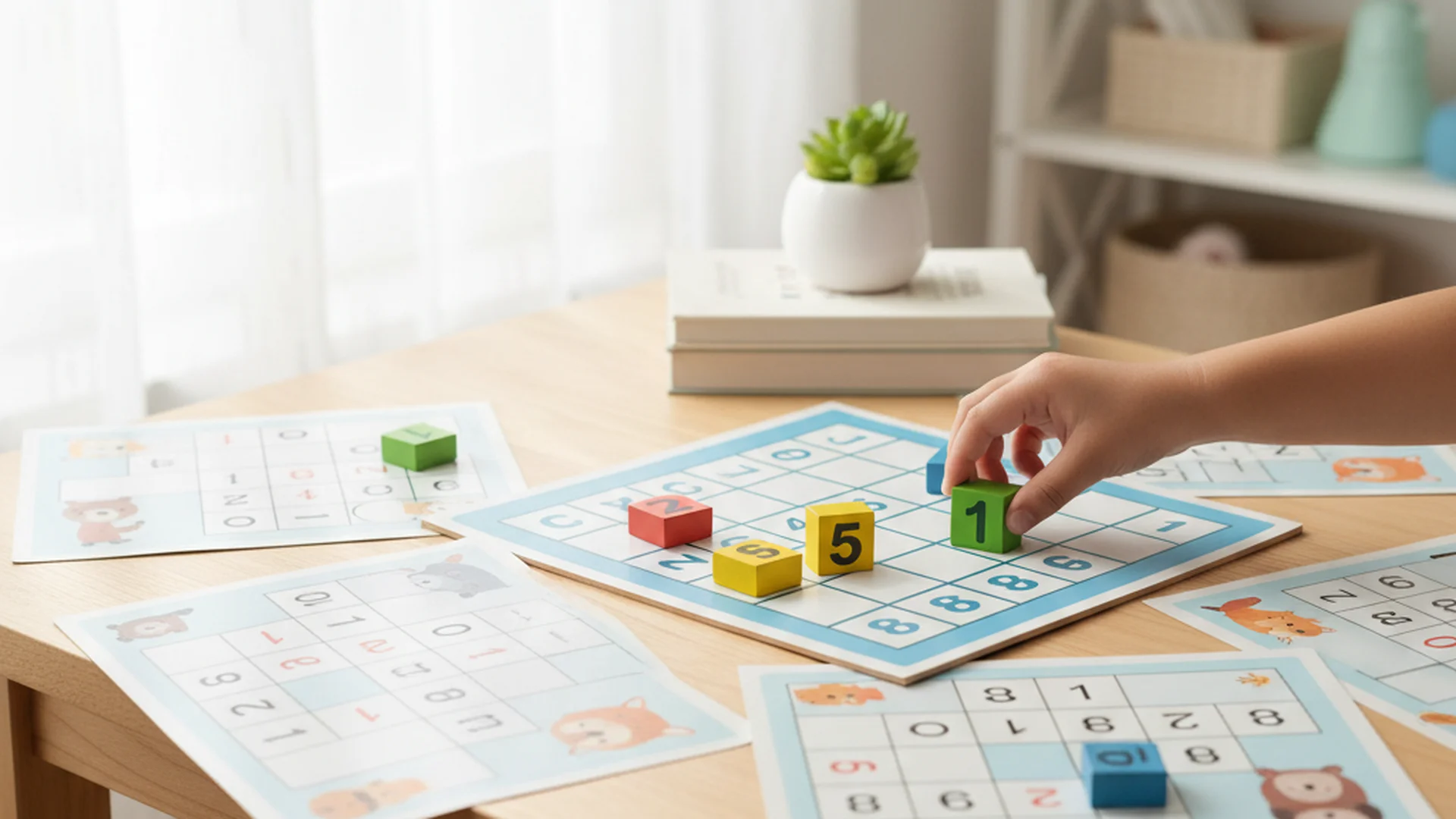
In an era dominated by digital distractions, finding an activity that balances entertainment with genuine cognitive development is a priority for parents and educators alike. Sudoku for kids has emerged as one of the most effective tools for fostering logical reasoning, spatial awareness, and "grit"—the ability to persist through a challenge. Far from being just a "numbers game," children sudoku is a gateway to high-level critical thinking.
As a Mathematical Logic Instructor, I have seen firsthand how a simple 4x4 grid can transform a child’s perception of challenge. In 2025, the demand for screen-free educational activities has surged, and Sudoku remains at the forefront of this movement. By teaching your child the "One of Each" rule, you aren't just giving them a puzzle; you are helping them wire their brains for future success in mathematics and computer science.
The Science of Sudoku: Why It Matters in 2025
The educational landscape of 2025-2026 places a heavy emphasis on "fluid intelligence"—the ability to solve new problems without relying on previously acquired knowledge. Recent school-integrated studies have highlighted the profound impact that regular logic puzzles have on developing minds.
Cognitive Improvements and IQ Gains
Research from 2025 indicates that children who engage in regular Sudoku play show a 17-19% improvement in math problem-solving abilities. More impressively, these students experienced a 24% boost in general focus and concentration compared to peers who did not engage in logic-based play.
Furthermore, Sudoku acts as a proxy for IQ development. Students solving these puzzles regularly showed a 15% uplift in scores on Raven’s Progressive Matrices. This is a standard measure of abstract reasoning and fluid intelligence, proving that the benefits of sudoku for kids extend far beyond the grid itself.
Brain Plasticity and Neuroimaging
According to 2025 neuroimaging findings from the University of Albany, logic puzzles like Sudoku engage three critical areas of the brain:
- The Prefrontal Cortex: Responsible for complex decision-making and planning.
- The Hippocampus: Vital for short-term and long-term memory.
- The Parietal Lobe: Essential for processing spatial reasoning and numerical information.
By stimulating these areas, children improve their brain plasticity, making it easier for them to pick up other STEM-related skills, such as coding or advanced geometry.
Breaking the "Math Game" Myth
One of the biggest hurdles parents face is the misconception that Sudoku is a math game. This often scares away children who consider themselves "language-leaning" or "creative."
In reality, Sudoku is a game of pattern recognition and deductive logic. It requires zero arithmetic—no addition, subtraction, multiplication, or division. You could replace the numbers with colors, animals, or fruit, and the logic would remain identical. This makes it highly accessible to children who might struggle with traditional math but excel at visual puzzles.
For more on how these puzzles impact the brain, see our article on Brain Health and Puzzles: Science of Cognitive Gaming.
Advertisement
Age-Appropriate Scaffolding: How to Start
You wouldn't ask a child to run a marathon before they can walk, and the same applies to Sudoku. Jumping straight into a 9x9 grid found in a local newspaper is the fastest way to discourage a young learner. Instead, follow this progressive scaffolding approach.
Level 1: Pre-Readers (Ages 4-6)
Start with 4x4 Picture Sudoku. Instead of numbers 1–4, use stickers of animals, different colored blocks, or shapes. At this age, the goal is simply to understand the concept of a row and a column.
Level 2: Early Elementary (Ages 6-8)
Introduce 4x4 Number Sudoku. Use the numbers 1 through 4. This is where the "no repeats" rule becomes the focus. Once they master 4x4, transition to 6x6 grids, which introduce a slightly more complex rectangular sub-grid (2x3).
Level 3: Intermediate Learners (Ages 8-10)
At this stage, children can begin tackling easy 9x9 grids. The key here is the number of "givens"—the numbers already filled in by the creator. An easy puzzle for a child should have at least 32-36 givens.
Level 4: Advanced Logic (Ages 10+)
Older children can begin learning specific techniques such as "Scanning" or "Hidden Singles." For those looking to push their skills further, you can introduce them to Hidden Singles in Sudoku or even Easy Sudoku Puzzles for Beginners.
| Level | Grid Size | Recommended Age | Focus Skill |
|---|---|---|---|
| 1 | 4x4 | 4-6 | Basic Rows/Columns |
| 2 | 6x6 | 6-8 | Numerical Sequencing |
| 3 | 9x9 (Easy) | 8-10 | Block/Box Logic |
| 4 | 9x9 (Med) | 10+ | Advanced Deduction |
Expert Teaching Strategies: The "Math Talk" Method
As an instructor, I recommend a collaborative approach to teaching children sudoku. Avoid simply telling them the answer; instead, use the "Math Talk" strategy to help them verbalize their thoughts.
The "One of Each" Rule
Explain the rules using simple language: "Every row (side to side), every column (up and down), and every little box must have one of each number. No twins allowed!"
The "Pencil First" Rule
Always encourage children to use a pencil. In Sudoku, mistakes are not failures; they are data points. Being able to erase a mistake prevents frustration and encourages the child to take risks with their logic.
Ask, Don't Tell
When your child gets stuck, ask guided questions:
- "Where can the number 2 go in this row?"
- "If we put a 3 here, what happens to the 3 already in that column?"
- "Why can't a 4 go in this square?"
2025–2026 Trends in Sudoku for Kids
The world of puzzles is evolving. In 2025, we are seeing new ways to engage children that go beyond the standard black-and-white grid.
- AI-Enhanced Learning: New 2025 apps like Kidoku use "smart hints." Unlike old apps that just gave the answer, these explain the logic (e.g., "This must be a 5 because 5 is already in the other two columns of this block").
- Sudoku Storytelling: A 2026 trend involves "narrative puzzles." Solving a 4x4 grid might unlock a clue in a mystery story or help a character cross a bridge in a book.
- Classroom Integration: Many homeschool curricula, such as JetLearn, now use Sudoku as a "brain warm-up" to build resilience and "grit" before moving into core subjects.
- Team Sudoku: In classrooms, "Giant Sudoku" is becoming a popular collaborative activity. Kids work on a large floor-sized grid, discussing moves and checking each other's work.
Advertisement
Common Mistakes to Avoid
Teaching Sudoku requires patience. Here are the most common pitfalls parents and educators encounter:
1. The Guessing Trap
Children often guess a number when they feel stuck. It is vital to teach them that Sudoku never requires a guess. If they find themselves guessing, they have missed a logical clue. Teach them to "scan" a different part of the board instead.
2. Starting Too Hard
Giving a child a standard newspaper puzzle is the fastest way to make them quit. These puzzles are designed for adults with years of experience. Always use age-appropriate books designed specifically for kids.
3. Focusing on Speed
In 2025, educators are pushing back against "timed" puzzles. Speed creates anxiety. Encourage "mindful solving," where the focus is on the elegance of the logic rather than how fast the clock is ticking.
4. Over-Correcting
If you see your child make a mistake, don't point it out immediately. Let them continue. Often, they will realize the mistake themselves when they try to place the final numbers in a row. This "self-correction" is a powerful learning moment.
For more tips on what to avoid, check out Common Sudoku Mistakes to Avoid.
Real-World Examples of Sudoku Logic
To help your child understand, use these real-world analogies:
- The Musical Chairs Example: "Just like in musical chairs, only one person can sit in each chair. In Sudoku, only one '1' can sit in each row. If two '1s' try to sit there, someone has to leave!"
- The Library Example: "Imagine you are a librarian. You have four books: Red, Blue, Green, and Yellow. You have to put them on the shelf so that no two shelves look exactly the same in any direction."
- The Team Sports Example: "A basketball team only has one point guard. If you have two point guards on the court at once, the referee blows the whistle. Your job is to make sure every 'team' (box) has exactly one of each player."
Frequently Asked Questions
What is the best age to start?
Most experts recommend starting around age 5 or 6. At this age, children can usually recognize numbers 1–4 and understand the basic concept of "no repeats." If your child is younger but shows interest, start with 4x4 picture grids.
Does my child need to be good at math to play?
Absolutely not. Sudoku is a logic-based game, not an arithmetic one. It requires no calculation. In fact, many children who struggle with math find Sudoku refreshing because it treats numbers as symbols in a game rather than tools for calculation.
How do I teach the rules simply?
Use the "One of Each" rule: Every row, every column, and every 2x2 (or 3x3) box must have exactly one of every number, with no doubles allowed.
Which grid size should beginners use?
Beginners should always start with 4x4 or 6x6 grids. A 4x4 grid only requires the numbers 1-4, which is much less intimidating for a child than the 81 squares of a standard 9x9 grid.
Are there non-number versions?
Yes! "Picture Sudoku" is highly recommended for pre-readers. You can use animals, colors, or shapes. This reinforces the logic of the game without the added layer of numerical recognition.
Conclusion: Building a Lifetime of Logic
Teaching sudoku for kids is an investment in their cognitive future. By moving through the stages of scaffolding—from simple 4x4 picture grids to the complexities of a 9x9 challenge—you are helping your child develop the focus, patience, and logical reasoning skills that will serve them across all academic disciplines.
Remember to keep the atmosphere light and fun. Use the "Math Talk" strategy, encourage the use of pencils, and celebrate those "Aha!" moments when the logic finally clicks. As they grow more confident, they might even want to try other logic games like Best Memory Games for Kids or learn How to Play Sudoku: Step-by-Step.
Sudoku isn't just a way to pass the time; it’s a way to build a better brain, one square at a time.
Ready to Start?
Begin your child's logic journey today with our beginner-friendly puzzles.
Put it into practice


Keep reading
Sudoku
Diagonal Sudoku Guide: Mastering the Rules and Solving Strategies
Learn how to master Diagonal Sudoku (Sudoku X). Discover essential rules, advanced solving strategies, and the mathematics behind this popular Sudoku variant.
Jul 17, 2026 12 min
Sudoku
Greater Than Sudoku: A Master Guide to Comparison Puzzles
Master Greater Than Sudoku with our expert guide. Learn advanced solving strategies, inequality chain logic, and how to tackle zero-clue comparison puzzles.
Jun 8, 2026 10 min

Sudoku
Jigsaw Sudoku Guide: Mastering Irregular Regions and Logic
Master Jigsaw Sudoku with our expert guide. Learn the Law of Leftovers, irregular region strategies, and 2026 trends.
Apr 11, 2026 12 min
Advertisement