Puzzles for Stress Relief: How Brain Games Help You Relax and Unwind
Discover how puzzles reduce stress and anxiety. Learn the science behind puzzle therapy and find the best relaxing puzzles for mental wellness and mindfulness.
By Free To Play Puzzles Editorial Team 11 min read
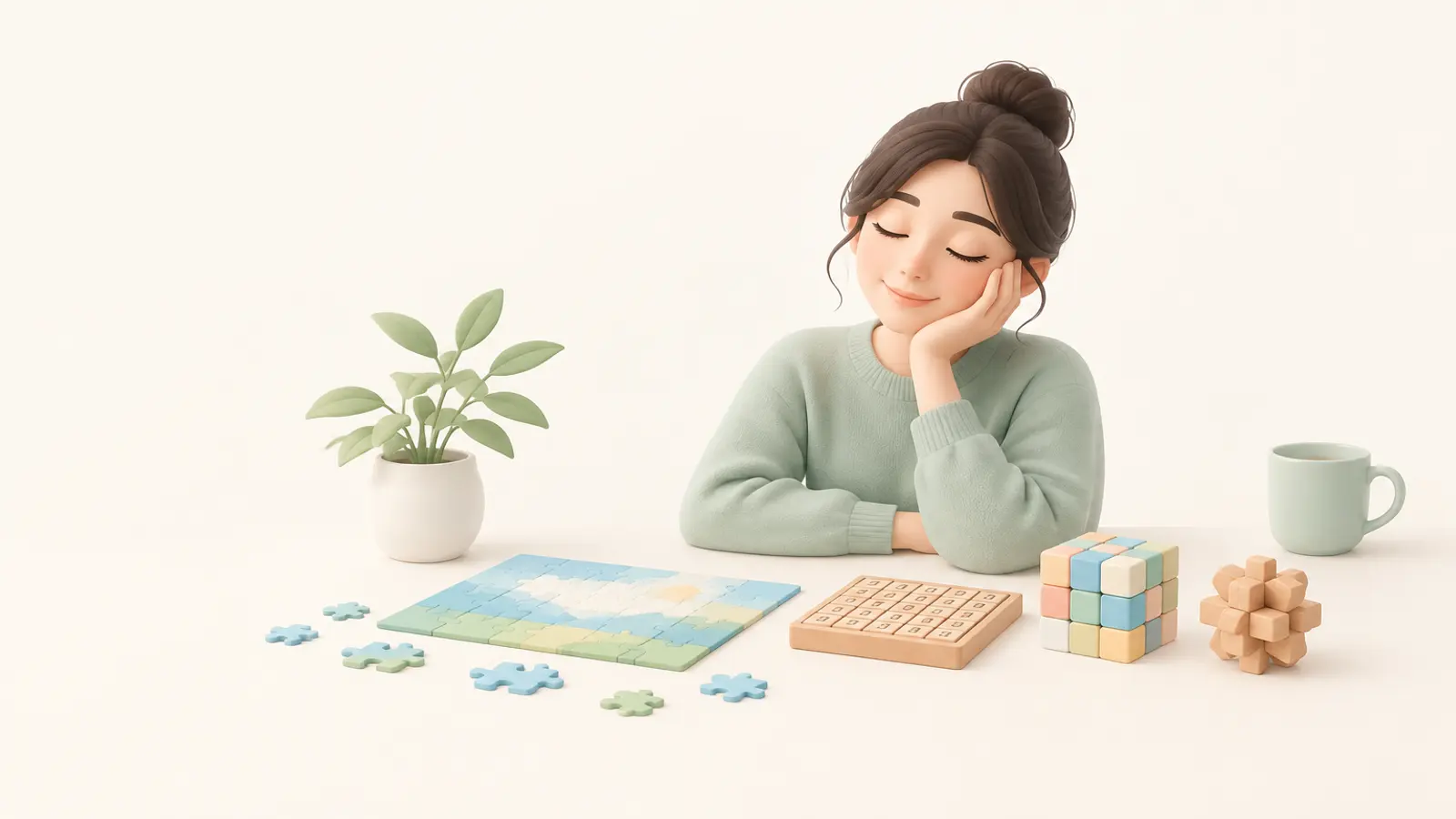
Puzzles for Stress Relief: How Brain Games Help You Relax and Unwind
In today's fast-paced world, stress has become an unwelcome constant companion for millions of people. Between work deadlines, family obligations, and the relentless barrage of digital notifications, finding moments of genuine calm can feel impossible. But what if the solution to your stress wasn't another meditation app or wellness trend—but something as simple as a puzzle?
The connection between puzzles and stress relief isn't just anecdotal. Research increasingly shows that engaging with puzzles triggers powerful psychological and neurological responses that actively combat stress, reduce anxiety, and promote mental wellness. Whether you're solving a crossword during your lunch break or unwinding with Sudoku before bed, puzzles offer a scientifically-backed pathway to relaxation.
In this comprehensive guide, we'll explore why puzzles are so effective for stress relief, which types of puzzles work best for relaxation, and how you can incorporate puzzle therapy into your daily wellness routine.
The Science Behind Puzzles and Stress Relief
Understanding why puzzles reduce stress requires looking at what happens in your brain when you solve them.
The Flow State and Mindfulness
When you engage with a puzzle, you enter what psychologist Mihaly Csikszentmihalyi calls "flow"—a state of complete absorption where you're fully present in the moment. This is essentially a form of active meditation.
During flow:
- Your mind stops ruminating on past regrets or future worries
- Time perception changes, making hours feel like minutes
- Stress hormones decrease as cortisol levels drop
- Feel-good neurotransmitters increase, particularly dopamine
- Mental chatter quiets, creating inner peace similar to meditation
Unlike passive relaxation (like watching TV), puzzles provide active engagement that crowds out anxious thoughts without requiring the mental discipline that makes traditional meditation challenging for many people.
Dopamine and Reward Systems
Every time you solve part of a puzzle—placing the right number in Sudoku, finding a word in a word search, or connecting tiles in 2048—your brain releases a small dose of dopamine.
Dopamine is the "reward chemical" that creates feelings of:
- Satisfaction and accomplishment
- Pleasure and motivation
- Improved mood and positive outlook
- Reduced perception of stress
This creates a positive feedback loop: solving puzzles feels good, which motivates you to continue, which keeps you in a relaxed, focused state. Unlike the dopamine spike from social media (which often leads to crashes and increased anxiety), puzzle-induced dopamine is gradual and sustainable.
Cognitive Distraction and Reframing
Puzzles provide what psychologists call "cognitive distraction"—engaging your working memory and executive functions so completely that there's no mental bandwidth left for worry.
Research published in the journal Anxiety, Stress & Coping found that structured cognitive activities like puzzles can:
- Interrupt rumination cycles that fuel anxiety and depression
- Create psychological distance from stressors
- Provide a sense of control when life feels chaotic
- Build cognitive resilience to future stress
When you're focused on finding the next crossword answer or completing a puzzle pattern, your brain literally can't simultaneously engage in catastrophic thinking or stress spirals.
Neuroplasticity and Long-Term Benefits
Regular puzzle-solving doesn't just provide immediate stress relief—it actually changes your brain's structure over time through neuroplasticity.
Studies show that consistent puzzle engagement:
- Strengthens prefrontal cortex function, improving emotional regulation
- Enhances GABA production, the brain's primary calming neurotransmitter
- Builds cognitive reserve, making your brain more resilient to stress
- Improves executive function, helping you manage stress more effectively
A 2019 study in the International Journal of Geriatric Psychiatry found that adults who regularly engaged in puzzles had brain function equivalent to people 10 years younger, with notably better stress management and emotional regulation.
The Best Types of Puzzles for Stress Relief
Not all puzzles provide the same relaxation benefits. Let's explore which types work best for different aspects of stress relief.
Sudoku: Logic and Calm
Why Sudoku reduces stress:
- Pure logic—no language processing required
- Clear rules create a sense of order and predictability
- Repetitive pattern recognition is inherently soothing
- Scalable difficulty lets you match your energy level
- No time pressure (unless you add it)
Best for: People who find comfort in structure and logical thinking; those who want to quiet mental chatter without words.
Stress relief rating: 9/10
Sudoku's number-based logic puzzle format makes it perfect for stress relief. Unlike word puzzles that engage language centers (which can activate rumination), Sudoku uses pure pattern recognition. This activates your brain's visual-spatial processing while giving verbal centers a rest—perfect for people whose stress manifests as racing thoughts.
Try our free Sudoku puzzles with multiple difficulty levels to match your mood and energy.
Word Search: Meditative Scanning
Why word searches reduce stress:
- Gentle, low-stakes gameplay
- Rhythmic eye scanning creates meditative effect
- Immediate gratification from finding words
- No complex problem-solving required
- Can be done in any environment
Best for: Beginners to puzzle therapy; people with high anxiety who need low-pressure activities; anyone seeking portable stress relief.
Stress relief rating: 8/10
Word searches offer what therapists call "soft fascination"—engaging enough to hold attention but not so demanding that they create mental strain. The repetitive scanning motion becomes almost hypnotic, similar to coloring books for adults. Research shows this type of gentle, repetitive visual activity reduces heart rate and promotes parasympathetic nervous system activation (the "rest and digest" response).
Explore our word search puzzles featuring thousands of calming themes from nature to literature.
Crossword Puzzles: Engaging Distraction
Why crosswords reduce stress:
- Total mental absorption prevents rumination
- Mix of difficulty keeps you in flow state
- Vocabulary building creates sense of growth
- Social element if done with others
- Progressive completion provides continuous satisfaction
Best for: People who need strong cognitive engagement to escape worry; word lovers; those seeking longer-form stress relief (30+ minutes).
Stress relief rating: 8/10
Crosswords require just enough mental effort to completely occupy your attention without causing frustration (when difficulty is matched appropriately). The alternation between "aha!" moments and steady progress creates an ideal stress-relief rhythm. Plus, completing a crossword—especially a challenging one—provides a significant mood boost from accomplishment.
Challenge yourself with our daily crossword puzzles updated with fresh content every day.
Memory Match: Mindful Attention
Why memory games reduce stress:
- Forces present-moment awareness (pure mindfulness)
- Low-pressure, forgiving gameplay
- Visual and spatial (non-verbal) processing
- Quick sessions fit any schedule
- Immediate feedback builds confidence
Best for: Short stress-relief breaks; people who struggle with traditional meditation; visual learners; anyone needing brain breaks during work.
Stress relief rating: 7/10
Memory matching games are deceptively powerful for stress relief. They require complete attention to visual details in the present moment—you literally can't worry about tomorrow's meeting while trying to remember card positions. This makes them excellent "emergency" stress relief tools during overwhelming days. The short game duration (5-10 minutes) also makes them perfect for micro-breaks.
Sharpen your mindful attention with our memory match games featuring beautiful card designs.
2048: Flow State Mastery
Why 2048 reduces stress:
- Highly addictive flow state
- Simple rules, complex strategy
- No time pressure (play at your pace)
- Clear progress tracking
- Satisfying tile combinations trigger dopamine
Best for: People who relax through strategic thinking; those who need extended distraction from stress; gamers seeking healthier habits.
Stress relief rating: 9/10
The sliding tile mechanics of 2048 create a uniquely absorbing experience. Each move requires planning and attention, keeping you locked in flow state for extended periods. The game's open-ended nature (you can always try for a higher score) means you control when to stop, avoiding the stress of strict time limits. Many players report entering almost trance-like states during longer sessions.
Get lost in the flow with our 2048 game and see how high you can score.
Word Scramble: Quick Mental Reset
Why word scrambles reduce stress:
- Very quick sessions (1-5 minutes)
- Instant gratification when solving
- Language play activates creativity
- Low barrier to entry
- Perfect for micro-stress relief
Best for: Quick breaks during stressful days; people with limited time; those who enjoy wordplay and language.
Stress relief rating: 7/10
Word scrambles offer rapid stress relief bursts. The "aha!" moment when letters suddenly rearrange into a recognizable word triggers immediate dopamine release and satisfaction. Because each puzzle takes only minutes, they're perfect for stressful work environments where you need quick mental resets without getting absorbed for too long.
Unscramble your stress with our word scramble puzzles featuring varied difficulty levels.
Math Puzzles: Structured Problem-Solving
Why math puzzles reduce stress:
- Logical structure creates sense of order
- Clear right/wrong answers (no ambiguity)
- Activates analytical thinking (quiets emotional reactivity)
- Builds confidence through solving
- Scalable complexity
Best for: People who find comfort in numbers and logic; those whose stress involves feeling out of control; analytical thinkers.
Stress relief rating: 7/10
For people who find numbers calming, math puzzles provide exceptional stress relief. Working through mathematical problems engages the brain's analytical centers while giving emotional centers a break. This can be especially valuable when stress has an emotional component—shifting to logical problem-solving creates helpful distance from overwhelming feelings.
Exercise your logical mind with our math puzzles ranging from basic to advanced.
Word Ladder: Progressive Challenge
Why word ladders reduce stress:
- Clear progression creates satisfaction
- Moderate difficulty maintains flow
- Creative thinking (not just recall)
- Self-paced—no time pressure
- Vocabulary building feels productive
Best for: People who enjoy creative problem-solving; those who want stress relief that feels "productive"; word game enthusiasts.
Stress relief rating: 8/10
Word ladders combine the stress-relief benefits of word puzzles with the satisfaction of step-by-step progress. Each successful transformation from one word to another provides a micro-accomplishment, keeping motivation and positive feelings high throughout the puzzle. The creative thinking required also activates different neural pathways than those involved in stress and worry.
Transform your mood with our word ladder games featuring hundreds of challenges.
Advertisement
How to Use Puzzles for Maximum Stress Relief
Simply solving puzzles provides benefits, but intentional practice amplifies the stress-relief effects.
Create a Puzzle Ritual
Rituals signal your brain that it's time to relax. Consider:
Morning puzzles: Start your day with 10 minutes of word search or Sudoku alongside coffee. This creates a calm, controlled beginning that sets a positive tone.
Lunch break decompression: Use a 15-minute crossword or 2048 session to mentally separate from morning stress before the afternoon.
Evening wind-down: Replace scrolling social media before bed with memory match or word scrambles. The blue light reduction and mental engagement promote better sleep.
Commute meditation: If you take public transit, use word searches or Sudoku as productive, stress-reducing alternatives to doomscrolling.
Match Puzzle Type to Stress Level
Different stress levels call for different puzzle types:
High anxiety/overwhelm: Choose simple, repetitive puzzles like word search or memory match. You need gentle engagement, not challenging problem-solving.
Moderate stress: Sudoku, crosswords, or word ladders provide absorbing distraction without excessive difficulty.
Racing thoughts: 2048 or challenging math puzzles demand enough focus to crowd out mental chatter.
Low-grade tension: Any puzzle type works—choose based on preference and available time.
Practice Mindful Puzzle-Solving
Transform puzzle time into active meditation:
-
Set intention: Before starting, take three deep breaths and consciously decide to be present with the puzzle.
-
Notice your experience: Pay attention to physical sensations, thought patterns, and emotional shifts as you solve.
-
Avoid time pressure: Unless specifically using timed puzzles for challenge, remove clock-watching that creates artificial stress.
-
Celebrate small wins: Acknowledge each correct answer or completed section with genuine appreciation.
-
Practice non-judgment: If stuck, observe frustration without self-criticism. Puzzles are practice, not performance.
Set Healthy Boundaries
While puzzles relieve stress, they can become compulsive if boundaries aren't maintained:
- Set time limits: Decide in advance how long you'll puzzle (use a timer if needed)
- Avoid "just one more": The drive to finish can create new stress—it's okay to leave puzzles incomplete
- Balance with other activities: Puzzles complement but don't replace physical exercise, social connection, and other wellness practices
- Monitor emotional response: If puzzles start creating frustration rather than relief, take a break or switch puzzle types
Puzzle Therapy: Integration with Mental Health
Mental health professionals increasingly recognize puzzle-solving as a valuable complementary therapy tool.
Clinical Applications
Therapists use puzzles to help clients with:
Anxiety disorders: Puzzles interrupt worry cycles and teach present-moment focus. Cognitive behavioral therapists often recommend puzzle breaks during exposure therapy.
Depression: The dopamine release and sense of accomplishment from puzzle-solving can help counteract anhedonia (inability to feel pleasure) and build motivation.
ADHD: Puzzles provide structured focus practice that builds attention skills without medication side effects.
Trauma and PTSD: Gentle puzzles can help regulate the nervous system during trauma processing, providing safe distraction during emotional overwhelm.
Insomnia: Pre-sleep puzzling (with paper or e-ink screens, not bright displays) helps transition from wakeful thinking to sleep-ready states.
When Puzzles Complement Professional Help
Puzzles work best for stress relief when combined with comprehensive mental health care:
- Mild to moderate stress: Puzzles alone may provide sufficient relief
- Chronic stress or anxiety: Combine puzzles with therapy, exercise, sleep hygiene, and social support
- Clinical disorders: Use puzzles as supplementary tools alongside professional treatment, not replacements
If stress interferes with daily functioning, relationships, or physical health, consult a mental health professional. Puzzles are powerful self-care tools, but they're not substitutes for clinical treatment when needed.
The Social Dimension: Puzzles and Connection
While puzzles are often solitary, they can also reduce stress through social connection.
Partner and Group Puzzling
Solving puzzles with others provides:
- Shared accomplishment that strengthens relationships
- Conversation framework for people who struggle with unstructured socializing
- Collaborative problem-solving that builds teamwork
- Reduced performance pressure compared to competitive activities
- Quality time without screens (for physical puzzles)
Try crosswords with a partner, word searches with kids, or Sudoku solving sessions with friends. The combination of cognitive engagement and social connection creates powerful stress relief.
Online Communities
Digital puzzle platforms offer community features:
- Leaderboards for friendly competition
- Forums for strategy discussion
- Shared solutions and tips
- Encouragement and motivation
These connections combat the isolation that often accompanies chronic stress while maintaining the stress-relief benefits of puzzle-solving.
Advertisement
Physical Puzzles vs. Digital Puzzles for Stress Relief
Both formats offer benefits, but with different stress-relief profiles.
Digital Puzzle Advantages
- Immediate availability: Access puzzles anywhere, anytime
- Unlimited variety: Never run out of new puzzles
- Adaptive difficulty: Many apps adjust challenge to your skill level
- Progress tracking: See improvement over time for motivation
- Portability: Entire puzzle library in your pocket
Best for: Consistent daily practice; people who always have phone/device available; those who enjoy tracking metrics.
Physical Puzzle Advantages
- Screen break: Reduces eye strain and blue light exposure
- Tactile engagement: Writing by hand engages different brain areas
- Ritual and routine: Physical puzzle book signals relaxation time
- No digital distractions: No notifications or other apps calling
- Collectibility: Completed puzzle books provide tangible accomplishment
Best for: Evening wind-down (better for sleep); people reducing screen time; those who prefer tactile experiences.
Hybrid Approach
Many people find optimal stress relief using both:
- Digital puzzles during commutes, lunch breaks, and moments of acute stress
- Physical puzzles in evenings, weekends, and designated relaxation time
Our free online puzzles provide instant access when stress strikes, while our printable versions offer screen-free alternatives.
Building Your Personal Puzzle Stress-Relief Plan
Create a sustainable puzzle practice with these steps:
Step 1: Assess Your Stress Patterns
- When is stress highest? Morning, afternoon, evening, weekends?
- What triggers it? Work, relationships, health, finances?
- How does it manifest? Racing thoughts, physical tension, emotional reactivity?
- What helps currently? Identify existing coping strategies that work
Step 2: Choose Compatible Puzzle Types
Based on your stress patterns:
- Morning stress: Quick word scrambles or memory games to start positive
- Work stress: Lunch break crosswords or Sudoku for midday reset
- Evening anxiety: Gentle word searches or low-difficulty puzzles for wind-down
- Racing thoughts: Absorbing games like 2048 or challenging math puzzles
Step 3: Set Realistic Goals
Start small and build:
- Week 1: One 10-minute puzzle session daily
- Week 2: Two 10-minute sessions or one 20-minute session
- Week 3: Daily puzzle ritual at consistent time
- Week 4: Assess stress levels and adjust as needed
Step 4: Track Your Experience
Notice changes:
- Stress levels before/after puzzle sessions
- Sleep quality on days with vs. without puzzles
- Overall mood and anxiety trends
- Favorite puzzle types and optimal timing
Step 5: Iterate and Optimize
Adjust based on results:
- Switch puzzle types if current ones feel stale or stressful
- Modify duration—more isn't always better
- Experiment with social vs. solitary solving
- Combine with other stress-relief practices (exercise, meditation, journaling)
Frequently Asked Questions
How long should I spend on puzzles for stress relief?
Research suggests 10-30 minutes provides optimal stress-relief benefits. Shorter sessions (5-10 minutes) work for acute stress, while longer sessions (30-60 minutes) suit deep relaxation. Listen to your body—puzzles should feel refreshing, not draining.
Can puzzles replace therapy or medication for anxiety?
No. While puzzles are powerful stress-management tools, they're not replacements for professional mental health treatment. Use them as complementary practices alongside therapy, medication, and other interventions recommended by healthcare providers.
What if puzzles frustrate me instead of relaxing me?
Choose easier difficulty levels or switch puzzle types. Frustration usually indicates a mismatch between current skill/stress level and puzzle difficulty. Word searches and memory games typically cause less frustration than logic puzzles. Also ensure you're approaching puzzles playfully rather than perfectionist-ically.
Are digital puzzles as good for stress relief as physical ones?
Both offer benefits. Digital puzzles provide convenience and variety, while physical puzzles offer screen breaks and tactile engagement. For pre-sleep relaxation, physical puzzles are better (no blue light). For immediate stress relief anywhere, digital puzzles win. Ideally, use both.
How quickly will I notice stress reduction from puzzles?
Many people report immediate mood improvement during and after puzzle sessions. Longer-term benefits—like reduced baseline anxiety and improved stress resilience—typically emerge after 2-4 weeks of consistent practice.
Can children use puzzles for stress relief?
Absolutely. Age-appropriate puzzles help children develop emotional regulation, focus, and stress management skills. Word searches, simple Sudoku, and memory games work well for kids. Make it fun rather than educational to maximize stress-relief benefits.
What time of day is best for stress-relief puzzling?
It depends on your stress patterns. Morning puzzles set a calm tone for the day. Lunch puzzles provide midday reset. Evening puzzles aid wind-down and sleep preparation. Experiment to find what works best for your schedule and stress rhythm.
Do I need to finish puzzles for stress relief, or is attempting enough?
Attempting is sufficient—completion is bonus. The stress-relief benefits come from the engagement and flow state, not necessarily finishing. That said, completing puzzles provides additional satisfaction and dopamine release. If time is limited, choose puzzles you can finish in available time.
Start Your Puzzle Stress-Relief Journey Today
Stress may be inevitable in modern life, but suffering from it isn't. Puzzles offer an accessible, scientifically-supported, and genuinely enjoyable pathway to calmer mind and nervous system.
Whether you're drawn to the logical elegance of Sudoku, the meditative scanning of word searches, the strategic absorption of 2048, or the creative challenge of crosswords, there's a puzzle perfectly suited to your stress-relief needs.
The best part? You don't need special equipment, expensive subscriptions, or extensive training. Just you, a puzzle, and a few minutes of focused attention.
Start relieving stress right now:
- Play Sudoku for logical calm and mental clarity
- Solve Word Searches for gentle, meditative relaxation
- Try Daily Crosswords for engaging distraction and vocabulary building
- Match Memory Cards for mindful present-moment attention
- Master 2048 for deep flow state and strategic thinking
- Unscramble Words for quick stress-relief bursts
- Challenge Math Puzzles for structured problem-solving calm
- Climb Word Ladders for creative, progressive relaxation
All our puzzles are completely free, require no signup, and are available instantly. Take a deep breath, choose a puzzle, and give yourself the gift of a calmer, more focused mind.
Your stressed-out brain will thank you.
Looking for more ways to boost mental wellness? Explore our comprehensive guides on brain training through memory games and cognitive benefits of daily puzzles.
Put it into practice

Keep reading
Brain Training
Puzzles for Anxiety Relief: How Games Calm Your Mind
Discover how puzzles reduce anxiety and stress. Learn the science behind calming games, grounding techniques, and the best puzzles for mental wellness.
Jan 19, 2025 11 min
Brain Training
Puzzles for ADHD: Brain Training Strategies That Actually Work
Discover how puzzles help manage ADHD symptoms. Science-backed strategies, recommended puzzle types, and expert tips for focus and attention.
Jan 19, 2025 11 min
Brain Training
Puzzles and Neuroplasticity: How Brain Games Reshape Your Mind
Discover how puzzles leverage neuroplasticity to rewire your brain. Science-backed insights on cognitive enhancement through Sudoku, crosswords, and more.
Jan 19, 2025 12 min
Advertisement